

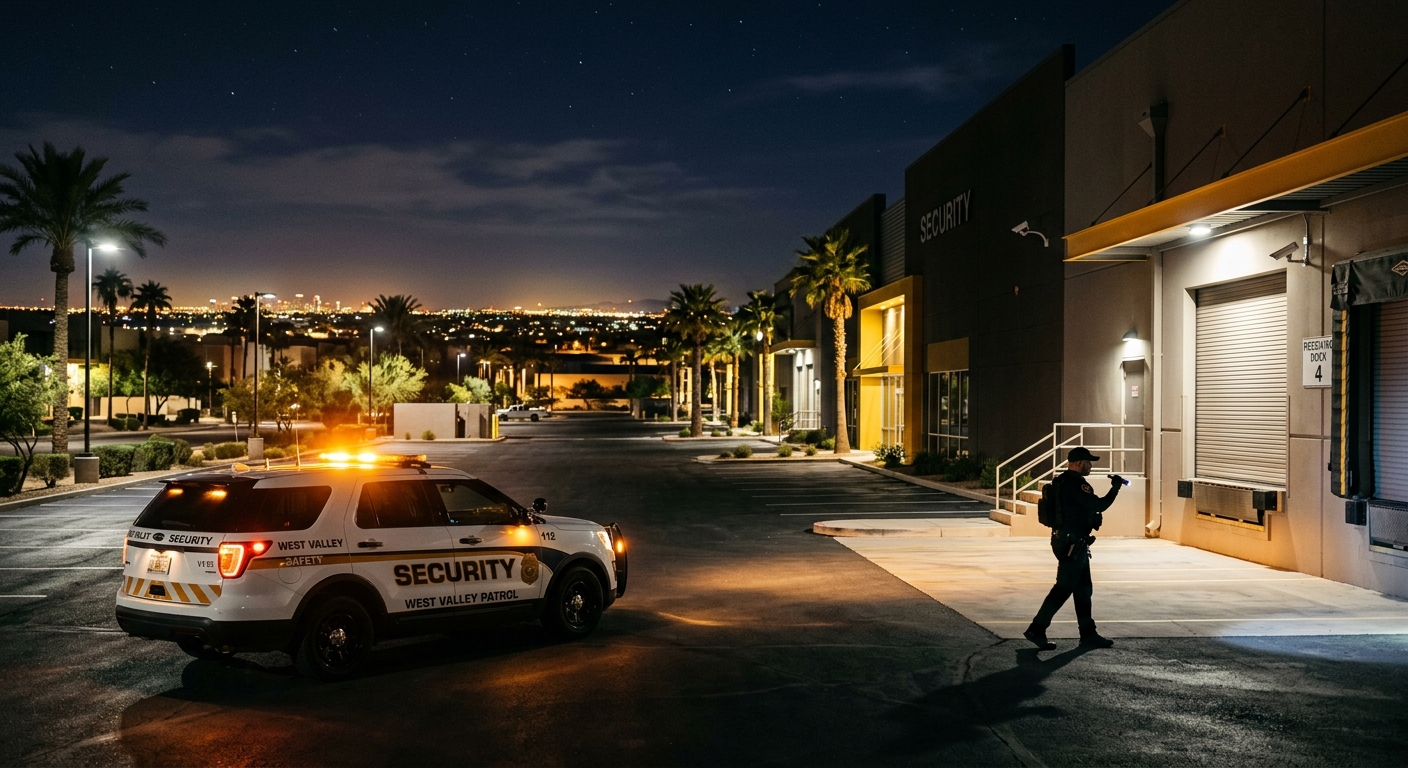
Mobile patrol security in Peoria, Arizona delivers scheduled and randomized vehicle-based protection across large, spread-out, or multi-site properties for a fraction of the cost of a fixed guard post. Honeybadger Solutions commands 24/7 armed mobile patrols, GPS-verified checks, alarm and lock-up response, and documented incident reporting throughout Peoria and the West Valley from our Arizona home base — Book online.
Why does mobile patrol fit Peoria properties so well?
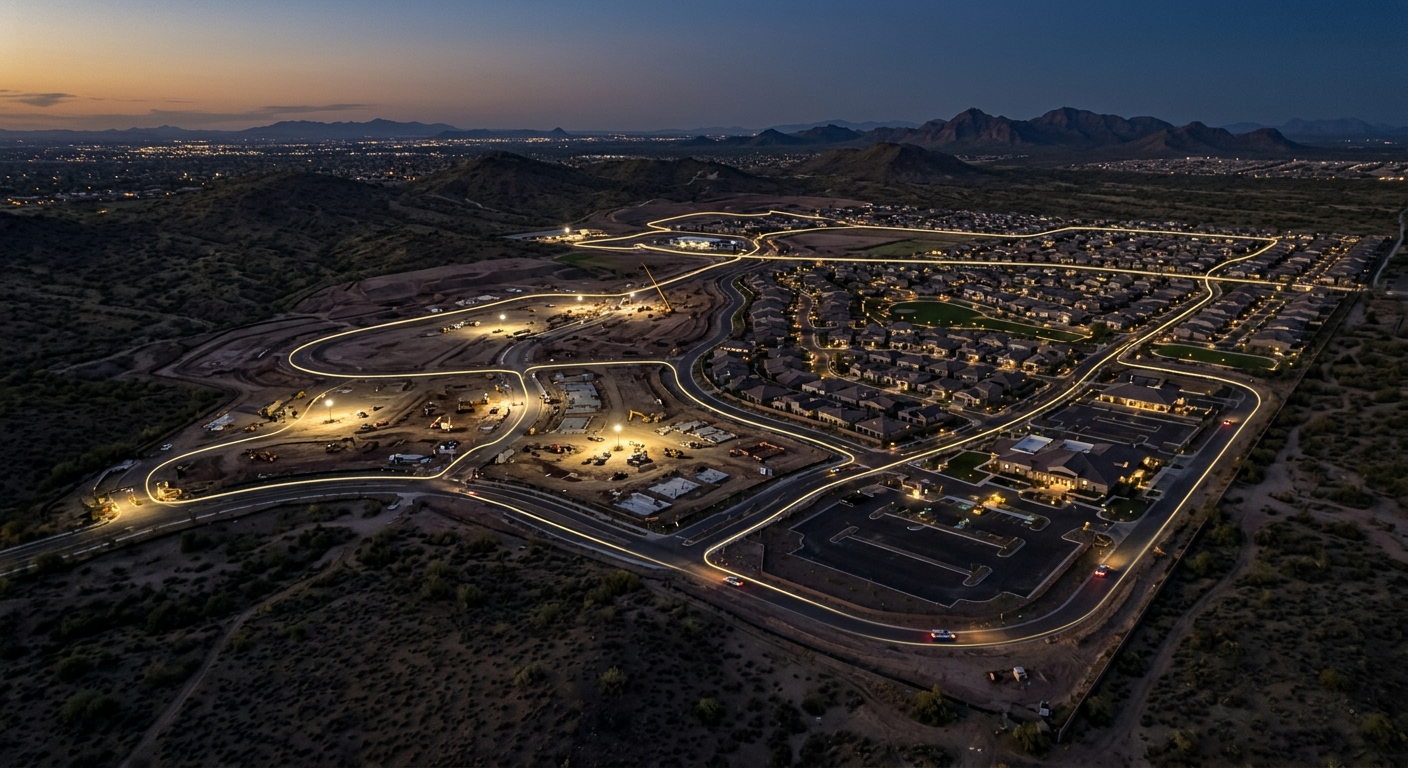
Peoria is not a dense downtown; it is one of the fastest-growing municipalities in the Phoenix metropolitan area, stretching from the P83 entertainment district and the Peoria Sports Complex north toward Lake Pleasant and the master-planned communities of Vistancia. That geography — sprawling residential enclaves, active construction corridors, business parks along Bell Road and the Loop 101, and vacant commercial pads awaiting development — is precisely where a single stationary guard fails and a disciplined mobile patrol excels.
A static officer protects one door. A mobile patrol protects a footprint. For a West Valley HOA of six hundred homes, a construction site with a quarter-million dollars of exposed copper and equipment, or a retail center with four separate parking fields, the question is rarely “how do we watch one point?” It is “how do we create unpredictable, verifiable presence across the whole property without paying for a guard at every corner?” Mobile patrol is the answer, and doing it at an elite level is a discipline, not a drive-by.
The specific risk profile of Peoria and the West Valley
The threats that mobile patrol is built to counter are opportunistic and time-sensitive: after-hours theft of construction materials and catalytic converters, vandalism and graffiti on vacant or transitional properties, illegal dumping and squatting on unoccupied land, trespass and loitering in commercial parking areas, and the slow erosion of order in a community when no one appears to be watching. According to the FBI Crime Data Explorer, property crime remains the dominant category of reported offenses nationwide, and the overwhelming share of it is opportunistic — deterred far more by visible, unpredictable presence than by a lock alone.
Mobile patrol vs. static guard: which does your property actually need?
The two are not competitors so much as different instruments for different problems. A world-class security posture often uses both — a static presence at a single high-value access point, mobile patrol to cover everything else. The table below is the decision framework we use with Peoria clients.
| Factor | Mobile Patrol | Static Guard |
|---|---|---|
| Coverage | Entire property / multiple sites | One fixed post or entrance |
| Cost per square foot protected | Low — one officer covers many acres | High — one officer, one point |
| Deterrent effect | Unpredictable, high visibility | Predictable, localized |
| Best for | HOAs, construction, vacant land, retail lots, multi-site portfolios | Lobbies, gated entries, single high-value asset |
| Response radius | Vehicle-mobile, rapid repositioning | Limited to post |
| Verification | GPS-tracked checkpoints, timestamped logs | On-site presence log |
| Weakness | Gaps between passes | No coverage beyond the post |
The honest reading of this table is that mobile patrol trades continuous presence for economical coverage. The craft lies in closing the gap between passes — through randomized timing so a route cannot be predicted, through alarm-triggered response that collapses the interval when it matters, and through the credible impression, to anyone watching, that a vehicle could appear at any moment. A cheap patrol runs the same loop at the same time every night; within a week, a determined trespasser has the schedule memorized. That is the difference between a service and a liability.
What does a professional mobile patrol actually do on your property?
Mobile patrol is often sold as “we drive by.” At an elite standard it is a structured sequence of tasks, executed and documented on every pass. A Honeybadger mobile patrol in Peoria typically includes:
- 24/7 armed mobile patrol on randomized and scheduled routes, timed so the pattern cannot be reverse-engineered by observation.
- Physical perimeter and interior checkpoints — fence lines, gates, loading docks, roof access, utility and electrical rooms, and known vulnerability points identified during the site survey.
- Lock-up, unlock, and alarm response — securing a facility at close, opening at dawn, and responding to alarm activations as the first credible presence on scene.
- GPS-verified patrol logging so every checkpoint hit is timestamped and geotagged — proof of service, not a promise of it.
- Detailed incident reporting and documentation — photographs, written narrative, and, where relevant, evidence handled to a standard that survives an insurance claim or a courtroom.
- Emergency coordination with Peoria Police, Fire, and property management, including a clear escalation protocol agreed in advance.
Communities and sites we protect across the West Valley
From our Arizona command, Honeybadger coordinates mobile patrol across Peoria, Glendale, Sun City, Sun City West, Surprise, El Mirage, and the surrounding West Valley for construction and development sites, retail and commercial centers, industrial and distribution facilities, HOAs and gated communities, luxury estates, healthcare and senior-living campuses, and municipal or public properties. Each site type carries a distinct threat model, and the patrol plan is built to it — a warehouse district is not policed the same way as a gated residential community.
How is elite mobile patrol built? A seven-step framework
The difference between a patrol that deters crime and one that merely logs miles is method. This is the sequence a serious provider follows before a single vehicle rolls.
- Threat and vulnerability survey. Walk the property, map access points, lighting gaps, blind spots, prior-incident history, and neighboring-parcel risk. The patrol plan is written from evidence, not a template.
- Route and cadence design. Define checkpoints, dwell times, and a randomization scheme so passes are frequent enough to deter yet impossible to predict.
- Checkpoint verification. Establish GPS or scan-verified checkpoints so completion is provable to the client and to an insurer.
- Escalation and response protocol. Predetermine what the officer does on discovering an open door, an active trespasser, a fire, or a medical emergency — and who is called, in what order.
- Officer selection and briefing. Assign licensed officers matched to the property’s risk level, with a documented post order specific to the site.
- Reporting standard. Set the format for nightly logs, photographic documentation, and incident narratives that will hold up under scrutiny.
- Review and adjust. Re-survey on a fixed cadence; adapt routes as construction phases change, tenants move, or incident patterns shift.
What separates a world-class patrol from a cheap one?
Price competition in this industry is brutal, and it hides real differences. Three separate an elite provider from a discount one.
Licensing and accountability. Arizona regulates security guards and agencies through the Department of Public Safety, which sets standards for guard cards, agency licensing, and armed endorsements — verifiable through AZ DPS licensing. A serious provider carries proper agency licensure, insurance, and armed authorization where the assignment calls for it. A cut-rate patrol may be running uninsured or under-licensed — a fact you discover only when something goes wrong on your property.
Verifiable presence. If a patrol cannot show you a timestamped, geotagged record of exactly where its officers were and when, you are paying for a claim, not a service. GPS checkpoint verification is the line between accountability and trust-me.
What happens after an incident. Most patrol companies write a report and move on. Honeybadger is a full security and investigations firm — when an incident occurs, the same command that runs your patrol can escalate to investigation, evidence handling, and, where digital or financial elements are involved, in-house forensic capability. Deterrence is the goal; resolution is the backstop. That continuity is rare in the mobile-patrol market and it is the reason discerning clients consolidate their physical security and investigative needs under one accountable command.
How does mobile patrol work alongside cameras and alarms?
Technology and boots on the ground are complements, not substitutes. Cameras record; alarms notify; neither of them intervenes. The most cost-effective posture for a Peoria property usually layers all three: video surveillance to observe and preserve evidence, monitored alarms to detect intrusion in real time, and a mobile patrol as the physical response that converts an alert into action. When an alarm trips at a construction trailer at 2 a.m., a camera feed tells you what is happening — but only a patrol officer, dispatched to the site, can confront the intruder, secure the scene, and document what occurred.
This is where randomized patrol and alarm response reinforce each other. Unpredictable passes deter the casual thief before an alarm ever sounds; alarm-triggered dispatch collapses the response interval for the determined one. A property owner who integrates the two is not paying for continuous presence yet still gets a credible, physical answer to any genuine event — the practical middle ground between an unwatched site and a full-time guard force. Designing that layering correctly, so the patrol cadence and the alarm-response radius actually cover the property’s real vulnerabilities, is exactly the kind of decision the initial threat survey is meant to settle.
How is Honeybadger’s Peoria patrol commanded?
Arizona is our home command. Honeybadger Solutions is an Arizona-licensed security and investigations firm with three offices — our Casa Grande headquarters, plus Phoenix and Oro Valley — positioning us across the state’s central corridor and both metropolitan poles. Peoria and the West Valley sit within our home theater, and our physical and armed patrol operations are staffed and commanded directly by our own in-house, AZ-licensed and DPS-endorsed officers, deployed to the specific requirements of each assignment.
That structure matters to a property owner in a practical way: you are contracting a licensed Arizona firm that owns the outcome, sets the standard, briefs the officers, and answers the phone when there is a problem — not a broker that hands your site to whoever is cheapest that week. For clients evaluating a broader posture, our patrol capability integrates with formal security consulting and, when needed, in-house investigations. If your requirement extends beyond Peoria, we coordinate nationwide and internationally through the same command discipline; explore the full Peoria service area or our Phoenix operations.
What does mobile patrol cost, and what drives the price?
There is no honest flat number, because mobile patrol is priced to the plan. The cost drivers are the number of sites and checkpoints, the frequency and hours of coverage, whether the assignment requires armed officers, the length of each pass, response-service inclusions like alarm and lock-up duty, and the level of reporting and technology required. A single vacant lot checked twice nightly is a modest engagement; a portfolio of construction sites under 24/7 armed coverage with GPS verification and full incident documentation is a substantial one.
The economic case is straightforward. Mobile patrol lets one officer protect what would otherwise require several fixed posts, so the deterrent value per dollar is high — provided the patrol is real, verifiable, and unpredictable. The right way to buy it is to start from the threat survey and let the plan set the price, rather than shopping a per-hour rate in a vacuum and discovering the coverage was theater. Guidance from bodies such as ASIS International, the leading professional association for security management, reinforces that effective physical security is designed to a documented risk assessment, not sold as a commodity.
Frequently asked questions
Is mobile patrol cheaper than a static security guard?
For most large or spread-out Peoria properties, yes. One mobile officer can cover acreage or multiple sites that would otherwise require several fixed posts, so the cost per square foot protected is substantially lower. The trade-off is that coverage is periodic rather than continuous, which professional route design and alarm-triggered response are built to manage.
Are your mobile patrol officers armed and licensed in Arizona?
Honeybadger Solutions is an Arizona-licensed security and investigations firm, and we command armed mobile patrol where the assignment warrants it, using officers qualified and endorsed under Arizona Department of Public Safety standards. Armed versus unarmed coverage is set during the threat survey based on the property’s specific risk profile.
Which areas around Peoria do you patrol?
We coordinate mobile patrol across Peoria and the broader West Valley, including Glendale, Sun City, Sun City West, Surprise, and El Mirage, from our Arizona command. As a statewide firm with offices in Casa Grande, Phoenix, and Oro Valley, we also serve the wider Phoenix metro and all of Arizona, with nationwide and international coordination available.
Can you prove the patrols actually happened?
Yes. Our patrols use GPS-verified checkpoints and timestamped logging, so every pass produces a geotagged, time-stamped record of where officers were and when. Combined with photographic and written incident documentation, this gives property owners and insurers verifiable proof of service rather than an unverifiable promise.
About Honeybadger Solutions
Honeybadger Solutions is an Arizona-licensed security and investigations firm serving all of Arizona, nationwide, and internationally. We command mobile and physical security, background intelligence, and in-house digital forensics, cybersecurity, and financial investigations under one accountable structure. Arizona is our home command, with three offices:
- Casa Grande — Headquarters (central Arizona)
- Phoenix — Metro operations
- Oro Valley — Southern Arizona
To scope mobile patrol for a Peoria or West Valley property, request a confidential threat survey and coverage plan. Book a consultation online to speak with our command team.
Browse by topic
Security guard services · Private investigations · Cybersecurity · Digital forensics · Financial fraud investigation · Executive protection · All articles