
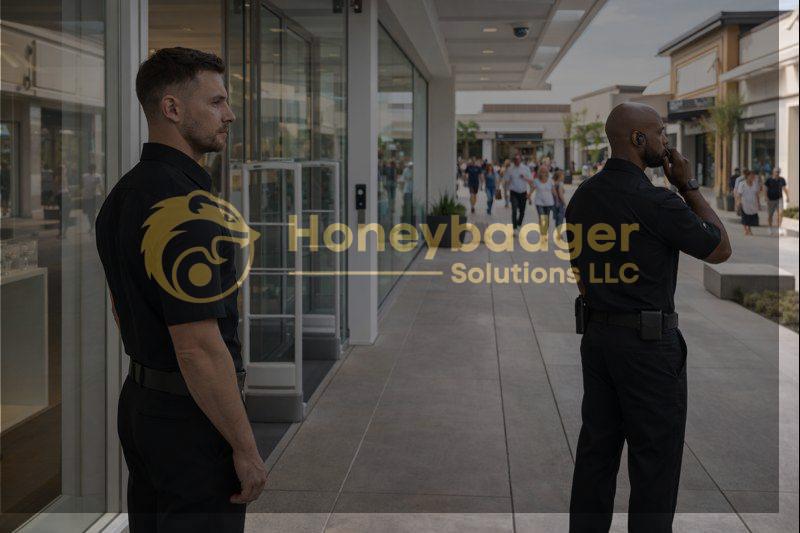

Honeybadger Solutions delivers veteran-led retail security and loss prevention across Surprise, Arizona and the West Valley—combining uniformed and plainclothes officers, shrink analytics, and in-house investigators. From Prasada and Surprise Marketplace to grocery, pharmacy, and big-box anchors, we deter organized retail crime, reduce inventory shrink, protect staff and shoppers, and build court-ready cases when theft becomes prosecution. Command runs from our Arizona home base; book a consultation online.
Why does Surprise retail need a different security posture?
Surprise is one of the fastest-growing municipalities in Arizona, and its retail footprint has expanded far faster than most loss-prevention programs have matured. Master-planned corridors like Prasada, Surprise Marketplace, and the Bell Road / Grand Avenue commercial spine draw high daily traffic from Surprise, Peoria, Sun City, El Mirage, Youngtown, and Waddell. That volume is good for revenue and equally good for the person casing your floor. High footfall lets a booster blend in; sprawling surface parking creates long, poorly observed approach and escape routes; and proximity to the Loop 303, US-60, and Grand Avenue gives organized crews fast highway egress toward Phoenix or the I-10 corridor within minutes of a grab.
A meaningful share of the retail threat in the West Valley is no longer opportunistic shoplifting. It is coordinated: multi-person crews, foil-lined bags to defeat sensors, staged diversions, and rapid clearance of high-value, easily fenced categories—consumer electronics, designer apparel, fragrances, power tools, baby formula, and over-the-counter health products. A guard standing at a door does not stop that. A designed program does. That distinction—between a body in a uniform and an intelligence-led loss-prevention operation—is the entire subject of this page.
What is actually driving retail shrink right now?
Shrink is the difference between the inventory your books say you hold and the inventory actually on the shelf. It is not a single problem; it is four problems wearing one label, and each demands a different countermeasure. Treating all shrink as “shoplifting” is the most common and most expensive mistake we see when we take over a Surprise account.
- External theft & organized retail crime (ORC): Individual boosters and professional crews reselling through online marketplaces and swap meets. ORC is the fastest-escalating category and the one most likely to turn violent.
- Internal / employee theft: Sweethearting at the register, void and refund fraud, gift-card manipulation, and back-of-house collusion with delivery drivers. Internal loss is quieter, lasts longer, and often exceeds a store’s entire external theft total.
- Process & administrative failure: Receiving errors, mis-scans, markdown abuse, and vendor fraud. No amount of floor presence fixes a broken receiving dock.
- Violence & safety incidents: Parking-lot confrontations, aggressive trespass, and “smash-and-grab” events where the store itself becomes the crime scene.
Nationally, the National Retail Federation’s National Retail Security Survey has documented shrink measured in the tens of billions of dollars annually and a sharp rise in the violence associated with retail theft. The federal picture is consistent: the FBI’s guidance on organized retail crime describes coordinated, multi-jurisdiction theft rings operating as businesses. We do not quote a store-specific loss figure until we have measured your actual data—manufactured statistics are worse than useless in a boardroom or a courtroom.
What does a Honeybadger retail security program include?
We build layered programs rather than selling headcount by the hour. Depending on your format—enclosed shopping center, big-box anchor, grocery, pharmacy, fashion, restaurant, or auto dealership—the mix is engineered to your risk profile, insurance requirements, and margin.
- Uniformed deterrence: Visible officers at entrances, on the floor, and across the parking field—deterrence you can see and insurers reward.
- Plainclothes loss prevention: Trained LP agents working the floor to observe, document, and apprehend within policy and Arizona law.
- Armed officers where warranted: For high-value inventory, cash-heavy operations, or elevated threat, deployed under Arizona licensing from our home command.
- CCTV & exception monitoring: Camera-coverage design, live monitoring, and point-of-sale exception analytics that flag void, refund, and discount abuse.
- Investigations & case building: In-house investigators who turn an incident into a documented, prosecutable case—interviews, evidence handling, and coordination with law enforcement and prosecutors.
- Emergency response & de-escalation: Officers trained to defuse customer conflict, manage trespass, and control smash-and-grab and active-threat scenarios.

How do you build a loss-prevention program that actually works?
World-class loss prevention is a sequence, not a product. Skipping steps is why so many stores pay for guards and still bleed inventory. This is the framework our Surprise teams run.
- Measure the baseline. Pull shrink by category and location, review POS exception data, and map where loss concentrates before deploying a single officer.
- Assess the physical environment. Walk the store and lot for camera blind spots, weak exit control, unmonitored high-theft fixtures, and receiving-dock vulnerabilities.
- Separate the four shrink sources. Distinguish external, internal, process, and safety loss—each gets a different countermeasure and a different owner.
- Deploy the right layer. Match uniformed, plainclothes, armed, and technology assets to the measured threat—not to a generic hourly package.
- Enforce lawfully. Apprehend and detain strictly within Arizona’s shopkeeper privilege and use-of-force limits, with documentation that survives legal scrutiny.
- Investigate and prosecute. Convert repeat and organized theft into court-ready cases with chain-of-custody evidence and law-enforcement coordination.
- Review and adapt. Re-measure monthly; crews change tactics, and a static program is a defeated program.
How do we compare to national guard companies?
Large national guard firms provide bodies and a badge. That has its place, but it is not the same as a loss-prevention operation with investigative depth. The table below frames the difference honestly.
| Capability | Commodity guard vendor | Honeybadger Solutions |
|---|---|---|
| Core model | Hourly headcount at the door | Intelligence-led, layered LP program |
| Personnel | High-turnover, minimally trained | Veteran-led |
| Shrink analytics | Rarely included | POS exception & category analysis |
| Investigations | Referred out or absent | In-house investigators, case building |
| ORC response | Observe and report only | Documented, prosecutable case files |
| Command | Distant regional call center | Arizona home command, local accountability |
| Adaptation | Static post orders | Monthly re-measurement and retasking |
Which Surprise and West Valley retailers do we protect?
Our retail coverage spans the full West Valley—Surprise, Peoria, Glendale, Sun City, Sun City West, El Mirage, Youngtown, and Waddell—with programs tuned to each format:
- Shopping centers & plazas: Prasada, Surprise Marketplace, and multi-tenant retail where common-area and parking security protect every tenant.
- Big-box & category killers: Department, home-improvement, and electronics stores with high-value, high-velocity ORC targets.
- Grocery & pharmacy: Supermarkets, drugstores, and convenience stores facing organized theft of health, beauty, and formula products.
- Fashion & specialty retail: Apparel, footwear, and accessory stores exposed to boosting and fitting-room concealment.
- Restaurants, hospitality & auto: Dining, hotels, dealerships, and service centers where cash handling and inventory both need cover.
What separates elite retail security from a warm body at the door?
Three things. First, legal discipline: an improper detention or an out-of-policy use of force converts a shoplifting loss into a civil-liability event that can dwarf the merchandise involved. Our officers operate strictly within Arizona’s shopkeeper privilege and documented use-of-force standards, because the cheapest theft is the one that never becomes a lawsuit. Second, investigative continuity: catching a booster once is noise; identifying the crew, its resale channel, and its pattern is signal. Our in-house investigators—the same discipline behind our digital forensics and financial investigations practice—turn scattered incidents into cases prosecutors will actually file.
Third, local command. National vendors route Surprise accounts through distant call centers. Honeybadger runs from an Arizona home command with offices in Casa Grande, Phoenix, and Oro Valley—so decisions, escalations, and reinforcements come from people who know the Loop 303 corridor, the local courts, and the West Valley’s crime patterns. That proximity is why we can put officers on-site quickly and why our post orders reflect the store in front of us, not a template.
What does retail security in Surprise actually cost—and what drives the number?
Serious buyers want an honest answer, not a lowball quote that balloons on the first invoice. Retail security pricing is driven by a handful of measurable variables, and understanding them lets you buy protection instead of buying hours. The dominant cost drivers are coverage hours (a single 24/7 armed post requires roughly four to five officers to staff lawfully once relief, breaks, and turnover are accounted for), officer tier (a licensed armed officer or a trained plainclothes LP agent costs more than a standing unarmed guard, and is worth it where the threat justifies it), and program complexity (analytics, investigations, and multi-site standardization add capability and cost).
The decisive point is return on spend. A cheap, static guard who deters nothing and documents nothing is pure expense. A right-sized program that measurably lowers shrink, prevents a single act of violence, or averts one wrongful-detention lawsuit pays for itself many times over. We scope to your data and your insurer’s requirements, price transparently, and never sell a heavier posture than the risk supports. When a technology layer or a plainclothes agent will outperform an additional armed post at lower cost, we say so.
How does Arizona law shape lawful loss prevention?
Loss prevention lives or dies on legal discipline. Arizona’s shopkeeper’s privilege permits a merchant or their agent to detain a suspected shoplifter, but only when detention is reasonable in manner and duration and supported by probable cause. Overstep it—detain without cause, use excessive force, or hold someone unreasonably long—and the store trades a merchandise loss for a false-imprisonment or civil-rights claim that can cost far more than any inventory. This is precisely where under-trained guard vendors expose their clients.
Our officers and LP agents operate to documented standards: observe the selection, concealment, and failure to pay; maintain continuous observation; detain only within policy; and record every step for evidentiary integrity. That discipline is what makes a case prosecutable and a detention defensible. For organized retail crime that crosses stores or jurisdictions, we build the evidentiary package—timestamped video, incident documentation, and chain-of-custody handling—that a prosecutor can file and law enforcement can act on, rather than a shaky report that collapses in court.
Why do parking lots and smash-and-grab events demand special attention?
In West Valley retail, the parking field is where much of the real risk lives. It is the largest, least-observed part of most properties, the site of vehicle break-ins, cart-based grab-and-runs, and confrontations that escalate away from cameras and staff. A program that ends at the front door ignores the ground where liability and violence most often occur. Our deployments treat the lot as an operational zone—patrolled, illuminated where possible in coordination with property management, and covered by officers positioned to interrupt an escape route rather than merely witness it.
Smash-and-grab and organized rush events require a different reflex again. The correct response is not heroics; it is trained de-escalation, rapid law-enforcement coordination, staff and customer protection, and disciplined evidence capture so the crew is identified and pursued after the fact. We drill officers on exactly these scenarios so that when seconds matter, the response protects people first and builds the case second—never the reverse.
Frequently asked questions
Do you provide armed retail security in Surprise?
Yes. Arizona is our home command, and we deploy licensed armed and unarmed officers across Surprise and the West Valley based on a threat assessment. Armed coverage is warranted for cash-heavy operations, high-value inventory, or elevated risk; many retailers are better served by plainclothes LP plus technology. We recommend the posture your risk and insurer actually require—not the most expensive option.
How fast can you deploy officers to a Surprise store?
Because we command from Arizona, we can stand up interim coverage quickly for urgent situations—an active ORC campaign, a terminated employee, or a post-incident gap—while we build the measured, longer-term program. Lead time depends on scope and licensing, and we confirm realistic timelines in the first conversation rather than overpromising.
Can you investigate employee theft as well as shoplifting?
Yes—and internal loss is often the larger problem. Our investigators examine POS exception data, refund and void patterns, and receiving discrepancies, then conduct lawful interviews and build documented cases. This is a core in-house capability alongside our financial investigations and background-intelligence work, handled discreetly to protect both the business and innocent staff.
Do you only serve Surprise, or the whole West Valley?
We serve Surprise, Peoria, Glendale, Sun City, El Mirage, Youngtown, Waddell, and the wider West Valley, plus all of Arizona from our Casa Grande, Phoenix, and Oro Valley offices. For multi-location retailers, we standardize programs across sites while tuning each store to its local threat profile.
About Honeybadger Solutions
Honeybadger Solutions is an Arizona-licensed security and investigations firm delivering enterprise-grade protection to retailers, businesses, and principals across Arizona, nationwide, and internationally. We command a full spectrum of capability—physical security and loss prevention, investigations, digital forensics, cybersecurity, financial investigations, and background intelligence—from an Arizona home base with three offices: Casa Grande (headquarters), Phoenix, and Oro Valley. Our retail programs are veteran-led, with a team that includes former law-enforcement professionals and engineered to reduce shrink, protect people, and build cases that hold up. To assess your Surprise or West Valley retail security needs, book a consultation online for a confidential consultation.
Learn more: Retail Security & Loss Prevention · Surprise, Arizona service area · Security services · Investigations · Phoenix operations.
Browse by topic
Security guard services · Private investigations · Cybersecurity · Digital forensics · Financial fraud investigation · Executive protection · All articles