
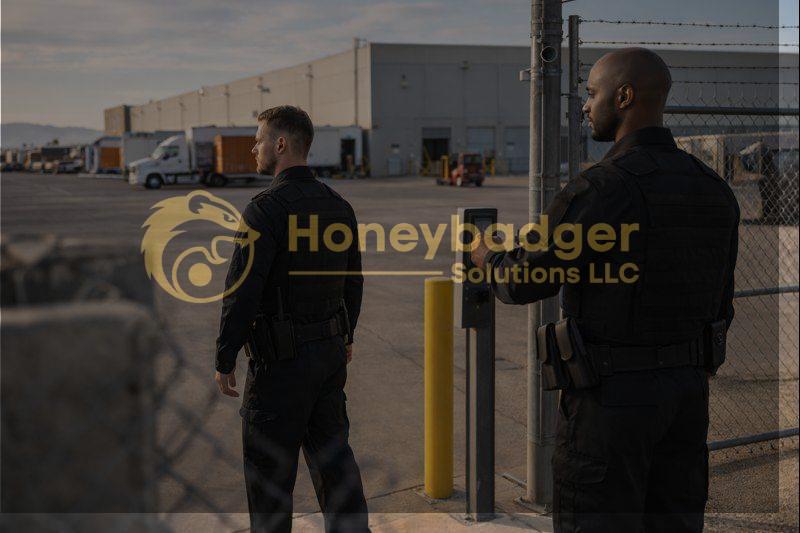

Honeybadger Solutions protects Avondale, Arizona industrial and logistics facilities through an Arizona home-command model that fuses on-site protective coverage with in-house investigations, digital forensics, and cybersecurity. Coverage spans the Southwest Valley—Avondale, Goodyear, Buckeye, Tolleson, and Litchfield Park—from firm offices in Phoenix, Casa Grande, and Oro Valley. Book a consultation online for a facility risk assessment.
Why Avondale’s Industrial Corridor Demands a Different Security Standard
Avondale sits at the center of one of the fastest-growing industrial and logistics markets in the United States. The West Valley’s position along the Interstate 10 corridor—linking Phoenix to the Southern California ports of Los Angeles and Long Beach—has drawn manufacturing plants, distribution centers, cold-storage operations, aerospace suppliers, and last-mile fulfillment hubs into a dense industrial belt stretching from Tolleson through Goodyear and Buckeye. That concentration of high-value inventory, capital equipment, and freight movement creates a risk profile that generic guard staffing was never designed to address.
Industrial facilities in this corridor are not office towers with a single lobby. They are sprawling footprints with truck courts, rail spurs, multiple gates, fenced yards holding trailers and equipment, and shift patterns that run around the clock. A break in coverage at 3 a.m. on a loading dock is a materially different exposure than a lobby incident during business hours. Protecting these environments correctly requires an operator that understands cargo flow, yard management, OSHA-driven life-safety obligations, and the investigative follow-through that turns an incident into recovered assets and a defensible insurance claim—not simply a warm body at a gate.
Honeybadger Solutions approaches Avondale facility protection as a command function. Arizona is the firm’s home command, and Southwest Valley operations are directed from our Phoenix office with support from headquarters in Casa Grande and our Oro Valley office. Physical protective coverage is delivered through licensed, vetted field personnel under firm command, while investigations, digital forensics, and cybersecurity are handled in-house—so a single team owns the entire arc from deterrence to detection to resolution.
What Threats Actually Target Southwest Valley Facilities?
The threats facing Avondale, Goodyear, and Buckeye industrial sites are specific and predictable—which is precisely why they are preventable with the right program. The most consequential exposures are rarely the dramatic ones:
- Cargo and freight theft. The I-10 corridor is a national cargo-theft artery. Full-trailer theft, “pilferage” of partial loads, and fictitious-pickup fraud—where thieves use fraudulent carrier credentials to drive loads off a yard—are a documented and rising threat tracked by the FBI and freight-industry reporting.
- Equipment and metal theft. Forklifts, generators, welding rigs, catalytic converters, copper wire, and fuel are liquid, high-resale targets that move quickly through regional markets.
- Internal loss and collusion. A significant share of inventory shrink originates inside the fence line—dock-door collusion, falsified manifests, and after-hours access abuse.
- Trespass, vandalism, and squatting. Large fenced yards and vacant tenant-improvement spaces attract unauthorized entry, copper stripping, and encampment.
- Workplace violence and access-control failure. The OSHA General Duty Clause obligates employers to furnish a workplace free of recognized hazards, and terminated-employee and domestic-spillover incidents remain a leading facility risk.
- Convergence attacks. Modern facilities run networked access control, video, and building-management systems; a breach of those systems is both a cyber and a physical-security event.
The distinguishing failure of commodity guard services is that they treat each of these as isolated. A theft becomes an incident report and nothing more; a suspicious credential is waved through; a compromised camera network is “an IT problem.” Honeybadger treats them as connected, because they are.
Guard-Only Staffing vs. an Integrated Command Model
Most Avondale facilities are sold “posts and hours”—a headcount at a gate. The difference between that and a command model shows up the moment something actually goes wrong.
| Capability | Commodity Guard Service | Honeybadger Integrated Command |
|---|---|---|
| Core offering | Bodies at a post, hourly | Risk-driven protective program under firm command |
| Incident follow-through | Written report only | In-house investigation and asset-recovery workup |
| Theft investigation | Referred out or dropped | Licensed investigators engaged in-house |
| Digital evidence | Not handled | Chain-of-custody digital forensics in-house |
| System / camera breach | “Call your IT vendor” | In-house cybersecurity response |
| Personnel vetting | Variable, high turnover | Vetted, licensed field personnel under command |
| Accountability | Diffused across vendors | Single firm owns the outcome |
When a trailer disappears from a Tolleson yard, the guard-only model produces a report. The command model produces surveillance review, a documented chain of custody on the digital evidence, an investigative timeline, coordination with law enforcement, and a claim file that survives insurer scrutiny. That is the gap between logging a loss and resolving one.

How Do You Build a Facility Security Program That Holds Up? A 7-Step Framework
Honeybadger builds every Avondale industrial engagement on a repeatable, evidence-driven framework rather than a fixed post count. The sequence matters—coverage decisions come after the risk picture is clear, not before.
- Threat and vulnerability assessment. Walk the site across shifts. Map every access point, blind spot, yard, dock door, and camera. Identify what is worth stealing and how it would actually leave the property.
- Crime Prevention Through Environmental Design (CPTED). Apply lighting, sightlines, fencing, signage, and natural-surveillance principles so the environment itself deters intrusion before a guard is ever tested.
- Access control architecture. Define credentialing, visitor and carrier verification, dock-door discipline, and the fictitious-pickup checks that stop fraudulent freight releases.
- Protective coverage design. Set posts, patrol routes, and response protocols to the risk map—fixed posts where deterrence matters, roving patrols where the footprint is large, with clear escalation.
- Technology integration. Align video, alarms, and access systems with human coverage, and harden those networked systems against compromise so surveillance cannot be blinded.
- Incident response and investigation readiness. Pre-stage the workflow so any loss triggers evidence preservation, chain of custody, and an investigative handoff—not a shrug.
- Audit, report, and refine. Deliver documented reporting that satisfies insurers and OSHA obligations, then tune the program against real incident data quarterly.
This is the same disciplined sequence elite security firms apply to Fortune-500 campuses, scaled to the operational reality of a Southwest Valley distribution center or manufacturing plant.
Access Control, the Yard, and the Loading Dock
For an industrial site, the perimeter and the dock are where the money is won or lost. A hardened access-control posture governs who enters, verifies carriers before a trailer is released, and enforces dock-door discipline so no load moves without a validated manifest and matching credentials. Yard management—knowing which trailers are staged where, sealed, and authorized to move—closes the single largest gap thieves exploit: the assumption that a truck in the yard belongs there.
Physical deterrence is paired with environmental design. Well-lit truck courts, clean sightlines, controlled gates, and unambiguous signage do more to prevent loss than any single post, because they remove opportunity. Honeybadger designs these controls against CISA physical-security guidance for critical facilities, then staffs the residual risk with vetted field personnel under firm command rather than defaulting to a headcount.
What Does an Industrial Security Program Actually Cost to Get Right?
Executives evaluating facility protection deserve candor on cost drivers, because the cheapest bid is almost always the most expensive outcome. Price on an industrial engagement is driven by four variables: the size and complexity of the footprint (number of gates, dock doors, and separate yards), the hours and posture of coverage (roving versus fixed, single-shift versus 24/7), the value and liquidity of what is being protected, and the depth of investigative and technical readiness built into the program.
Where commodity vendors compete purely on hourly guard rate, they externalize the real cost onto the client: high turnover, untrained personnel, no investigative follow-through, and losses that quietly compound. A properly designed program prices deterrence and resolution together. The relevant math is not the hourly rate—it is the total cost of a preventable trailer loss, a shrink pattern that runs for a year undetected, or an insurance claim denied for lack of documentation. Honeybadger scopes each Avondale engagement to that reality, sizing coverage to the risk map produced in the assessment rather than selling a fixed headcount and hoping it fits.
Where Physical Security Meets Investigations, Forensics, and Cyber
The reason a facility should not buy guards in isolation is that industrial loss is rarely purely physical. A recurring shrink pattern is an investigation. A falsified manifest is a forensic-accounting question. A compromised badge system or blinded camera network is a cybersecurity incident. Honeybadger delivers all of these in-house.
Our investigations team works internal-theft, collusion, and background-intelligence matters with licensed investigators and documented findings that stand up in an HR proceeding or a courtroom. Our digital forensics practice preserves and analyzes evidence from access-control logs, video systems, and devices under strict chain of custody—remote-by-design and available nationwide. And when the attack surface is the facility’s own networked systems, our cybersecurity team responds. One firm, one command, one accountable outcome—the model detailed across our industrial and manufacturing security practice.
This convergence is not theoretical. Consider a representative scenario: a distribution center notices its shrink creeping upward quarter over quarter. A guard-only vendor would add a post and log the numbers. The command model runs it as a case—correlating access-control logs against shift records, examining dock-door footage under chain of custody, tracing falsified manifests through the books with financial-investigation expertise, and confirming whether the badge system itself has been tampered with. The result is not a thicker incident file; it is an identified loss vector, a defensible internal-action package, and a hardened program that closes the gap for good. Representative scenarios like this reflect how elite firms operate—evidence first, then decisive action.
Which Avondale-Area Facilities and Service Areas Do You Cover?
Honeybadger Solutions serves the full Southwest Valley industrial belt, including Avondale, Goodyear, Buckeye, Tolleson, Litchfield Park, and the surrounding I-10 and Loop 303 logistics corridors. Local coverage is directed from our Phoenix office, backed by our Casa Grande headquarters and Oro Valley office. The facilities we protect and assess include:
- Manufacturing and assembly plants—production floors, tooling, and finished-goods inventory
- Warehousing and distribution centers—fulfillment hubs, cross-docks, and 3PL operations
- Cold storage and food processing—regulated, high-continuity environments
- Aerospace and automotive suppliers—high-value components and controlled materials
- Chemical and pharmaceutical facilities—compliance-driven, restricted-access sites
- Vacant and pre-lease industrial space—copper, fixtures, and squatting exposure
For area-specific detail and to reach the local team, see our Avondale, Arizona hub and our Phoenix operations page. Arizona is our home command; physical protective coverage is delivered statewide under firm direction, and our in-house digital forensics, cybersecurity, financial-investigation, and background-intelligence services extend nationwide and internationally.
Frequently Asked Questions
Does Honeybadger provide security specifically for Avondale industrial facilities?
Yes. Avondale and the surrounding Southwest Valley—Goodyear, Buckeye, Tolleson, and Litchfield Park—are core service areas directed from our Phoenix office. We deliver risk-driven protective coverage plus in-house investigations, digital forensics, and cybersecurity, with Arizona as the firm’s home command.
How is this different from hiring a standard guard company?
Commodity providers sell posts and hours and stop at a written incident report. Honeybadger runs a command model: when a loss occurs, our in-house investigators, forensic examiners, and cyber responders engage under one accountable firm—turning incidents into recovered assets and defensible documentation.
Can you investigate theft that has already happened at our facility?
Yes. Our licensed investigators and digital-forensics team work internal-theft, collusion, and cargo-loss matters—preserving evidence under chain of custody, building an investigative timeline, and producing findings suitable for insurance claims, HR action, or litigation.
What areas around Avondale do you cover?
We cover the full I-10 and Loop 303 industrial corridor: Avondale, Goodyear, Buckeye, Tolleson, Litchfield Park, and greater Phoenix. Physical coverage runs statewide under Arizona home command, while our forensics, cyber, financial-investigation, and background-intelligence services extend nationwide and internationally.
About Honeybadger Solutions
Honeybadger Solutions is an Arizona-licensed security and investigations firm serving all of Arizona plus nationwide and international mandates. We operate three offices—Casa Grande (headquarters), Phoenix, and Oro Valley—with Arizona as our home command. Our in-house, remote-by-design capabilities include digital forensics, cybersecurity, financial investigations, and background intelligence, backed by a firm-commanded network of vetted, licensed field personnel for physical and protective operations. For a confidential Avondale facility risk assessment, contact our team through our security consulting practice.
Browse by topic
Security guard services · Private investigations · Cybersecurity · Digital forensics · Financial fraud investigation · Executive protection · All articles