
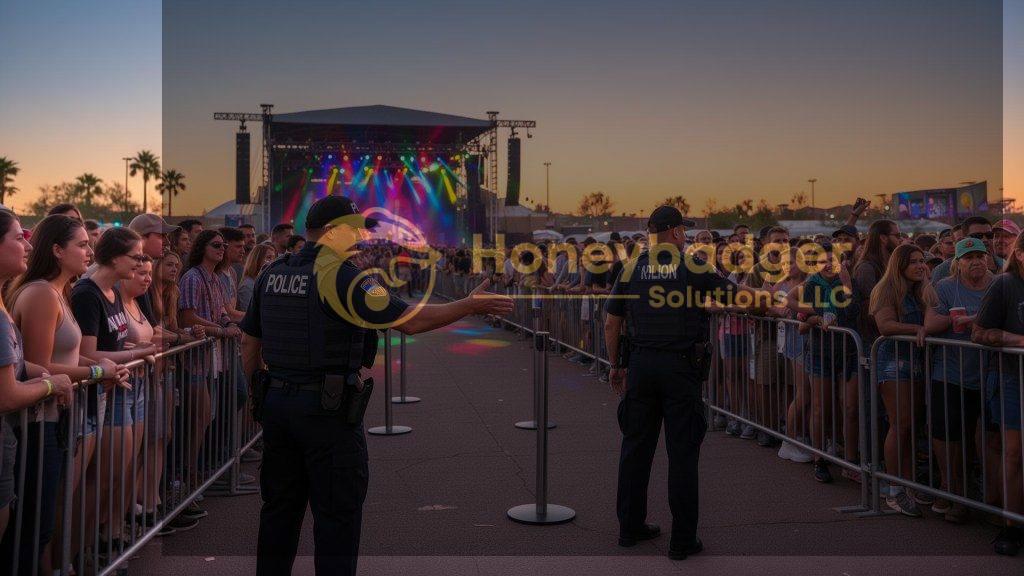

Event security in Chandler, Arizona is the coordinated protection of festivals, concerts, and corporate gatherings through advance threat assessment, crowd management, access control, and emergency planning. A professional program maps each venue, sizes the guard force to expected attendance, screens entry points, controls perimeters and parking, and pre-coordinates with Chandler Police, Fire, and EMS so an incident is contained in seconds—not minutes.
Chandler is no longer a quiet Southeast Valley suburb. It is a 280,000-resident city with a downtown entertainment district, a nationally known festival calendar, an arts center that draws touring acts, and one of the densest corporate campuses in the American Southwest. That combination—large crowds, high-value guests, and marquee brands—raises the stakes on every gate, barricade, and evacuation route. The difference between an event remembered for its lineup and one remembered for a crush, a medical failure, or a security lapse is almost always the plan built weeks before the doors open. This is how elite event security is actually done in Chandler, and what separates a world-class protective operation from a company that merely supplies bodies in polo shirts.
What does event security in Chandler actually involve?
Effective event security is not a guard count—it is a system. It begins long before the event with a written threat and vulnerability assessment: who is attending, who might target them, what the venue’s failure points are, and how quickly help can reach any point on the site. From that assessment flows every downstream decision—post positions, screening intensity, credential design, radio plans, medical staging, and evacuation routing. On the day, that plan is executed by a disciplined, licensed team under unified command, and it is documented so that any incident produces a defensible record rather than a liability.
For a Chandler festival or concert, the core functions break into five disciplines that must interlock:
- Advance and intelligence. Venue survey, threat assessment, and—where a public figure or executive is involved—a discreet review of specific, credible risk signals ahead of arrival.
- Access control and screening. Bag checks, wanding or magnetometers, ticket and credential validation, and a clean separation of public, VIP, staff, and vendor zones.
- Crowd management. Capacity monitoring, queue design, flow control, and density management at chokepoints—stages, gates, bars, and merchandise.
- Perimeter and parking. Vehicle standoff, hostile-vehicle mitigation at pedestrian areas, and lot patrols where a large share of real incidents actually occur.
- Emergency response. Medical staging, evacuation and shelter plans, severe-weather protocols, and pre-wired coordination with public safety.
Miss any one of these and the others are undermined. A flawless screening line means little if the parking lot is unpatrolled; a strong medical plan is wasted if crowd density blocks the aisle a medic needs. Integration is the discipline.
Which Chandler venues and event types shape the security plan?
Chandler’s geography drives its security posture. The city hosts open-ground festivals, a purpose-built performing-arts venue, a Western event center on the Gila River Indian Community’s edge, and corporate campuses that stage private functions with executive and sometimes celebrity guests. Each environment carries a different risk profile, and a credible provider tailors the plan to the venue rather than reusing a generic template.
Downtown Chandler and Dr. A.J. Chandler Park anchor street festivals and community celebrations with permeable perimeters and public right-of-way complications. Tumbleweed Park and large open sites host multi-day festivals—the kind of high-attendance, mixed-crowd events that demand serious crowd-density planning. The Chandler Center for the Arts brings seated-venue concert dynamics: fixed egress, defined capacity, and touring-artist requirements. Rawhide Event Center and resort venues along the Wild Horse Pass corridor stage concerts, galas, and corporate events at scale. And the “Silicon Desert” tech corridor—Intel’s Ocotillo campus, Northrop Grumman, PayPal, and neighbors—generates product launches, executive summits, and holiday functions where discretion and access control matter as much as headcount.
| Event type | Primary risk profile | Security posture emphasis |
|---|---|---|
| Outdoor festival (Ostrich Festival–scale) | Crowd density, heat/medical, permeable perimeter, alcohol | Crowd management, medical staging, layered access, lost-child protocol |
| Concert (arts center / touring act) | Fixed egress, artist/VIP protection, entry surges | Screening throughput, VIP zoning, egress control, stage barrier |
| Corporate event (tech campus / resort) | Executive exposure, IP and access risk, reputational sensitivity | Credentialing, discreet EP, visitor screening, zone segregation |
| Private gala / fundraiser | High-net-worth guests, gifts and valuables, media presence | Guest-list control, low-profile protection, perimeter and valet security |
| Sports / race event | Wide footprint, vehicle interface, spectator flow | Course/perimeter control, parking, medical dispersion, comms |
The takeaway for any organizer: the venue defines the vulnerabilities, and the vulnerabilities define the plan. A provider who quotes a flat “guards per hour” number before walking the site has not yet done the work that keeps an event safe.
How do you build a crowd management plan for a Chandler festival or concert?
Crowd management is the discipline most often underestimated and most often responsible for serious harm. Crowd-crush injuries do not require a “riot”—they occur in ordinary, well-intentioned events when density at a chokepoint exceeds safe limits and flow stops. Elite planning treats density as a measurable, manageable quantity, not a matter of luck. The following framework mirrors how a professional operation builds a defensible plan:
- Establish and enforce a real capacity. Confirm occupancy limits with the venue and fire code, then monitor live counts at entry so the site never silently exceeds them.
- Map flow and chokepoints. Identify where crowds converge—main stage front, gates, bars, restrooms, merchandise—and design queue geometry to keep people moving.
- Set density thresholds and triggers. Define what “too dense” looks like at each chokepoint and the specific action—hold the line, open a relief gate, pause entry—taken when it is reached.
- Design layered access. Separate public, VIP, staff, and vendor flows with distinct credentials and lanes so screening is faster and zones stay clean.
- Position posts for coverage, not optics. Place officers where they can see and reach the highest-risk points, with overlapping fields of observation and no blind corners.
- Build the communications net. A single radio plan links all posts, command, medical, and public-safety liaisons, with plain-language codes and a designated incident commander.
- Rehearse the failure modes. Walk the team through medical emergencies, a fight, a lost child, a severe-weather hold, and an evacuation before doors open—so the first time is not the real time.
- Document everything. Log incidents, ejections, medical calls, and decisions in real time; the record protects attendees, the organizer, and the venue.
Arizona adds a non-negotiable variable to every outdoor plan: heat. A spring or summer festival in Chandler routinely runs in triple-digit temperatures, and heat illness can generate more casualties in an afternoon than any deliberate threat. Water access, shade, cooling stations, and a medical footprint sized for heat are not amenities—they are core to the security plan.

What does access control and screening look like at the gate?
The perimeter is where an event’s security intent becomes visible—and where throughput and safety must be balanced. Screen too loosely and prohibited items enter; screen too slowly and the line itself becomes the hazard, as frustrated crowds surge and density spikes outside the gate before anyone is even inside. A professional screening operation is engineered to be both thorough and fast.
That means the right number of lanes for the expected arrival curve, clear signage on prohibited items published before the event, a defined bag policy (or clear-bag requirement) that speeds inspection, and trained officers who can read behavior rather than merely check tickets. It means separating credential validation from physical screening so neither bottlenecks the other, and staging VIP and accessible lanes so high-value or vulnerable guests are not exposed in a general crush. Access control does not end at the gate: internal credentialing keeps backstage, production, and hospitality areas restricted to the people who belong there, protecting artists, executives, equipment, and cash operations alike.
For events with a public figure, executive, or celebrity guest, close protection is layered on top of venue security—a distinct discipline requiring advance work, arrival and departure planning, and a protective detail that integrates with, but is not a substitute for, the venue team. In Arizona, Honeybadger delivers this protective capability with our own in-house, AZ-licensed protective agents, working under unified command from our Arizona home command.
How does emergency and medical planning work at a large event?
The measure of an event security program is not how it looks on a calm afternoon—it is how fast and how calmly it responds when something goes wrong. Emergency planning converts chaos into procedure. Before the event, the plan defines medical staging locations and the fastest routes to them, establishes who calls 911 and how responders are guided in, sets severe-weather thresholds for holds and evacuations, and maps at least two evacuation routes from every zone with staff assigned to direct them.
Pre-coordination with public safety is the force multiplier. When Chandler Police, the Chandler Fire Department, and EMS have seen the plan, know the command structure, and can reach the incident commander on a shared channel, response time collapses. Federal guidance for special-event planning and for protecting soft targets and crowded places is built on exactly this principle: relationships and rehearsed procedures established in advance, not improvised in the moment. A credible provider builds those relationships into the plan and rehearses the hand-off, so that when a medical emergency, a weather cell, or a security threat materializes, the response is a practiced sequence rather than a scramble.
What separates elite event security from a basic guard company?
Anyone can post a guard at a gate. The gap between adequate and elite shows up in the parts of the operation an organizer never sees until they are needed: the quality of the advance assessment, the discipline of the command structure, the training of the individual officer, and the defensibility of the documentation. A basic company sends a headcount. An elite operation delivers a plan, a chain of command, and a record.
Several factors distinguish a world-class provider. The first is a veteran- and law-enforcement-informed leadership culture that treats crowd behavior, use-of-force judgment, and de-escalation as trained competencies rather than instincts. The second is integrated intelligence: because Honeybadger’s digital forensics, cybersecurity, financial investigations, and background-intelligence capabilities are in-house and remote-by-design, an event team can be supported by genuine advance threat assessment—vetting a specific, credible concern about a person or a business dispute—rather than guarding blind. The third is licensure and insurance discipline: proper Arizona guard licensing, appropriate armed and unarmed credentials, and coverage that protects the organizer. The fourth is documentation: real-time incident logging that produces a defensible record if a claim or investigation ever follows.
Cost is driven by attendance and density, event duration and load-in/out, armed versus unarmed posture, the presence of VIPs requiring close protection, venue complexity, and the depth of advance work. The largest hidden cost, however, is never the quote—it is an incident at an under-planned event. Organizers evaluating providers should insist on a written site-specific plan, proof of Arizona licensure and insurance, a named incident commander, and a documented public-safety coordination protocol. For recurring programs, a single integrated partner that also handles ongoing security consulting and venue risk assessment avoids the seams of stitching multiple vendors together.
Which Chandler and Southeast Valley areas do you serve?
Honeybadger Solutions delivers event security across Chandler and the wider Southeast Valley, including Gilbert, Mesa, Tempe, Queen Creek, Scottsdale, and the greater Phoenix metro. With Arizona as our home command and offices in Casa Grande, Phoenix, and Oro Valley, we mobilize teams quickly for festivals, concerts, corporate functions, private galas, and sporting events throughout the region. Organizers coordinating a downtown Chandler street festival, a touring act at the Chandler Center for the Arts, a product launch on the tech corridor, or a resort gala along Wild Horse Pass work with a single command structure that scales from an intimate private event to a multi-day festival. Explore our hospitality and event security capabilities and our Chandler, Arizona service area, or review our full security services.
Frequently asked questions
How far in advance should I book event security in Chandler?
For festivals and large concerts, engage a provider four to eight weeks out so there is time for a proper venue survey, threat assessment, staffing plan, and public-safety coordination. Smaller corporate and private events can be planned in a shorter window, but earlier is always better—the advance work is what makes the day safe.
Do you provide armed and unarmed guards for Chandler events?
Yes. We command both armed and unarmed licensed personnel and match the posture to the assessed risk of your event and venue. Arizona is our home command, so physical event security here is delivered directly under a unified command structure with proper state licensing and insurance.
Can you handle VIP or celebrity protection at a concert or gala?
Yes. Close protection for a public figure, executive, or celebrity guest is layered on top of venue security, with advance work, arrival and departure planning, and a protective detail integrated into the overall command. We coordinate this alongside crowd management so the wider event stays secure.
How is crowd-crush risk managed at a festival?
By treating crowd density as a measurable quantity: enforcing real capacity limits, mapping chokepoints, setting density thresholds with defined actions, designing queue flow, and positioning officers for coverage. When density approaches unsafe levels, the plan triggers a specific response—holding a line, opening relief gates, or pausing entry—before a crush can form.
About Honeybadger Solutions
Honeybadger Solutions is an Arizona-licensed security and investigations firm providing event, festival, and concert protection across Chandler and the Southeast Valley, backed by in-house digital forensics, cybersecurity, financial investigations, and background intelligence capabilities that support genuine advance threat assessment. Arizona is our home command, and we operate three offices—Casa Grande (headquarters), Phoenix, and Oro Valley—serving all of Arizona plus nationwide and international mandates. Our event teams work under unified command with proper licensing, insurance, and public-safety coordination.
Planning a Chandler festival, concert, or corporate event? Book a consultation online to brief an event security lead and receive a site-specific protection plan. Discreet. Licensed. Veteran-led.
Authoritative references: CISA — Securing Public Gatherings & Soft Targets and Crowded Places, FEMA — Special Events planning guidance, and the National Fire Protection Association (NFPA 101 Life Safety Code) on occupancy and crowd egress.
Browse by topic
Security guard services · Private investigations · Cybersecurity · Digital forensics · Financial fraud investigation · Executive protection · All articles