


Effective security consulting starts with a structured risk assessment — threat likelihood, exploitable vulnerability, and the real-world consequence of loss — then translates those findings into a phased master plan covering physical countermeasures, technology design, policy, and a vetted guard force. Done well, it replaces guesswork and one-off purchases with a defensible, budget-sequenced program that measurably reduces loss exposure and holds up under insurance, legal, and board-level scrutiny.
Looking to engage us? Scope, deliverables and how a first engagement runs are on our security consulting services page.
Most organizations don’t have a security problem so much as a security-decision problem. A facility buys cameras after an incident, adds a guard after a complaint, patches a policy after an audit finding — and five years later owns a stack of disconnected tools, an access-control system nobody fully understands, and a guard contract nobody has ever formally reviewed. None of that is negligent so much as reactive, and reactive security is expensive precisely because it spends capital on the last incident instead of the next one.
Honeybadger Solutions is an Arizona-licensed security and risk-management firm built to fix that sequencing problem. Our own AZ-licensed practitioners conduct the physical assessments, surveys, and guard-force work across the state, while our security-consulting and intelligence capability designs and audits programs for facilities, executives, and general contractors nationwide. This guide walks through the methodology an elite consulting engagement actually follows — risk assessment, CPTED and physical surveys, master planning, technology design, policy and training, vendor and guard-force auditing, and how to measure whether any of it is working.
What does a professional security risk assessment actually measure?
A credible risk assessment is not a walkthrough with a clipboard. It is a structured analysis built on three variables that, taken together, determine where a security dollar produces the most risk reduction:
- Threat. Who or what could cause harm — workplace violence, organized retail theft, cargo diversion, an insider, a hostile termination, civil unrest near a corridor property, or a targeted act against an executive — and how likely is that actor or event given the site’s history, industry, and location.
- Vulnerability. Where the existing countermeasures — physical, procedural, technological, and human — actually fail to stop or slow that threat. A door with a card reader but no door-position monitoring, a loading dock with no visitor log, a guard post with no line of sight to the one entrance people actually use.
- Consequence. What it costs the organization if the threat exploits the vulnerability — injury and liability exposure, business interruption, reputational damage, regulatory exposure, or loss of a specific high-value asset — expressed in terms an executive or GC can weigh against the cost of the fix.
Multiplying likelihood by exploitability by impact produces a risk ranking, not a gut feeling — and a ranking is what lets a facilities director defend a capital request or a general counsel defend a security budget line to a board. This is the same discipline that underpins CISA’s published guidance on facility security assessments, and it’s the standard our security consulting engagements are built around from the first site visit.
A rigorous assessment also documents assumptions and evidence explicitly — incident history, crime statistics for the surrounding area, insurance loss runs, prior audit findings, and interviews with staff who actually work the space — so the resulting risk ranking can be defended, revisited, and updated rather than treated as a one-time snapshot that quietly goes stale.
What happens during a physical security survey and CPTED review?
The physical survey is where the risk assessment gets tested against the actual building, site, and behavior of the people who use it. Our practitioners walk the property at multiple times of day — daylight and after-hours matter differently — evaluating perimeter integrity, lighting, sightlines, access points, landscaping, signage, and how people, vehicles, and deliveries actually move through the space versus how the floor plan assumes they move.
Much of that evaluation runs through the lens of Crime Prevention Through Environmental Design (CPTED), a design discipline built on a small set of durable principles:
- Natural surveillance. Sightlines, lighting, and landscape height that let legitimate users see and be seen, removing the concealment an offender relies on.
- Natural access control. Site design — walkways, fencing, entrance placement — that channels people toward monitored, legitimate entry points rather than relying purely on locks and guards to redirect them.
- Territorial reinforcement. Clear signaling — signage, landscaping edges, defined transitions between public and private space — that communicates ownership and expected behavior.
- Maintenance. A well-kept site signals active management and oversight; deferred maintenance signals the opposite, and offenders read that signal accurately.
The output is a findings report ranked by the same threat-vulnerability-consequence logic as the broader risk assessment, with each finding tied to a specific, costed recommendation — not a generic “improve lighting” note, but a specification: fixture type, lumen target, coverage gap, and where it slots into the master plan’s phasing.
How is a security master plan built — and why does sequencing matter?
A master plan is what turns a findings report into an executable program instead of a list of regrets. It organizes every recommendation — physical, technological, procedural, and staffing — into phases based on risk severity, budget cycle, and operational disruption, so a facility isn’t asked to fund everything at once or, worse, fund the lowest-impact items first because they happened to be cheapest.
A well-built master plan typically separates recommendations into three horizons:
- Immediate (0–90 days). Low-cost, high-impact fixes — a broken gate arm, an unmonitored fire-exit door propped for convenience, an expired vendor certificate of insurance — that close the most dangerous gaps before any capital project begins.
- Near-term (3–18 months). Budget-cycle projects — access-control upgrades, camera and analytics deployment, guard-post restructuring — sequenced against the facility’s actual capital calendar rather than an arbitrary priority list.
- Long-term (18+ months). Structural and design-stage recommendations — a redesigned loading dock, a reconfigured lobby, a new perimeter — most relevant to general contractors and developers who can still influence the build before it’s poured.
For a GC or developer, this sequencing is the difference between security being bolted on after occupancy — always more expensive and always more visually intrusive — and security being designed in during schematic design, when a sightline problem is a pen-stroke instead of a demolition order. Our security program-design work routinely starts at that pre-construction stage for exactly this reason.
What technology should a modern security program actually include?
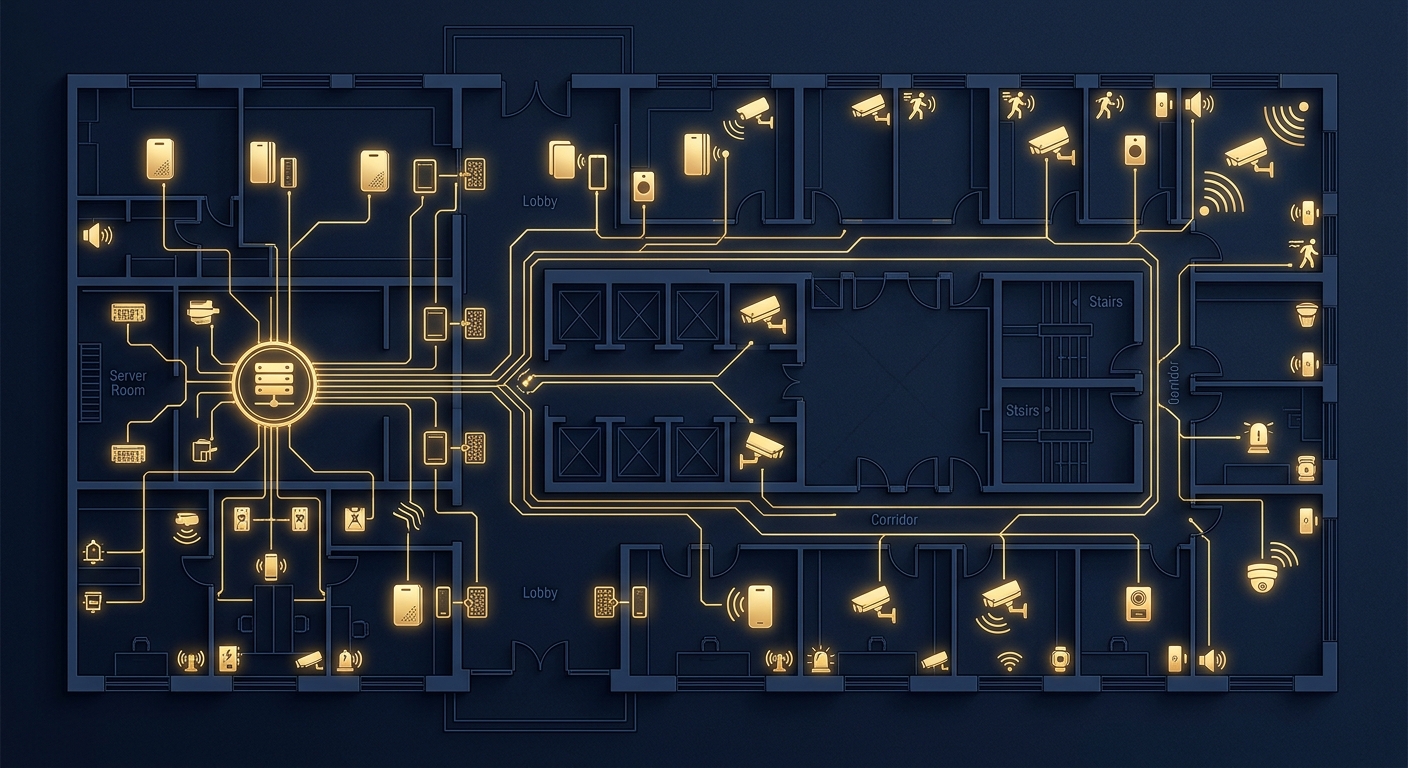
Technology is where security budgets are most often wasted — not because the equipment is bad, but because it’s purchased before the risk assessment defines what it needs to accomplish. A consulting-led technology design starts from the master plan’s findings and specifies systems to close identified gaps, not from a vendor’s product catalog.
| System | Baseline deployment | Risk-informed deployment |
|---|---|---|
| Access control | Card readers on main entries only | Credentialed control on every exterior and high-value interior door, with door-position monitoring and forced-open/held-open alarms |
| CCTV / video | Cameras recording to local storage, reviewed only after an incident is reported | Coverage engineered to eliminate the specific blind spots the survey identified, with analytics (loitering, line-crossing, license-plate recognition) tuned to real threat scenarios rather than left on factory defaults |
| Intrusion & duress alarms | Perimeter door/window contacts monitored during closed hours only | Zoned intrusion coverage tied to occupancy schedules, plus duress/panic hardware at reception, cash-handling, and high-conflict points, monitored around the clock |
| System integration | Access control, video, and alarms run on separate platforms with no shared alerting | Unified monitoring so a forced door automatically pulls the associated camera feed and notifies the right responder in seconds, not after a manual review |
The right column is more expensive up front and almost always cheaper over the life of the system, because it’s designed to prevent and quickly resolve incidents rather than just document them after the fact. Whether a specific gap justifies that investment is exactly the kind of question the risk assessment is built to answer with a number, not an opinion.
How do you turn policy into behavior that actually holds under pressure?
A binder of security policy that nobody has read is worse than no policy at all, because it creates a paper trail showing the organization knew what it should have done and didn’t train staff to do it. Effective policy work starts narrow — post orders, access-control procedures, visitor management, workplace-violence and active-threat response, incident reporting — and is written for the person who has to execute it under stress, not for the auditor who will read it later.
Training that holds up follows the same logic as the physical program: it’s tested, not just delivered. That means scenario-based tabletop exercises for management, hands-on drills for front-line staff and reception teams, and — critically — after-action review that feeds gaps back into the policy itself rather than treating the training session as the finish line. Organizations that run this loop consistently see faster, calmer responses to real incidents; organizations that treat an annual PowerPoint as compliance rarely do.
Reference frameworks such as ASIS International’s published standards and guidelines give a defensible, industry-recognized baseline to build policy against, which matters both for training quality and for demonstrating a reasonable standard of care if a policy is ever tested in litigation.
How do you vet and audit a guard force or security vendor?
Most organizations that contract security guard services sign the contract once and never formally audit performance again. That’s the single most common vulnerability we find during Arizona facility assessments — not the absence of a guard, but the presence of one whose licensing, post-order compliance, or supervision has quietly drifted since the contract was signed. A disciplined vendor and guard-force audit checks:
- State licensing status. Confirm the guard company and each individual officer hold current Arizona Department of Public Safety security-guard licensing, not just at contract signing but on an ongoing basis.
- Insurance and bonding. Verify current certificates of general liability and, where officers are armed, the specific coverage that role requires — and confirm the client is named as an additional insured.
- Post-order compliance. Compare written post orders against what officers actually do on unannounced site visits — patrol frequency, log accuracy, radio discipline, and whether posts are actually staffed for the full contracted shift.
- Training and use-of-force records. Review documented training hours, firearms qualification records for armed posts, and de-escalation and use-of-force training — not just a certificate on file, but a recent qualification date.
- Supervision and accountability. Confirm there’s an actual supervisory chain that reviews incident reports and patrol data, rather than officers operating unsupervised between client complaints.
- Turnover and staffing consistency. High officer turnover degrades site-specific knowledge fast; a vendor unwilling to share turnover data is itself a finding.
- Incident and after-action documentation. Pull a sample of past incident reports and score them for completeness, timeliness, and whether corrective action was actually tracked to closure.
In Arizona, this audit and the guard-force staffing itself are handled by our own in-house, AZ-licensed personnel — we are not marking up a subcontractor’s labor or vetting a stranger’s crew after the fact. Outside Arizona, we run the same audit standard against a commanded network of vetted field partners in established partner theaters, so a multi-state facilities portfolio gets one consistent standard of accountability rather than a different quality bar in every market.
How do you actually measure the ROI of a security program?
Security ROI is genuinely harder to prove than marketing ROI, because the best possible outcome — nothing happened — looks identical to having spent nothing at all. That’s exactly why the risk-assessment discipline matters at the back end of a program, not just the front: it gives you a baseline to measure against.
A credible ROI case for a security program draws on several converging indicators rather than one number:
- Loss and incident trend, pre- and post-implementation. Shrinkage, theft reports, workplace-injury claims tied to security gaps, or unauthorized-access events, tracked against the baseline the initial assessment established.
- Insurance and liability impact. Many carriers reduce premiums or improve terms for documented risk-mitigation programs; a completed assessment and master plan is often the exact documentation underwriters ask for.
- Operational efficiency. Integrated systems and better-audited guard coverage frequently reduce redundant patrol hours and false-alarm dispatch costs — a direct, measurable line item.
- Avoided-cost modeling. Estimating the cost of the incidents the program’s countermeasures were specifically designed to prevent, using the same consequence figures generated during the original risk assessment — labeled clearly as an estimate, never presented as a guaranteed saving.
The organizations that get the clearest ROI picture are the ones that treated the initial assessment as a baseline to revisit annually, not a one-time deliverable. Without that baseline, there’s no honest way to show the program is working — only a hope that it is.
Ad hoc security spending vs. a licensed consulting partner — what’s actually different?
| Factor | Ad hoc / reactive spending | Structured consulting partnership |
|---|---|---|
| What triggers a purchase | The last incident or complaint | A ranked risk assessment updated on a schedule |
| Budget defensibility | Hard to justify to finance or the board without data | Tied to documented likelihood/vulnerability/consequence findings |
| Vendor and guard oversight | Contract signed once, rarely re-audited | Scheduled licensing, insurance, and post-order audits |
| Technology fit | Purchased from a vendor’s catalog, integration an afterthought | Specified to close identified gaps, integrated by design |
| Legal / insurance posture | Little documentation of a reasonable standard of care | Assessment and master plan double as standard-of-care documentation |
| Multi-site or multi-state consistency | Different vendor, different standard, in every market | One accountable methodology across AZ owned operations and nationwide partners |
Neither approach is a moral failing — most reactive programs started that way because there was never a moment to step back and build the process. The point where it’s worth stepping back is usually after the second or third incident that “shouldn’t have happened,” or before a new lease, acquisition, or ground-up build locks in a floor plan for the next twenty years.
Arizona-based, own-agent delivery — with nationwide program design
Honeybadger Solutions is headquartered in Casa Grande, with additional offices in Phoenix and Oro Valley, giving executives, property managers, and general contractors across the Phoenix metro, Pinal County, Tucson, and the rest of Arizona direct access to our own in-house, AZ-licensed practitioners for physical assessments, CPTED surveys, and guard-force staffing and auditing — not a subcontracted crew assembled for the engagement.
For clients and portfolios outside Arizona, our security-consulting and intelligence practice designs and audits programs nationwide, coordinating with a vetted field-partner network in established partner theaters so a multi-state or multi-site organization gets a single accountable methodology instead of a different security standard in every market. Explore our broader intelligence capability for the research and due-diligence work that often runs alongside a consulting engagement.
Frequently asked questions
How long does a full security risk assessment take?
For a single facility, a thorough assessment — site survey, CPTED review, stakeholder interviews, and a ranked findings report — typically runs two to six weeks depending on site size and complexity. Multi-site portfolios are usually phased so the highest-risk locations are assessed first.
Do you provide your own security guards in Arizona, or subcontract them?
In Arizona, guard-force staffing is delivered by our own in-house, AZ-licensed agents — we are not a broker reselling a subcontractor’s labor. Outside Arizona, physical security is delivered through a commanded network of vetted partners in established theaters, audited to the same standard.
Can you design security into a new building before construction is finished?
Yes, and it’s significantly cheaper than retrofitting. Engaging during schematic design lets us influence sightlines, entry sequencing, camera and access-control conduit runs, and lobby layout before those decisions are locked into concrete and steel — which is why general contractors and developers are frequent consulting clients.
Will a security assessment help with our insurance or legal exposure?
Often, yes. A documented risk assessment and master plan can support underwriting conversations and demonstrates a reasonable, good-faith standard of care — useful if a security-related incident is ever reviewed by an insurer, regulator, or in litigation. It is not a substitute for legal or insurance advice specific to your situation.
About Honeybadger Solutions
Honeybadger Solutions is an Arizona-licensed security and risk-management firm serving all of Arizona, nationwide, and internationally. Our own in-house, AZ-licensed practitioners deliver physical security surveys, CPTED reviews, and guard-force staffing across Arizona, while our security-consulting and intelligence teams design, audit, and manage risk-management programs for executives, facilities, and general contractors nationwide. Offices: Casa Grande (HQ, central Arizona), Phoenix, and Oro Valley. Book a consultation online for a confidential consultation, or explore our security consulting and security services.
A security program is only as strong as the risk assessment behind it — build that foundation first, and every dollar after it works harder.
Browse by topic
Security guard services · Private investigations · Cybersecurity · Digital forensics · Financial fraud investigation · Executive protection · All articles