

Security guard services in Phoenix, AZ are on-site protective operations staffed, supervised, and licensed to guard commercial and corporate facilities. Honeybadger Solutions deploys our own in-house, Arizona-licensed officers across the Valley — fixed lobby and access-control posts, mobile patrol, loading-dock and after-hours coverage — backed by written post orders, real-time tour verification, and a defined escalation chain. Book a consultation online.
Why is Phoenix its own guarding environment?
Phoenix is not a generic metro to be guarded from a national playbook. It is a sprawling, low-density, car-dependent region where a single corporate portfolio can span office towers downtown, a data center in Chandler, a distribution hub in the West Valley, and a campus in North Scottsdale — each with a different threat profile and a different response-time reality. Distances between sites are large, which makes mobile patrol routing, guard-to-post ratios, and supervisory drive time operational variables that directly affect cost and coverage quality.
Layered on top of geography is the Sonoran Desert itself. Summer surface temperatures routinely exceed 110°F, and exterior posts, patrol vehicles, and after-hours perimeter checks all have to be planned around heat physiology, not just crime risk. A guarding program that works in a temperate coastal city will quietly fail here if it ignores hydration cycles, shaded relief points, vehicle cooling, and monsoon-season storm response. Add rapid population growth, a heavy logistics and semiconductor build-out, and a large seasonal event calendar, and Phoenix earns dedicated, locally-commanded guarding — which is exactly how we run it, from our home offices in Phoenix, Casa Grande, and Oro Valley.
What guard post and coverage types protect a commercial site?
“Security guard” is a category, not a job. A serious program specifies the exact post type, its purpose, and its post orders. The right mix depends on the asset, the traffic pattern, and where your loss exposure actually sits — a lobby is a reputation and access problem, a loading dock is an inventory-shrinkage and unauthorized-access problem, and an empty campus at 3 a.m. is a trespass, vandalism, and life-safety problem. Below are the core post types we staff and where each fits best.
| Post / coverage type | Primary purpose | Best-fit use & risk profile |
|---|---|---|
| Fixed lobby / reception post | Access control, visitor management, brand presence | Corporate HQs, medical buildings, multi-tenant towers — high foot traffic, first-impression and credential risk |
| Access-control / gate post | Credential verification, vehicle screening, tailgating prevention | Data centers, campuses, secure logistics yards — unauthorized-entry and insider risk |
| Mobile patrol | Randomized coverage of large or multi-building sites | Industrial parks, distribution centers, vacant property portfolios — perimeter, trespass, and vandalism risk |
| Loading-dock / dock-door post | Cargo verification, driver check-in, shrinkage control | Warehousing, retail distribution, manufacturing — theft, diversion, and chain-of-custody risk |
| After-hours / overnight post | Life-safety, alarm response, lockdown enforcement | Any facility during closed hours — intrusion, fire/utility, and squatting risk |
| Event / seasonal coverage | Crowd flow, credentialing, incident containment | Corporate events, retail peak season, temporary sites — surge and liability risk |
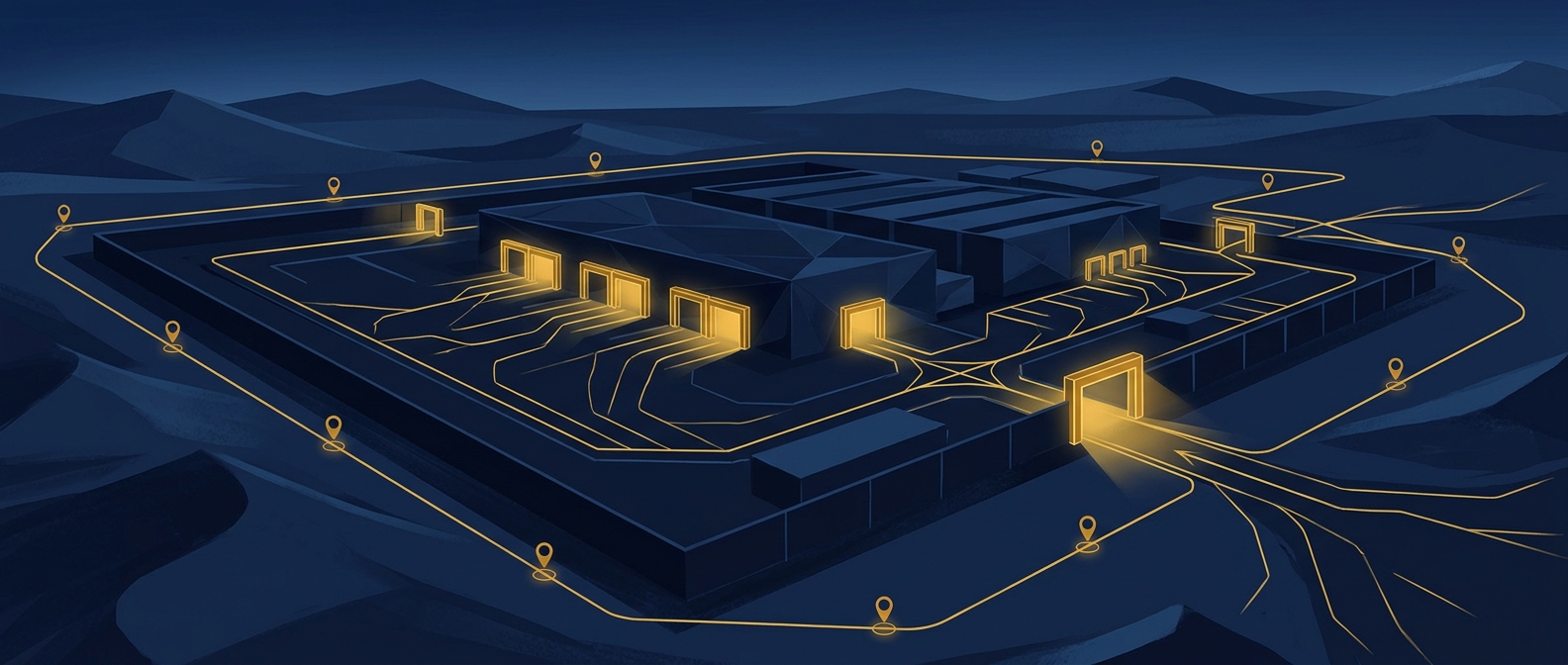
In practice these are combined. A technology campus might run a fixed access-control post at the main gate, a lobby post at the primary building, and an overnight mobile patrol that verifies the perimeter and outlying structures on a randomized loop. The discipline is in the design — matching post type to documented risk rather than selling a flat headcount.
Which Phoenix industries most need corporate guarding?
Phoenix’s economy has concentrated exactly the kinds of assets that demand professional guarding. Each vertical has a distinct dominant risk, and post orders should be written to it rather than copied between sites.
Technology & data centers
The Valley’s semiconductor and data-center build-out has made controlled physical access a board-level concern. Here the priority is rigorous credential verification, anti-tailgating enforcement at mantrap and gate posts, visitor escort discipline, and detailed access logging — aligned to the layered controls that CISA’s physical security guidance describes for critical facilities.
Healthcare & medical campuses
Hospitals, clinics, and medical office buildings need officers trained for de-escalation, patient-privacy awareness, controlled-substance area support, and 24/7 emergency-department coverage. The guard is often the first responder to a behavioral incident and must document it cleanly for legal and clinical follow-up.
Logistics, distribution & manufacturing
West Valley distribution corridors run on dock throughput. Loading-dock posts control driver check-in and cargo verification, mobile patrol covers vast yards, and shrinkage control depends on consistent chain-of-custody documentation. See our approach to warehouse security services in Phoenix and industrial and manufacturing security.
Retail & corporate campuses
Flagship retail, mixed-use, and corporate campuses balance an open, welcoming presence with loss prevention and executive-protection awareness. Officers manage access, deter theft, support opening/closing procedures, and coordinate with property management — the model detailed on our commercial and corporate security page. Active construction sites carry their own exposure; we cover that under construction site security in Phoenix.
How does Sonoran-desert heat change guard operations?
Heat is a controllable operational hazard in Phoenix, and how a firm manages it separates professionals from vendors who simply post a body outdoors and hope. When exterior temperatures push past 110°F, an unmanaged outdoor post is both a liability exposure and a coverage-quality failure — a heat-stressed officer is a slower, less observant officer. We plan exterior and patrol posts around the prevention principles in OSHA’s heat-exposure guidance: water, rest, shade, and acclimatization.
In practice that means scheduled hydration cycles and cool-down rotations built into post orders, shaded or climate-controlled relief points, heat-appropriate uniform options, patrol-vehicle air-conditioning as a functional requirement rather than a comfort, and supervisor monitoring for early heat-illness signs during peak hours. Monsoon season adds dust storms, flash flooding, and lightning — events that trigger specific post-order actions: securing loose materials, adjusting patrol routes, and shifting to sheltered observation. Our officers work the desert year-round; heat protocol is standard operating procedure, not an afterthought.
What is Arizona’s licensing and legal standard for security guards?
In Arizona, private security is regulated under A.R.S. Title 32, Chapter 26, and administered by the Arizona Department of Public Safety (AZ DPS). Security guard agencies must hold an agency license, and individual guards must be registered and fingerprint-cleared — armed officers carry additional training and registration requirements. This is not a formality; using unlicensed or improperly registered personnel exposes a facility owner to liability and can invalidate the very protection they paid for. You can confirm agency and guard credentials through AZ DPS licensing.
Honeybadger Solutions is an Arizona-licensed security and investigations firm, and in Arizona our officers are our own in-house, licensed, supervised personnel — not subcontractors pulled from an anonymous labor pool. That distinction matters for accountability: our command team owns hiring standards, background screening, training, discipline, and insurance coverage end to end. Beyond licensing, we align program design to recognized professional standards from bodies such as ASIS International, so post orders, reporting, and supervision reflect current best practice rather than the minimum the law allows.
What separates elite guarding from warm-body vendors?
The commodity guarding market sells presence: a uniform standing where you asked, at the lowest hourly rate. Elite guarding sells outcomes: documented deterrence, fast correct response, and a defensible record. The gap between the two is almost entirely in the operating system behind the officer — supervision, written post orders, verification, reporting, and escalation. The table below makes the difference concrete.
| Dimension | Commodity “warm-body” vendor | Elite guarding (Honeybadger) |
|---|---|---|
| Post orders | Generic or verbal, rarely site-specific | Written, site-specific, reviewed and version-controlled |
| Supervision | Absent or reactive after complaints | Scheduled supervisory visits and post inspections |
| Tour verification | Paper log or none — unverifiable | GPS / electronic tour checkpoints with timestamps |
| Incident reporting | Inconsistent, delayed, unstructured | Standardized, prompt, legally defensible records |
| Escalation | Ad hoc — guard decides | Defined escalation tree to command and client contacts |
| Staffing | High-churn subcontracted labor | In-house, licensed, screened, trained officers |
| Heat / weather protocol | None | OSHA-aligned heat and monsoon procedures |
Post orders are the contract between the client’s risk and the officer’s conduct: they define who gets access, what to observe, what to do at each contingency, and whom to call. Tour verification proves the patrol actually happened. Structured incident reports turn an event into evidence that survives an insurance claim or a courtroom. And a real escalation tree means a guard never has to guess — the right decision-maker is reached in minutes. Warm-body vendors skip these because they cost money to run properly; the savings evaporate the first time an undocumented incident becomes a liability.
How do you scope and procure a Phoenix guard program?
Buying guarding well is a procurement discipline, not a phone call for “two guards.” Use this sequence to build a program that maps spend to actual risk and gives you a defensible, measurable service.
- Define the assets and risks. Inventory each site, its hours, its critical assets, and the specific loss or life-safety exposure at each — lobby, dock, perimeter, after-hours.
- Conduct a site security assessment. Walk every post location, note sightlines, lighting, access points, camera coverage, and heat-exposed positions before deciding headcount.
- Verify licensing. Confirm the agency’s AZ DPS license and that individual officers are registered — and that guards are in-house, not anonymously subcontracted.
- Specify post types and coverage hours. Match fixed, patrol, dock, access-control, and after-hours coverage to the risks from step one; avoid flat headcount.
- Demand written post orders. Require site-specific post orders with contingency procedures, escalation contacts, and heat/weather protocol.
- Require tour verification and reporting. Insist on GPS/electronic checkpoint verification and standardized incident reporting with review cadence.
- Confirm supervision ratios. Ask how often a supervisor inspects posts and how quickly command is reachable 24/7.
- Review insurance and liability. Verify general liability and workers’ compensation coverage and indemnification language.
- Set measurable KPIs. Agree on response times, report timeliness, tour-completion rates, and incident trends — then review them.
- Pilot, then scale. Start on the highest-risk site, validate the operating system, and expand across the portfolio.
How does Honeybadger deliver its Phoenix guard force?
We run Phoenix as home command. Our own Arizona-licensed officers are hired, screened, and trained to our standard; every deployment ships with written, site-specific post orders; and patrols are verified with electronic tour checkpoints so completion is provable, not assumed. Supervisors conduct scheduled post inspections, and a defined escalation tree connects the officer on post to command and to your designated contacts around the clock. Heat and monsoon protocols are built into post orders as standard.
Because we operate from Phoenix, Casa Grande (HQ), and Oro Valley, we cover the entire Valley and greater Arizona with local supervisory reach — and we support clients nationwide and internationally. Our in-house digital forensics, cybersecurity, financial investigations, and background-intelligence teams mean a physical incident can be escalated into a full investigative response without handing your case to a stranger. Whether you need a single lobby post, a multi-site patrol program, or a fully-integrated corporate security operation, start with our security services overview or contact our command team directly. For Scottsdale corporate campuses, see our Scottsdale corporate security services.
Why does the company behind the guard matter more in Phoenix?
Search “security guard company Phoenix” and most of the results are lead-generation brokers: national platforms that collect the contract, then dispatch whichever local subcontractor bid lowest that week. In a metro this large — Maricopa County alone stretches from the West Valley distribution belt to the North Phoenix tech corridor near Loop 303 — that brokered model means your lobby guard tonight may be a different vendor’s employee than the one who staffed the same post last month, with no continuity of training, no shared post-order discipline, and no single chain of command to answer for a bad night.
Phoenix has also become a magnet for exactly the assets that make ownership of the guard force a real risk decision rather than a line-item: TSMC’s multibillion-dollar semiconductor fab campus in north Phoenix, the downtown medical district anchored by Banner — University Medical Center and Phoenix Children’s Hospital, the Camelback Corridor’s Class A office towers, and the cargo and logistics operations feeding Sky Harbor International Airport. Each of those sites carries a different threat profile, and the company you hire needs the command structure to staff them consistently — which is exactly why we run Phoenix as one of our three home offices, not a franchised territory.
In-house officers vs. subcontracted labor: what’s the actual difference?
Every Phoenix guard company will claim it is “licensed” and “professional.” The distinction that actually predicts performance is who employs, trains, and disciplines the person standing your post. The table below breaks down the two dominant models you’ll encounter when sourcing a security guard company in the Valley.
| Model | Who employs the guard | Where it typically fails | Honeybadger’s model |
|---|---|---|---|
| National broker | A regional subcontractor the broker doesn’t manage day-to-day | Inconsistent training, high turnover, no local supervision reach | N/A — we are not a broker in Arizona |
| Independent local subcontractor pool | Whichever contractor accepts the shift | No standardized post orders, unverifiable background screening | N/A — Arizona guards are our own employees |
| In-house AZ-licensed firm | The firm itself, under one AZ DPS agency license | Rare when the firm invests in supervision ratios | Our model in Phoenix: hiring, screening, training, discipline, and insurance owned end to end |
In Arizona, Honeybadger’s uniformed officers, mobile patrol, and access-control personnel are our own in-house, AZ-licensed, supervised employees. We do not broker Phoenix guard contracts to a third party. That ownership is what lets a single command team enforce one standard of post orders, one incident-reporting format, and one escalation chain across every site in the metro — from a downtown lobby to a North Valley industrial yard, without a hand-off between competing subcontractors ever weakening the chain of accountability.

What does Arizona law require of a security guard company?
Private security in Arizona is governed by A.R.S. Title 32, Chapter 26, and enforced by the Arizona Department of Public Safety (AZ DPS). A legitimate security guard company must hold an agency license, and every individual guard — armed or unarmed — must be separately registered and fingerprint-cleared, with additional certification for armed personnel. Before you sign a contract, verify both the agency license and the specific guards assigned to your site through AZ DPS licensing. A company that can’t produce current documentation for the officer standing at your gate is not a company you want holding your liability exposure.
Honeybadger Solutions holds its own Arizona agency license, and every Phoenix officer we deploy is individually registered under that license — not borrowed from a labor pool with its own separate (and unverified) paperwork. We also align our post-order and supervision standards to ASIS International guidance, which sets the bar well above the statutory minimum.
What drives the cost of a Phoenix guard contract?
Hourly rate alone is a misleading way to compare bids — it hides where a company is cutting corners. The real cost drivers are:
- Supervision ratio. How many officers does one field supervisor actually cover, and how often do they physically inspect the post?
- Officer tenure and turnover. A guard who has worked your site for a year knows your tenants, your traffic patterns, and your red flags; a revolving cast does not.
- Coverage geography. A single facilities portfolio spanning downtown Phoenix, the West Valley, and the North Valley tech corridor multiplies drive time between posts — a company without local supervisory density will bill for travel or simply skip inspections.
- Heat operations. Properly planned hydration cycles, shaded relief points, and air-conditioned patrol vehicles cost more than posting a guard outdoors and hoping — but they are the difference between a functioning summer post and a liability.
- Insurance and indemnification. General liability and workers’ compensation coverage that actually protects your facility, not just the vendor.
None of these show up on a one-page rate sheet, which is exactly why an apples-to-apples bid comparison across Phoenix vendors is harder than it looks. Two companies quoting the same hourly rate can deliver wildly different outcomes if one is staffing a supervisor over forty guards spread across the Valley and the other caps it at ten. Ask every bidder to itemize supervision, tenure data, and heat protocol separately from the base rate so you’re comparing the whole program, not just the number on the invoice.
How should you vet a Phoenix security guard company before signing?
Use this sequence before committing budget to any provider:
- Confirm the agency’s AZ DPS license and that it covers the specific officers who will staff your site.
- Ask directly: are guards employees or subcontractors? Get the answer in writing.
- Request the supervisor-to-officer ratio and how often posts are physically inspected.
- Require written, site-specific post orders — not a generic template reused across clients.
- Ask about heat and monsoon protocol for any exterior or patrol post.
- Verify GPS or electronic tour-verification capability so patrol completion is provable.
- Review insurance certificates for general liability and workers’ compensation.
- Ask how incidents escalate after hours and who answers the phone at 2 a.m.
- Check officer tenure data — high turnover predicts inconsistent coverage.
- Pilot on your highest-risk site before expanding the contract portfolio-wide.
How does Honeybadger staff Phoenix contracts?
We run Phoenix as home command alongside our Casa Grande headquarters and Oro Valley office. Every officer assigned to a Phoenix contract is our own employee, AZ DPS-registered, trained to our standard, and covered by written, site-specific post orders. Patrols are verified electronically, supervisors conduct scheduled post inspections, and a defined escalation tree connects the officer on post to our command center around the clock — with our in-house digital forensics, cybersecurity, and financial-investigations teams available if a physical incident needs to become a full investigative response. Start with our security services overview or call for a Phoenix site assessment.
Frequently asked questions
Does Honeybadger use its own guards in Phoenix or subcontractors?
In Arizona, Honeybadger uses its own in-house, Arizona-licensed, supervised officers — not a subcontracted labor pool. Our command team owns hiring, background screening, training, post orders, discipline, and insurance end to end, which is what makes accountability and quality enforceable across every Phoenix site.
What licenses are required for security guards in Arizona?
Arizona regulates private security under A.R.S. Title 32, Chapter 26, administered by AZ DPS. The agency must hold a guard-service license and each officer must be registered and fingerprint-cleared, with additional training and registration for armed officers. You can verify credentials through AZ DPS licensing before hiring any provider.
How do you keep guards safe and effective in Phoenix summer heat?
We build OSHA-aligned heat protocols into post orders: scheduled hydration and cool-down rotations, shaded or climate-controlled relief points, heat-appropriate uniforms, air-conditioned patrol vehicles, and supervisor monitoring for heat-illness signs. Monsoon procedures cover dust storms, flooding, and lightning, so coverage quality holds even at 110°F-plus.
What types of security posts can you staff for a commercial site?
We staff fixed lobby and reception posts, access-control and gate posts, mobile patrol, loading-dock posts, after-hours and overnight coverage, and event or seasonal coverage. Most programs combine several — designed to the documented risk at each site rather than a flat headcount — across technology, healthcare, logistics, retail, and corporate campuses.
About Honeybadger Solutions
Honeybadger Solutions is an Arizona-licensed security and investigations firm. In Arizona, our uniformed security officers, mobile patrol, and protective agents are our own in-house, Arizona-licensed, supervised personnel — not subcontractors. Digital forensics, cybersecurity, financial investigations, and background intelligence are run in-house and delivered worldwide. We serve all of Arizona and support clients nationwide and internationally.
Offices: Casa Grande (HQ), Phoenix, and Oro Valley, Arizona.
Phone: Book a consultation online
Confidential consultation: speak with our command team about a Phoenix guard-force program or site security assessment.
Browse by topic
Security guard services · Private investigations · Cybersecurity · Digital forensics · Financial fraud investigation · Executive protection · All articles