

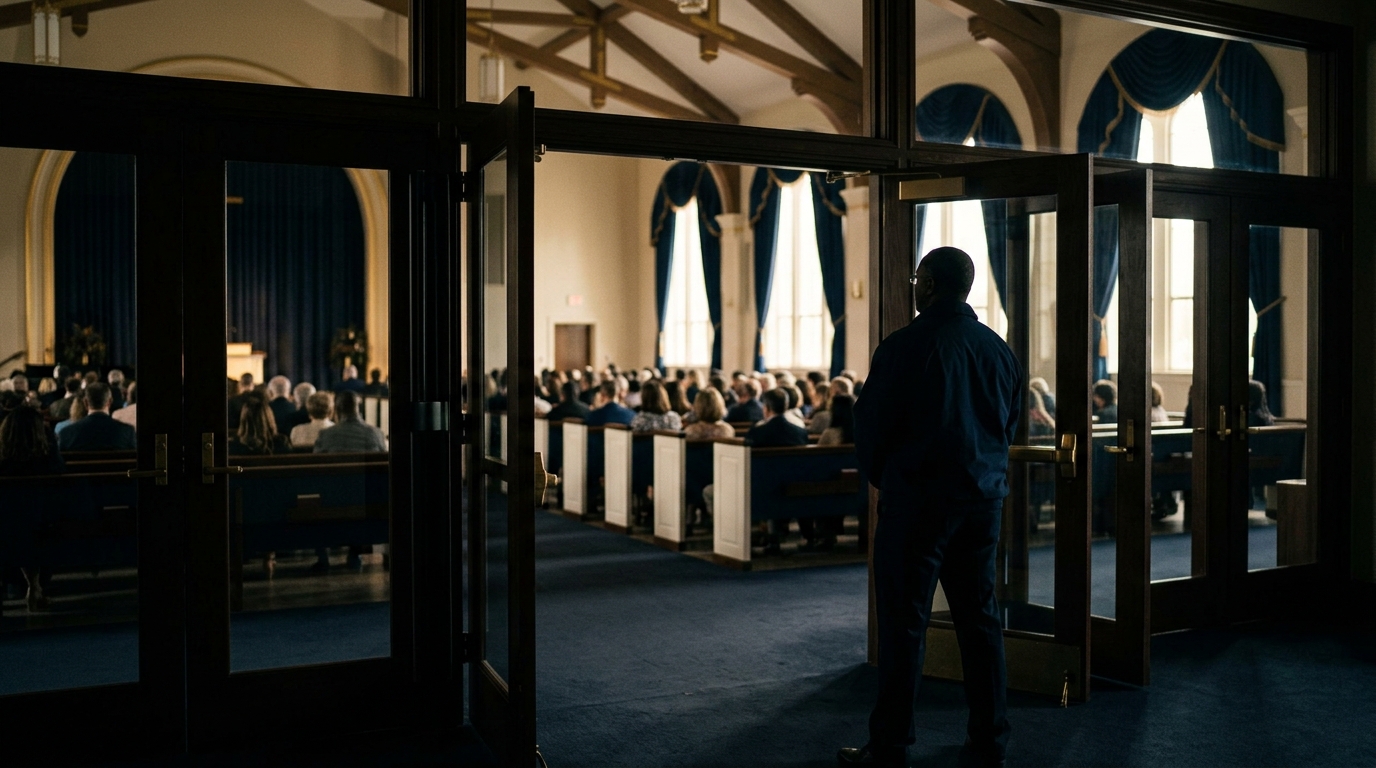
Effective places-of-worship security protects congregants without turning a sanctuary into a fortress. The discipline blends a formal threat and vulnerability assessment, a trained safety team, layered access control, rehearsed active-threat protocols, and a direct line to local law enforcement. Done well, most measures are invisible to worshippers — the welcome stays warm while the risk of harm falls sharply.
Faith communities gather to worship, grieve, celebrate, and belong. That openness is the mission — and it is also the exposure. Churches, synagogues, mosques, temples, and gurdwaras hold predictable services at published times, welcome strangers by design, and are frequently under-resourced on the security side. Across the United States, houses of worship have been targeted by hate-motivated attackers, disturbed individuals, and opportunistic criminals. Honeybadger Solutions helps faith organizations nationwide close that gap with professional, proportionate protection that preserves the spiritual environment rather than eroding it.
Why are houses of worship uniquely exposed?
Security professionals describe faith facilities as “soft targets” for structural reasons, not because congregations are careless. Four factors compound the risk:
- Predictability. Service times, holiday schedules, and processional routes are published, giving a planner ample time to observe patterns and choose a moment of maximum density.
- Openness by doctrine. Most traditions consider hospitality to the stranger a sacred obligation. Screening every visitor conflicts with the theology of welcome, so access controls must be subtle.
- Concentration and vulnerability. Hundreds of people, including children and the elderly, gather in a single room with limited exits and heightened emotion.
- Symbolic value. An attack on a house of worship is intended to terrorize an entire faith or community, which is precisely what draws ideologically motivated offenders.
The goal is not to eliminate openness. It is to add depth behind it — so that a welcoming front door is backed by trained people, sound procedures, and a plan that activates in seconds if hospitality is abused.
How do you balance a welcoming spirit with real security?
This is the central tension of faith-based protection, and the mediocre answer is to bolt on visible hardware — armed guards at the door, metal detectors, locked gates — until the building feels like a checkpoint. Congregations reject that, attendance suffers, and the mission is damaged in the name of protecting it.
The elite approach inverts the emphasis. Most of the security lives in people and procedure, not in obvious hardware. A greeter trained in behavioral threat recognition is more valuable than a camera nobody monitors. A rehearsed lockdown sequence matters more than a locked door that props open every Sunday. The best programs are felt as warmth and order, not as suspicion. Congregants notice that someone always seems to be paying attention and that the team is calm and competent — and they feel safer, not surveilled.
What does a threat and vulnerability assessment actually cover?
Every serious program begins with an assessment, not equipment. Buying cameras before understanding your risk is spending money to feel safe rather than to be safe. A professional house-of-worship assessment works through the following framework:
- Threat profile. Who realistically poses a risk to this specific community — ideological adversaries, a known individual in a domestic or congregational dispute, a person in mental-health crisis, property criminals? Generic fear is replaced with a named, prioritized threat picture, informed where appropriate by open-source intelligence monitoring.
- Physical vulnerability survey. A walk of the entire campus — parking, entrances, sightlines, lighting, doors, sanctuary layout, exits, childcare and school wings, offices, and safe-room candidates.
- Procedural review. How are doors managed during service? Who has keys and codes? What happens when an unknown visitor becomes agitated? Are there written policies, and does anyone follow them?
- People and training audit. Does a safety team exist? Is it trained, insured, and legally covered? Do staff and clergy know their roles in an emergency?
- Consequence and continuity. If the worst happens, what are the medical, legal, reputational, and pastoral consequences, and how quickly can the community recover?
The deliverable is a prioritized, budget-aware roadmap: what to fix this month at no cost (habits and procedures), what to fund this quarter (training, hardware, signage), and what belongs in a capital plan (structural changes, safe rooms). A credible assessment tells a board where not to spend as clearly as where to invest.

Volunteer safety team or professional security — which do you need?
This is the most common and most consequential decision a congregation faces. Many rely on volunteer teams drawn from members with military or law-enforcement backgrounds. That instinct is sound, but good intentions do not equal legal training, current certification, or coordinated response under stress — and an untrained armed volunteer can escalate an incident or create catastrophic liability. The right answer is usually not “one or the other” but a deliberate blend, matched to the threat profile.
| Dimension | Volunteer safety team | Professional security agents |
|---|---|---|
| Best role | Greeting, observation, first alert, ushering evacuations | Armed deterrence, use-of-force response, high-threat services |
| Training | Variable; needs formal, recurring instruction | Licensed, certified, insured, continuously trained |
| Legal exposure | High if armed and untrained; personal liability risk | Carried by the security firm; documented and covered |
| Cost | Low direct cost; high hidden risk | Higher direct cost; lower liability |
| Community feel | Familiar faces, warm, embedded | Discreet, professional, scalable to threat level |
Honeybadger Solutions is built to support, not replace, an existing team. We professionalize the volunteers you have — behavioral threat recognition, verbal de-escalation, evacuation and lockdown roles, and clear legal boundaries — and we layer in trained agents for high-risk services, holidays, controversial events, or credible threats. Armed and physical protection is delivered through our commanded, vetted-partner network, with established operational theaters in California, Texas, and Florida and home command in Arizona; nationwide mandates are staffed and supervised to the same standard. The result is a team that stays yours, elevated to a professional bar.
How should access control work in a place of worship?
Access control in a faith setting is a design problem, not a hardware catalog. The principle is layered depth — concentric zones that grow more protected toward the sanctuary and the most vulnerable areas, while the outer welcome stays open.
- Outer perimeter (parking and approach): lighting, clear sightlines, trimmed landscaping, and a greeter presence that doubles as observation. Most threats are visible here first.
- Entry layer: a single, staffed primary entrance during services with other doors secured but rapidly openable from inside for egress. Greeters are the real access control — trained to notice, engage, and quietly alert.
- Core (sanctuary): defined exits, an unobstructed path for the safety team, and a discreet way to signal or lock down without alarming the congregation.
- Protected wings (childcare, schools, offices): the strictest control on campus — controlled entry, sign-in, reunification procedures, and staff who verify identity before release of a child.
Cameras, electronic locks, and intercoms support this design; they do not substitute for it. The most common failure we correct is a facility that spent heavily on a camera system nobody watches while propping the main door open and leaving the children’s wing unmonitored. Where identity questions arise — a disputed volunteer, an insider concern, a leadership hire — discreet background intelligence and vetting closes a gap that hardware never can.
How do you prepare for an active-threat incident?
Active-threat preparedness is where preparation saves lives in the seconds before help arrives. Federal guidance for houses of worship centers on the widely taught Run, Hide, Fight hierarchy, adapted to the realities of a crowded sanctuary with children and elderly members. A world-class program moves beyond a printed policy to rehearsed capability:
- Recognition and alert. Any staff member or greeter can trigger a discreet, unmistakable alert to the safety team without inciting panic — a code word, a silent signal, a duress button.
- Evacuate or lock down. Pre-planned routes and safe rooms, with the safety team directing movement. Decisions are made by role, not improvised in the moment.
- Stop the harm. A trained, legally covered response by designated personnel — the narrow scenario where professional armed capability is decisive and where untrained volunteers are most dangerous.
- Care for casualties. AEDs, bleeding-control (“Stop the Bleed”) kits, and staff trained to use them in the gap before EMS arrives.
- Reunify and recover. Accountability for children, a family reunification plan, and pastoral and legal support afterward.
Plans that live in a binder fail under stress. We build the plan, then rehearse it — tabletop exercises with clergy and staff, walk-throughs with the safety team, and drills scaled so they inform rather than traumatize the congregation. If an incident does occur, our in-house investigative and digital-forensics capabilities support the after-action review, evidence preservation, and any threat that continues online.
How should a congregation coordinate with law enforcement?
Professional security does not compete with police — it multiplies their effectiveness. The single most valuable thing a house of worship can do before an incident is build a relationship with local law enforcement in peacetime. That means inviting officers to tour the facility, sharing floor plans and safe-room locations, agreeing on how the safety team will identify itself to responding officers (a critical detail that prevents tragic misidentification), and establishing a direct point of contact rather than dialing a general line under duress.
We also help congregations connect with the resources built for them. The Department of Homeland Security and CISA maintain dedicated faith-based security guidance and regional protective advisors, and FEMA’s Nonprofit Security Grant Program funds physical hardening for eligible houses of worship — a program most congregations qualify for but never apply to because the paperwork is daunting. Positioning a community to access that funding and those relationships is part of a complete program, not an afterthought.
What separates a world-class provider from a guard company?
Any firm can post a guard at a door. Elite faith-based protection is distinguished by judgment, restraint, and integration:
- Proportionality. The best providers routinely recommend spending less on hardware and more on training, because they are selling safety, not equipment.
- Discretion. Congregants should feel welcomed, not screened. Protection that changes the character of worship has failed even if no incident occurs.
- Legal and liability fluency. Use-of-force law, insurance, volunteer indemnification, and duty-of-care are handled explicitly, protecting the institution as well as its people.
- Intelligence and continuity. Threats increasingly begin online. In-house intelligence, background vetting, and digital forensics mean a provider can address a threat before and after it reaches the front door — not just guard the door.
Representative scenario: A mid-sized congregation receives escalating hostile messages before a major holiday service. A complete response is not simply adding guards. It is an intelligence review of the online threat, a rapid vulnerability check of the entrance and childcare wing, a briefing and refresher for the volunteer team, discreet professional agents for the specific high-risk service, and a coordinated notice to the local police liaison — layers that resolve the moment while leaving the community’s sense of sanctuary intact. This composite illustrates method; it is not a specific client engagement.
Frequently asked questions
Will professional security make our sanctuary feel unwelcoming?
No, when it is designed correctly. The majority of a strong program is invisible — trained greeters, procedures, and planning — with visible or armed measures scaled to genuine risk. Congregants typically report feeling calmer and better cared for, not watched.
We already have armed volunteers. Isn’t that enough?
Armed volunteers are a starting point, but untrained or uninsured armed members create serious legal and safety exposure. Formal training, clear policy, legal coverage, and professional supervision convert good intentions into a defensible, effective capability.
Can a small congregation afford this?
Yes. The first and most valuable steps — a threat assessment, procedural fixes, and team training — are low-cost. Federal grant programs such as FEMA’s Nonprofit Security Grant Program can fund physical hardening for eligible houses of worship, and we help position communities to qualify.
Do you only serve Arizona?
Honeybadger Solutions is headquartered in Arizona with offices in Casa Grande, Phoenix, and Oro Valley, and serves faith communities nationwide. Assessment, training, intelligence, and vetting are delivered anywhere; armed and physical protection is provided through our commanded, vetted-partner network with established theaters in California, Texas, and Florida and nationwide mandate coverage.
About Honeybadger Solutions
Honeybadger Solutions is an Arizona-licensed security and investigations firm serving faith communities and institutions across Arizona, nationwide, and internationally. Our in-house, remote-by-design capabilities include digital forensics, cybersecurity, financial investigations, and background intelligence, supported by licensed investigators and a commanded network of vetted protective partners. We help houses of worship assess risk, professionalize their safety teams, prepare for active-threat incidents, and coordinate with law enforcement — protecting people while preserving the sanctuary. Offices in Casa Grande (HQ), Phoenix, and Oro Valley. To arrange a confidential consultation or facility assessment, visit our security services and Phoenix pages.
Authoritative resources: CISA — Faith-Based Organizations and Houses of Worship Security and FEMA — Nonprofit Security Grant Program.
Browse by topic
Security guard services · Private investigations · Cybersecurity · Digital forensics · Financial fraud investigation · Executive protection · All articles