
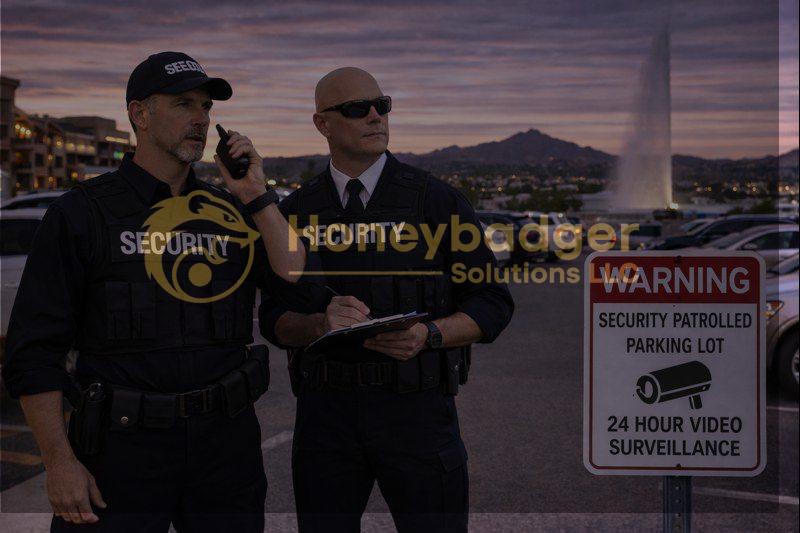

Parking lot and property security in Fountain Hills protects people, vehicles, and premises across the town’s retail plazas, HOA communities, medical offices, and event venues through licensed patrols, access control, lighting and CPTED design, and rapid incident response. Honeybadger Solutions commands vetted protective operations from its Arizona home command and integrates them with in-house investigations, forensics, and intelligence for full-spectrum coverage.
Few Arizona communities concentrate as much value into as small a footprint as Fountain Hills. An affluent master-planned town northeast of Scottsdale, it pairs luxury estates and active HOA communities with a compact commercial core along the Avenue of the Fountains, a signature waterfront park, and a seasonal event calendar that can multiply the town’s population in a single weekend. Every one of those assets funnels people and vehicles through parking lots and property perimeters—and those perimeters, not the buildings behind them, are where most preventable loss and liability actually occur. Property owners, HOA boards, retail operators, and estate managers who treat the parking lot as an afterthought are protecting the vault while leaving the gate open.
Why does parking lot and property security matter in Fountain Hills?
A parking lot is the one place on a property where the public, the asset, and the opportunity for crime intersect with the least supervision. It is dark for half the operating day, spread across a wide footprint, and populated by people who are distracted, loaded down with bags, or focused on their vehicles. That combination is precisely what opportunistic offenders look for. In Fountain Hills the stakes are elevated by the profile of the town: high-value vehicles, luxury retail traffic, and residents whose expectation of a safe, orderly environment is part of what their property values are built on.
The exposure is also legal, not merely reputational. Under Arizona premises-liability principles, a property owner or manager can be held responsible for foreseeable harm to invitees when reasonable security measures are absent. A shopping center that has logged prior vehicle break-ins, or an HOA that has documented after-dark loitering, is on notice; the failure to respond with proportionate measures—lighting, patrol, signage, camera coverage—is where negligent-security claims are born. Professional security is not only loss prevention. It is a documented, defensible record that the property took reasonable care.
What are the specific risks in Fountain Hills parking lots and structures?
Generic “guard on a stool” coverage fails because it is not matched to the actual threat pattern of the site. An elite program starts by naming the risks the property faces and designing against each one:
- Vehicle-focused theft. Smash-and-grab of valuables left in cabins, catalytic-converter theft targeting the undercarriage of parked vehicles, and full auto theft—all concentrated in low-visibility rows and after-hours periods.
- Person-directed crime. Robbery, assault, and harassment of shoppers, employees closing late, and residents crossing dim community lots between vehicle and door.
- Property damage and disorder. Vandalism, graffiti, hit-and-run collisions, and dumping that degrade the environment and signal that no one is watching.
- Access and enforcement failures. Trespassing, unauthorized and overflow parking, abandoned vehicles, and use of private lots by non-patrons—chronic problems around a walkable town center with a shared parking pool.
- Event-surge exposure. Seasonal festivals and community gatherings that overwhelm normal capacity, create overflow and remote parking, and draw crowds that ordinary staffing was never sized for.
- Liability incidents. Slip-and-fall, inadequate-lighting, and trip hazards that convert an ordinary accident into a claim when documentation is thin.
Parking structures add a distinct set of problems. Stacked decks create blind corners, poor natural surveillance, stairwell and elevator ambush points, and uneven lighting between levels. They cannot be patrolled the way an open surface lot can, and they reward a design-plus-patrol approach over either alone.
Which security coverage model fits which property?
There is no single correct posture; the right model depends on the property’s footprint, hours, traffic, and threat history. The table below frames the trade-offs an owner or HOA board should weigh before signing any contract.
| Coverage model | Best-fit property | Primary strength | Key limitation |
|---|---|---|---|
| Roving mobile patrol | Multi-lot HOAs, business parks, large surface lots | Wide coverage, unpredictable timing, cost-efficient | Not present at every moment; gaps between passes |
| Static / dedicated post | High-traffic retail, medical, single high-risk lot | Constant visible deterrent, immediate response | Fixed field of view; higher hourly cost |
| Hybrid patrol + post | Town-center plazas, mixed-use properties | Anchored presence plus roving coverage | Requires coordinated scheduling and supervision |
| Technology-led (CCTV / access) | Structures, gated communities, after-hours sites | 24/7 recording, evidentiary value, scalable | Records but does not intervene without human response |
| Event / surge detail | Festivals, seasonal peaks, community gatherings | Sized to crowd, traffic and overflow control | Temporary; needs advance planning and permits |
Most Fountain Hills properties are best served by a blended model—technology for persistent coverage and evidence, human presence for deterrence and intervention, and event details layered on during peaks. What matters is that the mix is engineered to the site, not sold from a template.

How should an HOA or property owner build a protection program?
World-class physical security is a designed system, not a headcount. The discipline that separates a defensible program from a false sense of safety is the assessment that precedes the patrol. The following framework mirrors how elite operators—and the Crime Prevention Through Environmental Design (CPTED) methodology they draw on—actually build coverage:
- Threat and history assessment. Review incident logs, local crime patterns, prior claims, and the property’s specific vulnerabilities before proposing a single guard-hour.
- Site and CPTED walk. Map lighting levels, sightlines, blind corners, entry and exit choke points, landscaping that conceals, and natural surveillance—then engineer the environment to remove opportunity.
- Lighting and camera coverage. Verify illumination to recognized standards across every row and stairwell, and position cameras for evidentiary value at entrances, structures, and known hot spots.
- Access and enforcement rules. Define who may park where, how overflow is handled, how abandoned and unauthorized vehicles are documented and removed, and how signage puts violators on notice.
- Patrol design. Set randomized patrol timing, defined checkpoints, and coverage that eliminates predictable gaps an offender could exploit.
- Response and escalation protocol. Establish clear rules of engagement, direct coordination with the Maricopa County Sheriff’s Office and local first responders, and defined thresholds for when patrol escalates to law enforcement.
- Documentation and reporting. Log every patrol, incident, and safety hazard in a time-stamped record that supports insurance, liability defense, and continuous improvement.
- Review and adjust. Re-audit on a fixed cadence and after any incident, tuning the program as traffic, tenants, and threat patterns change.
A provider that cannot walk an HOA board through steps like these is selling labor, not security. The assessment is where the value is created; the patrol merely executes it.
How does Honeybadger command physical security across Arizona?
Arizona is our home command. From it, Honeybadger Solutions coordinates a vetted network of licensed protective personnel and integrates their work with capabilities that most guard companies simply do not have in-house. When a parking-lot incident becomes something larger—an organized theft ring, a fraud pattern, a threat that follows an employee home, or digital evidence pulled from a camera system—we do not hand the client off to a third party. Our investigations, digital forensics, and intelligence functions are ours, delivered without a seam.
That integration is the difference between a security vendor and a security partner. A patrol company writes an incident report and closes the file. A full-spectrum firm treats the report as the first step in a case: identifying the pattern, preserving the evidence to an admissible standard, and, where warranted, building the file that supports prosecution or a civil recovery. For property owners whose exposure does not end at the property line, that continuity is decisive. It is also why our physical-security work in Arizona is best understood as one component of a broader security and security-consulting practice rather than a standalone guard service.
How do you secure Fountain Hills events and seasonal surges?
Fountain Hills lives on its events. Signature arts festivals and community gatherings draw crowds that dwarf the town’s resident population and turn ordinary parking capacity into a logistics problem overnight. Overflow lots open, remote and satellite parking comes into play, pedestrians and vehicles compete for the same ground, and the value density of a crowd creates opportunity for theft and disorder. A parking plan that works on a normal Tuesday will fail on a festival Saturday.
Event security is planned, not improvised. Effective surge coverage begins weeks out: mapping ingress and egress, sizing personnel to expected attendance, coordinating with the Town of Fountain Hills and the Maricopa County Sheriff’s Office, establishing traffic and pedestrian flow, staffing overflow and remote lots that would otherwise be unwatched, and setting a documented emergency and evacuation posture. The goal is an event that feels effortless to attendees precisely because the risk was engineered out in advance. For estate managers and principals attending high-profile events, that same planning discipline extends to discreet protective coverage that never draws attention to itself.
What separates a world-class provider from a mediocre one?
Any company can put a person in a marked shirt in a parking lot. The difference shows in licensing, supervision, and accountability. In Arizona, security guards and the agencies that employ them are licensed and regulated by the Department of Public Safety; a compliant provider carries the correct agency license, properly trained and vetted personnel, and insurance sized to the exposure. A mediocre provider cuts those corners, and the property owner inherits the liability when an under-trained or improperly licensed guard mishandles an incident.
Cost drivers are straightforward once the model is set: the number of posts and patrol hours, armed versus unarmed coverage, technology integration, event surges, and reporting depth all move the price. The largest hidden cost is not the hourly rate—it is a program that produces no usable documentation when an incident becomes a claim, or a guard force with no supervision, no defined protocols, and no line to law enforcement. Owners should insist on a written site assessment, named licensing, verifiable supervision, time-stamped reporting, and a clear escalation path. Those five items separate a security partner from a warm body.
Which Fountain Hills areas and properties do you cover?
We protect commercial and residential property across Fountain Hills and the surrounding Northeast Valley—including the Avenue of the Fountains and town-center district, retail plazas and shopping centers, medical and professional office parks, restaurants and hospitality venues, HOA and gated communities, and event grounds. Adjacent service areas include Scottsdale, Rio Verde, Fort McDowell, Cave Creek, Carefree, and Paradise Valley. Coverage is coordinated from our three Arizona offices—Casa Grande (headquarters), Phoenix, and Oro Valley—and detailed further on our Fountain Hills location page.
Frequently asked questions
Do you provide armed and unarmed parking lot guards in Fountain Hills?
Yes. From our Arizona home command we coordinate both armed and unarmed licensed protective personnel, matched to the property’s threat assessment. Not every lot needs armed coverage; the right posture is set by the site’s risk history, traffic, and hours, and every assignment uses properly licensed, vetted, and insured personnel.
Can security help reduce our premises-liability exposure?
Yes. A documented program—site assessment, adequate lighting, patrol logs, incident reports, and a defined response protocol—creates a defensible record that the property took reasonable care. That time-stamped documentation is often as valuable in defending a negligent-security or slip-and-fall claim as the deterrence itself.
Do you handle large Fountain Hills events and seasonal surges?
Yes. Event and surge details are planned weeks in advance—sizing staff to attendance, mapping ingress and egress, staffing overflow and remote lots, and coordinating with the Town of Fountain Hills and the Maricopa County Sheriff’s Office—so capacity, traffic, and crowd risk are managed before the first vehicle arrives.
What makes Honeybadger different from a standard patrol company?
Our physical security is backed by in-house investigations, digital forensics, and intelligence. When a parking-lot incident points to an organized pattern or requires admissible evidence, we escalate within one firm instead of handing the client to a subcontractor—turning an incident report into a resolvable case.
About Honeybadger Solutions
Honeybadger Solutions is an Arizona-licensed security and investigations firm protecting property, people, and events across Fountain Hills and the Northeast Valley. We command vetted protective operations from our Arizona home command and pair them with in-house investigations, digital forensics, and intelligence for coverage a standalone guard company cannot match. We operate three Arizona offices—Casa Grande (headquarters), Phoenix, and Oro Valley—and serve all of Arizona plus nationwide and international engagements.
Ready to protect your property to standard? Book a consultation online to request a Fountain Hills site assessment. Discreet. Licensed. Accountable.
Authoritative references: Arizona Department of Public Safety Licensing on security-guard and agency regulation, ASIS International on physical-security standards, and CISA on physical-security best practices.
Browse by topic
Security guard services · Private investigations · Cybersecurity · Digital forensics · Financial fraud investigation · Executive protection · All articles