


To choose an Arizona private investigator who actually gets results, verify an active Arizona DPS license, confirm the firm’s specialization matches your case, and demand a documented, court-ready methodology with chain of custody. The best investigators combine field surveillance with in-house digital forensics, financial investigation, and background intelligence, communicate in writing, and price on scope—not on promises.
Arizona’s investigative market is crowded and uneven. It ranges from retired officers running one-person surveillance shops out of personal vehicles to full-spectrum firms that can process a phone, trace a wire transfer, and testify to the evidence they collected. For a business owner facing partner fraud, a general counsel preparing for litigation, or a family protecting a reputation, the difference between those two ends of the market is not a matter of price—it is the difference between usable evidence and a wasted retainer. This guide explains, in the language of the discipline, how to select a private investigator anywhere in Arizona and how to tell the professionals from the amateurs before you sign.
Why does choosing the wrong investigator cost more than the investigation?
An investigation is not a commodity. Its value is realized only when the findings survive scrutiny—from opposing counsel, an insurer, a judge, a board, or a regulator. A cheap investigator who mishandles a device, trespasses to get a photograph, records a conversation unlawfully, or breaks the chain of custody does not simply produce a weaker result. They produce a liability. Evidence gathered improperly can be excluded, and the manner of its collection can expose the client to counterclaims for invasion of privacy, stalking, or wiretap violations.
The most expensive investigation is the one you have to run twice. When a surveillance-only operator delivers grainy footage with no corroborating digital trail, or a background “specialist” hands over a public-records printout that any paralegal could pull, the client has spent the retainer and still lacks a defensible case file. Elite firms think in terms of the end use first—the deposition, the demand letter, the insurance claim, the criminal referral—and work backward to the collection method that will hold. That discipline, more than any single tool, is what separates results from activity.
How do you verify an Arizona private investigator is properly licensed?
In Arizona, private investigators are licensed and regulated by the Arizona Department of Public Safety (AZ DPS) under Title 32, Chapter 24 of the Arizona Revised Statutes. Licensure is not a formality—it is the baseline of legitimacy, and it is your first and easiest filter. A qualifying-party agency license requires documented investigative experience, a background check, fingerprint clearance, and insurance. Operating as an investigator for hire without that license is a criminal offense in Arizona.
Before you discuss your case, do three things. First, ask for the firm’s AZ DPS agency license number and the name of the qualifying party (the licensed principal responsible for the agency’s work). Second, confirm the license is active and unencumbered—Arizona DPS maintains the licensing authority and can verify status. Third, ask whether every operative who will touch your matter—surveillance, forensics, field partners—works under that license or an equivalent credential. A firm that hesitates on any of these points has told you what you need to know.
License verification also matters when your matter crosses state lines. A truly capable Arizona firm will hold its home credential and command a vetted network for out-of-state field work rather than improvising in jurisdictions where it is not authorized to operate. Ask specifically how multi-state or international work is credentialed and supervised.
Does the investigator’s specialization match your case?
Most Arizona investigators specialize in one narrow lane—surveillance, process serving, or public-records background checks. That is fine when your need is narrow. It becomes a problem when your case is not, because modern matters rarely stay in one lane. Infidelity turns into asset concealment. A workers’-compensation claim turns on both video and social-media metadata. Corporate theft is proven not by a camera in a parking lot but by device forensics, access logs, and a financial trail. The right question is not “are you a good investigator?” but “is your capability set matched to what my case actually requires?”
Honeybadger Solutions is built as an integrated firm precisely because the disciplines converge. Digital forensics, cybersecurity, financial investigations, and background intelligence are delivered in-house and remote-by-design, so evidence is collected under one chain of custody rather than handed off to third parties who add weeks and break continuity. Field investigation and surveillance combine in-house capacity with vetted field partners. Physical protection and armed assignments are run through a commanded, vetted-partner network—with established theaters in California, Texas, and Florida and Arizona as home command. Use the table below to map your matter to the capability it demands.
| Case type | Core capability required | Why a surveillance-only shop falls short |
|---|---|---|
| Corporate fraud / IP theft | Digital forensics, financial investigation, access-log analysis | The proof lives in devices and money flows, not in a parking lot |
| Infidelity with asset concealment | Surveillance plus financial investigation and background intelligence | Video alone won’t trace hidden accounts or entities |
| Insurance / workers’ comp claim | Multi-day surveillance plus social-media and metadata analysis | Footage is disputed without a corroborating digital record |
| Executive threat / stalking | Cyber intelligence, background intelligence, protective coordination | Amateur monitoring can escalate risk and violate the law |
| Pre-transaction due diligence | Background intelligence, financial and reputational vetting | A public-records printout is not diligence |
What methodology separates admissible evidence from a wasted retainer?
Elite investigation is a documentation discipline as much as an intelligence one. The output that matters is a case file another professional can stand behind under oath. That requires methodology, not improvisation. When you evaluate a firm, probe how it handles the following—because these are the points where amateur work fails.
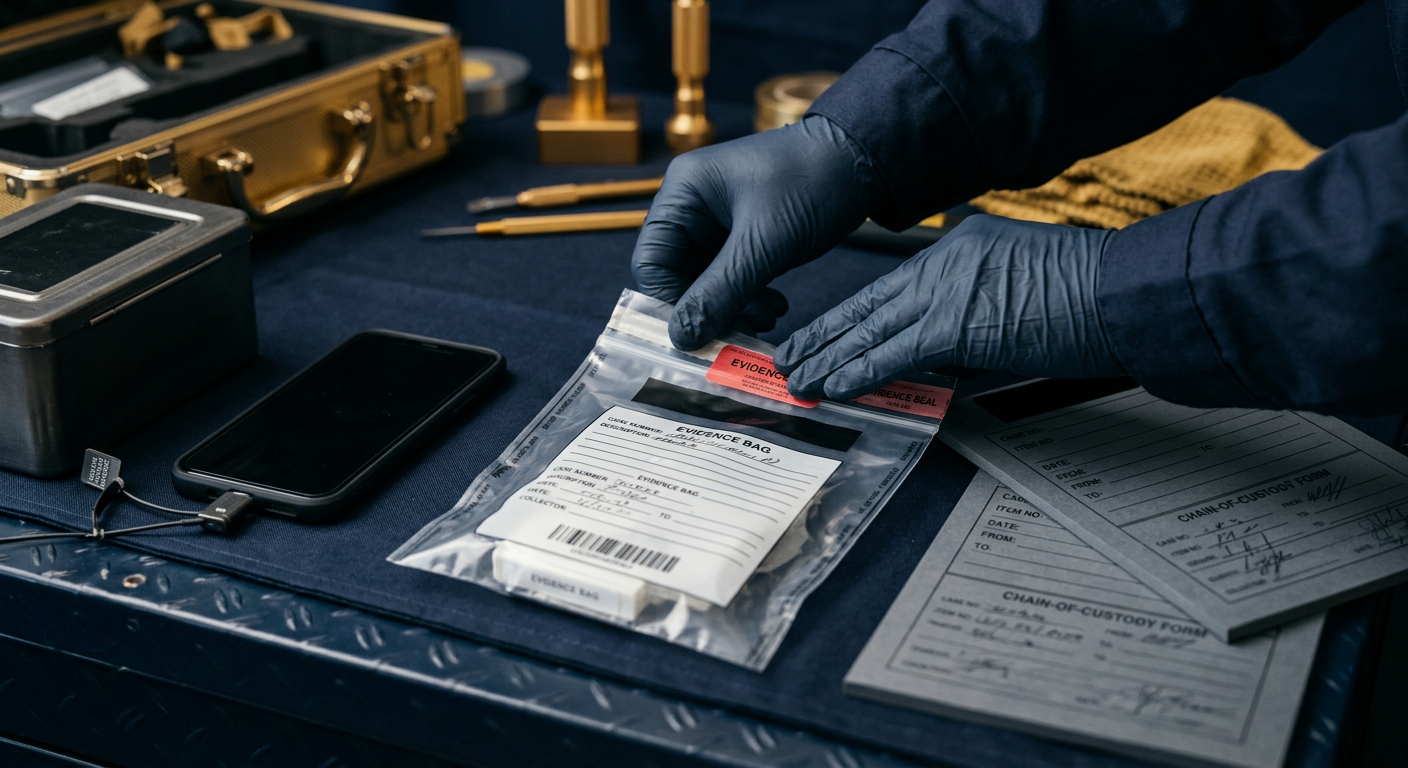
- Chain of custody. Every piece of evidence—a phone, a drive, a video card, a document—should be logged, sealed, and tracked from collection to production. Ask to see a sample custody form.
- Forensic soundness. Digital evidence should be acquired with validated tools and preserved as a verifiable image, never altered on the original. Hash values should confirm integrity.
- Legality of collection. Surveillance from public vantage points, lawful consent for recordings, and no pretexting for protected financial or phone records. A method that would embarrass you in court is worthless.
- Corroboration. Findings should be cross-verified across sources—field observation confirmed by digital or documentary evidence—so no single point can be dismissed.
- Reporting and testimony. A written, exhibit-ready report with timestamps, and investigators prepared to authenticate their work if the matter is litigated.
A firm that cannot describe its methodology in these terms is not disciplined; it is lucky. Luck does not survive cross-examination.
What is the 9-point framework for vetting an Arizona investigator?
Use this sequence before you sign an engagement letter. It takes one conversation and screens out most of the market.
- Confirm the AZ DPS license—agency number, qualifying party, active status, insurance.
- Match specialization to the case—does the firm hold the disciplines your matter actually needs?
- Ask about in-house vs. outsourced work—who touches the evidence, and does it stay under one chain of custody?
- Demand a methodology walkthrough—chain of custody, forensic soundness, legality, corroboration.
- Review a redacted sample report—clarity, exhibits, and testimony-readiness reveal the true standard.
- Clarify communication cadence—who is your point of contact, how often you’ll be updated, and in what format.
- Get scope and pricing in writing—hourly vs. flat, expenses, and what defines completion.
- Confirm conflict and confidentiality controls—conflict checks, secure data handling, privileged coordination with counsel.
- Test for realistic expectations—a professional frames probabilities, not guarantees.
What are the red flags that signal an amateur?
Certain behaviors reliably predict a poor outcome. Treat any of the following as a reason to walk away. An investigator who guarantees a specific result—”I’ll get you the proof”—either misunderstands the work or is willing to manufacture it. One who is vague about licensing, or who cannot produce an agency number, is disqualifying on its face. Cash-only arrangements with no written scope, no engagement letter, and no reporting standard signal an operator who leaves no accountable trail—which is exactly what you do not want representing your interests.
Be equally wary of investigators who casually offer to obtain protected records—bank statements, phone logs, or account details—without a subpoena or lawful basis. That is not sophistication; it is pretexting, and it is illegal. The same applies to anyone who proposes planting a tracker on a vehicle they have no authority to touch, accessing a device without consent, or trespassing to get a photograph. These shortcuts do not just risk exclusion of evidence; they can convert your investigation into your own legal exposure. A world-class firm’s first instinct is to protect the client from the very tactics an amateur sells as a competitive edge.
What questions should you ask before you sign?
The strongest signal of a professional is how they answer hard questions. Ask directly: What is your AZ DPS license number and who is the qualifying party? Which parts of this case will your own people handle, and which go to partners? How do you preserve chain of custody on digital evidence? Have your investigators testified, and will they authenticate this work if needed? What is your written scope, and what happens if the case expands? How will you communicate with me and with my attorney? A firm that answers these plainly, without deflection, is showing you the discipline it will bring to your matter.
Ask, too, about coordination with counsel. Serious investigations are frequently run under attorney direction to preserve privilege and ensure the work product is litigation-ready. An investigator who understands that dynamic—and volunteers it—is operating at a different level than one who treats the case as a standalone surveillance job.
Why does statewide Arizona coverage and national reach matter?
Arizona cases rarely respect city limits. A subject surveilled in Phoenix banks in Tucson, travels through Scottsdale, and holds an LLC registered out of state. A firm that only knows one metro area—or that cannot follow the evidence across jurisdictions—will lose the thread precisely when the matter gets interesting. Honeybadger Solutions operates statewide across Arizona from three offices—Casa Grande as central headquarters, Phoenix, and Oro Valley near Tucson—and extends nationwide and internationally through in-house remote capabilities and a commanded partner network. That footprint lets a single case team follow a matter from a Maricopa County surveillance detail to a multi-state financial trace without handing your file to strangers.
For most clients, the practical takeaway is simple: choose the firm whose reach matches where your problem actually lives, and whose home credential is unquestionable. In Arizona, that means a properly licensed local command with the technical depth to handle the digital and financial dimensions that now define modern investigations—and the judgment to keep every step defensible. Explore the firm’s investigations services, review the credentials on the About page, and see coverage across the Arizona service area. Matters that turn on devices or money benefit from integrated digital forensics and disciplined background intelligence.
Frequently asked questions
Do private investigators have to be licensed in Arizona?
Yes. Arizona requires private investigators to be licensed by the Arizona Department of Public Safety under A.R.S. Title 32, Chapter 24. Operating for hire without a license is a criminal offense. Always confirm the agency license number, the qualifying party, and active status before engaging any investigator.
How much does a private investigator cost in Arizona?
Pricing varies by scope and discipline. Surveillance is typically billed hourly plus expenses, while forensic, financial, and background work is often scoped as a defined project. Reputable firms provide a written engagement with scope, rates, and expense terms—never a vague cash arrangement or a guaranteed-result quote.
Will evidence from a private investigator hold up in court?
It will if it was collected lawfully and documented properly. Court-ready evidence depends on chain of custody, forensically sound acquisition, legal collection methods, and an investigator prepared to authenticate the work. Evidence obtained through trespass, unlawful recording, or pretexting can be excluded and may create liability.
Should my attorney hire the investigator instead of me?
Often, yes. Engaging an investigator through counsel can help preserve privilege and keep the work product aligned with litigation strategy. Experienced firms routinely coordinate with attorneys, structure reporting for legal use, and support depositions or hearings when a matter proceeds to court.
About Honeybadger Solutions
Honeybadger Solutions is an Arizona-licensed security and investigations firm serving all of Arizona, nationwide, and internationally. We deliver digital forensics, cybersecurity, financial investigations, and background intelligence in-house and remote-by-design, combine in-house and vetted field partners for investigations and surveillance, and command a vetted-partner network for protective and armed assignments (established theaters in California, Texas, and Florida; Arizona as home command). Three offices anchor our work: Casa Grande (headquarters), Phoenix, and Oro Valley. For a confidential consultation, visit our investigations and about pages. Authoritative. Precise. Discreet.
Authoritative Resources
Browse by topic
Security guard services · Private investigations · Cybersecurity · Digital forensics · Financial fraud investigation · Executive protection · All articles