
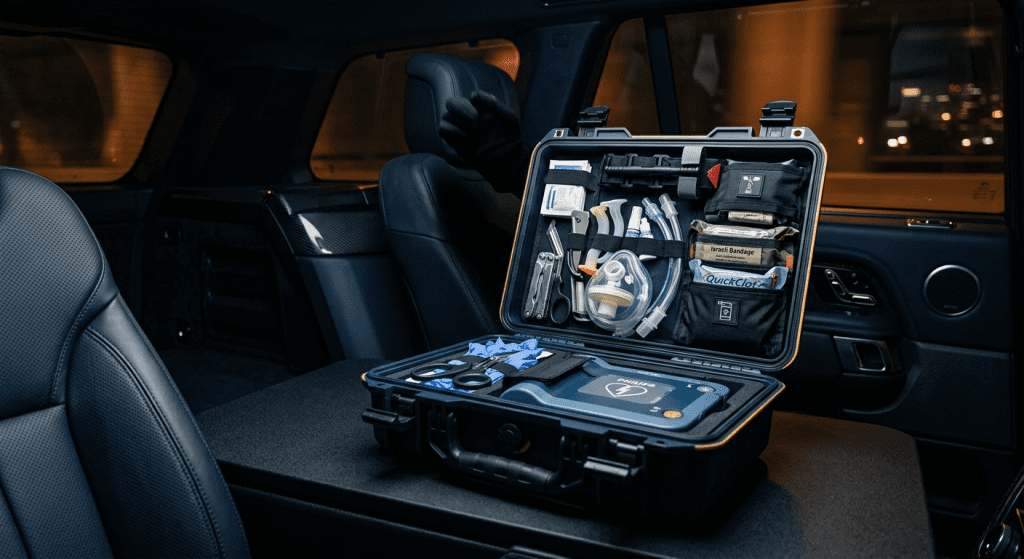

A protection detail that can only fight is protecting against the wrong threat. For most principals, a sudden cardiac event, stroke, anaphylaxis, or serious accident is far more probable than a targeted attack. Elite executive protection therefore integrates tactical and protective medicine — medically-trained agents, staged trauma equipment, and medical advance work — so a qualified first responder is already at the principal’s side in the minutes that decide the outcome.
The image of executive protection sold by film and by lesser vendors is a large individual in a dark suit, scanning for an assailant. That image is not wrong so much as it is dangerously incomplete. The men and women who guard heads of state, Fortune-500 chief executives, and ultra-high-net-worth families are trained to counter violence — but violence is the rare event. The common event is a medical one: a principal in his sixties collapses in a boardroom, a guest goes into anaphylaxis at a private dinner, a driver is injured in a highway collision, a diabetic principal’s condition destabilizes on a long-haul flight. In each case the deciding factor is not marksmanship. It is whether the person standing closest knows exactly what to do, has the right equipment within reach, and has already mapped the fastest route to definitive care.
This is the discipline that separates a bodyguard from a protection professional, and a commodity security vendor from a firm operating at the Crisis24, Pinkerton, or Kroll standard. At Honeybadger Solutions, medical capability is treated as a core protective function — not an afterthought, not a certificate on a wall, but a designed, drilled, and equipped competency held to a common standard across every protective engagement we command.
Why Is Medical Capability the Missing Half of Executive Protection?
The math of risk is unsentimental. Across a full year of protective coverage, the overwhelming majority of genuine threats to a principal’s life are medical and accidental, not adversarial. Sudden cardiac arrest alone claims hundreds of thousands of lives annually in the United States, and it does not consult a person’s calendar, net worth, or security posture. Add strokes, severe allergic reactions, choking, falls, vehicle accidents, and the acute complications of chronic conditions — the kinds of pressures a demanding executive schedule tends to amplify — and the picture is clear: a detail that has invested only in confrontation has prepared for the least likely scenario while leaving the most likely one uncovered.
The reason time is the master variable is physiological. In sudden cardiac arrest, the American Heart Association reports that survival falls by roughly seven to ten percent for every minute that passes without CPR and defibrillation. In severe hemorrhage, a person can bleed out in a matter of minutes. In stroke, the window in which intervention preserves brain function is measured in a small number of hours, and every minute of delay costs viable tissue. Emergency medical services in a well-served metropolitan area may take eight to twelve minutes to arrive — longer in a rural setting, at a remote estate, or abroad. The protection agent is, by position, the first responder. What that agent does in the interval before EMS arrives frequently determines whether the principal survives, and whether they recover fully or not at all.
Understood this way, medical readiness is not a soft complement to “real” security. It is the part of the mission most likely to be tested. A protector who can neutralize a threat but cannot manage an airway, control a bleed, or run a code until paramedics arrive is solving a small fraction of the problem they were hired to solve.
What Is Tactical and Protective Medicine, and How Does It Differ From First Aid?
Consumer first-aid training teaches a bystander to help until professionals arrive. Protective medicine is a different discipline: it prepares a security professional to deliver time-critical, stabilizing care in uncontrolled, sometimes hostile environments, while simultaneously maintaining the security mission. Its foundations come from Tactical Combat Casualty Care (TCCC), the battlefield-proven framework developed for military medics and now adapted for law enforcement and civilian protection, alongside civilian CPR and automated external defibrillator (AED) certification.
The distinction matters because a principal’s emergency rarely occurs in a clean, calm room. It happens in a moving vehicle, on a crowded stage, in a foreign hotel, or in the immediate aftermath of the very incident the detail was guarding against — an accident, an assault, an evacuation. Protective medicine trains the agent to prioritize catastrophic hemorrhage, airway, and breathing under pressure; to improvise with what is on hand; to move a casualty to safety while treating them; and to hand off cleanly to EMS with a coherent account of what happened and what was done. It is care delivered by someone who is also responsible for the scene’s security — a fundamentally harder problem than first aid in a quiet office.
| Dimension | Bodyguard-Only Detail | Medically-Integrated Protection |
|---|---|---|
| Primary threat modeled | Targeted violence (rare) | Medical, accidental, and violent events (full spectrum) |
| Agent qualification | Physical/firearms focus | CPR, AED, and TCCC-based trauma competency |
| Equipment carried | Communications, defensive tools | Trauma kit, tourniquets, airway tools, AED, hemostatics |
| Advance work | Routes and access control | Routes plus nearest trauma centers, hospitals, blood supply |
| First-responder window | Wait for EMS | Immediate stabilizing intervention on scene |
| Coordination with EMS | Ad hoc | Structured handoff, documentation, medical liaison |
The right-hand column is not a premium upgrade. It is what the word “protection” is supposed to mean. Our executive protection standard is built on the premise that the detail should be equally prepared for the emergency the principal is statistically most likely to face.
What Does Medical Advance Work Actually Involve?
Elite protection is won in the advance — the reconnaissance and planning that happens before the principal ever arrives. Most people understand the security half of advance work: surveying venues, mapping ingress and egress, controlling access, identifying choke points. Fewer appreciate that a world-class advance is also a medical advance. The team that plans the motorcade route is the same team that must answer, before anyone travels, a single question: if the worst happens here, where do we go, and how fast can we get there?
A thorough medical advance identifies the nearest Level 1 and Level 2 trauma centers, cardiac-capable hospitals, and stroke-certified facilities at every destination and along every route — not the closest hospital on a map, but the closest one actually equipped to treat the emergency in question. It confirms which facilities are open, which have the relevant specialty coverage at the relevant hours, and how a principal would be routed there under traffic. For international travel it extends to the quality and reliability of local emergency medicine, the availability of medical evacuation, and the location of facilities that meet a Western standard of care. It accounts for the principal’s known conditions, medications, allergies, and blood type, held with strict confidentiality. Done properly, the destination hospital is chosen before the trip, not searched for during the crisis.

This is the same disciplined, intelligence-led planning we apply across our practice. Just as our protective intelligence analysts assess the human threat environment before a principal moves, the medical advance assesses the care environment. The two are not separate workflows; they are one integrated plan, because in a real emergency the security decision and the medical decision are made in the same breath.
How Are Protection Agents Medically Trained and Equipped?
Medical capability is not a claim to be made in a proposal; it is a standard to be demonstrated and drilled. The framework below defines the medical readiness we require across the protective engagements we command, and it is a useful checklist for any principal or family office evaluating a provider.
- Certified baseline competency. Every protection agent holds current CPR and AED certification and is trained in TCCC-based trauma principles — control of catastrophic bleeding, airway management, and breathing — so stabilizing care begins immediately, not on EMS arrival.
- Staged, professional-grade equipment. Details and vehicles carry trauma kits appropriate to cardiac, hemorrhagic, and airway emergencies: tourniquets, hemostatic dressings, airway adjuncts, and an AED where feasible. Equipment is inventoried, in-date, and positioned for reach, not stowed and forgotten.
- Scope discipline. Agents operate strictly within their training and licensure. They stabilize; they do not practice medicine beyond their scope. The objective is to preserve life and function until qualified medical professionals take over — cleanly and without ego.
- Medical advance and hospital selection. Before movement, the team maps trauma centers, cardiac and stroke facilities, and evacuation options for every location and route, tailored to the principal’s medical profile.
- Rehearsal under realistic conditions. Medical response is drilled alongside security contingencies — man-down scenarios, evacuation with a casualty, and structured EMS handoff — so the detail executes from muscle memory when seconds are scarce.
- Discreet documentation and continuity. Incidents are documented appropriately and privately, the family and any treating physicians are coordinated with, and confidentiality over the principal’s health information is absolute.
Held to this standard, medical readiness stops being a marketing phrase and becomes an auditable capability. When a principal or general counsel evaluates protective services, these six items are a more honest measure of quality than the size of the agents or the make of the vehicles.
Why Does Travel Multiply Medical Risk for Principals?
Travel is where the medical dimension of protection is stressed hardest, and where under-prepared details are most exposed. A principal at home is minutes from familiar, high-quality care and their own physicians. The same principal on the road is subject to time-zone disruption, dehydration, long periods of immobility that elevate clot risk, disrupted medication schedules, unfamiliar food that can trigger allergic or gastrointestinal events, altitude, heat, and infectious-disease exposure — all while further from a hospital they know and trust.
International movement compounds every one of these factors. Emergency-care quality varies enormously by country; the nearest hospital may lack the specialty capability, the blood supply, or the standards a principal’s condition requires. Language barriers slow triage. Medications available at home may be restricted or counterfeit abroad. For these reasons, serious protective planning for travel incorporates traveler health guidance and, for higher-risk destinations, pre-arranged medical evacuation and access to vetted, Western-standard facilities. Public resources such as the U.S. Centers for Disease Control and Prevention’s traveler health program inform the baseline, but a principal’s plan is bespoke — built around their specific medical profile, itinerary, and risk tolerance, and held in strict confidence.
The point is not to make travel frightening. It is to make it managed. A family that knows the evacuation plan, the receiving facility, and the medically-trained team traveling with them can move through the world with genuine peace of mind rather than the false comfort of a detail that has planned for everything except the likeliest emergency.
How Does Honeybadger Deliver This Standard Nationally and for UHNW Families?
Honeybadger Solutions commands executive protection through a vetted-partner network held to a single, uncompromising standard — and medical readiness is written into that standard, not left to chance. Our established partner-delivered protective theaters are California, Texas, and Florida, with Arizona as our home command; engagements in other jurisdictions are undertaken on a mandate basis, coordinated centrally so the quality bar never moves. Whether a principal is protected in Los Angeles, Houston, Miami, or Phoenix, the requirement is the same: agents who are medically trained, equipped, and rehearsed to function as the first responder they are statistically most likely to become.
For ultra-high-net-worth families, executives, and public figures, this integrated posture matters even more, because the consequences of a mishandled incident extend beyond the medical to the reputational and the legal. Our protective work connects to the wider capabilities of the firm — protective intelligence and advance planning, our remote-by-design security consulting for household and travel risk, and background intelligence on the people entering a principal’s orbit. The result is a protective program in which the medical, the physical, and the intelligence functions operate as one, so that when something goes wrong — and eventually, for a busy life, something will — the right help is already at arm’s reach, and the right plan is already in motion.
Our philosophy is stated plainly: protect the principal’s life in every sense of the word. That means the discipline to counter a threat and the competence to run a code, control a hemorrhage, and get a principal to definitive care before the golden hour closes. Anything less is a bodyguard. What a serious family, board, or general counsel should demand is protection.
Frequently Asked Questions
Why does an executive protection agent need medical training?
Because the most probable threat to a principal is medical, not violent. Cardiac events, strokes, severe allergic reactions, and accidents are far more common than targeted attacks, and the protection agent is, by position, the first responder. Immediate CPR, defibrillation, and hemorrhage control in the minutes before EMS arrives frequently determine whether the principal survives and fully recovers.
What is the “golden hour” in executive protection?
It refers to the critical early window after a serious medical or traumatic event in which rapid, correct intervention dramatically improves survival and recovery. In sudden cardiac arrest the American Heart Association reports survival falls roughly 7 to 10 percent per minute without CPR and defibrillation. Trained agents, staged trauma equipment, and pre-planned hospital routing exist to protect that window.
Do medically-trained agents replace paramedics or doctors?
No. Agents operate strictly within their training and licensure. Their role is to deliver immediate, stabilizing care — bleeding control, airway support, CPR and AED use — and to move the principal safely until EMS and hospital specialists take over. They document the incident, coordinate a clean handoff, and never practice medicine beyond their scope.
Does Honeybadger provide executive protection outside Arizona?
Yes. Protective services are commanded through a vetted-partner network with established partner-delivered theaters in California, Texas, and Florida, and Arizona as our home command; other jurisdictions are served on a mandate basis under the same standard. Our in-house intelligence, digital forensics, and consulting capabilities are remote-by-design and support principals nationwide and internationally.
About Honeybadger Solutions
Honeybadger Solutions is an Arizona-licensed security and investigations firm serving executives, families, and institutions across all of Arizona, nationwide, and internationally. Our in-house, remote-by-design capabilities span protective intelligence, digital forensics, cybersecurity, financial investigations, and background intelligence. Executive protection is commanded through in-house leadership and a vetted-partner network with established partner-delivered theaters in California, Texas, and Florida, and Arizona as home command. We maintain three Arizona offices — Casa Grande (headquarters), Phoenix, and Oro Valley.
When protection has to include the emergency your principal is most likely to face, medical readiness is not optional. Speak with our team confidentially at Book a consultation online. Learn more about our executive protection services. Authoritative references: American Heart Association CPR & ECC, NAEMT Tactical Combat Casualty Care, and CDC Travelers’ Health.
Browse by topic
Security guard services · Private investigations · Cybersecurity · Digital forensics · Financial fraud investigation · Executive protection · All articles