
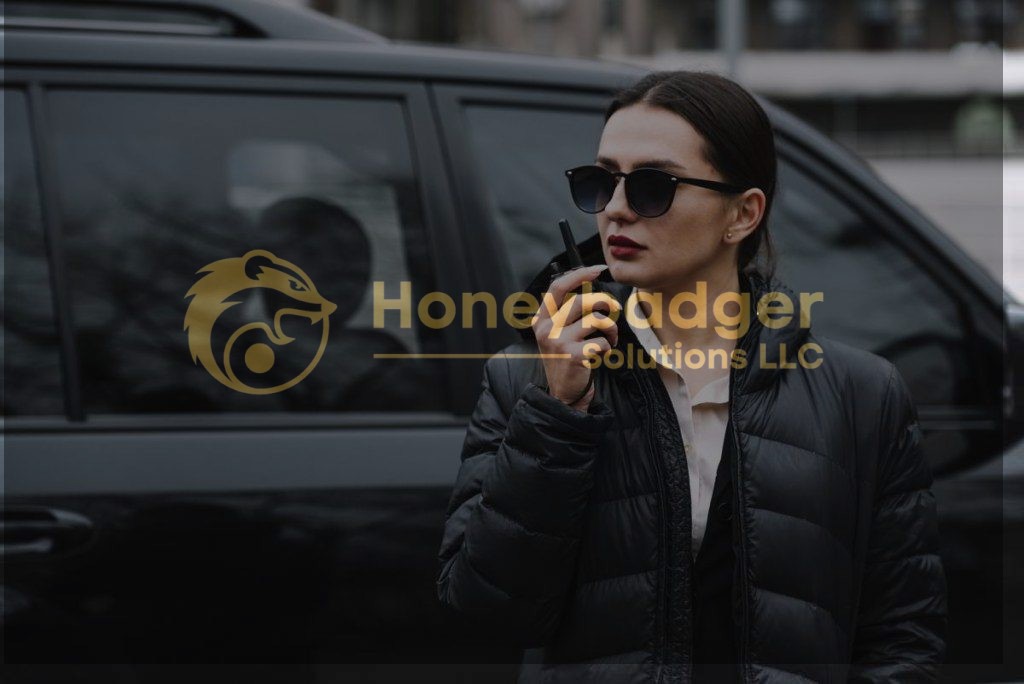

Female executive protection agents deliver a decisive operational advantage: they provide close, low-profile coverage in spaces male agents cannot appropriately enter, integrate invisibly into family and social settings, and often de-escalate threats before force is ever required. For UHNW principals, executives, and public-facing clients, a well-deployed female agent is not a diversity gesture — it is superior threat management.
When most people picture a bodyguard, they imagine a 6’4″ man in a dark suit and an earpiece. That image sells movies. It does not describe how the world’s most exposed people are actually protected. At the elite tier of executive protection (EP), effectiveness is a function of awareness, judgment, access, and the ability to end a problem before it begins — not shoulder width. This is precisely why the most sophisticated protective programs treat female agents as a core capability rather than a specialty add-on, and why Honeybadger Solutions builds mixed-gender details around the mission, not the myth.
Why do sophisticated principals request female protection agents?
The demand is driven by a hard operational reality: the visible bodyguard is often the weakest form of protection. A protector who signals “high-value target here” invites the exact attention a principal is paying to avoid — from opportunistic criminals, stalkers, aggressive media, and hostile surveillance teams alike. The objective of world-class EP is to be present everywhere the threat could materialize while appearing to be nowhere at all. Female agents expand the number of environments where that invisibility is achievable.
For a principal, a female agent frequently reads as an assistant, a colleague, a friend, a nanny, or simply another guest. That single fact changes the geometry of a protective operation. It closes coverage gaps that an all-male detail is structurally unable to close, and it does so while lowering the principal’s profile rather than raising it.
What access do female agents provide that a male detail cannot?
Protective coverage is only as strong as its weakest transition point — and for many principals, the highest-risk moments occur in precisely the spaces a male agent cannot follow. Security does not always mean standing out; sometimes the safest posture is remaining unseen and immediately adjacent. A female agent can maintain arm’s-length coverage of a female principal through environments where a man’s presence would be inappropriate, unwelcome, or outright barred:
- Spas, wellness retreats, and treatment rooms
- Fitting rooms, boutiques, and personal-shopping suites
- Women’s restrooms and locker facilities
- Medical, OB/GYN, fertility, and cosmetic appointments
- Salon chairs, bridal suites, and private social gatherings
- Religious and cultural spaces that separate by gender
These are not trivial errands. They are recurring, scheduled, predictable movements — exactly the pattern-of-life data a hostile actor exploits. A stalker who knows a principal’s standing spa appointment has a fixed point of vulnerability. Placing a trained protective agent inside that space, rather than posting a man conspicuously outside the door, converts a blind spot into a covered position. The principal feels protected, not followed.
How do female agents protect families and children?
Family protection is one of the most demanding disciplines in EP, because the mission is not only to keep principals safe but to preserve a sense of normalcy — especially for children who should not grow up feeling surveilled. Overt security can be frightening and stigmatizing to a child; it also broadcasts the family’s status to every other parent, staff member, and observer at a school or activity.
A female protective agent frequently integrates into the household ecosystem with far less friction — presenting naturally in the roles that surround a family: assistant, tutor, family staff, or trusted travel companion. That low-visibility footprint reduces unwanted attention at school drop-off, extracurriculars, and social events, while allowing the agent to build genuine rapport with children who are more likely to follow calm instructions from someone they trust in a crisis. The protective posture is fully intact; the packaging simply does not alarm a seven-year-old or announce the family to the carpool line.

Are female agents a threat-management advantage, or only an access advantage?
Both — and the threat-management dimension is the one most often underestimated. The overwhelming majority of protective incidents are resolved not through physical force but through detection, avoidance, and de-escalation. Elite protection is measured by the confrontations that never happen. In this arena, communication and situational diplomacy are primary weapons, and skilled female agents are frequently exceptional at deploying them.
Consider the tactical texture of real exposure. An aggressive individual approaching a principal will often calibrate his behavior differently when the person managing the interaction does not present as a physical challenge to be met head-on. A composed, verbally adept agent can absorb, redirect, and defuse an encounter that a wall of muscle might inadvertently escalate. In crowd management, unwanted-attention scenarios, domestic-adjacent disputes, and sensitive social dynamics, the ability to lower the temperature is worth more than the ability to raise it. Female agents also expand a detail’s counter-surveillance capability: a two-person male-and-female team reads as a couple, dramatically improving the ability to work a follow, hold a fixed observation post, or blend into a venue without tripping a hostile surveillant’s pattern recognition.
None of this trades away hard capability. Protective work is a professional discipline built on medical training, advance planning, defensive driving, weapons proficiency where lawful and warranted, and rehearsed emergency response. The point is not soft skills instead of hard skills — it is the full protective skill set delivered through a profile that opens doors and closes gaps.
Male vs. female vs. mixed detail: which configuration fits the mission?
There is no universally “better” agent — there is only the right configuration for a specific principal, threat picture, and lifestyle. A disciplined risk assessment drives the composition of the detail. The table below frames how elite programs think about it.
| Scenario / Requirement | Best-fit configuration | Why |
|---|---|---|
| Female principal with private-space routines (spa, medical, fitting) | Female lead agent | Maintains arm’s-length coverage into gender-restricted environments |
| Family with young children | Female agent integrated with household | Low-profile presence, child rapport, no stigma |
| High-visibility deterrence (event door, motorcade optics) | Overt agent(s), often male | Visible deterrent posture is the intended signal |
| UHNW couple traveling together | Mixed detail | Covers both principals across all environments; reads as companions |
| Covert follow / counter-surveillance | Mixed male-female team | “Couple” cover defeats surveillance pattern recognition |
| Elevated kidnap/assault threat, hostile environment | Layered mixed detail + advance | Depth, redundancy, and access across every transition |
The recurring conclusion at the top of the market is that a mixed detail is frequently optimal. It gives a protective operation the full spectrum: overt deterrence when a visible posture is warranted, covert access when invisibility matters more, and seamless coverage of principals of any gender across every environment in a day — from a boardroom to a school run to a black-tie gala.
How should you evaluate and deploy female protective agents? A 7-point framework
Deploying female agents effectively is a matter of methodology, not tokenism. The following framework mirrors how a professional program scopes and stands up coverage.
- Start with the threat and vulnerability assessment. Map the principal’s pattern of life, exposure, and adversary profile before deciding who staffs the detail.
- Identify the access-critical environments. List every space in a typical week where coverage could break down for gender reasons — those points often mandate a female agent.
- Verify credentials, not optics. Confirm licensing, protective training, medical certification, driving qualification, and armed authorization where applicable. The bar is identical regardless of gender.
- Match profile to lifestyle. The agent must plausibly inhabit the principal’s world — corporate, social, family, or luxury — without friction.
- Build the advance. Route surveys, venue liaison, medical-facility identification, and safe-room planning are performed before movement, not improvised.
- Configure the detail deliberately. Decide overt vs. covert, single-agent vs. mixed team, based on threat and environment — and be ready to flex within a single day.
- Rehearse and review. Emergency action plans, communication protocols, and after-action reviews turn a group of qualified individuals into a functioning detail.
Where does cultural versatility change the outcome?
Global principals move through settings where the wrong protective posture is not just conspicuous — it is offensive, obstructive, or disqualifying. Many cultural, diplomatic, religious, and international environments draw sharp lines around who may accompany a woman, enter a family space, or stand close during a private engagement. In those settings a female agent is frequently the only configuration that permits genuine coverage rather than a protector left waiting at a threshold. The same versatility applies to Western contexts where discretion is currency: a female agent can hold a position at a fashion show, a wellness retreat, a hospital ward, a girls’ school, or an intimate dinner without becoming the story.
This adaptability is why elite programs prize female agents for assignments demanding social fluency, cultural sensitivity, and low visibility. They deliver comprehensive protection across schools, corporate offices, medical facilities, social events, and international travel without disrupting the principal’s personal or professional life — the definition of protection that works with the client rather than against them.
What separates a world-class protective program from a mediocre one?
The difference is rarely visible in a calm moment — it surfaces the instant something goes wrong. Mediocre providers sell presence: a warm body in a suit, hired by height. Elite providers sell outcomes engineered before the principal ever leaves the residence. The distinction shows up in a handful of decision criteria and cost drivers that sophisticated buyers learn to interrogate:
- Advance work. World-class details survey routes, venues, medical facilities, and exits in advance; mediocre ones react on arrival. Advance planning is where most incidents are quietly prevented — and it is a major, legitimate cost driver.
- Intelligence integration. Elite protection is fused with background intelligence and threat monitoring so a detail knows who and what to watch for; weaker programs are blind past arm’s reach.
- Credentialing depth. Verified licensing, protective and medical training, driving qualification, and lawful armed authorization — for every agent, of any gender — versus unvetted labor.
- Configurational discipline. The ability to flex between overt and covert, single-agent and mixed detail, within one day, based on threat and environment.
- Discretion as doctrine. A commitment to protecting the principal’s privacy, reputation, and normal life — not just their body.
Judged against these criteria, the presence of qualified female agents is a reliable signal of a serious program. A provider that cannot field them is, by definition, unable to cover a meaningful share of a principal’s week.
How does Honeybadger Solutions deliver protective coverage nationwide?
Honeybadger Solutions is an Arizona-licensed security and investigations firm serving clients across all of Arizona, nationwide, and internationally. Our home command is in Arizona, with offices in Casa Grande, Phoenix, and Oro Valley. Physical and executive protection are delivered through a vetted-partner network under our command and standards, with established operational theaters in California, Texas, and Florida and mandate-driven coverage elsewhere. Every partner agent is vetted against the same credentialing, training, and conduct requirements we apply to our own personnel.
That model matters for female protective coverage specifically. Because we command a network rather than a fixed roster, we can match the right agent — including experienced female agents — to the principal, the environment, and the threat, then wrap the detail in the intelligence backbone that makes protection proactive: investigations, background intelligence on individuals of concern, and continuous threat intelligence. Where a case involves digital stalking, doxxing, or device compromise, our in-house digital forensics and cybersecurity capabilities close the loop between physical and online exposure. Explore our full security services to see how the pieces integrate.
The representative scenarios throughout this article illustrate common protective challenges and are not accounts of specific clients or engagements. Every principal’s program is scoped confidentially to their unique risk picture.
Frequently asked questions
Are female executive protection agents as capable as male agents?
Yes. Professional EP is a skill-based discipline built on training, judgment, medical readiness, and rehearsed response — not physical size. Qualified female agents meet the same licensing, protective-training, and conduct standards, and they add access and de-escalation advantages that expand what a detail can cover.
When is a mixed-gender detail the right choice?
A mixed detail is often optimal when a principal moves through many environments in a day, when a couple or family travels together, or when covert coverage and counter-surveillance matter. It delivers both overt deterrence and low-profile access, and it covers principals of any gender in every space without gaps.
Can female agents be armed?
Where lawful, warranted by the threat assessment, and supported by proper licensing and firearms qualification, protective agents may be armed regardless of gender. Armed posture is a mission decision driven by risk and jurisdiction, not by the agent’s profile.
Does Honeybadger provide female protection agents nationwide?
Yes. From our Arizona home command, we deploy protective details through a vetted-partner network with established theaters in California, Texas, and Florida and mandate-driven coverage elsewhere. Book a consultation online for a confidential assessment matched to your principal, environment, and threat picture.
About Honeybadger Solutions
Honeybadger Solutions is an Arizona-licensed security and investigations firm providing executive protection, investigations, background intelligence, digital forensics, and cybersecurity to executives, UHNW families, and organizations across Arizona, nationwide, and internationally. We command a vetted-partner protective network with established theaters in California, Texas, and Florida, anchored by three Arizona offices: Casa Grande (HQ), Phoenix, and Oro Valley. For a confidential protective consultation, book a consultation online.
Authoritative references: the ASIS International professional-security standards community and CISA guidance on personal and physical security.
Browse by topic
Security guard services · Private investigations · Cybersecurity · Digital forensics · Financial fraud investigation · Executive protection · All articles