


Secure transportation is protective operations on wheels, not premium chauffeuring. It fuses route intelligence, advance reconnaissance, hardened or armored vehicle selection, and drivers trained in evasive handling and threat recognition to move a principal from origin to destination while controlling the single most exposed phase of any protective detail. The objective is not comfort or speed — it is arriving calm, arriving safely, arriving alive.
Anyone can drive a black SUV. Very few can operate one intelligently when the environment turns hostile — an aggressive tail through downtown traffic, a staged breakdown blocking a chokepoint, a crowd surging at a hotel entrance, or a medical emergency in a moving vehicle forty minutes from a trauma center. For an executive, a general counsel, or an ultra-high-net-worth principal, the drive is statistically and operationally the most dangerous part of the day. It is where the protectee is confined, predictable, and surrounded by variables no one controls. That is precisely why secure transportation is a distinct discipline, and why the firms that treat it as a car service get people hurt.
What Is the Difference Between Secure Transportation and a Limo Service?
A chauffeur delivers a pleasant ride. A security driver delivers a survivable one. The chauffeur optimizes for punctuality and presentation; the security driver optimizes for the outcome when something goes wrong — and builds every decision, from the route to the parking position, around that contingency. The two look similar from the curb. Under pressure, they are not remotely the same profession.
| Dimension | Limo / Chauffeur Service | Secure Transportation |
|---|---|---|
| Primary objective | Comfort, punctuality, presentation | Risk reduction and survivability of the principal |
| Route | Fastest or most scenic path | Primary + alternates, chokepoint analysis, safe-haven mapping |
| Driver training | Livery license, clean record | Evasive/defensive driving, threat recognition, emergency medical, comms |
| Vehicle | Luxury finish | Mechanically vetted platform; armored where warranted, kept discreet |
| Pre-movement | Confirm pickup time | Advance work, venue recon, arrival/departure staging |
| When it fails | You are late | You are trained and equipped to break contact and reach safety |
The distinction matters because attackers, stalkers, and opportunists study patterns. A predictable route driven by an untrained operator in an unremarkable sedan is a soft target. A varied route, run by a driver who recognizes surveillance and knows how to respond, in a vehicle ready to move under pressure, is a hard one. Deterrence lives in that gap.
Why Is the Vehicle the Most Vulnerable Point in a Protective Detail?
Protective doctrine has long recognized that movements — not residences or offices — are where principals are most exposed. Inside a vehicle the protectee is fixed in space, on a schedule, and channeled onto known roads. Ingress and egress points — the moment of getting into and out of the car — concentrate that exposure further. Historically, a disproportionate share of attacks on protected persons has occurred during transit or at the arrival/departure interface, which is why elite programs invest their planning energy precisely there.
Secure transportation answers that exposure with three layers working together: the operator, the platform, and the plan. Weakness in any one collapses the other two. A superb driver in an unreliable vehicle on an unplanned route is still exposed. An armored vehicle driven by someone who cannot recognize a follow car is a false sense of security. World-class execution treats all three as a single system.
What Separates a Trained Security Driver From a Chauffeur?
The operator behind the wheel is the discipline. A security driver is selected and trained against a standard a livery service never approaches, because the skill set is measured by what happens in the worst two minutes, not the routine two hours.
- Advanced vehicle handling: Control at the limits of traction — threshold and trail braking, weight transfer, precision reversing, and low-speed maneuvering in tight, congested environments where most real incidents actually occur.
- Threat recognition and counter-surveillance awareness: Reading traffic for the follow car, the staged obstacle, the person who does not belong — and distinguishing genuine indicators from noise without over-reacting.
- Situational awareness and chokepoint discipline: Continuous scanning of intersections, on-ramps, tunnels, and pinch points; keeping a reactionary gap to the vehicle ahead so the car is never boxed in at a stop.
- Emergency response: Basic trauma and medical response, fire and extraction familiarity, and the composure to execute a rehearsed break-contact drill rather than freeze.
- Communication and coordination: Working in sync with a close protection team and an operations center so movements stay discreet, tracked, and adaptable in real time.
The result is a driving style built on safety, discretion, and preparedness — never speed or theatrics. The best security drivers are invisible. Nothing about the ride signals that anything unusual is happening, right up until the instant it needs to.
How Do You Select and Armor the Right Vehicle?
The vehicle is a rolling safety platform, and platform selection is a risk decision, not a taste decision. For most executive movements, a well-maintained, mechanically vetted modern SUV — discreet, common to its environment, and reliable — is the correct answer. Reliability is a security attribute: a vehicle that will not start or stalls under load is a liability at exactly the wrong moment.
For elevated-risk principals or environments, armored vehicles are sourced with an appropriate ballistic protection rating while keeping the exterior visually unremarkable. Armoring is specified to the threat — handgun, high-power rifle, or fragmentation — under recognized standards, and always with an honest accounting of the trade-offs. Every layer of protection adds weight, which changes braking distance, handling, and tire load, and which is why an armored car in untrained hands can be more dangerous than an unarmored one. Discretion is deliberate: the goal is a vehicle no observer looks at twice, protection that is felt only if it is ever needed.
Selection criteria we weigh for every movement:
- Threat level: Does the risk picture justify armor, and to what rating? Under-armoring is exposure; over-armoring is wasted mobility and money.
- Environment fit: Does the vehicle blend with local traffic, or does it announce the principal?
- Mechanical readiness: Documented maintenance, fuel discipline, tire and brake condition, and redundancy for long or remote legs.
- Capacity and configuration: Seating for principal, protection team, and — where the profile warrants it — a follow vehicle or motorcade posture.
- Egress capability: Can the vehicle move immediately from any staged position without a three-point turn in a kill zone?
Why Does Advance Work and Route Intelligence Decide the Outcome?
Secure transportation is won before the wheels ever move. Advance work — the quiet, unglamorous reconnaissance that happens hours or days ahead — is where risk is actually removed. By the time the principal steps into the car, the hard problems have already been solved on paper and on the ground.
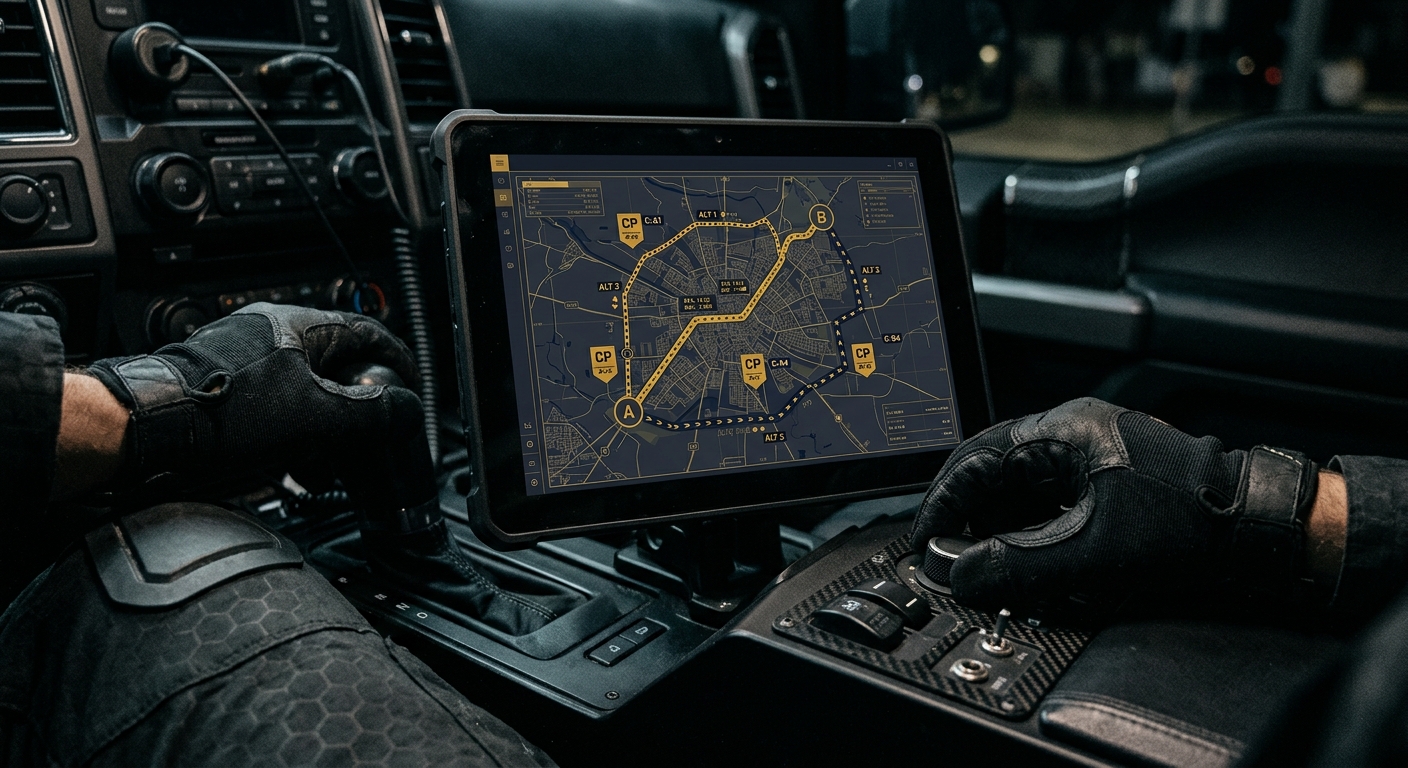
Route intelligence begins with mapping primary and alternate paths, then studying each for chokepoints, single points of failure, construction, event congestion, and the locations of hospitals, police stations, and other safe havens along the way. Timing is analyzed against traffic and predictability — varying routes and departure windows denies a hostile actor the pattern they need. Arrival and departure points receive the most scrutiny, because that is where the principal is most exposed: the advance confirms staging positions, secure entrances, and how the vehicle will be positioned for an immediate departure rather than trapped nose-in against a curb.
A disciplined pre-movement sequence looks like this:
- Risk assessment: Establish the principal’s threat profile, itinerary sensitivity, and any known concerns before planning begins — informed where appropriate by protective intelligence.
- Route and venue advance: Physically or virtually walk primary/alternate routes and arrival venues; identify chokepoints, safe havens, and staging.
- Vehicle and equipment check: Mechanical inspection, fuel, comms, medical kit, and a pre-movement walk-around of the vehicle.
- Live monitoring: Track the movement in real time with an operations center or coordinated protection team, adjusting for traffic and emerging conditions.
- Secure arrival and departure: Controlled pickup and drop-off procedures, with the vehicle always positioned to leave.
- After-action review: Debrief anomalies to sharpen the next movement.
When Do You Need a Single Vehicle Versus a Motorcade?
Most executive protection movements are single-vehicle operations — discreet, efficient, and appropriate to the threat. A follow vehicle or full motorcade posture is reserved for elevated risk: credible threats, hostile or unfamiliar environments, large public events, or principals whose profile draws crowds. A motorcade adds a security vehicle to absorb and respond to threats, provide additional protection personnel, and give the principal’s car a screen — but it also increases visibility and complexity, which is why it is a deliberate decision driven by the risk assessment, not a default. The right answer is always the minimum footprint that adequately manages the assessed threat. Discretion is a security asset, and over-visible protection can create the very attention it is meant to avoid.
How Are Airport Arrivals and High-Risk Transitions Handled?
Airports and other public transitions compress every vulnerability into a small space: fixed schedules, dense crowds, controlled and predictable pathways, and a principal who is fatigued and carrying luggage. These transition points — curbside pickups, private terminal (FBO) movements, hotel entrances — demand advance coordination. That means confirming the arrival gate or FBO, staging the vehicle for a clean and immediate link-up, minimizing the exposed walking distance, and coordinating with venue or aviation security so the handoff between aircraft, terminal, and vehicle is seamless. For international and cross-country travel, secure transportation is coordinated as one continuous chain rather than disconnected local pickups, so there is no unmanaged gap between legs. The transition from one secure environment to another is where details are won or lost.
How Does Honeybadger Solutions Deliver Secure Transportation Nationally?
Honeybadger Solutions provides secure transportation and protective driving through a commanded, vetted-partner network built for national and ultra-high-net-worth demand. Arizona is our home command — with offices in Casa Grande (HQ), Phoenix, and Oro Valley — and we run established partner-delivered executive-protection and secure-driving theaters in California, Texas, and Florida, with the ability to stand up capability elsewhere as a mandate. Every partner operator is selected, vetted, and coordinated to a single standard, so a principal moving between markets experiences one program rather than a patchwork of local vendors.
Around the physical movement sits the firm’s global, in-house capability — investigations, background intelligence, digital forensics, and cybersecurity — which lets protective planning draw on real intelligence about threats, venues, and persons of interest rather than assumptions. Secure transportation is not a limo service. It is the disciplined management of your most exposed hours, executed so quietly that, on a good day, you never notice it working at all.
Frequently Asked Questions
Is secure transportation the same as hiring a bodyguard?
No. Secure transportation focuses on the movement phase — the driver, the vehicle, and the route — while close protection covers the principal on foot and at venues. They are complementary. Many details combine a security driver with a protection team, and the two are coordinated as one plan through a shared operations picture.
Do I need an armored vehicle?
Only if the threat assessment justifies it. For many executives, a mechanically vetted, discreet SUV with a trained security driver and proper route planning is the right posture. Armoring is specified to a defined threat and adds weight and cost, so it is a deliberate decision — not a default — made after evaluating the actual risk picture.
How far in advance should secure transportation be arranged?
Earlier is always better, because advance work — route reconnaissance, venue coordination, and vehicle readiness — is where risk is actually removed. For known itineraries, days of lead time allow full planning. We also support time-sensitive and emergent movements, scaling the advance to the window available while never skipping the essential checks.
Where does Honeybadger Solutions provide secure transportation?
Arizona is our home command, and we operate established partner-delivered secure-driving and executive-protection theaters in California, Texas, and Florida through a vetted-partner network. We coordinate nationwide movements for national and UHNW clients, standing up capability in additional markets as a mandate, all managed to one consistent standard.
About Honeybadger Solutions
Honeybadger Solutions is an Arizona-licensed security and investigations firm serving clients across Arizona, nationwide, and internationally. We command a vetted-partner network for executive protection and secure transportation — with established partner-delivered theaters in California, Texas, and Florida and Arizona as our home command — backed by in-house, global capability in digital forensics, cybersecurity, financial investigations, and background intelligence. Our offices: Casa Grande (HQ), Phoenix, and Oro Valley. To discuss a protective transportation program, call Book a consultation online or visit our security services page. Arrive calm, arrive safely, arrive alive.
Authoritative Resources
Browse by topic
Security guard services · Private investigations · Cybersecurity · Digital forensics · Financial fraud investigation · Executive protection · All articles