

Corporate security in Atlanta means protecting the operations that define the metro’s economy — global logistics and distribution anchored by the world’s busiest airport, a booming film and television production industry, and one of the densest concentrations of corporate headquarters in the country — against cargo theft, insider data loss, workplace violence, intellectual-property leakage, and executive exposure. Done well, it fuses in-house cyber, forensics, and intelligence with physical and executive protection delivered through a commanded, vetted-partner network, so a company facing a threat gets one coordinated program rather than four disconnected vendors.
Few American cities compress as many distinct corporate-security problems into one metro as Atlanta does. Hartsfield-Jackson Atlanta International Airport is the busiest passenger airport in the world and a major air-cargo gateway, feeding a distribution economy of warehouses, freight forwarders, and last-mile operations that stretch across the Southeast. Georgia’s film and television tax incentive has turned metro Atlanta into one of the largest production centers on earth, with soundstages, backlots, and location shoots running year-round. And the region hosts an unusually dense cluster of Fortune 500 and multinational headquarters — consumer brands, telecom, logistics, energy, and financial institutions — each a campus full of people, data, and reputation to protect. This guide is written for the general counsel, chief security officer, facility director, or production executive who owns risk in that environment: what actually threatens an Atlanta company, how logistics, film, and headquarters security differ, and how to build a program that holds up when something goes wrong.
Why is Atlanta a distinct corporate-security environment?
Atlanta’s risk profile is shaped by three economic engines that rarely coexist in one place, and each attracts a different adversary. The logistics engine — airfreight, trucking, distribution centers, and the intermodal networks that move goods through the Southeast — is a standing target for organized cargo theft and supply-chain fraud, where a single diverted trailer or a corrupted shipping record can erase millions in value with no violence at all. The film and media engine concentrates enormous transient value in temporary spaces: expensive equipment, cash-heavy productions, high-profile talent, and unreleased intellectual property that is worth more to a leaker than the props are to a thief. The headquarters engine gathers executives, sensitive corporate data, and large in-person workforces onto campuses that must stay open and welcoming while remaining defensible.
What ties these together is that the highest-consequence Atlanta losses are rarely brute-force break-ins. They are convergence events that live in the seam between physical, cyber, and personnel security: a warehouse insider feeding shipment schedules to a theft crew; a production assistant leaking a script or a set photo; a departing headquarters employee walking out with a customer database and a pipeline of trade secrets; a fixated individual escalating from online threats to the lobby. A security program built as separate silos — IT owns the network, a guard company owns the door, HR owns the people — misses these by design, because no single silo can see the whole path. The FBI has repeatedly emphasized that economic-espionage and insider losses at U.S. companies typically move through trusted access, not perimeter defeat. In Atlanta, that seam is wide, and it is where a serious program concentrates its attention.
What are the main corporate-security threats facing Atlanta companies?
The dominant threats to an Atlanta enterprise, in rough order of frequency and financial impact, are cargo and supply-chain theft targeting the distribution economy; the malicious or negligent insider moving data, product, or intellectual property out the door; IP and pre-release content leakage from productions and R&D functions; targeted cyber intrusion aimed at credentials, financial systems, and customer data; and physical threats to facilities and executives, including workplace violence and the exposure created by publicly known leadership. Each of these is amplified by the region’s scale — more freight, more sets, more headquarters — and by the transience of much of the workforce, where seasonal, contract, and gig labor rotates through sensitive access faster than most vetting programs are built to handle.
The strategic mistake most companies make is treating these as unrelated line items. In practice they interconnect: a cyber intrusion into a transportation-management system enables physical cargo theft; a leaked set photograph is both an IP loss and a physical-security tell about where valuable equipment sits; a workplace-violence event often has a months-long digital and behavioral runway that monitoring could have surfaced. A credible Atlanta program maps each threat to the specific operation it endangers and to the control that actually mitigates it, rather than buying generic guards and generic software and hoping the two happen to overlap where the real risk lives.
How do you protect logistics and distribution operations in Atlanta?
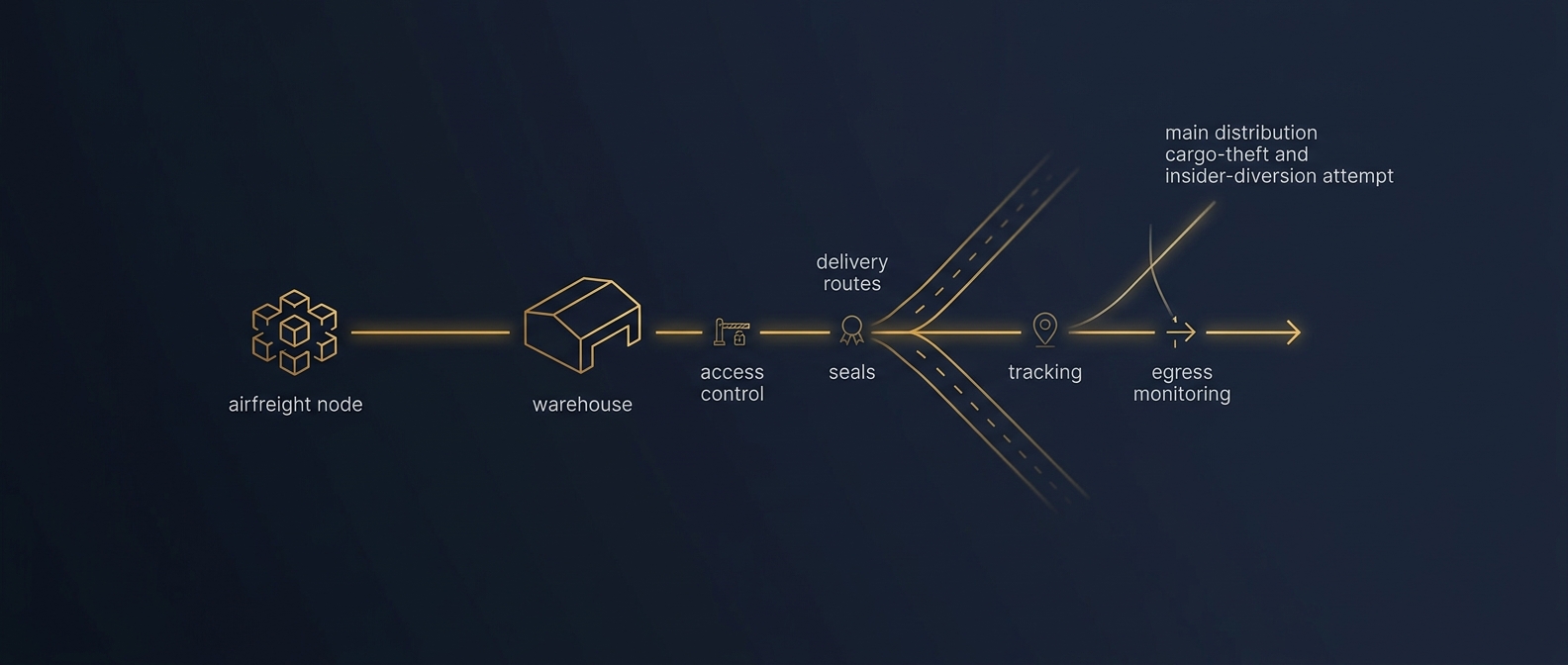
Cargo and supply-chain security is a discipline of its own, and the metro’s role as a national freight hub makes it central to protecting an Atlanta logistics operation. Organized cargo theft has grown more sophisticated: alongside straight physical theft of trailers and containers, criminal groups now run strategic theft — fictitious pickups, identity theft of legitimate carriers, and double-brokering scams that redirect a shipment with forged paperwork before anyone notices it is gone. These schemes exploit the same convergence seam: they begin with data (a leaked load board, a compromised email account, an inside tip on high-value freight) and end with a physical loss. CISA frames supply-chain resilience as exactly this kind of blended physical-and-cyber problem.
Effective distribution security therefore layers controls end to end: hardened facility access and yard management so trailers cannot be staged or removed without authorization; seal integrity and chain-of-custody discipline on every high-value load; identity verification of drivers and carriers to defeat fictitious pickups; monitoring of transportation-management and load-board systems for the account compromise that precedes strategic theft; behavioral and access analytics inside the warehouse to surface the insider feeding schedules to a crew; and a rehearsed response that preserves evidence when a load does go missing. The best programs also run pre-employment and periodic vetting proportionate to access, recognizing that the person with legitimate visibility into what ships when is the highest-leverage risk in the building. When a theft or diversion occurs, the response is investigative as much as physical — recovering digital evidence from compromised accounts, reconstructing the paper and data trail, and building a case that supports recovery, insurance, and prosecution.
What does security look like for Atlanta film and television production?
Film and media production is one of Atlanta’s signature industries and one of its most misunderstood security challenges, because a production is a high-value enterprise assembled and dissolved on a compressed timeline. On any given day a set concentrates expensive camera, lighting, and grid equipment; production vehicles and cash floats; high-profile cast whose presence draws crowds, media, and occasionally fixated individuals; and closely guarded intellectual property in the form of scripts, footage, and unreleased storylines. The security program has to protect all of it inside temporary locations — a soundstage this week, a residential street the next — with a large, rotating crew of cast, contractors, extras, and vendors, most of whom the production has no long-term relationship with.
World-class production security addresses several fronts at once: physical set and perimeter control that keeps the public and unauthorized personnel out without turning a working set into a fortress; asset protection for equipment, vehicles, and cash; talent and executive protection scaled to the profile of the principals and the crowd risk of a given location; and — increasingly the decisive front — content and information security to prevent script leaks, set photography, and footage exfiltration that can destroy the commercial value of a project before release. That last piece is where in-house cyber and forensic capability earns its keep: locking down digital dailies and post-production workflows, controlling who can copy footage, watermarking to trace leaks, and, when a leak happens, investigating it forensically to identify the source. Location security also depends on discreet advance work — assessing a neighborhood, coordinating with local authorities, and planning access and egress — the same protective-intelligence discipline that underpins executive protection.
How do you secure a corporate headquarters and campus in metro Atlanta?
A headquarters is a different problem again: it must stay open, welcoming, and productive while protecting concentrated people, data, and reputation. The tension is permanent — a campus that feels like a checkpoint erodes the culture it is meant to protect, while one that feels like a coffee shop invites the tailgater, the fixated visitor, and the opportunist. Mature headquarters security resolves this with layered, unobtrusive controls: audited access that distinguishes public lobbies from working floors and sensitive areas; visitor management that verifies who is in the building and why; workplace-violence prevention built on behavioral-threat assessment rather than reaction; secure handling of the sensitive data and financial systems that live at corporate; and an emergency-response and business-continuity plan that is actually rehearsed. Recognized standards such as the ASIS International guidance on workplace-violence prevention provide a defensible framework for the people side of that program.
Executives and their families are a distinct attack surface on top of the campus. Headquarters leadership is named in filings, quoted in press, and photographed at events, and that visibility connects a public profile to a home address, a routine, and a family. Executive security in Atlanta starts in the digital domain — reducing the online footprint that exposes a principal, monitoring for direct and indirect threats, and briefing on travel and elicitation — and escalates into protective operations only when intelligence warrants. The point is proportionality: most executives are served by digital-footprint reduction, threat monitoring, and secure travel practices, with a close-protection detail reserved for the profile or threat picture that genuinely requires one.
How do these three domains compare, and where do they overlap?
Logistics, film production, and headquarters security share a common backbone — access control, insider defense, intelligence, and investigative response — but their priorities and pressure points differ sharply. The table below maps the distinctions a sophisticated Atlanta buyer should internalize before scoping a program, so resources are matched to the operation rather than spread evenly across all of them.
| Dimension | Logistics & Distribution | Film & Media Production | Corporate Headquarters |
|---|---|---|---|
| Primary asset at risk | Freight, product, shipment data | Equipment, IP/content, talent | People, corporate data, reputation |
| Signature threat | Cargo theft & strategic/fictitious pickup | Content leaks & asset theft | Insider data theft & workplace violence |
| Environment | Fixed warehouses + moving freight | Temporary sets & locations | Permanent open campus |
| Workforce risk | Insiders with shipment visibility | Large transient crew & vendors | Trusted long-tenure access |
| Decisive control | Chain of custody + system monitoring | Content security + set access control | Behavioral threat assessment + access audit |
| Typical owner | Supply-chain & loss-prevention lead | Production & studio security | CSO, GC, facilities, HR |
The overlap is the insider and the intelligence function. In all three domains, the person with legitimate access — the warehouse coordinator, the production assistant, the trusted headquarters employee — is the highest-leverage risk, and in all three the earliest warning usually appears in digital and behavioral signals before it becomes a physical loss. That is why an Atlanta program should be built around a shared insider-threat and intelligence capability, with domain-specific controls layered on top, rather than three unrelated security silos that never share what they see.
How do you build an insider-threat program for an Atlanta enterprise?
Because the insider is the connective risk across logistics, production, and headquarters operations, a governed insider-threat program is the highest-return investment most Atlanta companies can make. The framework below is the order elite advisors follow to stand one up without grinding a fast-moving operation to a halt or crossing employment-law and privacy lines.
- Identify and map your crown jewels. Determine what would actually hurt if it left — shipment and customer data, unreleased content, financial systems, trade secrets — and where each lives across systems, sites, and endpoints. You cannot protect what you have never mapped.
- Control access on least-privilege and just-in-time principles. Enforce multi-factor authentication, role-based access, and time-limited permissions so people can reach only what their job requires, and access disappears when the need ends.
- Instrument egress and behavior. Log and alert on bulk downloads, unusual file, footage, or shipment-record access, removable-media use, and personal-cloud or email exfiltration, so a theft attempt is detected in real time rather than discovered after the person is gone.
- Vet proportionate to access. Match pre-employment and periodic background intelligence to the sensitivity of the role, with particular rigor for positions that see high-value freight, unreleased IP, or executive and financial data.
- Establish a cross-functional hub. Bring security, HR, legal, and IT together to correlate access, behavioral, and life-event indicators under a documented, privacy-respecting process, so signals are acted on consistently and defensibly.
- Discipline the departure. Make clean, logged, evidence-preserving offboarding the default for every exit — revoking access and, where warranted, forensically preserving devices before they are wiped — because the departing employee is a leading source of data and IP loss.
- Rehearse the investigation and response. Pre-build the workflow for a suspected insider event — who investigates, how evidence is preserved with proper chain of custody, when counsel and law enforcement are engaged — and exercise it, so a bad day does not destroy the very evidence you will later need.
Notice how little of this is hardware. The value is in mapping, access discipline, behavioral monitoring, and the governance that lets security, HR, and legal act on a signal without tripping over privacy or employment law. A camera nobody monitors and a policy nobody enforces are gaps, not controls — and the difference between a defensible company and a negligent one is usually whether the assessment, the access change, and the response were documented.
How does Honeybadger deliver corporate security in Atlanta?
Honeybadger Solutions delivers commercial and corporate security for Atlanta logistics operators, production companies, and headquartered enterprises as an integrated program rather than a single-domain service, drawing on our investigations, cyber, digital forensics, and intelligence practices. Because our digital forensics, cybersecurity, financial-investigation, and background-intelligence capabilities are handled in-house and delivered globally, we work the seam where Atlanta’s real losses live — connecting a warehouse insider to the compromised account that fed a cargo theft, a set photo to a content-leak investigation, and a departing headquarters employee’s data theft to a forensic case that supports recovery and, if needed, prosecution.
Based in Arizona with offices in Casa Grande, Phoenix, and Oro Valley, we serve companies, productions, and investors across all of Arizona, nationwide, and internationally — including metro Atlanta and the wider Southeast. Where an engagement surfaces a physical, set, or executive-protection requirement, it is delivered through our commanded, vetted-partner network: threat assessment, planning, tradecraft standards, and single-point accountability are directed from Arizona home command, while protective operations are executed by rigorously vetted, jurisdiction-licensed teams in the field. Georgia is an expansion theater engaged on a mandate basis — distinct from our established partner-delivered armed and executive-protection theaters in California, Texas, and Florida — so an Atlanta client gets a coordinated, accountable response rather than the costly fiction that any firm owns a fully staffed armed office in every city. The result is one coherent security program — cargo and supply-chain protection, content and IP security, insider-threat defense, facility and executive security, and forensic incident response — that is defensible to your board, your insurer, and, if it comes to it, a court.
Frequently asked questions
Why is cargo theft such a serious risk for Atlanta logistics companies?
Metro Atlanta is a national freight and distribution hub anchored by the world’s busiest airport, which concentrates high-value goods moving through warehouses, airfreight, and trucking. Modern cargo theft is no longer just stolen trailers — it increasingly runs as strategic theft: fictitious pickups, carrier-identity fraud, and double-brokering scams that redirect a shipment with forged paperwork. These schemes begin with data (a leaked load, a compromised account, an inside tip) and end with a physical loss, so effective protection blends yard and access control, chain-of-custody discipline, carrier verification, system monitoring, and investigative response.
What does film production security actually protect against?
A production concentrates expensive equipment, cash, high-profile talent, and closely guarded intellectual property inside temporary locations with a large, rotating crew. Production security protects the set perimeter and public access, the equipment and vehicles, the safety of cast and executives, and — often most critically — the content itself, preventing script leaks, set photography, and footage exfiltration that can undercut a project’s commercial value before release. Strong content security relies on in-house cyber and forensic capability to lock down digital workflows and to trace a leak back to its source when one occurs.
How is protecting a corporate headquarters different from a warehouse or set?
A headquarters has to stay open and welcoming while protecting concentrated people, sensitive data, and reputation, so the emphasis shifts to unobtrusive layered access control, visitor management, behavioral threat assessment for workplace-violence prevention, and executive security. A warehouse prioritizes chain of custody and insider monitoring around freight; a set prioritizes temporary-perimeter control and content security. All three share an insider-threat and intelligence backbone, which is why the smartest programs build that capability once and layer domain-specific controls on top.
Does Honeybadger provide executive and physical protection in Atlanta?
Yes, on a coordinated, mandate basis. Our in-house digital forensics, cyber, financial-investigation, and background-intelligence capabilities are delivered globally, including throughout Georgia. Physical, set, and executive protection is provided through our commanded, vetted-partner network; Georgia is an expansion theater directed from our Arizona home command, distinct from our established partner-delivered theaters in California, Texas, and Florida. In practice that means we assess the threat, reduce a principal’s digital exposure, and stand up protective operations as a directed, coordinated response — at the office, on set, and while traveling — rather than an improvised scramble during a crisis.
About Honeybadger Solutions
Honeybadger Solutions is an Arizona-licensed security and investigations firm delivering intelligence-led corporate security, supply-chain and content protection, insider-threat and investigations services, executive protection, and cyber and forensic capabilities to companies, productions, and investors nationwide and internationally. Digital forensics, cybersecurity, financial investigations, and background intelligence are handled in-house and delivered globally. Physical and executive protection is delivered through a commanded vetted-partner network with established partner-delivered theaters in California, Texas, and Florida, and coordinated, mandate-based coverage in expansion theaters such as Georgia, directed from Arizona home command.
Offices: Casa Grande (HQ), Phoenix, and Oro Valley, Arizona.
Phone: Book a consultation online
Confidential consultation: discuss a corporate-security program for your Atlanta logistics, production, or headquarters operation with our command team.
Browse by topic
Security guard services · Private investigations · Cybersecurity · Digital forensics · Financial fraud investigation · Executive protection · All articles