
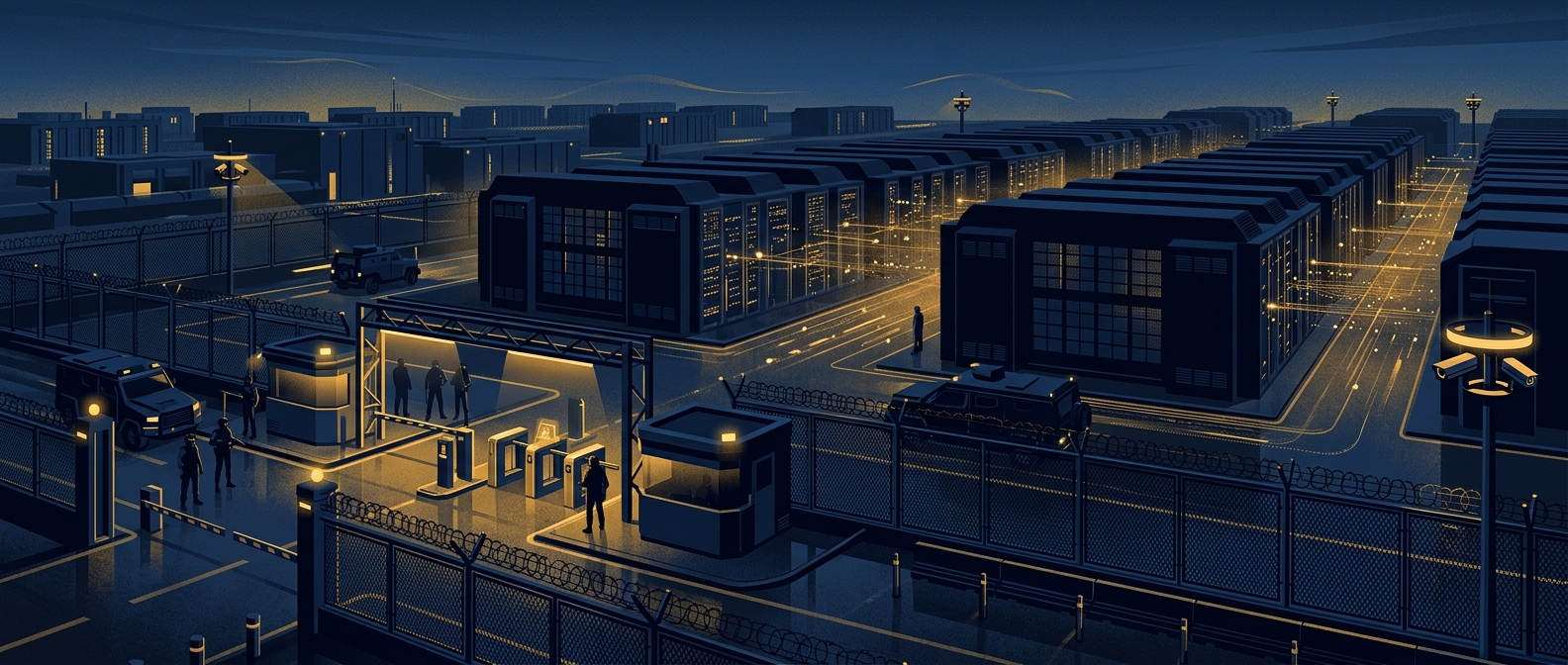
Data center physical security is the layered discipline of controlling who and what can approach, enter, and touch the buildings, halls, and cabinets where critical computing runs. It combines perimeter defense, building and floor access control, identity verification, visitor and vendor governance, loading-dock control, continuous monitoring, and a trained guard force — engineered so that no single failure exposes the servers, data, or uptime that the business depends on.
Arizona has become one of the most concentrated data-center markets in North America, and the Phoenix-Mesa corridor now hosts hyperscale campuses, wholesale colocation, and enterprise facilities measured in hundreds of megawatts. That concentration changes the physical-security equation. A cage in a shared colocation hall, a hyperscale campus on the edge of the Sonoran Desert, and a converted enterprise room each carry distinct exposure — and each is only as defensible as the officers, procedures, and access design standing between an intruder and a live rack. Honeybadger Solutions secures these environments in Arizona with our own AZ-DPS-licensed, supervised, in-house officers, backed by access-control design that maps to the compliance frameworks operators are audited against.
Why does the Phoenix-Mesa corridor concentrate data-center risk?
The same factors that made Arizona attractive to operators also raise the stakes for physical security. Cheap, abundant power, a low incidence of natural catastrophe, competitive land, and dense fiber routes have pulled hyperscalers and wholesale providers into Mesa, Chandler, Goodyear, and the west valley at extraordinary speed. The result is a corridor where a single campus can represent billions in capital and host workloads for dozens of downstream tenants who never set foot on site.
Risk concentrates in three ways. First, blast radius: a breach at one multi-tenant facility can touch every customer in the building, so the security posture must satisfy the most demanding tenant, not the average one. Second, construction churn — the corridor is in a near-permanent build cycle, and active construction means a rotating population of contractors, equipment deliveries, and temporary access points that are the most common vector for unauthorized entry. Third, the desert edge: sprawling suburban and exurban campuses have long, remote perimeters where a fence line runs for thousands of feet past low-traffic roads, giving a determined intruder time and darkness. Insider risk and social engineering compound all three, because the person who tailgates through a door or talks past a distracted officer bypasses every dollar spent on the fence.
What are the layers of data center physical security?
World-class data-center security is built as concentric rings, each independently defensible, so that defeating one layer only delivers an intruder into the next controlled zone rather than to the servers. This defense-in-depth model — reflected in ASIS International guidance and NIST physical-protection controls — is the difference between a facility that is genuinely hard and one that merely looks secure.
- Perimeter. Anti-ram fencing or bollards, clear zones free of concealment, vehicle standoff and gate control, crash-rated entry for delivery lanes, and camera coverage with analytics that flag loitering, fence-line breaches, or a vehicle stopped where none should be. The perimeter’s job is detection and delay, not decoration.
- Site and building envelope. Hardened exterior doors, no unmonitored entries, secured roof and utility penetrations, and a single controlled visitor approach that funnels everyone through one accountable point.
- Interior common areas. Lobbies, corridors, and staging separated from the data floor by controlled doors, so a person with lobby access cannot drift toward the halls.
- Data hall / floor. Access-controlled entry, typically through an anti-tailgating vestibule, with authorization scoped to the specific hall a person is cleared for.
- Cabinet, cage, and colocation suite. The last ring — locking cabinets, caged suites, and per-customer access lists so that a tenant cleared for their own cage cannot reach a neighbor’s equipment. In multi-tenant environments this ring is where physical security and contractual liability meet.
The common failure is treating these as a checklist of products rather than an integrated system. A biometric reader on the data-hall door is worthless if the roof hatch is unmonitored, and a hardened perimeter means little if a contractor props a loading-dock door for convenience. Each ring must be surveyed, tested, and maintained as part of one program — the same principle we apply in critical infrastructure physical security planning.
How should access control and identity be engineered?
Access control is where most of the sophistication — and most of the recurring mistakes — live. The goal is provable identity, least-privilege authorization, and defeat of tailgating, credential sharing, and cloning. Engineering it well means designing for the failure modes, not the happy path.
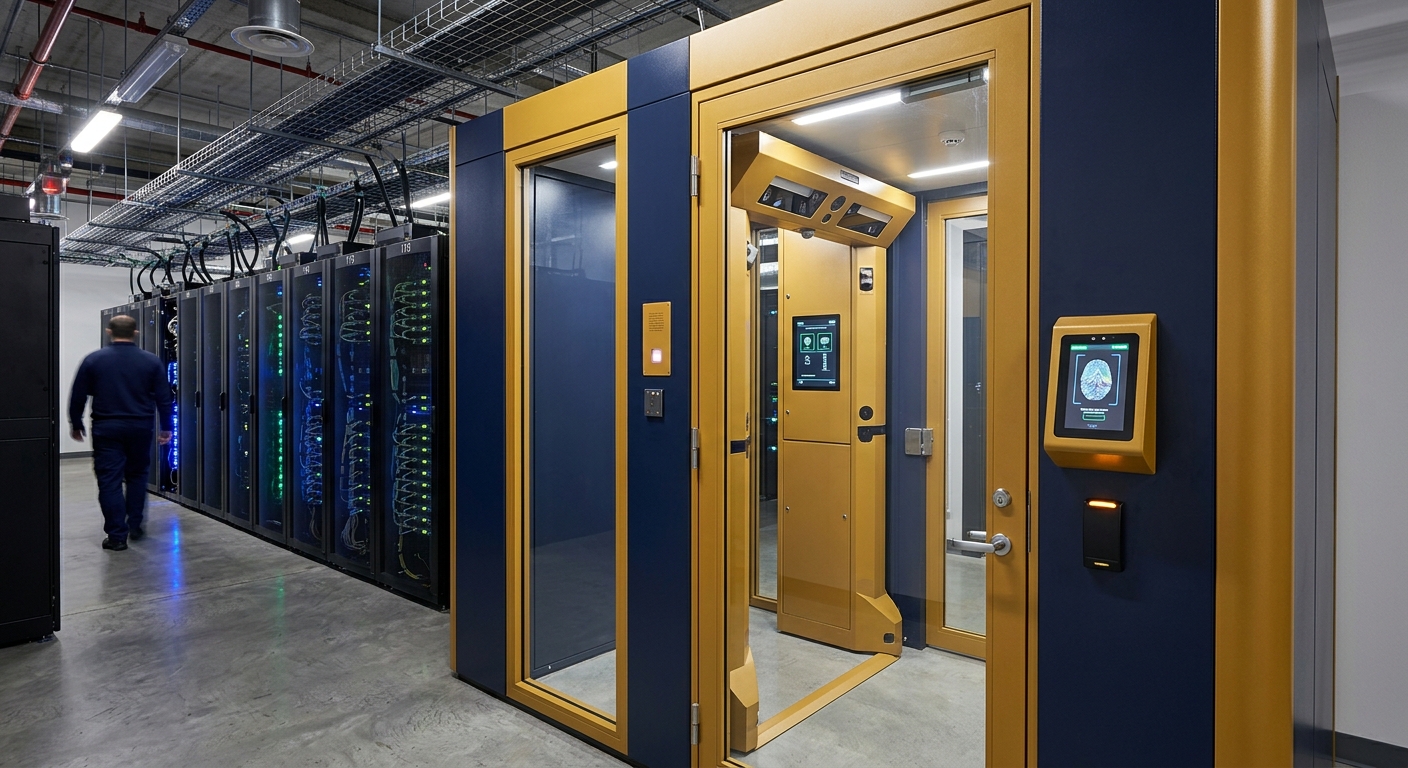
- Mantraps (access-control vestibules). A two-door interlock where the second door cannot open until the first is secured and a single occupant is verified defeats tailgating by design. At high-security halls, anti-piggybacking sensors or optical portals count occupants and refuse a second body.
- Multi-factor and biometrics. A credential proves possession; a PIN proves knowledge; a biometric proves the person. High-assurance zones combine at least two, with biometrics (fingerprint, iris, or vascular) reserved for the data floor and cage entry rather than the parking gate. Modern encrypted smart credentials replace clonable legacy proximity cards.
- Anti-tailgating and anti-passback. Anti-passback logic prevents one credential from being used to enter twice without exiting — stopping the “badge, then hand it back over the fence” trick — and forces clean entry/exit records that matter enormously during an audit or investigation.
- Credential lifecycle governance. The strongest reader is undone by weak administration. Access must be provisioned to a named individual, scoped to specific zones, time-bound for contractors, and — critically — revoked the moment a role changes or an engagement ends. Orphaned credentials are among the most common findings in a serious physical-security audit.
Design decisions here also carry cyber consequences: access-control systems are networked, and a poorly segmented physical-security network becomes an attack surface of its own. We coordinate physical access design with logical controls so the two reinforce rather than undercut each other — an intersection we address through our cyber services alongside physical protection.
How do you run visitor, vendor, and loading-dock control?
The perimeter and the biometric door protect against the outsider trying to break in. Visitor, vendor, and dock control protect against the far more likely event: someone legitimately invited who should never have reached the floor unescorted, or a delivery that becomes a delivery of the wrong thing. In an active-construction corridor like Phoenix-Mesa, this is the highest-frequency risk surface, and it is where a professional guard force earns its value.
A disciplined program pre-registers every visitor and vendor, verifies government identification on arrival, matches the person to an authorized work ticket or host, issues a visibly distinct temporary badge scoped to a specific area and time window, and enforces escort rules for anyone without standing floor access. Contractors get zone-limited, time-boxed credentials that expire automatically — no manual cleanup required. The loading dock — the classic soft spot — is treated as its own controlled zone: deliveries are scheduled and verified against a manifest, drivers stay in a holding area rather than roaming, inbound equipment is inspected, and the dock door is never a convenient shortcut onto the floor. Every entry, exit, escort handoff, and delivery is logged, because an unrecorded access is the one that surfaces during a breach investigation when no one can say who was where.
What does the guard force and security operations center actually do?
Technology detects and delays; people decide and respond. A data-center guard force is not a lobby fixture — it is the trained human layer that turns an alarm into a resolved incident and enforces the procedures that access-control hardware cannot. Officers verify identity at the point where judgment matters, conduct interior and perimeter patrols on varied routes, respond to door-forced and tailgating alerts, escort visitors and contractors, control the dock, and de-escalate the confrontations that inevitably arise when someone is told they cannot proceed.
Behind them, the security operations center (SOC) is the nervous system: consolidated video, access-control events, intrusion and environmental alarms, and analytics on one monitored surface, staffed by operators who follow written post orders and escalation matrices. The quality difference between a mediocre and a world-class SOC is not the video-wall size — it is disciplined alarm triage, tested escalation paths, dependable radio and mass-notification procedures, and rehearsed response to the scenarios that actually happen: a propped door, a tailgate, a suspicious vehicle on the fence line, a medical event, a power or cooling anomaly that demands the floor be cleared. In Arizona, the officers running our patrols, checkpoints, and SOC positions are Honeybadger’s own AZ-DPS-licensed, supervised personnel — not subcontracted labor — which is what makes accountability, post-order discipline, and chain-of-command enforceable rather than aspirational. This is the same standard we bring to industrial and manufacturing security across the state.
How does physical security map to SOC 2, ISO 27001, PCI, and uptime tiers?
For data-center operators and their tenants, physical security is not only about stopping intruders — it is a controlled, evidence-producing function that auditors examine directly. The frameworks do not prescribe identical measures, but they converge on the same expectations: restrict physical access to authorized individuals, verify identity, monitor and log entry, and demonstrate that the controls operate consistently over time.
- SOC 2. Physical access is squarely within the security and availability criteria. Auditors sample access logs, review provisioning and de-provisioning records, and expect evidence that badges and escorts are governed — not just that a reader exists.
- ISO/IEC 27001. Its Annex A physical and environmental controls call for secure areas, entry controls, and protection against external and environmental threats, all documented within the information security management system.
- PCI DSS. Requirement 9 focuses specifically on restricting and monitoring physical access to cardholder-data environments, distinguishing personnel from visitors and mandating visitor logs and media handling.
- Uptime and resilience tiers. The Uptime Institute tier framework governs availability and fault tolerance, and a physical-security failure that forces an unplanned floor evacuation or equipment shutdown is an availability event — which is why security design and resilience objectives must be planned together.
The practical takeaway: design the program to produce clean, retrievable evidence as a byproduct of daily operation. If proving compliance requires reconstructing who entered a hall last quarter from memory, the control has already failed — regardless of how good the hardware looked.
Baseline vs. enterprise-grade data-center security posture
| Control area | Baseline (adequate) | Enterprise-grade (world-class) |
|---|---|---|
| Perimeter | Fence, gate, some cameras | Anti-ram barriers, clear zones, vehicle standoff, analytics-driven detection |
| Access control | Prox card at key doors | Encrypted credentials, MFA, biometrics on the floor, anti-passback |
| Anti-tailgating | “Don’t hold the door” signage | Mantraps / optical portals with occupancy detection |
| Visitor & vendor | Paper sign-in sheet | Pre-registration, ID verification, scoped time-boxed badges, enforced escort |
| Loading dock | Shared door, informal deliveries | Scheduled, manifest-verified, inspected, isolated holding area |
| Guard force | Untrained, high-turnover contract labor | Licensed, supervised officers with written post orders and drills |
| Monitoring | Recorded video, reviewed after events | Staffed SOC, live triage, tested escalation matrix |
| Compliance evidence | Assembled reactively before an audit | Continuous, retrievable logs produced by daily operation |
What is the framework for building a data-center security program?
A defensible program is built in sequence — threat understanding before technology, and design before procurement. The following framework is how we approach a new or maturing Arizona facility.
- Threat and risk assessment. Characterize the site, tenants, adversaries, and consequence of compromise. A remote hyperscale campus and a downtown colocation suite do not share a threat model.
- Layered design. Define the concentric rings and the delay-and-detection objective for each, from perimeter to cabinet, before selecting any product.
- Access and identity architecture. Specify credentialing, MFA and biometric zones, mantrap placement, anti-passback logic, and the provisioning/revocation lifecycle.
- Detection and monitoring. Design camera coverage, analytics, intrusion and environmental alarms, and the SOC that watches them, with written triage and escalation.
- Guard force and post orders. Staff the human layer with licensed, supervised officers; codify patrols, checkpoints, visitor and dock procedures, and use-of-force and de-escalation standards.
- Visitor, vendor, and dock governance. Stand up pre-registration, escort rules, contractor time-boxing, and delivery verification as enforced procedure, not signage.
- Compliance mapping. Align controls and evidence capture to SOC 2, ISO 27001, PCI, and uptime obligations so audits are a report, not a scramble.
- Testing and continuous improvement. Run access-control audits, tailgating and social-engineering tests, tabletop and live drills, and close findings on a schedule.
What drives the cost of data-center physical security?
Buyers who benchmark on a single number — a guard’s hourly rate, a camera’s price — consistently overspend on the wrong things and underspend on the risks that matter. The real cost drivers are structural. Facility scale and perimeter length set the fixed footprint of cameras, barriers, and patrol time. Tenancy model matters: multi-tenant colocation multiplies the access lists, cage controls, and audit obligations relative to a single-occupant enterprise room. Compliance scope drives evidence and process overhead — a PCI cardholder-data environment or a SOC 2 Type II report carries recurring cost that a non-regulated workload does not.
The largest and most under-appreciated driver is the guard force itself: officer quality, licensing, supervision, and turnover. Cheap contract labor looks like savings until a preventable tailgate, a mishandled confrontation, or a gap in coverage becomes an incident with regulatory, contractual, and reputational cost that dwarfs the line-item difference. Coverage hours (24/7 versus business-hours), the sophistication of access and detection technology, and integration with logical security round out the picture. The disciplined approach is to spend against the risk assessment — heaviest investment at the highest-consequence rings — rather than uniformly, which is exactly what our security consulting engagements are structured to produce.
How does Honeybadger secure Arizona data centers?
Honeybadger Solutions is an Arizona-licensed security and investigations firm, and within Arizona the officers who staff our data-center posts — checkpoints, patrols, dock control, and SOC positions — are our own AZ-DPS-licensed, supervised, in-house personnel. That single fact changes accountability: post-order discipline, chain of command, screening standards, and continuity of coverage are things we own and enforce directly, not outcomes we hope a staffing subcontractor delivers. For operators in the Phoenix-Mesa corridor, that means the people standing between an intruder and a live rack answer to us.
We pair that guard force with access-control and layered-security design, compliance-aligned evidence practices, and — where an engagement reaches beyond Arizona — a commanded network of vetted partners with established presence in markets such as California, Texas, and Florida, so a multi-site operator gets one accountable point of contact. From our offices in Casa Grande, Phoenix, and Oro Valley we serve the entire state, with nationwide and international reach for clients whose footprint extends past it. Whether you are commissioning a new campus, hardening a colocation cage, or preparing a facility for its next audit, the starting point is a confidential assessment of the rings you have and the gaps between them. Explore our full security services and Phoenix-area coverage to begin.
Frequently asked questions
Are Honeybadger’s data-center security officers in-house or subcontracted?
Within Arizona, they are our own. The officers who staff data-center checkpoints, patrols, loading docks, and security operations center positions are Honeybadger’s in-house, AZ-DPS-licensed, supervised personnel — not subcontracted labor. That direct employment is what makes screening, post-order discipline, chain of command, and coverage continuity enforceable. For engagements that extend outside Arizona, we coordinate a commanded network of vetted partners with established presence in markets like California, Texas, and Florida.
What is a mantrap and why do data centers use them?
A mantrap, or access-control vestibule, is a two-door interlock where the second door will not open until the first is secured and a single authorized occupant is verified. Data centers use them because they defeat tailgating — someone slipping in behind an authorized person — by design rather than relying on signage or vigilance. At high-assurance halls, occupancy sensors or optical portals refuse entry if a second body is detected, providing a clean, auditable one-person-per-authorization record.
How does physical security support SOC 2 and ISO 27001 compliance?
Both frameworks treat physical access to computing environments as a control that auditors examine directly. SOC 2 places it within its security and availability criteria; ISO/IEC 27001 addresses it through Annex A physical and environmental controls. Each expects restricted, verified, monitored, and logged access, with evidence that controls operate consistently over time. A well-run program produces that evidence as a byproduct of daily operation, so audits become a report rather than a reconstruction.
Does Honeybadger secure colocation cages as well as full facilities?
Yes. In multi-tenant colocation, the cabinet and cage form the innermost security ring, where physical control and contractual liability meet. We design and support per-customer access lists, cage and cabinet controls, escort procedures, and audit-ready logging so a tenant cleared for their own suite cannot reach a neighbor’s equipment. Whether the scope is a single cage, a private suite, or an entire campus, the program is engineered against a threat assessment specific to that footprint.
About Honeybadger Solutions
Honeybadger Solutions is an Arizona-licensed security and investigations firm serving data centers and critical facilities across the Phoenix-Mesa corridor and the entire state. Within Arizona, our security officers are our own AZ-DPS-licensed, supervised, in-house guards — not subcontracted labor — which is what makes accountability, post-order discipline, and coverage continuity enforceable. We provide layered physical protection, access-control design, and compliance-aligned security operations, with nationwide and international reach through a commanded network of vetted partners.
Offices: Casa Grande (HQ), Phoenix, and Oro Valley, Arizona.
Phone: Book a consultation online
Confidential consultation: Contact us to schedule a discreet assessment of your facility’s security posture.
Browse by topic
Security guard services · Private investigations · Cybersecurity · Digital forensics · Financial fraud investigation · Executive protection · All articles