

Corporate investigations for Seattle technology companies address four recurring threats: theft of trade secrets and source code, insider threat inside cloud and software environments, misconduct and harassment allegations, and hidden risk in an acquisition, investment, or partnership. The work is conducted discreetly and to a litigation-ready standard, with digital evidence preserved forensically from the first hour so findings survive a Washington courtroom, arbitration, or regulatory review.
The Seattle–Bellevue–Redmond corridor concentrates a distinct kind of corporate exposure. Cloud platforms, enterprise software, e-commerce, gaming, and a dense layer of venture-backed startups all compete for the same scarce engineering talent, and that talent carries the company’s most valuable assets in its head and on its laptop. When a principal engineer, a product lead, or a founder leaves for a competitor—or launches a rival venture—the risk is not a stolen filing cabinet. It is a cloned repository, an exported customer database, a copied model, and a set of cloud credentials that were never rotated. A world-class corporate investigation does not slow the business down; it lets general counsel, the board, and executives act on fact instead of suspicion, and it builds the evidentiary record before the dispute, not after.
What Makes Corporate Investigations in Seattle Tech Different?
Three features distinguish a Seattle technology matter from a generic corporate investigation. First, the crown jewels are digital and portable: source code, model weights and training data, architecture and roadmap documents, customer lists, and the cloud infrastructure itself. Exfiltration can happen in minutes and leaves faint, perishable traces. Second, the talent economy is fluid—engineers move between Amazon, Microsoft, and a rotating field of startups—so departing-employee data theft and insider misuse are first-order risks, not afterthoughts. Third, Washington law is materially different from most states on recording, on non-competes, and on data privacy, and a misstep on any of the three can convert your best evidence into your opponent’s motion to suppress.
Any firm conducting investigations in Washington must hold the appropriate state license. Private investigators in Washington are licensed and regulated by the Washington State Department of Licensing, and using an unlicensed operator can taint the evidence and expose the client. Discretion, licensing, and legal defensibility are not competing priorities—they are the same standard.
What Are the Core Corporate Investigation Mandates for Tech Firms?
Most engagements in this market fall into five mandates. They share a methodology—preserve first, analyze the record before memory fades, document everything—but each has a distinct objective, evidence base, and typical trigger. The table maps them.
| Mandate | Typical trigger | Core evidence base | Primary objective |
|---|---|---|---|
| Trade-secret & IP theft | Key engineer or founder departs to a competitor or launches a rival | Forensic disk/cloud images, repository and access logs, exfiltration artifacts | Prove misappropriation, support injunctive relief, stop the bleed |
| Insider threat | Anomalous access, mass download, privileged-account misuse, data-loss alert | Cloud audit logs, endpoint telemetry, identity and access records | Scope the exposure, attribute the activity, contain and remediate |
| Departing-employee review | Resignation of a high-access employee, especially to a competitor | Device images, USB history, cloud-sync and forwarding logs | Confirm whether data left, and preserve evidence before it is overwritten |
| Misconduct & harassment | HR complaint, ethics hotline, board concern, regulator inquiry | Messages, devices, access data, interviews, policy record | Defensible finding; protect against wrongful-termination and retaliation claims |
| Deal & partner due diligence | Acquisition, investment, JV, integration, or key-vendor onboarding | Public and proprietary records, litigation history, beneficial ownership | Surface hidden risk, conflicts, and misrepresentation before signing |
The remainder of this guide walks each mandate as it is actually executed at an elite level—not the textbook version, but the decisions that separate a defensible investigation from an expensive liability.
How Do You Investigate Trade-Secret and Source-Code Theft?
In a software and cloud economy, the most damaging theft is not cash—it is the source code, the machine-learning model, the customer list, the pricing algorithm, or the unreleased roadmap that walks out the door with a departing engineer. These matters move on a clock: the value of injunctive relief decays by the day, so the first 72 hours often decide the outcome.
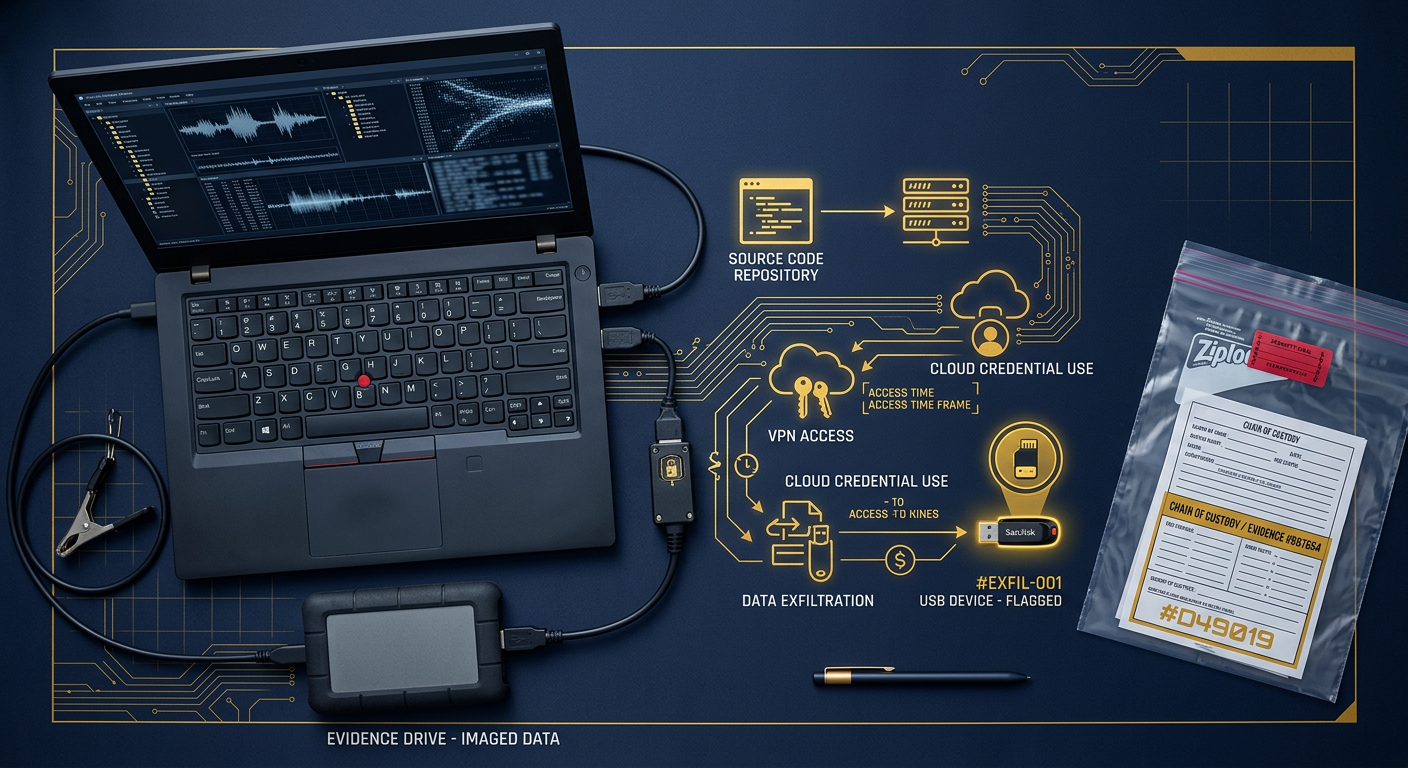
The investigation begins with forensic preservation. Company-issued laptops, cloud accounts, email, source-code repositories, and collaboration platforms are imaged before anyone browses them, because opening a file or letting a live account keep running can overwrite the very artifacts that prove exfiltration—USB-insertion records, repository clone and pull events, cloud-sync logs, mass-download bursts, personal-email forwarding, and deletion remnants. Chain of custody is opened at acquisition and maintained through production so the evidence survives a challenge to its integrity. From the artifacts, examiners reconstruct exactly what was taken, when, by what channel, and where it went.
Because misappropriation claims proceed under the federal Defend Trade Secrets Act and Washington’s Uniform Trade Secrets Act (RCW 19.108), the forensic record is built to satisfy the legal test: that the information qualifies as a protected trade secret, that the company took reasonable measures to secure it, and that the departing party acquired, disclosed, or used it improperly. That evidence file is what converts a suspicion into a viable motion for a temporary restraining order or preliminary injunction. This is where our in-house digital forensics and cybersecurity capabilities carry the case—and because both are remote-by-design, preservation can begin within hours of the call, wherever the device or the cloud tenant sits.
How Is Insider Threat Handled in Cloud and Software Environments?
Insider threat is the discipline of detecting, scoping, and responding to harm caused by people who already have legitimate access. In a cloud-native company that is a large and trusted population—engineers with production access, administrators with privileged credentials, contractors with repository rights, and service accounts that never sleep. The threat is not always malicious; negligent handling and compromised-credential misuse produce the same data loss. The Cybersecurity and Infrastructure Security Agency (CISA) frames insider threat as a program, not a single tool, and that is the right posture for a Seattle software firm.
Investigatively, the work centers on the record the cloud already keeps. Identity-provider logs, cloud audit trails (who assumed which role, when, from where), repository access history, data-loss-prevention alerts, and endpoint telemetry are correlated into a timeline that separates normal engineering behavior from anomalous staging and exfiltration. A single mass download at 2 a.m. from an unusual IP, followed by a repository clone to a personal device and a spike in personal-email traffic, tells a story—but only if the logs were preserved before retention windows expired. Elite practice pairs the forensic investigation with a hard remediation step counsel often forgets in the heat of the moment: rotate credentials, revoke tokens and keys, and close the access paths, so the departing insider cannot continue reaching into the environment after the laptop is returned. Our investigations, forensics, and cybersecurity functions run this as one integrated workstream.
What Is the Right Playbook for a Departing High-Access Employee?
The resignation of an employee with deep access—especially one leaving for a competitor—is the single most common trigger for a Seattle tech investigation. The mistake companies make is treating it as an HR offboarding task rather than an evidence-preservation event. By the time IT wipes and reissues the laptop, the artifacts that would have proven whether data left are gone forever.
A disciplined departing-employee review follows a repeatable framework:
- Freeze, do not wipe. Quarantine the returned device and preserve the cloud accounts in their current state before reimaging or reissuing anything—retention clocks are already running.
- Image forensically. Create verified forensic images of the device and relevant cloud tenants, opening chain of custody at acquisition.
- Reconstruct the final weeks. Examine USB history, bulk downloads, repository activity, cloud-sync and print logs, and forwarding to personal accounts in the period before departure.
- Compare against role. Distinguish routine work from staging behavior—was the access consistent with the employee’s actual responsibilities in that window?
- Preserve, then decide. Package the findings so counsel can choose the path—cease-and-desist, injunction, negotiated resolution, or no action—on evidence rather than fear.
Done properly, most reviews are quietly reassuring: they confirm nothing left, and the employee moves on without a manufactured dispute. When something did leave, the same preserved record is what makes the response fast, proportionate, and defensible. Related departing-employee, non-compete, and trade-secret scenarios are covered across our corporate investigations resources.
How Should Misconduct and Harassment Allegations Be Investigated?
Misconduct and harassment matters carry a double risk: the underlying conduct, and the way the company responds to it. In a high-visibility Seattle tech employer, a botched investigation can generate a retaliation or wrongful-termination claim larger than the original complaint—and, given the sector’s public profile, a reputational event that outlasts the legal one.
The discipline that protects the organization is sequence. Evidence—messages, documents, access and badge data—is preserved before the subject is alerted; the privilege posture is settled with counsel before the first email is sent; and interviews are conducted outward-in: reporting party, then witnesses, then the subject last, so the subject responds to a documented record rather than an open-ended question. For senior executives and founders, discretion is paramount, with a need-to-know circle often of only two or three. A finding stated as “substantiated,” “not substantiated,” or “inconclusive,” on a preponderance standard, with credibility reasoning shown, is what a court respects; a rushed, one-sided inquiry is what plaintiffs’ counsel dismantle in deposition. This is the core of our corporate investigations methodology, and it is built to withstand challenge.
Why Does Due Diligence Matter for Tech Acquisitions and Partnerships?
Seattle’s technology market runs on acquisitions, strategic investments, integrations, and vendor relationships struck faster than the paperwork verifying them. A startup being acqui-hired, a co-investor in a fund, a founder taking a strategic check, an overseas development partner, or a key infrastructure vendor—each carries risk that a data-room summary and a credit report will never surface. Investigative due diligence answers the question the term sheet cannot: who is actually on the other side of this, and what are they not telling us?
A rigorous diligence engagement verifies principals and true entity structure, maps beneficial ownership and control to expose hidden partners and conflicts, searches civil, criminal, bankruptcy, lien, and regulatory history across relevant jurisdictions, tests whether represented funding and assets actually exist, and screens against sanctions, watchlists, and adverse media. For technology targets specifically, it also probes IP provenance—does the company actually own the code and models it claims, or is there open-source-license or prior-employer contamination lurking in the stack? The deliverable is a decision-grade risk picture: what is verified, what is unverifiable, and what is a red flag serious enough to reprice, restructure, or walk. Our financial investigation and background-intelligence capabilities feed this work directly, and for cross-border counterparties the same standard applies internationally. Getting diligence right is far cheaper than unwinding a deal after signing—a discipline reinforced by the anti-fraud guidance of the U.S. Securities and Exchange Commission for investment-grade transactions.
What Does Washington Law Change About the Playbook?
Washington is not a state where a national playbook can be applied unmodified. Four differences shape every Seattle engagement and are where inexperienced operators create fatal errors:
- All-party consent for recording. Washington’s Privacy Act (RCW 9.73.030) generally requires the consent of all parties to record a private conversation. Recording without it can render the recording inadmissible and expose the recorder to liability, so interview and surveillance methodology must be designed around it.
- Non-competes are sharply restricted. Under RCW 49.62, most employee non-compete covenants are unenforceable unless the employee’s earnings exceed an annually adjusted statutory threshold, and other conditions are met. Protection of proprietary information therefore rests primarily on trade-secret law and confidentiality obligations—not on a non-compete—which changes how IP-theft cases are framed and proven.
- Expanding data-privacy obligations. Washington’s privacy landscape, including the My Health My Data Act, governs how certain personal data is collected and handled, requiring disciplined scoping and data minimization even when the investigation itself is legitimate.
- Trade-secret framework. The Washington Uniform Trade Secrets Act (RCW 19.108) defines what qualifies and what “reasonable measures” look like, so the forensic evidence must be built to that standard from the first image.
An investigation that ignores these features can win the facts and lose the case. The competent operator designs around them from hour one.
How Do You Engage an Investigator Without Tipping Off the Target?
Discretion is operational, not decorative. The engagement is structured through counsel where privilege matters, the need-to-know circle is kept deliberately small, and preservation frequently happens before the subject is aware anything has changed. Communications about the matter move on secure channels, off the systems that may themselves be evidence. For the client, the practical sequence is short and disciplined:
- Contain the circle. Limit knowledge of the concern to those who must act; over-notification taints witnesses and warns the subject.
- Preserve, do not investigate yourself. Resist the urge to log into the account or search the laptop—that is how metadata and access artifacts are destroyed. Isolate it and hand it to a forensic examiner.
- Engage counsel and investigators together. Set the privilege posture and the legal objective before evidence is collected.
- Let the record lead. Build the documentary and forensic timeline before interviews, and act on findings, not suspicion.
National Reach, Puget Sound on the Ground
Honeybadger Solutions serves technology clients in Seattle, Bellevue, Redmond, and across the Puget Sound region with a model built for exactly this work. Our digital forensics, cybersecurity, financial investigations, and background-intelligence functions are in-house and remote-by-design, so preservation and analysis of cloud tenants, repositories, and devices can begin within hours of a call regardless of where the conduct or the counterparty sits. On-the-ground investigative fieldwork in Washington is delivered through vetted, locally licensed field partners under our command, while Arizona remains our home base. Whether the matter is a single executive complaint, a nine-figure acquisition in diligence, or a source-code exfiltration in progress, the standard does not change—explore our full corporate investigations, digital forensics, and security capabilities.
Frequently Asked Questions
Do corporate investigators working in Seattle need a Washington license? Yes. Private investigators operating in Washington must be licensed through the Washington State Department of Licensing. Using an unlicensed operator can taint the evidence, jeopardize its admissibility, and expose the client to liability, so licensing and legal defensibility go hand in hand with discretion.
What should I do first if I suspect an engineer took source code or data? Preserve, do not investigate yourself. Do not log into the account, wipe, or reissue the laptop—that can overwrite the exfiltration artifacts that prove the theft. Freeze the device and cloud accounts, limit who knows, and engage counsel and a forensic examiner immediately, because the value of injunctive relief decays quickly.
Are non-compete agreements enforceable against Washington tech employees? Only in limited circumstances. Under RCW 49.62, most employee non-competes are void unless the employee’s earnings exceed an annually adjusted statutory threshold and other conditions are met. As a result, protecting proprietary information in Washington relies primarily on trade-secret law and confidentiality obligations rather than on a non-compete.
Can I record a conversation as evidence in Washington? Washington is an all-party-consent state under its Privacy Act (RCW 9.73.030), meaning recording a private conversation generally requires the consent of everyone involved. Recording without it can make the recording inadmissible and expose the recorder to liability, which is why interview and surveillance methods must be designed around Washington law.
About Honeybadger Solutions
Honeybadger Solutions is an Arizona-licensed security and investigations firm serving all of Arizona, the nation, and international clients, with dedicated support for Seattle and Pacific Northwest technology companies. We combine in-house digital forensics, cybersecurity, financial investigations, and background intelligence with vetted, locally licensed field partners for on-the-ground work, delivering discreet, litigation-ready corporate investigations built to withstand Washington courts, arbitration, and regulatory scrutiny.
Three offices: Casa Grande (HQ), Phoenix, and Oro Valley. To discuss a confidential corporate matter, book a consultation online. Learn more about our corporate investigations capabilities and request a discreet consultation.
Browse by topic
Security guard services · Private investigations · Cybersecurity · Digital forensics · Financial fraud investigation · Executive protection · All articles