

Construction site security in Phoenix, AZ is a layered protection program that combines licensed on-site patrol officers, jobsite surveillance technology, and access control to stop theft of copper, wire, tools, fuel, and heavy equipment during the unmanned hours a project is most exposed. On active Phoenix builds, Honeybadger Solutions deploys its own Arizona-licensed patrol officers alongside cameras, mobile surveillance towers, alarm monitoring, and GPS asset tagging — then applies in-house investigations when a loss occurs.
Planning coverage for a Phoenix-area jobsite? See our construction site security services in Arizona.
Why are Phoenix construction sites such high-value targets right now?
Metropolitan Phoenix is one of the most active construction markets in the United States, and that growth is exactly what makes its jobsites attractive to organized theft crews. Hyperscale data centers, semiconductor fabrication plants and their supplier campuses, distribution and logistics warehouses, and vast master-planned residential communities are breaking ground across the Valley — from the Loop 303 corridor and Deer Valley to Mesa, Chandler, Queen Creek, Buckeye, and the Casa Grande / Pinal County industrial belt. Each of these sites concentrates enormous quantities of high-resale materials and mobile equipment in open, still-unfinished environments that lack the walls, locks, and monitored infrastructure a completed building would have.
Three factors compound the exposure. First, value density: a single mechanical or electrical rough-in stages tens of thousands of dollars in copper, switchgear, and HVAC components in one place. Second, mobility: skid steers, generators, compressors, and tool trailers are designed to be moved, so a thief who breaches the perimeter can drive the loss away. Third, schedule pressure: in a booming market, a stolen transformer or a burglarized tool crib does not just cost the replacement price — it triggers procurement delays, idle crews, and liquidated-damages exposure that can dwarf the value of the stolen item itself. The general contractor, developer, and project executive absorb that risk directly.
What actually gets stolen from Arizona jobsites?
Construction theft is not random vandalism; it is target selection driven by resale liquidity. On Phoenix-area projects, the recurring targets are:
- Copper and wire — bulk THHN, feeder cable, bus, and ground wire are stripped and sold for scrap value; copper is the single most persistent construction-theft target nationwide.
- Catalytic converters and fuel — converters are sawed from fleet trucks and equipment for their precious-metal content, and diesel is siphoned from parked machines and fuel cells overnight.
- Power tools and tool trailers — cordless tool ecosystems, generators, welders, and compressors are small, serialized, and instantly resellable through online marketplaces.
- Heavy equipment and attachments — skid steers, mini-excavators, and trailers, along with buckets and hydraulic attachments; the National Insurance Crime Bureau (NICB) and the National Equipment Register document that most stolen heavy equipment is never recovered.
- Materials and appliances — lumber, rebar, HVAC condensers, PVC, plumbing fixtures, and, on residential builds nearing completion, installed appliances and finished cabinetry.
Because much of this inventory is not uniquely marked or logged, losses are frequently discovered days later and are difficult to trace — which is precisely why deterrence and marking matter more than after-the-fact reaction.
When does construction site theft happen?
The threat is overwhelmingly concentrated in the unmanned window. Crews clear the site at the end of the shift, and from that moment until the next morning — plus the full stretch of weekends and holidays — the jobsite is a lightly defended cache of valuables sitting in the open. Long weekends around holidays are the single most predictable spike, because a crew that hits a site Friday night has until Monday or Tuesday before anyone notices. Paydays, month-end, and the days immediately after large material deliveries are secondary risk peaks.
Phoenix adds a seasonal wrinkle: summer heat pushes overnight activity later and makes remote desert-edge sites even more isolated after dark. An effective security posture therefore is not uniform — it is heaviest precisely when the site is empty, which is why fixed daytime presence alone is insufficient and roving patrol plus remote monitoring during off-hours is the core of the model.
What does a layered deterrence model look like?
No single control secures a jobsite. Cameras without response are a recording of your loss; guards without technology cannot watch a 40-acre perimeter; fencing without lighting and monitoring is climbed in seconds. Enterprise-grade construction security is built in layers so that defeating one control still leaves an intruder inside a detection-and-response envelope. The proven model integrates four reinforcing layers: deter (visible officers, signage, lighting, hardened perimeter), detect (surveillance towers, motion analytics, alarm sensors), delay (access control, gates, secured tool cribs and containers), and respond (live monitoring escalation, dispatch of patrol, law-enforcement coordination).
The table below maps common Phoenix jobsite targets to their vulnerability window and the countermeasure that most directly reduces the risk.
| Target / threat | Vulnerability window | Recommended countermeasure |
|---|---|---|
| Copper & feeder wire (electrical rough-in) | Overnight & weekends after material delivery | Secured storage container, motion-triggered camera zone, roving patrol checks |
| Heavy equipment & skid steers | Weekends / long holidays | GPS asset tags, immobilization, gated staging, surveillance-tower coverage |
| Tool trailers & power tools | Nightly close-out to next shift | Locked/alarmed trailer, serial-number registry, alarm monitoring |
| Diesel fuel & catalytic converters | Overnight on parked fleet | Lighting, camera analytics, unpredictable patrol timing |
| Perimeter breach / trespass | All unmanned hours | Access control at gates, lighting, live-monitored towers with voice-down |
How do live video monitoring and mobile surveillance towers work?
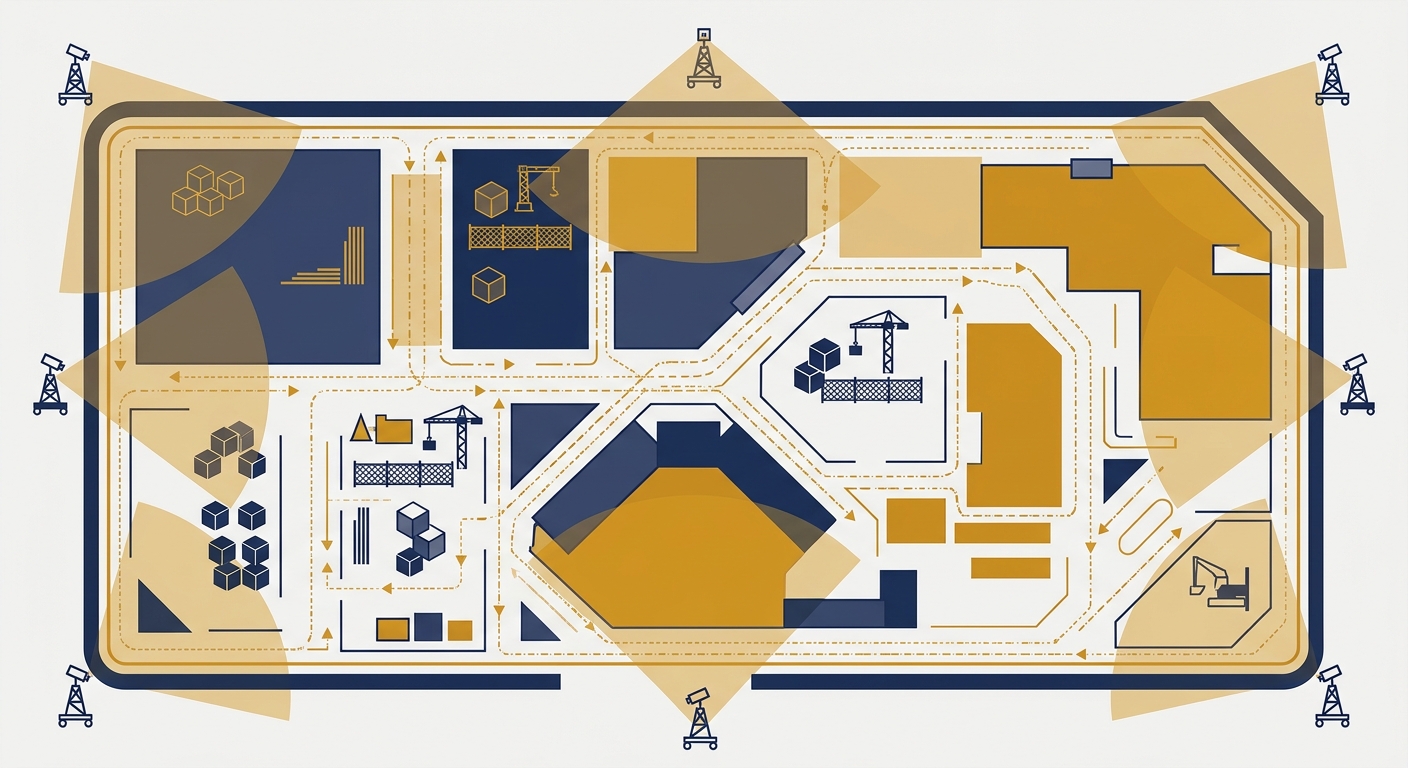
Mobile surveillance towers are the workhorse of modern jobsite protection. A tower is a self-contained, solar- or generator-powered mast carrying multiple cameras — typically a mix of high-resolution color, low-light, and thermal sensors — with onboard analytics, floodlights, and a two-way speaker. Towers are rapidly repositioned as the build progresses and the high-value staging areas move, which is a decisive advantage over fixed cameras on a site with no permanent power or structure yet.
The technology only pays off when it is tied to live response. In a monitored configuration, video analytics distinguish a human intrusion from wind, animals, or headlights and push a verified alert to a monitoring operator, who can issue an immediate voice-down warning over the tower speaker (which ends a large share of intrusions on its own), escalate to a dispatched patrol officer, and coordinate with law enforcement using live footage. Recorded-only cameras, by contrast, mostly document a loss after it is complete. Pairing towers and cameras with our own Arizona-licensed patrol officers closes the gap between detection and physical response — the difference between a deterred attempt and a filed insurance claim.
How does equipment marking, GPS, and asset recovery reduce loss?
Deterrence lowers the odds of a theft; asset intelligence lowers the cost when one still occurs and raises the odds of recovery and prosecution. A disciplined program tags and logs high-value equipment and tool inventories before they arrive on site: covert and overt GPS trackers on machines and trailers, serial-number and PIN registration (so items can be entered into the NICB and National Equipment Register databases), and unique property marking that destroys resale value and links recovered goods back to the project.
Marking and registration also change thief economics: crews prefer anonymous, untraceable metal, so visibly marked and GPS-monitored assets are frequently passed over. When something does move, geofence alerts and location data give patrol and law enforcement an actionable trail rather than a cold report. Maintaining an accurate asset register — what is on site, its serials, and its assigned storage zone — is also the foundation of any credible insurance claim and any subsequent investigation.
What is the role of investigations after a loss?
Jobsite theft is frequently the work of organized rings that hit multiple sites, fence through recurring channels, and sometimes rely on inside knowledge of delivery schedules and site access. That is where Honeybadger’s investigative capability separates it from a guards-only vendor. When a loss occurs, our in-house teams can reconstruct the event from surveillance and access-control logs, analyze patterns across incidents to identify a repeat crew, run background intelligence on suspected internal involvement, and apply digital forensics and financial-investigation techniques to trace fenced goods and money flows.
These findings support law-enforcement referral, insurance recovery, and civil action — and they feed directly back into the security plan, closing the access or scheduling gap the ring exploited. Investigations, digital forensics, cybersecurity, and financial and background intelligence are all delivered in-house and worldwide, so the same firm that guards the site can pursue the loss after it happens. See our broader investigations and security capabilities for how these disciplines integrate.
What are Arizona’s security guard licensing and liability rules?
In Arizona, private security is regulated by the Department of Public Safety (AZ DPS) under Arizona Revised Statutes Title 32, Chapter 26. Security guard agencies must hold an agency license, and individual guards must hold a valid guard registration card, meet training and background requirements, and work under a licensed and insured agency. Using unlicensed or improperly supervised personnel on a jobsite is not a technicality — it exposes the general contractor and developer to liability, undermines any incident that reaches court, and can void the protection the client believed they were buying.
This is a core distinction of how Honeybadger operates in Arizona: our uniformed officers and mobile patrol are our own in-house, Arizona-licensed, supervised personnel — not a subcontracted or vetted-network staffing arrangement. That means one accountable chain of command, consistent post orders, verifiable training, and a firm that stands behind the officers on your site. It is the same standard we apply across industrial and manufacturing security and warehouse security in Phoenix.
How does Honeybadger deliver patrol plus technology in Phoenix?
We build a single, accountable program rather than selling either a camera package or a guard shift in isolation. A Honeybadger construction security engagement follows a structured plan the project executive can audit and adjust as the build advances through its phases.
- Risk assessment and site walk. Evaluate perimeter, access points, staging areas, lighting, surrounding-area crime patterns, and the project schedule to map where value will concentrate and when.
- Define the vulnerability windows. Document unmanned hours, delivery dates, and phase transitions (rough-in, mechanical, finish) that create predictable risk peaks.
- Harden the perimeter and access. Fencing, gates, controlled entry with visitor and vehicle logging, and secured storage for copper, tools, and fuel.
- Deploy surveillance technology. Position mobile surveillance towers and cameras for full coverage of staging and access points, tied to live remote monitoring with verified-alarm response.
- Assign licensed patrol. Schedule our own Arizona-licensed officers on roving and fixed posts with unpredictable timing during high-risk windows, backed by documented post orders.
- Tag and register assets. Apply GPS tracking, serial registration, and property marking to high-value equipment and tool inventories before they reach the site.
- Establish alarm monitoring and escalation. Connect sensors, towers, and cameras to a monitored escalation path: voice-down, patrol dispatch, and law-enforcement coordination.
- Integrate reporting. Provide the GC and developer with incident logs, patrol verification, and footage on a defined cadence for accountability and insurance.
- Reposition as the build evolves. Move towers, patrol posts, and storage as staging areas shift, so coverage tracks the value rather than lagging it.
- Investigate and recover on loss. Trigger in-house investigations, forensics, and asset-recovery support if a theft occurs, and feed the findings back into the plan.
Honeybadger Solutions serves the entire Phoenix metropolitan area and Arizona’s fastest-growing construction corridors — Deer Valley and the Loop 303, Mesa, Chandler, Gilbert, Queen Creek, Buckeye, Goodyear, Surprise, and the Pinal County industrial belt around Casa Grande. We operate three Arizona offices — Casa Grande (headquarters), Phoenix, and Oro Valley — which lets us stand up patrol and technology quickly on data-center, semiconductor, warehouse, and master-planned residential jobsites statewide. Explore our Phoenix security services, our dedicated Phoenix security guard services, and our statewide Arizona construction site security program.
Frequently asked questions
Does Honeybadger use its own guards for Phoenix construction sites?
Yes. In Arizona, our uniformed officers and mobile patrol are our own in-house, Arizona-licensed, supervised personnel — not subcontractors or a staffing network. That gives your jobsite one accountable chain of command, consistent post orders, and verifiable training, paired with our own surveillance technology.
What is the most cost-effective way to secure a jobsite overnight?
For most Phoenix sites the strongest value is a layered mix: live-monitored mobile surveillance towers covering staging and access points, secured storage for copper and tools, and roving licensed patrol during unmanned hours. Technology extends coverage across a large site, while patrol provides the physical response that cameras alone cannot.
Can you recover stolen equipment after a theft?
Recovery odds rise sharply when assets are GPS-tagged, serial-registered, and property-marked before a loss. When theft occurs, our in-house investigators reconstruct the incident, analyze cross-site patterns, and support law-enforcement referral and insurance claims — using digital forensics and financial-investigation resources to trace goods and identify organized crews.
Do security guards in Arizona need a license?
Yes. Under Arizona Revised Statutes Title 32, Chapter 26, security agencies must be licensed by the Arizona Department of Public Safety and individual guards must hold a valid registration card, meet training requirements, and work under a licensed, insured agency. Using unlicensed personnel creates real liability for the contractor and developer.
About Honeybadger Solutions
Honeybadger Solutions is an Arizona-licensed security and investigations firm. In Arizona, our uniformed officers and mobile patrol are our own in-house, Arizona-licensed, supervised personnel — not subcontractors — and we pair them with jobsite security technology. Digital forensics, cybersecurity, financial investigations, and background intelligence are run in-house and delivered worldwide. We serve all of Arizona and support clients nationwide and internationally.
Offices: Casa Grande (HQ), Phoenix, and Oro Valley, Arizona.
Phone: Book a consultation online
Confidential consultation: speak with our command team about a Phoenix construction site security plan.
Browse by topic
Security guard services · Private investigations · Cybersecurity · Digital forensics · Financial fraud investigation · Executive protection · All articles