

Surveillance in Tucson and Pima County is lawful and evidence-grade when it is conducted from public vantage points, records only what any observer could lawfully see, and is documented to a court-ready standard. Honeybadger Solutions runs Tucson surveillance with our own in-house, Arizona-licensed investigators coordinated from our nearby Oro Valley office and producing time-stamped video, chronological logs, and chain-of-custody-controlled deliverables built to survive scrutiny in Pima County courts.
Tucson is not Phoenix, and surveillance here is not a copy-paste of Valley tradecraft. The terrain, the community layout, the traffic patterns, and even the pace of movement are different—and an investigator who does not know the ground gets burned. For attorneys, insurers, employers, and private principals in Southern Arizona, this guide explains how professional covert surveillance is actually conducted in the Tucson metro: the local operating environment, the Arizona legal boundaries that govern the work, the deliverables that hold up in court, and why using an agency’s own licensed investigators matters. It is general information, not legal advice; confirm specifics with counsel before acting.
Who conducts surveillance in the Tucson area?
In Arizona, Honeybadger’s surveillance is performed by our own in-house, Arizona-licensed private investigators—personnel we employ, train, and supervise directly. Southern Arizona is part of our home command; our Oro Valley office sits in the northern Tucson metro, so the investigator working your Pima County matter is a Honeybadger investigator.
This distinction is easy to overlook and expensive to ignore. When surveillance evidence is later challenged, the investigator who gathered it may need to authenticate the footage and testify to the method. An in-house, Arizona-licensed investigator who followed a documented procedure is a credible witness. Arizona private investigators are licensed and regulated by the Arizona Department of Public Safety, and working with a properly licensed agency is the floor for defensible work.
What makes Tucson’s terrain distinct for surveillance?
Effective surveillance is a function of the ground it is run on. Tucson and Pima County present a specific operating environment that shapes every method decision.
- Low-density, spread-out development. Much of the metro is low-rise and horizontally dispersed, with long sightlines and limited natural cover. A vehicle that lingers is conspicuous, so post selection and rotation are critical.
- Foothills and desert edges. Neighborhoods in the Catalina Foothills, Oro Valley, and Marana border open desert and washes; roads can be winding and lightly trafficked, where a following vehicle stands out immediately.
- Gated and HOA communities. Many residential areas have controlled access and sparse public parking, requiring lawful observation from perimeter public roads rather than interior streets.
- University and downtown density. Around the University of Arizona and central Tucson, foot surveillance can blend into pedestrian flow—an option that suburban follows rarely allow.
- Heat and light. Extreme summer temperatures limit how long an operator can sit undetected, and the intense high-desert light and long golden hours affect camera positioning and timing.
- Corridor traffic and the I-10/I-19 spine. Cross-town and cross-border movement funnels onto a few major routes, which both aids and complicates mobile follows depending on spacing and hand-offs.
Local knowledge converts these constraints into advantages. An investigator who knows which foothills roads dead-end, where public parking is plausible, and how traffic flows at a given hour can hold a subject without ever appearing to follow them.
Pima County also stretches well beyond the urban core. Engagements can reach into Sahuarita, Green Valley, Vail, the far exurban edges near the Santa Rita and Rincon mountains, and the rural stretches along the I-19 corridor toward the border region. These environments amplify every challenge: on a lightly traveled rural road, a single vehicle behind a subject is instantly conspicuous, and there is often nowhere to sit that looks natural. Working them successfully requires greater standoff distance, disciplined use of the terrain’s few natural vantage points, and frequently a second investigator to leapfrog ahead rather than trail behind. An out-of-town operator dropped into these areas without local familiarity is at a severe disadvantage—one more reason surveillance in Southern Arizona should be run by investigators who actually know the ground.
What are the legal boundaries under Arizona law?
The rules are the same statewide, and they define professional surveillance in Tucson exactly as they do in Phoenix.
- One-party consent for recording conversations. Arizona is a one-party-consent state; recording a private conversation you are not a party to, without any participant’s consent, is prohibited. Our default is to avoid capturing private audio, and video without audio is analyzed separately.
- Reasonable expectation of privacy is off-limits. Arizona law bars surreptitious viewing or recording of a person in a place where privacy is reasonably expected—bathrooms, bedrooms, changing areas. We observe only what is visible from lawful public vantage, never into private interiors or screened yards.
- No trespass. Investigators do not enter private property or cross barriers to record. Observation is from public streets, rights-of-way, and areas open to the public or where we have consent.
- Licensing. The work is conducted by Arizona-licensed investigators—both a legal requirement and a precondition for admissibility.
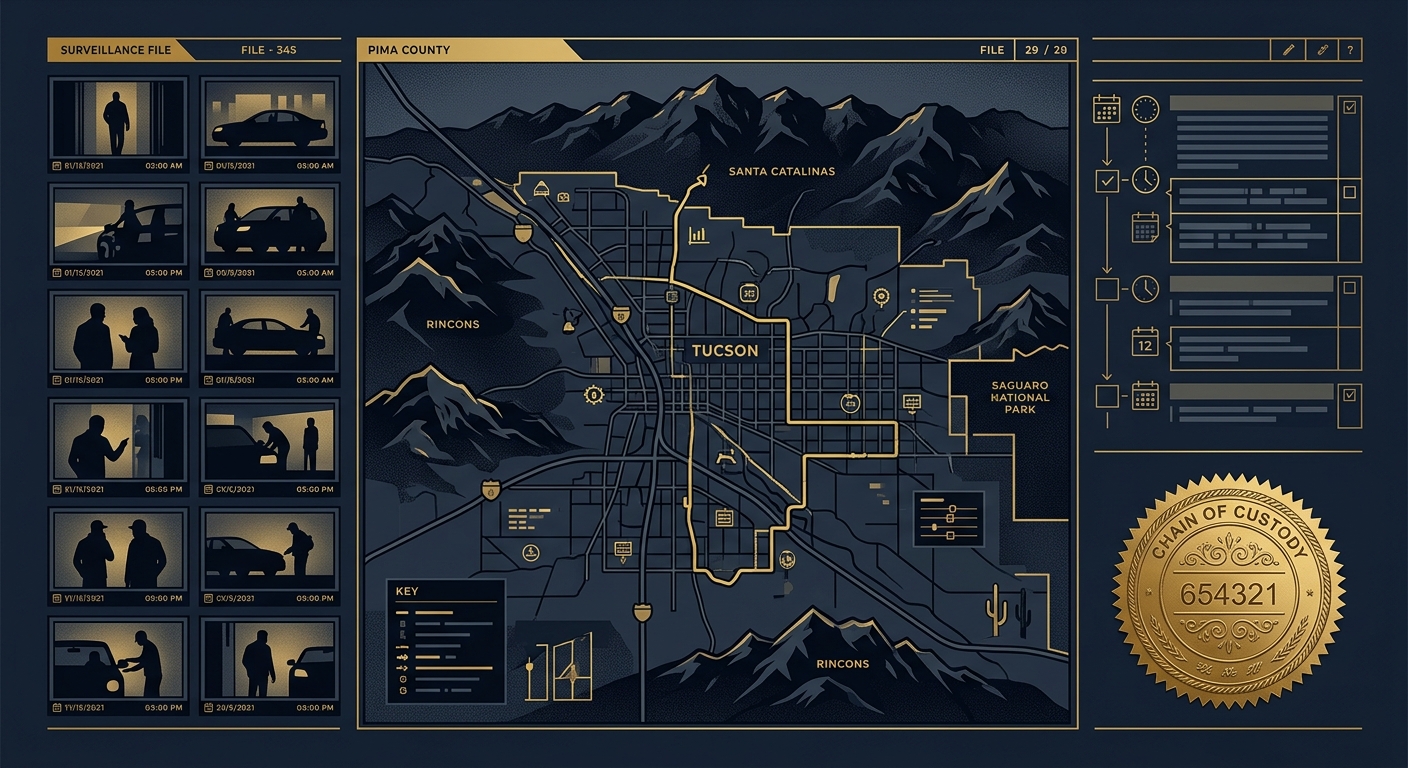
Which surveillance methods fit the Tucson environment?
Method selection is driven by the subject, the objective, and the ground. The table below maps common techniques to how they play in Southern Arizona.
| Method | Best used for | Tucson / Pima considerations |
|---|---|---|
| Stationary observation post | Confirming routines, presence, and visitors at a location | Long sightlines expose lingering vehicles; requires careful post choice and rotation, especially in foothills neighborhoods |
| Mobile (vehicle follow) | Documenting destinations and activity away from a fixed site | Lightly trafficked roads make tailing obvious; corridor spine (I-10/I-19) aids spacing but demands hand-offs |
| Foot surveillance | University district, downtown, malls, medical complexes | Viable where pedestrian density exists; limited in dispersed suburbs |
| Covert photography / video | Anchoring the report with a clear visual record | Long lenses from lawful distance; account for intense light and long shadows |
| Multi-investigator team | Difficult subjects, long routes, cross-metro movement | Reduces burn risk on open roads; enables continuous coverage |
The professional standard is patience over pursuit. On Tucson’s open, low-traffic roads especially, an operator who crowds a subject is spotted quickly; the disciplined approach holds distance, predicts the route, and breaks off before burning the operation—because a subject who realizes they are watched changes behavior and the case’s value evaporates.
What do you receive? Court-ready deliverables
The value of a surveillance engagement lives in its record. Our Pima County deliverables are built for counsel, adjusters, and, if necessary, testimony:
- Chronological activity log—a contemporaneous, minute-by-minute factual narrative of observed activity, times, and locations, written in neutral language.
- Time-stamped video and photographs—the visual record keyed to the log, preserved in original form with a working evidentiary copy.
- Investigator identification and declaration—the licensed investigator who did the work can authenticate the footage and, if required, testify to the method.
- Objective summary report—a concise overview tying observations to the engagement’s questions, free of speculation.
- Chain-of-custody documentation—a continuous record of capture, storage, and transfer so integrity is verifiable end to end.
Our reports state what was observed, not what we assume—objectivity is what makes them hard to impeach. When a Tucson matter also involves digital evidence, we bring in our digital forensics team so recovered messages, geolocation, or device data are preserved to the same evidentiary standard.
What are common Tucson surveillance use cases?
Surveillance is labor-intensive, so it belongs where observation is the strongest route to proof. In Pima County the recurring engagements include:
- Insurance and workers’ compensation defense—documenting activity inconsistent with a claimed injury for carriers and defense counsel.
- Family law and domestic matters—establishing patterns relevant to custody, cohabitation, or, where lawful and relevant, suspected infidelity.
- Employment and corporate—confirming moonlighting, benefit abuse, or conduct tied to an internal inquiry.
- Financial and fraud matters—observing activity or lifestyle inconsistent with claims, corroborating a broader financial investigation.
- Due diligence and threat assessment—discreetly verifying a subject’s routines and associations within a larger risk picture.
Honeybadger covers the full Tucson metro—central Tucson, the Catalina Foothills, Oro Valley, Marana, Sahuarita, Vail, and surrounding Pima County—directed from our nearby Oro Valley office and coordinated statewide with our Casa Grande headquarters and Phoenix office. You can review our Arizona service footprint for the full picture. Because these are our own licensed investigators, coverage across Southern Arizona is consistent and accountable.
Representative scenario: the foothills follow
Consider a representative matter. Counsel needed to document whether a subject in a foothills neighborhood was engaged in physical activity inconsistent with a disability claim. The winding, low-traffic roads made a conventional tail impossible—any following vehicle would have been obvious within a block. The investigator instead established a lawful public post on a through-street with a natural sightline to the residence’s driveway, timed observation windows to the subject’s known routine, and documented the subject repeatedly loading and unloading equipment and performing sustained physical labor. When the subject drove into the metro, a second investigator picked up the follow on the busier arterial, allowing continuous coverage without exposure. No trespass, no audio, no contact—just a clean, time-stamped record tied to a contemporaneous log. This is an illustrative scenario, not a named client or claimed outcome, but it reflects how local knowledge and disciplined method produce evidence that stands on its own.
Frequently asked questions
Does Honeybadger use its own investigators in Tucson or subcontract the work?
In Arizona—including the Tucson metro—we use our own in-house, Arizona-licensed private investigators. Southern Arizona is part of our home command, and our Oro Valley office is in the northern Tucson metro. The investigator on your Pima County matter is a Honeybadger employee operating under our methodology and chain-of-custody controls, able to authenticate the work if testimony is needed. Only outside Arizona do we combine in-house teams with vetted field partners.
Is it legal to record someone in public in Tucson?
Generally, recording what is plainly visible from a lawful public vantage point is permitted, provided there is no trespass and no intrusion into places where a person has a reasonable expectation of privacy. Arizona is a one-party-consent state for recording conversations, so we default to avoiding private audio capture. Video without audio, taken from public space, is analyzed separately and is a core, lawful surveillance tool when documented properly.
Why does Tucson surveillance require different tradecraft than Phoenix?
Tucson’s lower density, long desert sightlines, winding foothills roads, gated communities, and lighter traffic make lingering vehicles and following cars far more conspicuous than in a dense metro. Effective work here depends on local knowledge of the ground—post selection, timing, and route prediction—and often on multiple investigators to maintain coverage without exposure. Tradecraft that works on a busy Phoenix arterial can burn instantly on a quiet Catalina Foothills lane.
How long does a Tucson surveillance engagement take?
It depends on the objective. Confirming a single fact may take a few hours of well-timed observation; establishing a defensible pattern of activity usually requires multiple days of coverage, sometimes with more than one investigator. Because open terrain limits sit-time and follow options, we scope realistic coverage windows up front and match the level of effort to the evidentiary standard the matter must meet. Call to discuss your specific situation.
About Honeybadger Solutions
Honeybadger Solutions is an Arizona-licensed security and investigations firm delivering full-spectrum investigations, surveillance, digital forensics, and security services. In Arizona, our surveillance and field investigations are performed by our own in-house, AZ-licensed investigators supervised under documented methodology with chain-of-custody controls and court-ready reporting. We operate three Arizona offices—Casa Grande (headquarters), Phoenix, and Oro Valley—serving the full Tucson metro and Pima County, all Arizona venues, and, through in-house teams and vetted partners, engagements nationwide and internationally.
Need discreet, lawful, court-ready surveillance in Tucson or Pima County? Book a consultation online to brief an investigations lead and scope an approach with your counsel. Confidential. Defensible. Arizona-owned.
This article is general information, not legal advice; laws vary and change—confirm specifics with qualified counsel. Authoritative references: A.R.S. § 13-3005, interception of communications (Arizona State Legislature) and Arizona Department of Public Safety — Licensing (private investigators).
Browse by topic
Security guard services · Private investigations · Cybersecurity · Digital forensics · Financial fraud investigation · Executive protection · All articles