
Workers’ compensation surveillance in Arizona holds up when it is lawfully obtained from public vantage points, documents activity plainly inconsistent with claimed restrictions, and is preserved to a sub-rosa evidentiary standard—contemporaneous logs, time-stamped video, an investigator who can testify, and unbroken chain of custody. Honeybadger Solutions conducts this work with our own in-house, Arizona-licensed investigators, producing evidence built to survive challenge before the Industrial Commission and in court.
For carriers, third-party administrators, self-insured employers, and defense counsel, workers’ compensation surveillance is a high-stakes, tightly scrutinized tool. Done well, it produces objective proof that a claimed limitation does not match reality—the kind of evidence that resolves inflated or fraudulent claims. Done poorly, it produces footage that is inadmissible, an investigator who cannot authenticate the work, or, worse, conduct that hands the claimant’s counsel a harassment or privacy argument. This guide explains how sub-rosa surveillance is conducted to a standard that actually holds up in Arizona. It is general information, not legal advice; confirm specifics with counsel.
What is sub-rosa surveillance in a workers’ comp claim?
“Sub rosa”—literally “under the rose”—is the insurance-defense term for covert surveillance conducted without the claimant’s knowledge to document their actual physical capabilities and daily activity. The premise is straightforward: a claim rests on a description of what the injured worker can no longer do. Sub-rosa surveillance tests that description against observable reality. If a claimant who reports being unable to lift, bend, stand, or drive is documented doing exactly those things, the objective record contradicts the claim.
The purpose is not to “catch” anyone through trickery; it is to gather a truthful, neutral record of activity that any observer could lawfully see. That neutrality is the point. Sub-rosa evidence is powerful precisely because it is not argument—it is documentation. But it only carries that weight if it is gathered lawfully and preserved to an evidentiary standard, which is where the discipline lives.
Is workers’ comp surveillance legal in Arizona?
Yes—when conducted within Arizona’s legal boundaries. Insurance-defense surveillance is well-established, but the same limits that govern all Arizona surveillance apply with full force here, and claimant’s counsel will probe every one of them.
- Public vantage only; no trespass. Investigators observe from public streets, rights-of-way, and areas open to the public. They do not enter private property, cross fences, or use pretext to gain access (Arizona criminal trespass, A.R.S. §§ 13-1502 to 13-1504).
- No intrusion into private spaces. Arizona law protects places where a person has a reasonable expectation of privacy. Investigators document activity visible from lawful vantage—never into a home’s interior or a screened, fenced yard.
- One-party consent for audio. Arizona is a one-party-consent state (A.R.S. §§ 13-3005 and 13-3012); secretly recording a private conversation the investigator is not part of is unlawful. Sub-rosa work relies on video without private audio.
- No harassment. Surveillance must be passive observation. Following too closely, confronting, or conduct a claimant could characterize as intimidation undermines the evidence and creates liability. Professionals stay invisible and non-interfering, well clear of conduct that could implicate Arizona’s stalking statute (A.R.S. § 13-2923).
- Licensed investigators. The work is performed by Arizona-licensed private investigators, licensed under A.R.S. Title 32, Chapter 24 and regulated by the Arizona Department of Public Safety—a legal requirement and a foundation for admissibility.
Arizona workers’ compensation matters are administered through the Industrial Commission of Arizona, and evidence offered in that forum—or in related litigation—must satisfy the same standards of lawful acquisition and authentication as any other. Surveillance gathered outside these limits is not merely weak; it can be excluded and can convert a defensible claim into a liability exposure.
What makes surveillance evidence actually hold up?
The gap between footage that resolves a claim and footage that gets thrown out is method. Elite sub-rosa work satisfies both legality and evidentiary foundation. The table below contrasts the two ends of the spectrum.
| Requirement | Holds up | Gets challenged or excluded |
|---|---|---|
| Acquisition | Lawful public vantage, no trespass, no intrusion | Trespass, shooting into private spaces, pretext access |
| Audio | Video only; no unlawful conversation capture | Secretly recorded private conversations |
| Continuity | Continuous, contemporaneous activity log | Selective clips with unexplained gaps |
| Authentication | Licensed investigator available to testify | Anonymous subcontractor who cannot be produced |
| Integrity | Original media preserved; chain of custody documented | Edited or re-encoded footage with no provenance |
| Objectivity | Neutral record of what was observed | Narrated conclusions the footage doesn’t support |
A recurring mistake amateurs make is capturing only the “gotcha” moment while discarding the surrounding context. Claimant’s counsel exploits those gaps, arguing the clip is cherry-picked or misleading. Disciplined sub-rosa work documents the full sequence—arrival, activity, departure—so the record is complete and the activity cannot be dismissed as a momentary exception. Continuity and context are what make a few seconds of decisive footage unassailable.
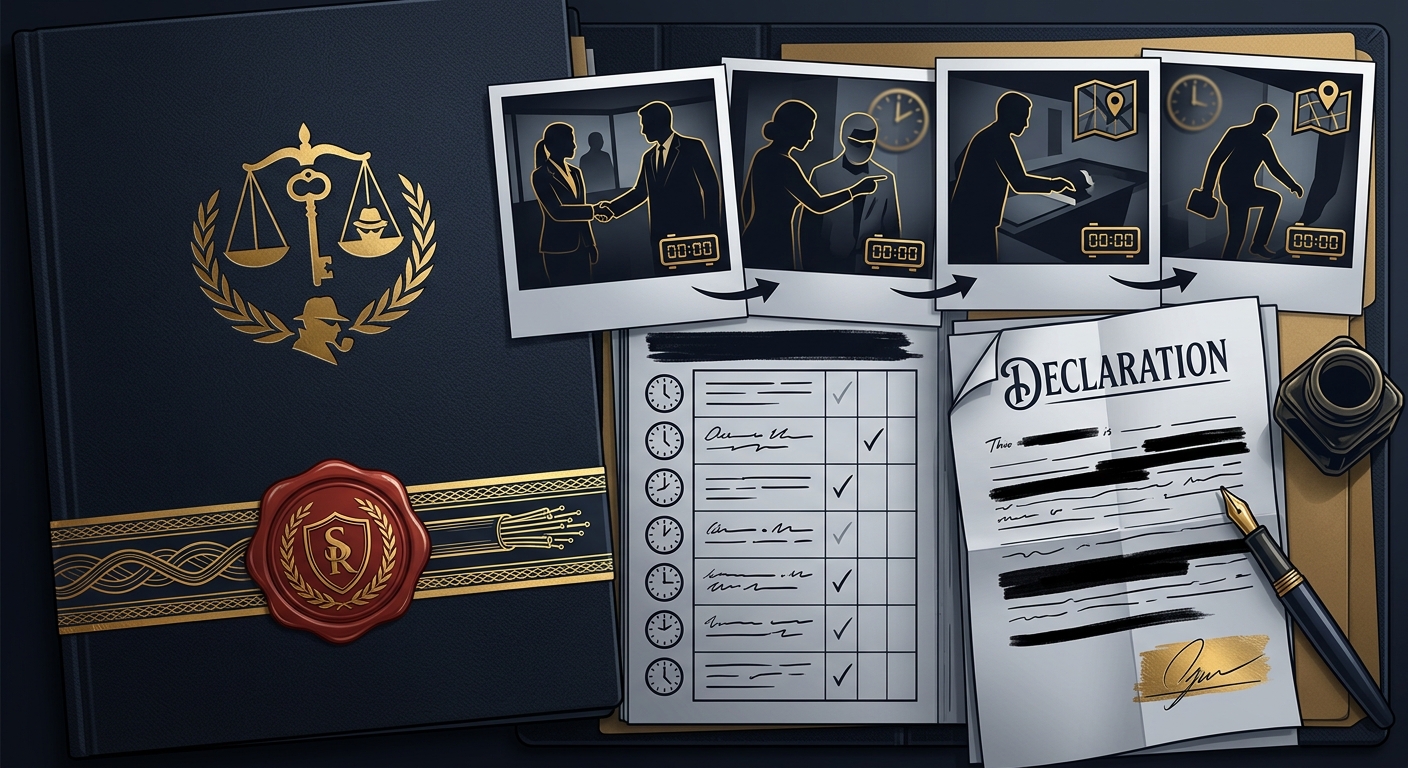
Arizona tribunals apply ordinary rules of authentication to surveillance. Under Ariz. R. Evid. 901, the proponent must show the evidence is what it purports to be—here, a true and unaltered record of what the investigator actually observed. That foundation is built from three things working together: the investigator’s testimony about the vantage and the method, the contemporaneous activity log, and a documented chain of custody over the original media from capture to production. Preserve all three and the footage is difficult to attack; neglect any one and even damning video becomes vulnerable to a foundational objection that keeps it out of the record entirely.
How is a professional sub-rosa operation run?
A defensible workers’ comp surveillance engagement follows a disciplined sequence from intake to deliverable.
- Case review and objective setting. The investigator studies the claimed restrictions and the questions the defense needs answered, so surveillance targets activity that is genuinely probative—not random footage.
- Reconnaissance. The area around the claimant’s residence and likely destinations is assessed for lawful vantage points, parking, sightlines, and cover, so the operation looks natural from the outset.
- Timing to activity windows. Coverage is scheduled around when meaningful activity is likely, maximizing probative observation per hour of effort.
- Patient, non-interfering observation. The investigator documents from a lawful distance, never crowding or confronting the claimant, capturing continuous sequences rather than isolated fragments.
- Contemporaneous logging. Every observation is recorded in real time—times, locations, activity—so the narrative is built as it happens.
- Secure preservation. Original footage is preserved unaltered under chain-of-custody controls, with a working copy for review.
- Reporting. A neutral, factual report ties the visual record to the log and the claim’s questions, ready for the adjuster, counsel, and, if needed, the Commission or court.
Where a claim intersects with digital evidence—social-media activity, geolocation, or device data that corroborates observed behavior—we integrate our digital forensics capability so that evidence is preserved and authenticated to the same standard. This is also where workers’ comp surveillance connects to broader insurance-claim fraud investigation for carriers.
Which claims justify surveillance, and how much is enough?
Surveillance is an investment, and not every claim warrants it. Experienced adjusters and defense counsel reserve it for files where the medical picture, the claimant’s reported limitations, and observable indicators do not line up—where activity levels seem inconsistent with the injury, where a claim has extended well beyond expected recovery, where prior red flags exist, or where the exposure is large enough that objective proof materially changes the outcome. Deploying surveillance against a well-documented, credible injury usually wastes resources and can even backfire if the footage merely confirms the claimant’s restrictions.
The question of “how much” is equally important. A single short clip rarely resolves a contested claim; a claimant seen doing something once can plausibly argue it was a bad decision they paid for later. What holds up is a documented pattern—repeated activity across multiple days and contexts that is flatly inconsistent with the claimed limitation. That is why professional sub-rosa engagements are typically scheduled as multi-day surveillance windows timed to likely activity, not open-ended monitoring. The goal is to capture enough continuous, contextual footage to establish a pattern a reasonable factfinder cannot dismiss, while spending the client’s resources efficiently. A disciplined provider will tell a client honestly when a claim does not justify surveillance, or when the coverage obtained is sufficient and further days would add cost without adding proof. That candor protects the client’s budget and the credibility of the evidence alike, and it is one more reason contested Arizona claims are best handled by an accountable, in-house team rather than a provider paid simply to keep the meter running.
Activity check versus full surveillance: which does a claim need?
Not every file calls for the same intensity of coverage, and matching the tool to the question is part of spending a client’s budget responsibly. In insurance defense, two distinct products serve two distinct purposes, and confusing them is a common way to waste money or come up short.
- Activity check. A short, targeted effort—often a partial day—to answer a narrow threshold question: is the claimant physically active at all, do they leave the residence, are they driving, is there any visible inconsistency worth pursuing? An activity check is a cost-controlled first look that tells an adjuster whether fuller surveillance is even justified before larger sums are committed.
- Full surveillance. Multi-day, multi-shift coverage designed to establish a documented pattern of activity inconsistent with the claimed restrictions. This is what produces the continuous, contextual record that survives a cherry-picking argument and carries weight before an IME physician or an administrative law judge.
A disciplined provider recommends the lighter tool when it fits and escalates only when the file warrants it. Running full surveillance on a claim an activity check could have resolved burns budget; running a single activity check on a large, hotly contested exposure and stopping there can leave the defense without the pattern evidence it actually needs. The right sequence—activity check to qualify the file, full surveillance to prove the pattern—protects the client’s spend and the strength of the eventual record at the same time.
Why do our own Arizona investigators matter here?
In Arizona, Honeybadger performs sub-rosa surveillance with our own in-house, Arizona-licensed investigators—not subcontractors. This is decisive in the workers’ comp context specifically, because these matters are frequently contested and the investigator’s testimony is often required to authenticate the footage and describe the method. When that witness is our trained, licensed employee who followed documented procedure and maintained chain of custody, the evidence stands. When the footage came from an anonymous field operator hired by a broker, defense counsel is left unable to produce a credible authenticating witness—and the most persuasive video can collapse on that gap alone.
Ownership also means consistency: the same standard of tradecraft, logging, and reporting on every assignment across the state. Outside Arizona, we extend the identical standard through in-house teams and vetted field partners, but Arizona claims are handled entirely by our own personnel. Honeybadger supports carriers, TPAs, self-insured employers, and defense counsel across the state—Phoenix, Tucson, and everywhere between—coordinated from three offices. Review our Arizona coverage for the full footprint.
How is sub-rosa footage used at an IME or ICA hearing?
Surveillance rarely resolves a claim on its own; its value is realized when it reaches the right decision-maker in the right form. In Arizona workers’ compensation, two forums matter most.
The independent medical examination (IME). When a carrier questions the extent of a claimed impairment, footage is frequently provided to the examining physician. A doctor who has read that a claimant cannot lift, bend, or reach overhead—and then watches that same claimant do all three, repeatedly and without apparent difficulty—may revise the impairment rating or the work restrictions accordingly. That medical opinion, informed by objective activity, often carries more weight than the raw video, because it converts observation into a clinical conclusion the claim actually turns on.
The ICA hearing. Contested Arizona claims are decided by an administrative law judge at the Industrial Commission of Arizona. There, the footage must be authenticated—which is exactly why the investigator who captured it, kept the log, and preserved the original media is indispensable. Under Ariz. R. Evid. 901 the video must be shown to be what it claims to be, and a licensed investigator who can describe the vantage, the method, and the unbroken chain of custody supplies that foundation. Footage from an anonymous operator who cannot be produced to testify invites the exclusion that unravels an otherwise decisive record.
The lesson for carriers and defense counsel is that the deliverable is never just video. It is video plus a credible authenticating witness plus a clean evidentiary trail—built from the first shift with the IME and the hearing already in mind, not assembled after the fact.
Representative scenario: the complete sequence
Consider a representative Arizona matter. A carrier was defending a claim of a severely disabling shoulder injury that, per the file, prevented the claimant from lifting or performing overhead work. Rather than seek a single dramatic clip, the investigator documented a full sequence over several days from lawful public vantage: the claimant arriving at a property, repeatedly lifting and carrying heavy items, and performing sustained overhead work for an extended period—each segment continuous, time-stamped, and logged contemporaneously. Because the footage captured the entire activity rather than an isolated fragment, there was no “momentary exception” argument available. No trespass, no audio, no contact, and the licensed investigator was available to authenticate the record. The objective evidence resolved the matter. This is an illustrative scenario, not a named client or claimed outcome, but it reflects how lawful, complete, well-preserved sub-rosa work produces proof that holds up.
Frequently asked questions
Is sub-rosa surveillance legal in Arizona workers’ comp cases?
Yes, when conducted lawfully. Investigators may observe and record a claimant’s activity from public vantage points without trespass and without intruding into places where the claimant has a reasonable expectation of privacy. Arizona is a one-party-consent state, so sub-rosa work relies on video without unlawful audio capture, and it must be passive observation—no harassment or confrontation. Performed within these limits by a licensed investigator, the evidence is admissible and defensible.
Why does surveillance footage sometimes get excluded?
Usually because of how it was obtained or preserved: trespass, recording into private spaces, unlawful audio, selective clips with unexplained gaps, edited footage with no provenance, or an investigator who cannot be produced to authenticate it. The fix is discipline—lawful acquisition, continuous and contemporaneous logging, preservation of original media under chain of custody, and a licensed investigator available to testify. Complete, objective, well-preserved footage is far harder to challenge.
Does Honeybadger subcontract Arizona workers’ comp surveillance?
No. In Arizona we conduct sub-rosa surveillance with our own in-house, Arizona-licensed investigators. This matters especially in contested comp claims, where the investigator often must authenticate the footage and testify to the method. Our own trained, licensed employee who followed documented procedure and chain of custody is a credible witness; an anonymous subcontractor is a gap. Outside Arizona we combine in-house teams with vetted field partners under the same standard.
Can social media be used alongside surveillance?
Yes, when handled correctly. Publicly visible social-media activity can corroborate observed physical surveillance, but it must be preserved and authenticated properly to be usable—screenshots alone are often insufficient. We integrate digital-forensics preservation so that online evidence is captured with verifiable integrity and tied to the broader record, strengthening the overall picture rather than introducing a weak, challengeable link.
How is surveillance footage used at an Arizona ICA hearing?
Contested Arizona workers’ compensation claims are decided by an administrative law judge at the Industrial Commission of Arizona, and footage offered there must be authenticated under Ariz. R. Evid. 901—shown to be a true, unaltered record of what was observed. The licensed investigator who captured the video, kept the contemporaneous log, and preserved the original media provides that foundation and can testify to the method. Before a hearing, footage is also frequently shown to an IME physician, who may revise impairment ratings or work restrictions after seeing activity inconsistent with the claimed limitations.
About Honeybadger Solutions
Honeybadger Solutions is an Arizona-licensed security and investigations firm delivering full-spectrum investigations, sub-rosa surveillance, digital forensics, and financial investigation services. In Arizona, our surveillance is performed by our own in-house, AZ-licensed investigators—not subcontractors—supervised under documented methodology with chain-of-custody controls and court-ready reporting for carriers, TPAs, self-insured employers, and defense counsel. We operate three Arizona offices—Casa Grande (headquarters), Phoenix, and Oro Valley—serving every Arizona venue and, through in-house teams and vetted partners, engagements nationwide.
Defending a questionable Arizona workers’ comp claim? Book a consultation online to brief an investigations lead and scope lawful, admissible sub-rosa surveillance with your counsel. Confidential. Defensible. Arizona-owned.
This article is general information, not legal advice; laws vary and change—confirm specifics with qualified counsel. Authoritative references: Industrial Commission of Arizona and Arizona Department of Public Safety — Licensing (private investigators).
Browse by topic
Security guard services · Private investigations · Cybersecurity · Digital forensics · Financial fraud investigation · Executive protection · All articles