
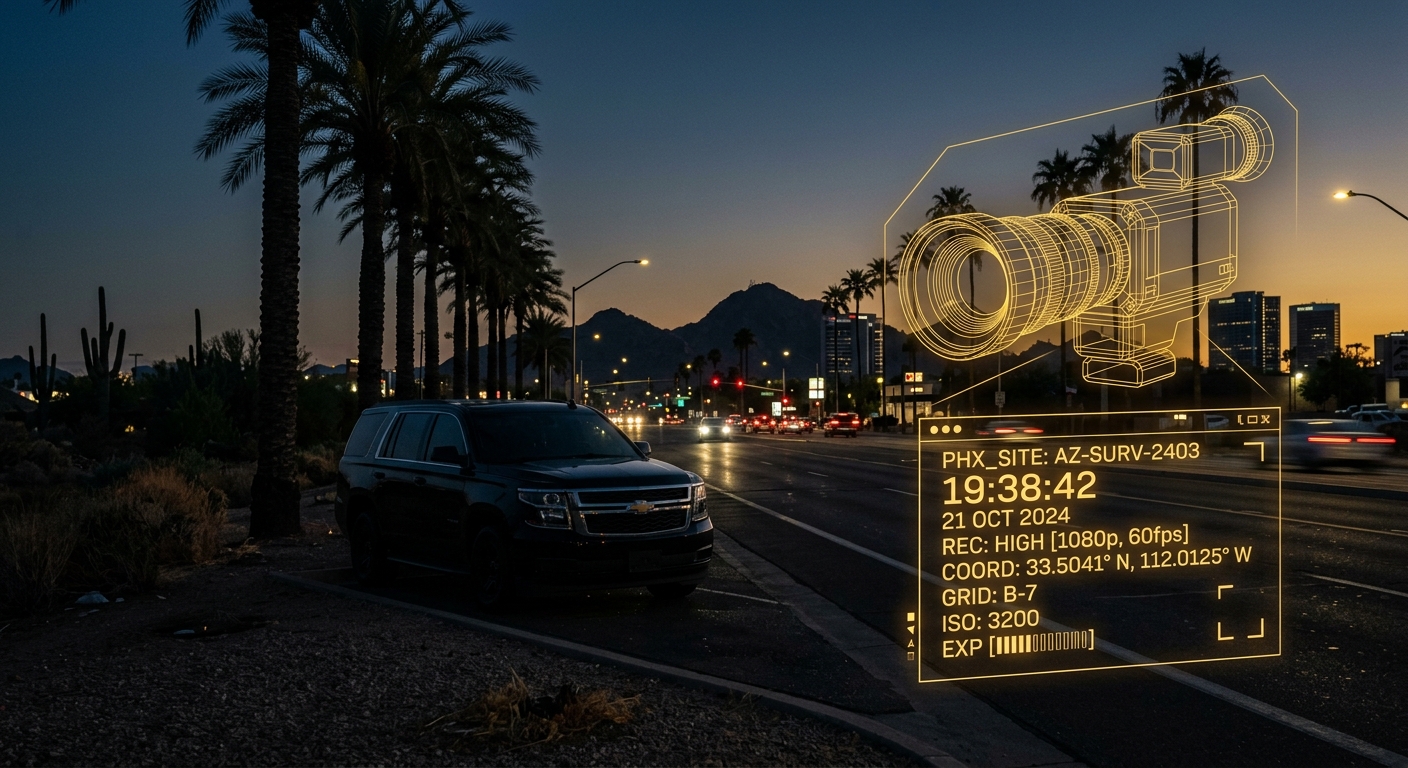
Covert surveillance in Phoenix is a lawful, evidence-grade discipline when it is conducted from public vantage points, records only what any person could observe, and is documented to an admissible standard. Honeybadger Solutions runs Phoenix surveillance with our own in-house, Arizona-licensed investigators producing continuous activity logs, time-stamped video, and chain-of-custody-controlled deliverables built to survive cross-examination in Maricopa County courts.
For general counsel, insurers, family-law attorneys, and principals, surveillance is the point where a suspicion either becomes proof or becomes a liability. A single burned operation, an unlawful recording, or a sloppy log can destroy the value of an otherwise strong case—and in the worst instances, hand the other side a weapon. This guide explains how elite covert surveillance is actually conducted in Phoenix and across the Valley of the Sun: the legal boundaries under Arizona law, the field methods and equipment that separate professional operators from amateurs, the deliverables that hold up in court, and the use cases where surveillance earns its cost. It is general information, not legal advice; confirm specifics with counsel before acting.
Who conducts Honeybadger’s surveillance in Phoenix?
In Arizona, surveillance is performed by Honeybadger Solutions’ own in-house, Arizona-licensed private investigators—personnel we employ, train, supervise, and stand behind. This is a deliberate distinction. Because Arizona is our home command, we do not broker the work here. The investigator sitting on your subject is our investigator, operating under our procedures, our chain-of-custody controls, and our reporting standard.
That matters for two reasons. First, quality: mobile and foot surveillance in a sprawling, car-dependent metro like Phoenix is difficult, and the difference between a clean capture and a burned subject is experience and coordination. Second, defensibility: when surveillance evidence is challenged, the person who gathered it may have to testify. An in-house, licensed investigator who followed a documented methodology is a credible witness; an anonymous subcontractor is a gap in your case. Private investigators in Arizona are licensed and regulated by the Arizona Department of Public Safety, and working with a properly licensed agency is the baseline for admissible work.
Is covert surveillance legal in Arizona?
Yes—within clear limits. Professional surveillance in Arizona relies on observing and recording what is plainly visible from lawful, public, or consented vantage points. The legal guardrails that govern how we work in Phoenix are specific and non-negotiable.
- Recording conversations — one-party consent. Arizona is a one-party-consent state for the interception of oral and electronic communications. A party to a conversation may lawfully record it; recording a private conversation you are not part of, without any participant’s consent, is prohibited. Video without audio is analyzed separately from audio capture, and our default is to avoid capturing private audio.
- No reasonable expectation of privacy. Surveillance is confined to what is observable from public space or a lawful vantage. Arizona law specifically prohibits surreptitious viewing or recording of a person in a place where they have a reasonable expectation of privacy—bathrooms, bedrooms, dressing areas, and the like. We do not photograph through windows into private interiors or into fenced, screened yards.
- No trespass. Investigators do not enter private property, cross fences, or use pretext to gain physical access to record. Observation is conducted from streets, public rights-of-way, commercial parking areas open to the public, or locations where we have the property owner’s consent.
- No GPS on vehicles we don’t control. Attaching a tracking device to a subject’s personal vehicle without authorization is a distinct legal question and is not part of standard covert surveillance; location intelligence, when appropriate, is handled separately and lawfully.
- Licensing. The work is performed by Arizona-licensed investigators, which is both a legal requirement and a foundation for admissibility.
The unifying principle is simple: we document only what a reasonable person standing in a lawful place could see, and we capture it with methods a court will accept. That discipline is exactly what makes the resulting evidence usable.
What surveillance methods do professional investigators use?
“Surveillance” is not one technique but a toolkit selected to fit the subject, the environment, and the objective. Phoenix presents specific challenges—long, straight arterials with sparse cover, gated communities, master-planned suburbs with limited public parking, extreme summer heat that constrains how long an operator can sit undetected, and heavy freeway commuting that makes mobile follows demanding. Professional method selection accounts for all of it.
| Method | Best used for | Phoenix-specific considerations |
|---|---|---|
| Stationary (fixed observation post) | Confirming presence, routines, visitors at a residence or business | Limited street parking in HOA neighborhoods; heat limits vehicle sit-time; unmarked vehicles that fit the area |
| Mobile (vehicle follow) | Documenting activity, destinations, and behavior away from a fixed location | Wide multi-lane roads and freeways require multiple hand-offs and disciplined spacing to avoid burning |
| Foot surveillance | Malls, downtown, event venues, medical complexes | Used selectively; blends operator into pedestrian flow in walkable districts |
| Covert photography / video | Producing the visual record that anchors the report | Long lenses from lawful distance; timestamped; no capture into private interiors |
| Multi-investigator team | High-value, high-risk subjects or complex routes | Reduces “burn” risk; enables continuous coverage through hand-offs and rotation |
The mark of a world-class operation is patience and restraint. Amateur surveillance chases the subject and gets spotted; professional surveillance predicts the subject, holds distance, and lets the pattern reveal itself. When a follow risks exposure, a disciplined investigator breaks off rather than burn the entire operation for one uncertain frame—because a burned subject changes behavior, and the case is often lost the moment they know they’re being watched.

What equipment supports court-ready surveillance?
Equipment serves the evidence, not the other way around. The objective is footage that is clear, continuous, accurately time-stamped, and defensible as to when and where it was captured. Professional Phoenix surveillance typically employs:
- High-resolution cameras with long telephoto reach, so subjects can be documented from a lawful distance without approaching private property—essential for capturing activity that contradicts a claimed limitation.
- Stabilized video capable of maintaining a usable image from a moving or distant position, with reliable low-light performance for early-morning and dusk activity.
- Accurate, verifiable timestamps and, where appropriate, location metadata, so the record establishes not just what happened but precisely when and where.
- Discreet, area-appropriate vehicles selected to blend into the specific Phoenix neighborhood rather than draw attention—no repeated use of a vehicle a subject has already seen.
- Secure storage and transfer, so original media is preserved unaltered from the field to the report under chain-of-custody controls.
What separates elite work is not the price of the camera but the integrity of the pipeline: original footage is preserved, never edited into the evidence copy, and every clip is tied to a contemporaneous log entry. That is what makes it survive a challenge.
What do you actually receive? The deliverables.
A surveillance engagement is only as valuable as the record it produces. Our Phoenix deliverables are built for counsel, adjusters, and, if needed, a courtroom:
- Chronological activity log. A minute-by-minute narrative of observed activity—times, locations, movements, and events—written contemporaneously in the field, in neutral, factual language.
- Time-stamped video and photographs. The visual record keyed to the log, preserved in original form with an evidentiary working copy for review.
- Investigator declaration and identification. The licensed investigator who conducted the work can be identified and, where required, testify to the methodology and authenticate the footage.
- Summary report. A concise, objective overview tying observations to the engagement’s questions—without speculation or conclusions the evidence does not support.
- Chain-of-custody documentation. A continuous record of how media was captured, stored, and transferred, so integrity is verifiable end to end.
Crucially, our reports state what was observed—not what we assume. Objectivity is a feature: a report that overreaches invites impeachment, while a disciplined factual record is far harder to attack. When surveillance intersects with digital evidence—recovered messages, geolocation, or device activity—we integrate our digital forensics capability so the complete evidentiary picture is preserved to the same standard.
When is surveillance the right tool? Common Phoenix use cases
Surveillance is expensive and labor-intensive, so it should be deployed where observation is genuinely the best route to proof. In the Phoenix metro, the recurring engagements include:
- Insurance and workers’ compensation defense—documenting activity inconsistent with a claimed injury or disability for carriers and defense counsel.
- Family law and domestic matters—establishing patterns relevant to custody, cohabitation, or, where lawful and case-relevant, suspected infidelity.
- Corporate and employment—confirming moonlighting, workers’-comp abuse, policy violations, or activity tied to an internal investigation.
- Fraud and financial matters—observing lifestyle inconsistent with claimed finances, or corroborating a broader financial inquiry.
- Due diligence and threat assessment—discreetly verifying a subject’s routines and associations as part of a larger risk picture.
Honeybadger Solutions provides these services across the entire Valley—Phoenix, Scottsdale, Tempe, Mesa, Chandler, Gilbert, Glendale, Peoria, and surrounding Maricopa County communities—directed from our Phoenix office and coordinated statewide alongside our Casa Grande headquarters and Oro Valley office. Because these are our own licensed investigators, coverage across the metro is consistent and accountable.
Representative scenario: the claim that didn’t match the record
Consider a representative matter. A Valley employer’s insurer was defending a claim of a totally disabling back injury. Rather than confront the claimant, an investigator established a stationary post on the public street outside the residence in the early morning, then transitioned to a disciplined mobile follow as the subject drove across the metro. Over several days, from lawful public vantage points, the operator documented the subject loading heavy landscaping materials, bending and lifting repeatedly, and performing physical work for a side business—each sequence time-stamped and tied to a contemporaneous log. No trespass, no audio capture, no contact with the subject. The clean, objective record allowed counsel to resolve the matter on the strength of what the evidence plainly showed. This is an illustrative scenario, not a named client or claimed outcome, but it reflects how lawful, patient, well-documented surveillance produces proof that stands on its own.
Frequently asked questions
Are Honeybadger’s Phoenix surveillance investigators employees or subcontractors?
In Arizona, they are our own in-house, Arizona-licensed private investigators—not subcontractors or brokered field agents. Arizona is our home command, so the person conducting your surveillance is a Honeybadger investigator operating under our training, supervision, methodology, and chain-of-custody controls, and able to authenticate the work if testimony is required. Outside Arizona we combine in-house personnel with vetted field partners, but in-state the work is owned entirely by us.
Can surveillance video be used as evidence in Arizona court?
Yes, when it is lawfully obtained and properly documented. Video captured from a public or lawful vantage point, without trespass or intrusion into private spaces, and preserved with accurate timestamps and an unbroken chain of custody, is generally admissible. Admissibility also depends on authentication—establishing the footage is what it purports to be—which is why a licensed investigator who followed a documented method and can testify to it is essential. We build every engagement to that standard.
Will the subject know they are being watched?
Not if the operation is run correctly. The entire discipline of covert surveillance is remaining undetected—maintaining distance, using area-appropriate vehicles, rotating investigators on complex follows, and breaking off before a follow burns rather than pressing a risky capture. A professional operation prioritizes staying invisible over getting every frame, because once a subject knows they are watched, they change behavior and the evidentiary value collapses.
How much does surveillance in Phoenix cost?
Cost is driven by the number of investigators, hours of coverage, travel across the metro, the difficulty of the subject and environment, and the reporting depth required. Some matters need a few hours to confirm a single fact; others require multi-day, multi-investigator coverage to establish a pattern. We scope each engagement to the objective and the evidentiary standard it must meet, so the investment is matched to what the case actually requires rather than an open-ended meter. Call to discuss your specific situation.
About Honeybadger Solutions
Honeybadger Solutions is an Arizona-licensed security and investigations firm delivering full-spectrum investigations, surveillance, digital forensics, and security services. In Arizona, our surveillance and field investigations are performed by our own in-house, AZ-licensed investigators supervised under documented methodology with chain-of-custody controls and court-ready reporting. We operate three Arizona offices—Casa Grande (headquarters), Phoenix, and Oro Valley—serving the entire Phoenix metro, all Arizona venues, and, through in-house teams and vetted partners, engagements nationwide and internationally.
Need discreet, lawful, court-ready surveillance in Phoenix? Book a consultation online to brief an investigations lead and scope an approach with your counsel. Confidential. Defensible. Arizona-owned.
This article is general information, not legal advice; laws vary and change—confirm specifics with qualified counsel. Authoritative references: A.R.S. § 13-3005, interception of communications (Arizona State Legislature) and Arizona Department of Public Safety — Licensing (private investigators).
Browse by topic
Security guard services · Private investigations · Cybersecurity · Digital forensics · Financial fraud investigation · Executive protection · All articles