

Honeybadger Solutions provides security guard services across Mesa and the East Valley using our own in-house, Arizona-licensed officers. We staff and supervise uniformed guard posts, mobile patrol, and access control for warehouses, distribution centers, manufacturing sites, retail centers, and residential and HOA communities in Mesa, Gilbert, Chandler, Tempe, Queen Creek, and Apache Junction. Every officer is our personnel, dispatched and audited from our Arizona command structure.
What makes the East Valley a distinct security environment?
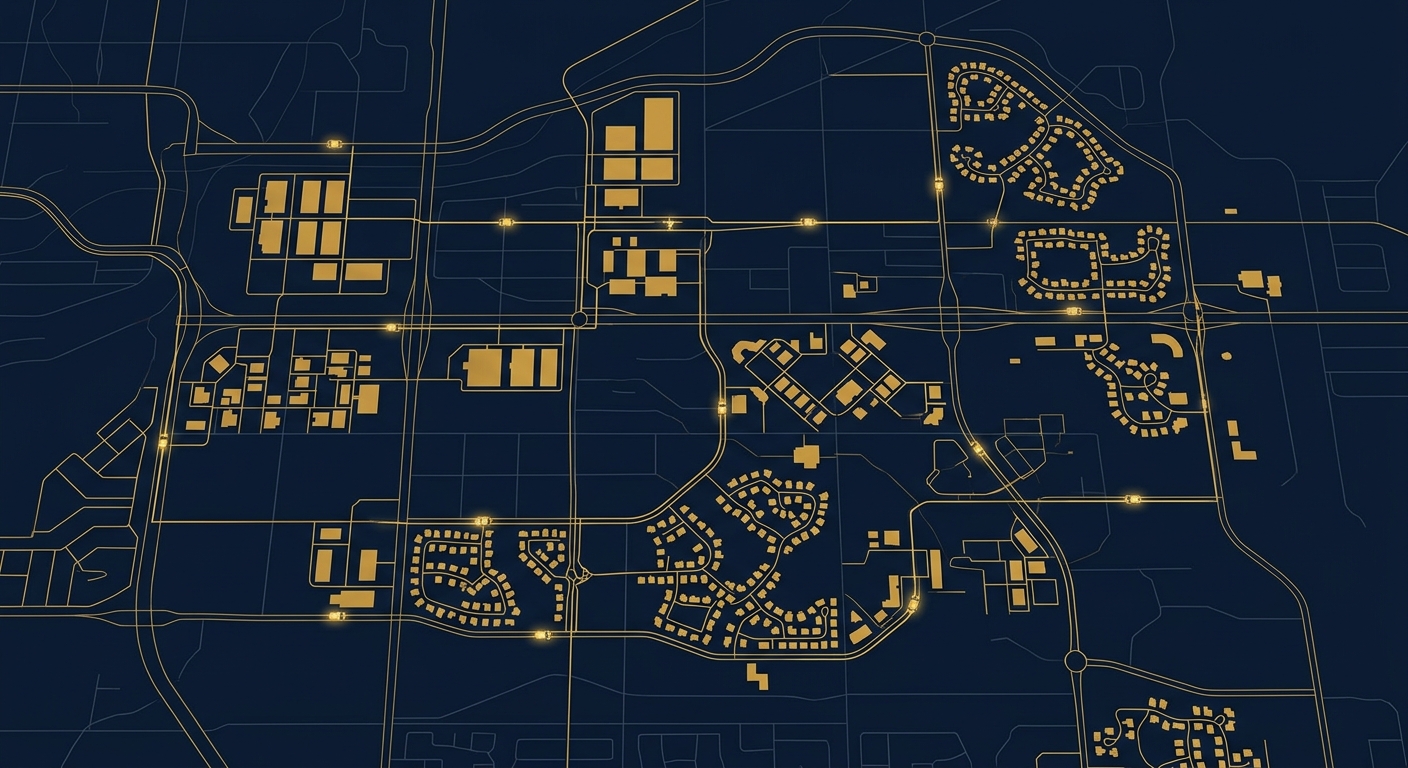
The East Valley is not a single downtown core; it is a sprawling, low-density corridor of industrial parks, retail power centers, master-planned residential communities, and rapidly developing land. Mesa alone spans well over 130 square miles, and the surrounding cities of Gilbert, Chandler, Tempe, Queen Creek, and Apache Junction each carry their own mix of logistics, manufacturing, and residential risk. A protection program built for a compact urban tower does not translate here.
Sprawl changes the physics of guarding. Response distances are longer, perimeters are larger, and a single fixed post rarely covers a property that may run several hundred thousand square feet with multiple truck courts and access points. Effective East Valley coverage blends fixed posts at critical control points with mobile patrol that can move across a wide footprint on randomized, GPS-verified routes. Our officers are dispatched and supervised from our Arizona command structure, with our Phoenix office positioned to support Mesa and the surrounding cities directly.
How should warehouses and distribution centers be guarded?
The East Valley has become one of Arizona’s dominant logistics corridors, with large-format distribution and fulfillment buildings clustered along the freeway network. These facilities concentrate high-value inventory, continuous truck traffic, and large unmanned perimeters, which makes them a persistent target for cargo theft, trailer burglary, and after-hours intrusion. The National Insurance Crime Bureau tracks cargo theft as a growing national exposure, and freeway-adjacent, distribution-dense regions such as the East Valley carry elevated risk because a stolen load can be on the interstate within minutes of a breach.
Our warehouse and distribution guarding centers on controlling movement. That means gatehouse and dock-door access control, driver and trailer verification, seal checks, visitor and vendor logging, and yard patrol on foot and by vehicle. Officers document trailer positions, flag tampered seals, and maintain a defensible record of who entered, when, and why. For sites that already run camera and alarm systems, our officers serve as the intelligent response layer that a sensor cannot provide. Explore our warehouse security services for the full operational model that we extend into Mesa and the East Valley.
What does manufacturing site security require in the East Valley?
The East Valley is at the center of Arizona’s advanced-manufacturing and semiconductor expansion, and that growth pulls in a distinct risk profile: high-value process equipment, controlled clean-room and lab space, proprietary intellectual property, contractor churn during buildouts, and strict regulatory and safety expectations. A manufacturing campus is simultaneously a physical-security problem and an intellectual-property problem.
Our officers manage layered access control that separates general staff, contractors, and restricted process areas; enforce badge and escort protocols; monitor loading and shipping for material diversion; and provide a documented chain of presence during high-turnover construction and commissioning phases. Because Honeybadger also runs digital forensics, financial investigations, and background intelligence in-house, a manufacturing client that suspects insider theft or IP loss can escalate from the guard post to a full investigative response without changing vendors. See our industrial and manufacturing security capabilities for the complete framework.
How do retail centers reduce loss with guard posts?
East Valley retail runs from enclosed malls and grocery-anchored centers to big-box power centers and mixed-use developments. The threats are concurrent: organized retail crime, shoplifting, parking-lot incidents, trespassing, loitering, and after-hours vandalism. A uniformed presence changes offender behavior before an incident starts, which is why visible deterrence is often the highest-leverage control a center can deploy.
Our retail posts combine a fixed, visible presence at entrances and common areas with proactive patrol of parking structures and service corridors, incident documentation that supports prosecution, and coordination with store loss-prevention teams and local law enforcement. Officers are trained to observe and report rather than to escalate physical confrontation, protecting both the client’s liability position and public safety. Our approach is detailed in our retail security and loss prevention practice.
How does patrol work for HOA, residential, and multifamily communities?
The East Valley’s master-planned neighborhoods, gated HOA communities, and multifamily complexes create a residential security demand that is often underserved. Residents expect a consistent, professional presence; boards and property managers expect documentation, liability protection, and discretion. The core risks are package and vehicle theft, unauthorized access, amenity misuse, noise and rule enforcement, and emergency response coordination.
For these communities, mobile patrol is usually the most cost-effective posture: our officers run randomized, GPS-verified routes across one or many communities, checking gates, pools, clubhouses, and common areas, logging each pass so the board has a defensible record. Where a single community warrants it, we staff a fixed gatehouse or courtesy-officer post. Because our officers are our own in-house, Arizona-licensed personnel, an HOA gets a supervised, accountable guard force.
How do heat operations affect guarding in Arizona?
Extended summer heat is a genuine operational and safety factor in the East Valley, where triple-digit temperatures persist for months. A guard program that ignores heat exposes officers to illness and the client to liability, and it degrades coverage precisely when outdoor perimeters, cooling infrastructure, and vacant properties are most vulnerable. The U.S. Occupational Safety and Health Administration treats heat as a recognized workplace hazard requiring water, rest, shade, and acclimatization planning.
Our heat operations build these controls in by default: hydration and rest cycles, shaded or climate-controlled post rotations, heat-adapted patrol scheduling that shifts intensive outdoor sweeps to cooler hours, vehicle-based patrol for large footprints, and officer training on the early signs of heat illness. This is not an afterthought in Arizona; it is a core competency, and it is one reason a local, in-house force outperforms an out-of-state or improvised crew.
What are the Arizona licensing and liability requirements?
In Arizona, private security is regulated under A.R.S. Title 32, Chapter 26, and administered by the Arizona Department of Public Safety (AZ DPS). Guard agencies must hold an agency license, and individual security guards must be registered and hold a valid guard card, with background screening and training requirements set by the state. Hiring an unlicensed provider transfers real legal and insurance risk directly to the client.
Honeybadger Solutions is an Arizona-licensed firm, and in Arizona our officers are our own in-house, licensed, supervised personnel. That structure matters for liability: you contract with one accountable firm that owns the licensing, insurance, training, and supervision, rather than a broker that layers subcontractors between you and the officer on your property. Every post is backed by documented policies, incident reporting, and a defensible chain of supervision.
Elite versus commodity guarding: what is the difference?
Commodity guarding sells a body in a uniform at the lowest hourly rate. It typically means high turnover, minimal training, weak supervision, and no investigative depth when something actually goes wrong. For a warehouse holding millions in inventory or a semiconductor supplier protecting proprietary processes, the cheapest guard is frequently the most expensive decision.
Elite guarding treats the officer as one visible layer of a broader risk program. It means selective hiring, real supervision and post audits, documented procedures, and the ability to escalate into digital forensics, financial investigation, or background intelligence when a physical incident reveals a deeper threat. Honeybadger operates to that standard, and because our officers are our own personnel, the accountability runs straight back to our command team.
What property types need which guard posture?
| East Valley property type | Dominant risk | Recommended guard posture |
|---|---|---|
| Warehouse / distribution center | Cargo and trailer theft, after-hours intrusion | Gatehouse access control + dock verification + yard patrol |
| Advanced manufacturing / semiconductor | IP loss, material diversion, contractor churn | Layered access control + escort protocols + investigative escalation |
| Retail center / power center | Organized retail crime, parking-lot incidents | Visible fixed post + proactive lot and corridor patrol |
| HOA / master-planned community | Trespassing, vehicle and package theft | Randomized GPS-verified mobile patrol + optional gatehouse |
| Multifamily / apartment complex | Unauthorized access, amenity misuse, after-hours activity | Courtesy-officer post + evening and overnight patrol |
| Construction / development site | Equipment and material theft, vandalism | Overnight fixed post + perimeter patrol + access logging |
How does Honeybadger scope a Mesa or East Valley guard program?
We build every program from a documented risk assessment rather than a generic staffing template. Use the following framework to scope a guard or mobile-patrol program for a Mesa or East Valley property.
- Define the assets and threats. Identify what you are protecting (inventory, IP, people, property) and the specific threats each faces.
- Map the footprint. Measure the perimeter, access points, truck courts, common areas, and blind spots across the full site or portfolio.
- Set coverage objectives. Decide required hours, response-time targets, and which points demand a fixed post versus mobile patrol.
- Choose the posture. Select fixed posts, mobile patrol, or a hybrid, and define patrol frequency and randomization.
- Integrate technology. Align officers with existing cameras, alarms, and access systems so the human layer amplifies the electronic layer.
- Build heat and safety controls. Schedule hydration, rest, shaded rotations, and heat-adapted patrol timing per Arizona conditions.
- Confirm licensing and liability. Verify Arizona licensing, insurance, and that officers are supervised in-house personnel.
- Establish reporting. Define incident documentation, GPS patrol logs, and escalation paths, including investigative escalation.
- Set supervision and audits. Schedule post audits, officer accountability checks, and periodic program reviews.
- Review and adjust. Reassess on a defined cadence as the site, threat, and season change.
Where does Honeybadger operate in Arizona?
Honeybadger Solutions serves Mesa and the full East Valley, including Gilbert, Chandler, Tempe, Queen Creek, and Apache Junction, as well as the greater Phoenix metro and all of Arizona. We operate three Arizona offices: our Casa Grande headquarters, our Phoenix office, and our Oro Valley office near Tucson, and we support clients nationwide and internationally. Our Phoenix office anchors East Valley coverage, and you can review our full Arizona locations or our broader security services to see how guarding fits our end-to-end capabilities. For Phoenix-specific coverage, see our Phoenix security guard services.
Which Mesa industries and landmarks shape guard staffing decisions?
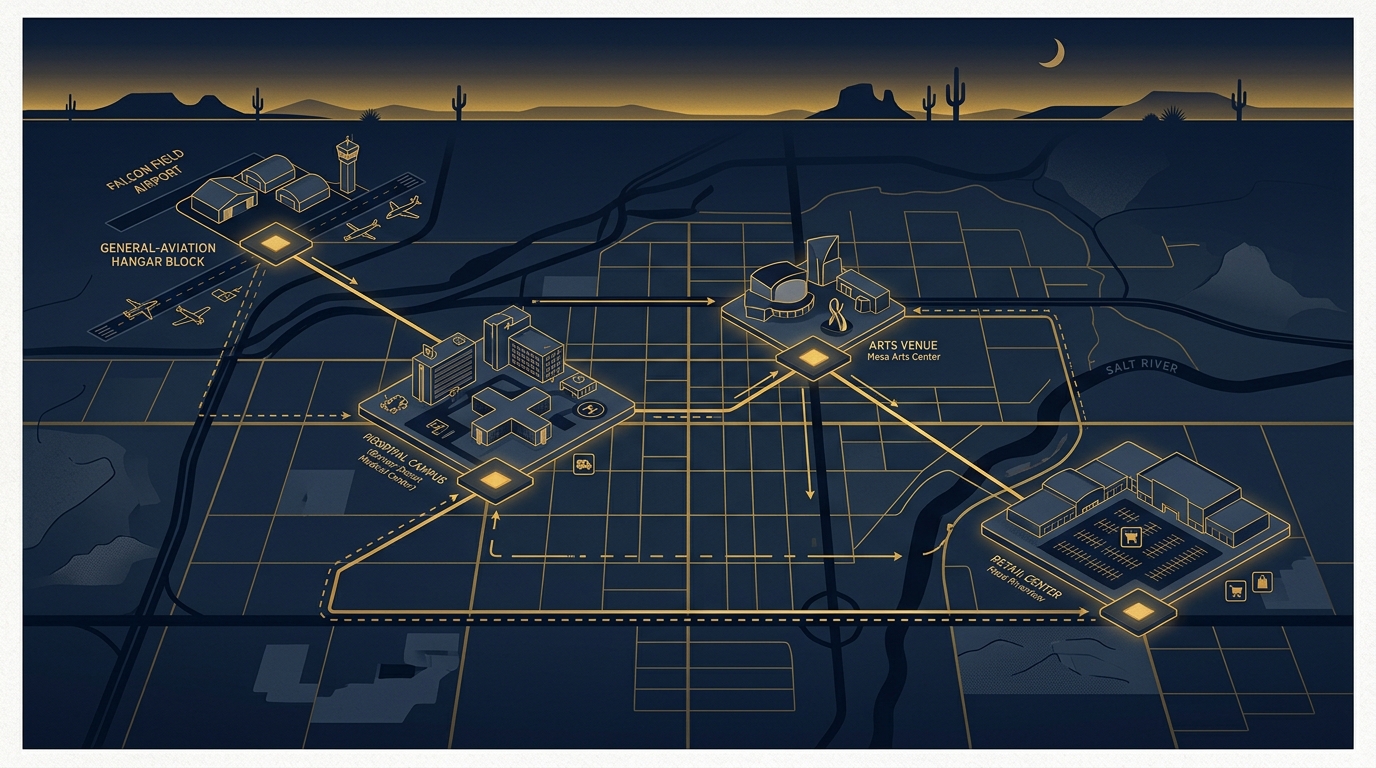
Boeing’s Mesa facility, adjacent to Falcon Field Airport, manufactures the AH-64 Apache helicopter and anchors a defense-adjacent manufacturing corridor where access control, badge verification, and insider-threat awareness matter as much as a visible guard presence. Falcon Field itself hosts general-aviation hangars and maintenance operations where aircraft parts and avionics equipment are a recognized theft target. Banner Health’s Banner Desert Medical Center and Cardon Children’s Medical Center bring hospital-specific security needs, from emergency-department disturbance response to lobby and visitor screening. Downtown Mesa’s Arts District and the Mesa Arts Center, along with the Cactus League crowds that Sloan Park draws each spring, create seasonal event-security demand. Mesa Riverview and the Fiesta District carry the retail-loss-prevention profile of any major shopping corridor, while the city’s residential growth toward the ASU Polytechnic and Phoenix-Mesa Gateway area in the southeast keeps demand growing for HOA and multifamily patrol.
How should a Mesa business choose a security guard company?
Use this framework before signing with any provider:
- Verify Arizona licensing. Confirm the firm and its individual officers are registered under A.R.S. Title 32, Chapter 26, through the Arizona Department of Public Safety.
- Confirm employment status. Ask directly whether guards on your property are the company’s own employees or subcontracted through a labor broker.
- Require a documented risk assessment. A serious provider scopes your property’s specific threats before proposing a post count or patrol frequency.
- Match posture to threat. Decide, post by post, whether a fixed guard, mobile patrol, or hybrid coverage fits the risk.
- Check armed versus unarmed certification. Confirm the officer assigned to an armed post holds the additional Arizona armed-guard certification the post requires.
- Review insurance and supervision. Ask how officers are supervised, audited, and how incidents are escalated after hours.
- Confirm technology and reporting. GPS-verified patrol checkpoints and digital incident reporting should be standard, not an upcharge.
- Get a transparent, itemized quote. Pricing should break out hourly rate, armed premium if applicable, and any setup or equipment costs.
Are Honeybadger’s Mesa guards our own employees or subcontracted?
They are our own. In Arizona, every uniformed officer, mobile patrol unit, and armed protective agent assigned to a Mesa post is Honeybadger’s in-house, Arizona-licensed, supervised personnel. We do not broker Mesa posts to a subcontractor or a third-party staffing network. That matters practically: when a single firm owns the licensing, training, insurance, and day-to-day supervision behind the officer standing on your property, you have one accountable point of contact rather than a chain of vendors to sort through when something goes wrong.
Subcontracted guard staffing is common in the Phoenix metro because it is cheaper to run for the vendor: a broker wins the contract, then fills the post through whichever third-party staffing agency has an available body that week. Turnover on that model tends to be high, supervision is thin, and the officer on your property often has little accountability to the firm whose name is on your contract. Because Mesa is served directly from our nearby Phoenix office rather than through a subcontracted layer, the officer patrolling your property, the supervisor who audits that patrol, and the firm that carries the licensing and insurance are the same organization from top to bottom.
How is aerospace and healthcare-adjacent security handled differently in Mesa?
The Falcon Field aerospace corridor and Mesa’s hospital campuses demand training beyond a standard uniformed post. At a manufacturing or hangar facility, officers focus on controlling movement: verifying badges at every access point, escorting visitors and contractors, logging tool and material movement, and escalating any anomaly, such as an unfamiliar device on a workstation or an unusual after-hours entry, to an investigative team rather than treating it as routine. At a hospital campus, officers are trained in de-escalation for emergency-department disturbances, lobby and visitor screening protocols, and coordination with clinical staff during a code response, recognizing that a healthcare environment calls for restraint and communication as much as a visible presence.
What does a Mesa risk assessment actually look for?
A site walk is not a formality; it is where the guard plan actually gets built. For an aerospace or manufacturing site near Falcon Field, the assessment maps every vehicle and pedestrian access point, badge-reader coverage, and blind spot along a fence line that may run for a mile or more. For a hospital campus, it maps emergency-department entry and exit flow, visitor-check-in chokepoints, and after-hours lobby exposure. For a retail center or downtown event venue, it maps parking-lot lighting, sightlines, and pedestrian flow during peak hours and events. That documented assessment, not a generic post-count template, is what determines whether a property needs a single fixed post, a mobile patrol route, or a hybrid of both, and it is the same document we revisit if an incident occurs so the posture can be adjusted rather than guessed at.
How does Mesa’s sprawling footprint change patrol strategy compared to a compact urban core?
A downtown Phoenix office tower can often be covered by a single well-placed lobby post because the entire risk surface sits within one building envelope. Mesa rarely offers that luxury. A single commercial client might operate a manufacturing building near Falcon Field, a retail location near Mesa Riverview, and a multifamily property near the Gateway corridor, three sites separated by ten or more miles of surface streets. Rather than staffing each site identically, we typically build a coverage plan around randomized, GPS-verified mobile patrol that rotates across a defined territory, layered with fixed posts only where a specific chokepoint, entrance, or asset genuinely requires a constant physical presence. This keeps coverage responsive across Mesa’s geography without paying for redundant fixed staffing at every location.
What happens if a Mesa incident requires more than a guard on the scene?
A guard program is only as strong as what stands behind it once something actually happens. If a Mesa post uncovers internal theft at a manufacturing site, a false workers’ compensation claim, or a pattern of after-hours access that looks like more than a one-off trespass, that incident does not have to be handed off to an outside investigator who starts from zero. Because our investigations division sits inside the same firm, a Mesa guard incident can escalate directly into a documented internal investigation, complete with interview support, surveillance if warranted, and, where digital evidence is involved, coordination with our in-house forensic examiners. Fewer handoffs mean a faster, more defensible response and a single point of accountability from the moment a guard reports something unusual to the moment the matter is resolved.
Frequently asked questions
Does Honeybadger use its own guards in Mesa and the East Valley?
Yes. In Arizona, every uniformed officer, mobile patrol unit, and protective agent is our own in-house, Arizona-licensed, supervised personnel. We do not broker your post to a subcontractor or a third-party network. You contract with one accountable firm that owns the licensing, training, insurance, and supervision behind the officer on your property.
Which East Valley cities does Honeybadger cover?
We provide security guard and mobile patrol services throughout Mesa, Gilbert, Chandler, Tempe, Queen Creek, and Apache Junction, along with the greater Phoenix metro and all of Arizona. Our Phoenix office anchors East Valley coverage, supported by our Casa Grande headquarters and our Oro Valley office.
Can guards handle both warehouses and residential communities?
Yes. Our officers are trained across post types, from access control at distribution centers and manufacturing campuses to randomized mobile patrol for HOA and multifamily communities. Because we scope each program from a risk assessment, we match the posture, whether fixed post, mobile patrol, or a hybrid, to the specific property and threat.
Are Honeybadger officers licensed in Arizona?
Yes. Arizona regulates private security under A.R.S. Title 32, Chapter 26, administered by the Arizona Department of Public Safety. Honeybadger holds Arizona agency licensing, and our individual officers are registered and screened as required by the state. Verifying licensing protects you from the legal and insurance exposure that comes with an unlicensed provider.
About Honeybadger Solutions
Honeybadger Solutions is an Arizona-licensed security and investigations firm serving Mesa and the East Valley. In Arizona, our uniformed security officers, mobile patrol, and protective agents are our own in-house, Arizona-licensed, supervised personnel — not subcontractors. Digital forensics, cybersecurity, financial investigations, and background intelligence are run in-house and delivered worldwide. We serve all of Arizona and support clients nationwide and internationally.
Offices: Casa Grande (HQ), Phoenix, and Oro Valley, Arizona.
Phone: Book a consultation online
Confidential consultation: speak with our command team about a Mesa or East Valley guard and patrol program.
Browse by topic
Security guard services · Private investigations · Cybersecurity · Digital forensics · Financial fraud investigation · Executive protection · All articles