
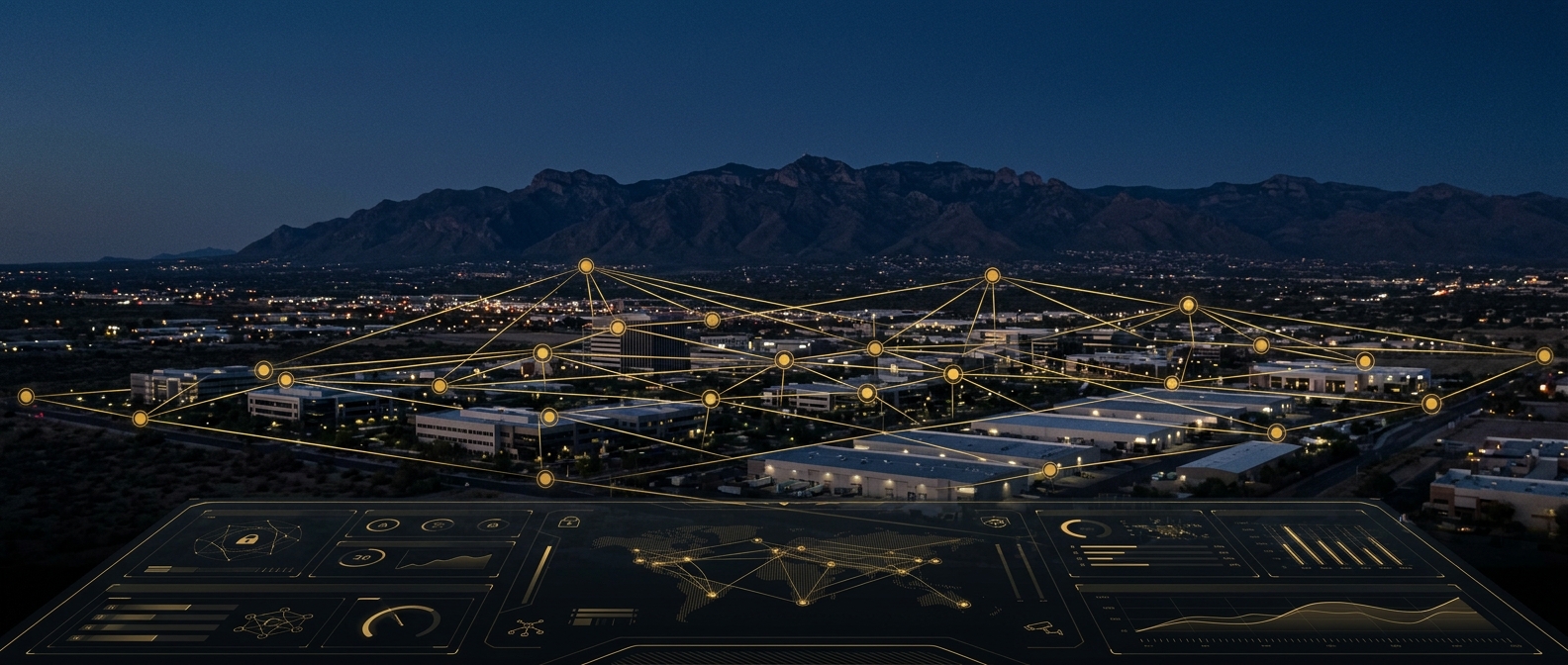
Private surveillance services in Tucson mean designed, installed, and remotely monitored camera systems — not covert investigator tailing — that give businesses and property owners continuous video coverage, verified alarm response, and evidence-grade recordings. Honeybadger Solutions designs and monitors surveillance systems for Tucson and Pima County properties, commanded from our Oro Valley office, and backed by our own in-house Arizona-licensed guard force and investigations team when footage reveals something that needs a human response.
This is a different service from hiring an investigator to covertly follow a person — that discipline is covered on our Tucson surveillance investigator page. What follows here is the physical-security discipline: cameras, sensors, and monitoring built into a property so ownership can see what is actually happening at a warehouse yard, a retail center, a construction site, or a residence — day and night, and provable after the fact.
Why does Tucson’s geography and climate demand a different camera design than a coastal metro?
A surveillance system designed for a temperate coastal city fails quietly in the Sonoran Desert. Cameras and housings have to survive sustained triple-digit summer heat without image drift or thermal shutdown, monsoon-season dust storms and driving rain that can blind a poorly placed lens or flood a junction box, and intense, low-angle desert sun that washes out footage from cameras aimed the wrong direction at dawn and dusk. Tucson’s dispersed, low-rise development pattern also means many commercial and industrial sites have long open perimeters — yards, parking fields, and access roads — that a single wide-angle camera cannot meaningfully cover. Effective design starts with the site, not the equipment catalog: sun path, dust exposure, distance-to-subject, and lighting at night around loading docks, gates, and parking areas.
Which Tucson properties need dedicated surveillance coverage?
Camera and monitoring needs differ sharply by property type across the metro.
Warehousing and logistics along I-10 and I-19
Yards and gates near Tucson’s interstate logistics corridor face cargo theft, trailer tampering, and after-hours perimeter breaches. Coverage priorities are gate and license-plate capture, yard-wide perimeter cameras with night vision, and trailer-seal verification zones tied to access logs.
Retail centers and mixed-use properties
Shopping centers around Park Place, El Con, and the broader retail corridor need parking-lot coverage for vehicle break-ins, entrance and point-of-sale cameras for organized retail crime, and footage clear enough to support a loss-prevention case. See our related retail security and loss prevention approach.
Construction sites
Active build sites across Tucson’s growth corridors in Marana, Vail, and the northwest carry high equipment-theft exposure with no permanent structure to secure cameras to. Temporary, solar-powered, cellular-connected units with remote monitoring are the standard answer, paired with overnight guard patrol where exposure warrants it.
Aerospace, defense, and industrial sites
Facilities near the Raytheon Missile Systems (RTX) corridor and Davis-Monthan Air Force Base often carry contractual or federal expectations around access logging, visitor recording, and camera retention that a commodity residential-grade system cannot meet. This is scoped alongside our commercial security practice.
High-value residential — Catalina Foothills and Oro Valley
Larger, view-oriented lots in the Catalina Foothills and Oro Valley often have long driveways, walled perimeters, and desert-wash boundaries that create blind approach routes. Coverage here typically combines driveway and gate cameras, wash-facing perimeter sensors, and discreet monitoring that does not clutter the architecture.
What are the core components of a Tucson surveillance system?
The table below maps the building blocks to what they actually solve on the ground.
| Component | What it solves | Tucson-specific note |
|---|---|---|
| Perimeter / yard cameras | Long-sightline coverage of open lots, fence lines, and gates | Sized for desert dust and heat; positioned against low-angle sun glare |
| License-plate recognition | Vehicle identification at gates and entrances | High value on I-10/I-19-adjacent logistics and industrial sites |
| Remote video monitoring | Live human review and verified alarm response, not just recording | Reduces false-alarm dispatch and speeds response on true incidents |
| Solar / cellular temporary units | Coverage on sites with no permanent power or network | Standard for active construction sites and vacant land |
| Access-control integration | Ties badge/gate events to recorded video | Expected on defense-adjacent and university-adjacent contracts |
| Cloud & local storage / retention | Evidence-grade footage retrieval after an incident | Retention length matched to insurance and, where applicable, contractual requirements |
Live monitoring or recording-only — which does your property need?
This is the decision that separates a genuinely protective system from an expensive recording device nobody watches until after the loss has already happened.
- Recording-only preserves footage for after-the-fact investigation and loss-prevention documentation. It is lower cost but does nothing to stop an incident in progress.
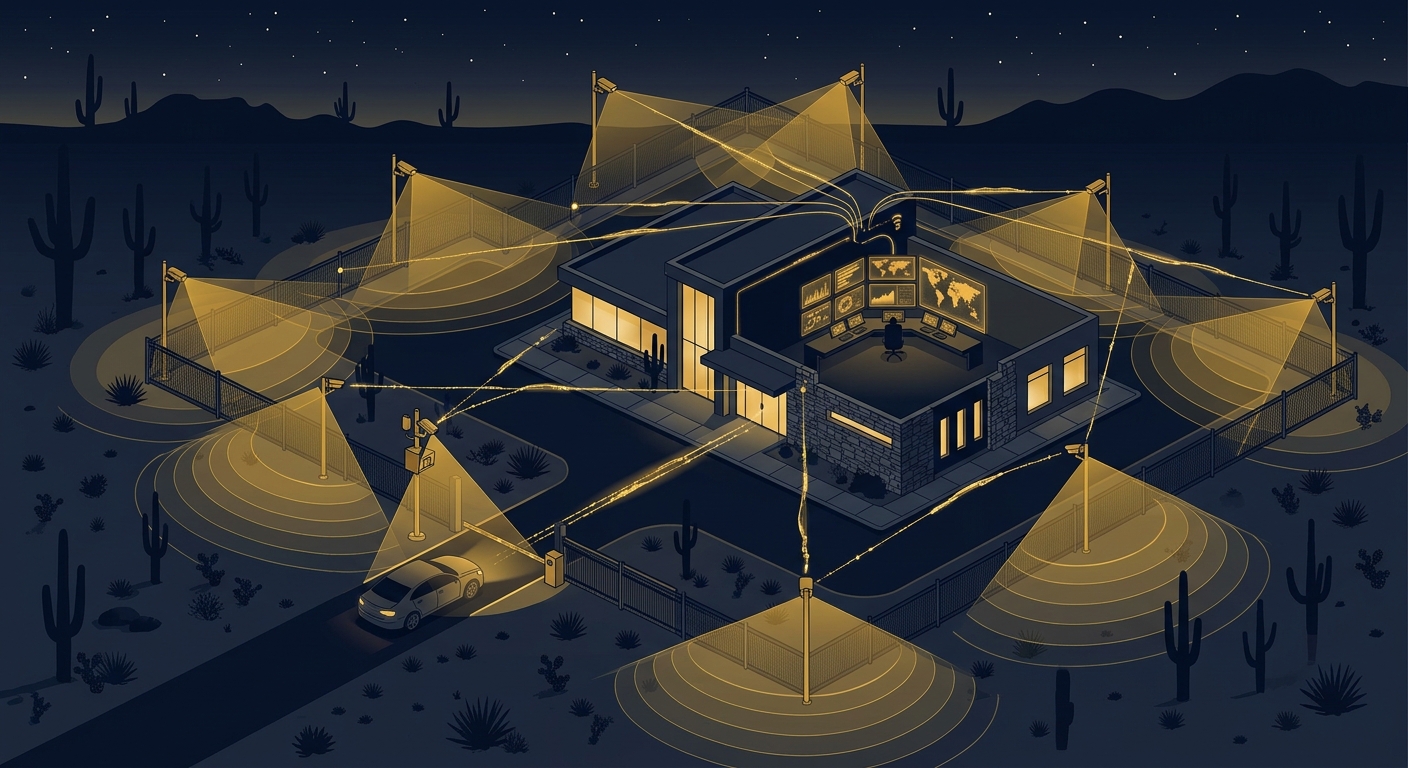
- Live remote monitoring puts trained personnel watching real-time feeds, able to issue a verbal warning through on-site speakers, verify an alarm before dispatching a response, and escalate to our own guard force or law enforcement when warranted. This is the standard for high-value yards, active construction sites, and properties that have already experienced a loss.
- Hybrid coverage combines both — live monitoring during high-risk overnight hours (when Tucson’s after-hours theft and trespass risk peaks) with recording-only during lower-risk daytime periods, controlling cost without leaving the highest-risk window unwatched.
How do you scope a private surveillance system? A ten-step process
Use this sequence to move from a bare idea to a system that actually addresses your Tucson property’s risk.
- Walk the site and map every entry point, blind approach, and prior incident location.
- Identify the property type’s dominant risk — cargo theft, retail shrink, equipment theft, trespass, or personal safety.
- Decide live monitoring, recording-only, or hybrid coverage by zone.
- Select camera placement and hardware rated for desert heat, dust, and glare.
- Design power and connectivity — permanent wiring versus solar/cellular temporary units.
- Integrate access control and license-plate capture at vehicle and pedestrian entry points.
- Set retention periods matched to insurance requirements and, where applicable, contract obligations.
- Define escalation protocol — what monitoring staff handle versus what triggers guard dispatch or law enforcement.
- Plan for seasonal surge — Gem Show week, winter-visitor season, and holiday retail volume.
- Test and audit the system quarterly, and after any incident.
What legal boundaries apply to surveillance cameras in Arizona?
Property surveillance cameras are legal in Arizona when they observe your own property or areas visible from it, and avoid recording into a space where a person has a reasonable expectation of privacy — a neighbor’s interior, a bathroom, or a changing area. Arizona is a one-party-consent state for recording conversations, which is why we generally design commercial and residential systems around video capture and treat audio recording as a separate, deliberate decision made only where clearly lawful and appropriate. Individuals and companies operating surveillance systems remain responsible for how footage is stored, who can access it, and how long it is retained.
What happens when footage reveals a real incident?
This is where a pure camera vendor stops and Honeybadger keeps going. Because our surveillance-systems team sits inside the same company as our in-house, Arizona-licensed guard force and our investigations and digital forensics practice, a monitored incident — a break-in in progress, a pattern of after-hours access anomalies, a loading-dock theft caught on tape — can move directly into a guard dispatch, an internal investigation, or an evidence-preservation workflow without a second vendor, a second contract, or a break in the chain of custody. For a facility owner, that consolidation matters most in the moment it matters most: right after something goes wrong.
What drives the cost of a Tucson surveillance system?
Camera hardware is rarely the largest line item. The real cost drivers are: the number of zones requiring coverage and their distance from power and network access, whether units need solar/cellular independence versus hard-wired connectivity, live monitoring hours versus recording-only, retention length, integration with existing access-control or alarm systems, and ongoing maintenance in a climate that is genuinely hard on outdoor electronics. A construction site needing three temporary solar units for six months costs and scopes very differently than a warehouse campus needing permanent perimeter coverage, license-plate capture at two gates, and 24/7 live monitoring. Any credible proposal walks the site first and prices the actual risk, not a generic camera-count spreadsheet.
Representative scenario: the yard nobody was watching
Consider a representative matter. A logistics operator near the I-10/I-19 interchange had recording-only cameras covering its yard — footage existed, but nobody reviewed it until after a trailer had already been tampered with overnight, and by then the loss was done. Honeybadger redesigned the coverage around the actual risk window: perimeter cameras with night vision along the fence line, license-plate capture at the single active gate, and live remote monitoring restricted to overnight hours when the yard’s own activity logs showed virtually all legitimate traffic stopped. Within the first month, monitoring staff flagged and verbally interrupted an attempted after-hours entry before it became a loss, and dispatched our own patrol unit to hold the perimeter until local law enforcement arrived. This is an illustrative scenario, not a named client or claimed outcome, but it reflects how shifting from passive recording to a risk-matched, monitored design changes what a camera system actually does for a property.
How does Honeybadger deliver surveillance systems locally in Tucson?
Honeybadger maintains an office in Oro Valley, inside the Tucson metro, giving us genuine local design and monitoring presence rather than a system installed once and left unmanaged. We serve Tucson, Oro Valley, Marana, Sahuarita, Green Valley, and greater Pima County, and we operate three Arizona offices in total — Casa Grande (headquarters), Phoenix, and Oro Valley — so command stays close to the ground statewide. We serve all of Arizona plus clients nationwide and internationally. Review our Arizona locations hub, our statewide security guard services, and for covert investigative surveillance rather than installed camera systems, our Tucson surveillance investigator page.
Because system design, monitoring, guard dispatch, and investigations all sit under one Arizona-licensed command structure, a Tucson property owner is never left stitching together separate vendors after an incident. The same local team that scoped your camera placement can dispatch a patrol officer overnight, and the same command that reviews flagged footage can open a formal investigation the next morning if the pattern warrants it — a level of coordination a pure camera-installation company or a national alarm brand rarely offers.
Frequently asked questions
Is private surveillance different from hiring a surveillance investigator in Tucson?
Yes. Private surveillance systems are designed, installed, and monitored cameras that give a property continuous coverage — a physical-security service. A surveillance investigator is a licensed private investigator who covertly observes and documents a specific person for a legal, insurance, or corporate matter. Honeybadger provides both, but they are distinct services scoped differently.
Do you offer live remote monitoring or only recording?
Both, and most Tucson commercial clients choose a hybrid: live monitoring during the highest-risk overnight hours with recording-only coverage during lower-risk periods, balancing cost against real-time response capability.
How does desert heat affect surveillance camera reliability?
Standard consumer-grade cameras can suffer image drift, housing degradation, or thermal shutdown in sustained Tucson summer heat. We specify hardware rated for the environment and position units to avoid direct low-angle sun glare at dawn and dusk, with dust-resistant housings for monsoon-season conditions.
Can surveillance footage be used as evidence if there’s an incident?
Yes, when the system captures lawful areas, retention and access are properly documented, and footage is preserved without alteration. We design retention and export practices to hold up for insurance claims and, where needed, law-enforcement or civil proceedings, and can connect a serious incident directly to our in-house investigations team.
About Honeybadger Solutions
Honeybadger Solutions is an Arizona-licensed security and investigations firm with an office in Oro Valley serving the Tucson metro. In Arizona, our uniformed security officers, mobile patrol, and protective agents are our own in-house, Arizona-licensed, directly employed, and supervised personnel. Digital forensics, cybersecurity, financial investigations, and background intelligence are run in-house and delivered worldwide. We operate three Arizona offices: Casa Grande (headquarters), Phoenix, and Oro Valley. We serve all of Arizona and support clients nationwide and internationally.
Need a surveillance system designed for a Tucson property? Book a consultation online for a free site assessment and quote, or book a consultation through our AI scheduling agent.
Authoritative references: A.R.S. Title 13, Chapter 30 (Interception of Communications) — Arizona State Legislature and FBI — Crime Prevention and UCR Program Resources.
Browse by topic
Security guard services · Private investigations · Cybersecurity · Digital forensics · Financial fraud investigation · Executive protection · All articles