

Private surveillance for Scottsdale businesses means workers’-compensation and insurance-claim investigations, employee-theft and loss-prevention cases at resorts and retailers, and vendor or business-partner due diligence — run by Honeybadger Solutions’ own Arizona-licensed investigators, not subcontractors. Every engagement stays inside Arizona’s one-party-consent and no-trespass rules and produces a chronological, chain-of-custody report built to hold up before the Industrial Commission of Arizona, an insurer’s special investigations unit, or in Maricopa County Superior Court.
Scottsdale is not just gated communities and resort valets — it is also one of the densest corporate and commercial corridors in the Valley. The Scottsdale Airpark, stretched along the Loop 101/Pima corridor near Scottsdale Airport, houses corporate headquarters, aerospace and aviation tenants, and a heavy concentration of professional-services, healthcare, and technology employers. Add the resort and hospitality economy running from the Camelback corridor north toward Troon, the luxury retail and gallery footprint around Scottsdale Fashion Square and Old Town, and Maricopa County’s workers’-comp claim volume, and you get a distinct set of business surveillance needs: verifying a claimant’s activity level, catching internal theft in an F&B or housekeeping department, and vetting a vendor or partner before a contract is signed. This guide is written for HR directors, risk managers, insurance adjusters, third-party administrators, and in-house counsel handling those matters — not for personal or family-law surveillance, which we cover separately for Scottsdale here.
Who performs private surveillance for Scottsdale businesses?
Honeybadger Solutions runs Scottsdale business surveillance with our own in-house, Arizona-licensed private investigators — personnel we employ, train, and supervise, not a referral to whichever contractor is free that week. Arizona is our home command: private investigators here are licensed and regulated by the Arizona Department of Public Safety, and that licensing is the foundation an ICA hearing officer, a defense attorney, or an insurer’s SIU auditor expects to see before they will rely on the work. The investigator who conducts your investigation can be identified, is bound to documented methodology, and can testify to it if the claim or case requires it.
What kinds of private surveillance do Scottsdale employers and insurers actually need?
The requests we see out of Scottsdale cluster around five recurring situations, each tied to a specific part of the local economy:
| Use case | Typical requester | What we document |
|---|---|---|
| Workers’-comp claim surveillance | Employer, TPA, insurance adjuster | Physical activity inconsistent with a claimed injury or restriction |
| Employee theft & internal misconduct | Resort GM, retail loss-prevention manager, HR director | Pattern of theft, policy violation, undisclosed off-the-clock work for a competitor |
| Vendor & contractor fraud | Airpark corporate counsel, procurement/finance | Billing discrepancies, unauthorized subcontracting, kickback or conflict-of-interest patterns |
| Business-partner & transaction due diligence | Corporate counsel, board, prospective investor | Lifestyle/asset inconsistency, undisclosed conflicts, reputational red flags before a deal closes |
| Liability & disability-claim verification | Property & casualty insurer, TPA | Activity inconsistent with a claimed physical limitation in a premises-liability matter |
Is workplace and employee surveillance legal in Arizona?
Yes, within defined limits that every engagement is built around:
- One-party consent for recorded conversations. Arizona is a one-party-consent state under A.R.S. § 13-3005, with the consent exception at A.R.S. § 13-3012. A participant to a conversation may lawfully record it; recording a private conversation you are not part of, without any participant’s consent, is not.
- No recording in areas with a reasonable expectation of privacy. Restrooms, locker rooms, and similarly private employee spaces are off-limits regardless of employer policy.
- Public and semi-public areas are fair ground. Sales floors, warehouses, loading docks, parking lots, and common hallways can generally be observed and recorded, particularly where posted policy gives notice of monitoring.
- Company-owned vehicles vs. a claimant’s personal vehicle. GPS tracking of a company-owned fleet vehicle is generally permissible business practice with policy notice; placing a tracker on a subject’s personal vehicle without authorization is a different legal question entirely and is not part of a standard engagement.
- No trespass. Investigators do not enter private property, gated employer campuses, or HOA-controlled areas without authorization to establish an observation post.
How does workers’-compensation surveillance work for Scottsdale employers?
Arizona workers’-comp claims are administered through the Industrial Commission of Arizona, and a claim that reaches a contested hearing lives or dies on evidence quality. Scottsdale’s claim volume comes from two very different employer profiles: self-insured or large-deductible corporate employers in the Airpark corridor with warehouse, logistics, or light-industrial exposure, and resort/hospitality employers whose housekeeping, banquet, and food-and-beverage departments generate a disproportionate share of soft-tissue and lifting-related claims. A sub-rosa surveillance engagement documents the claimant’s actual physical activity — lifting, bending, driving, working a second job — against the restrictions on file, without ever entering the claimant’s home or a place with a reasonable expectation of privacy. The result is a chronological log and time-stamped video an adjuster, defense counsel, or an ICA administrative law judge can rely on, tied together with unbroken chain-of-custody documentation. For the deeper legal and procedural framework, see our statewide workers’ comp surveillance guide.
How do you investigate employee theft at Scottsdale resorts and retailers?
Old Town Scottsdale’s gallery district and the Scottsdale Fashion Square/Fifth Avenue retail corridor carry high-value inventory that makes organized retail crime and internal theft expensive problems fast, and the resort corridor running from the Camelback area north to Troon has large hourly F&B, housekeeping, and valet staffs where cash handling, comp abuse, and inventory diversion are recurring loss-prevention concerns. Investigating an employee suspected of theft or a serious policy violation requires the same discipline as any other matter: observation limited to work areas and public space, no covert recording in break rooms or restrooms, and a documented pattern — not a single ambiguous incident — before a termination or referral to law enforcement is recommended. Where internal misconduct intersects a company laptop, POS system, or email account, our digital forensics team preserves and examines the device evidence alongside the physical surveillance, so HR and counsel get one coordinated file rather than two disconnected investigations. See our statewide employee misconduct surveillance guide for the broader legal framework.
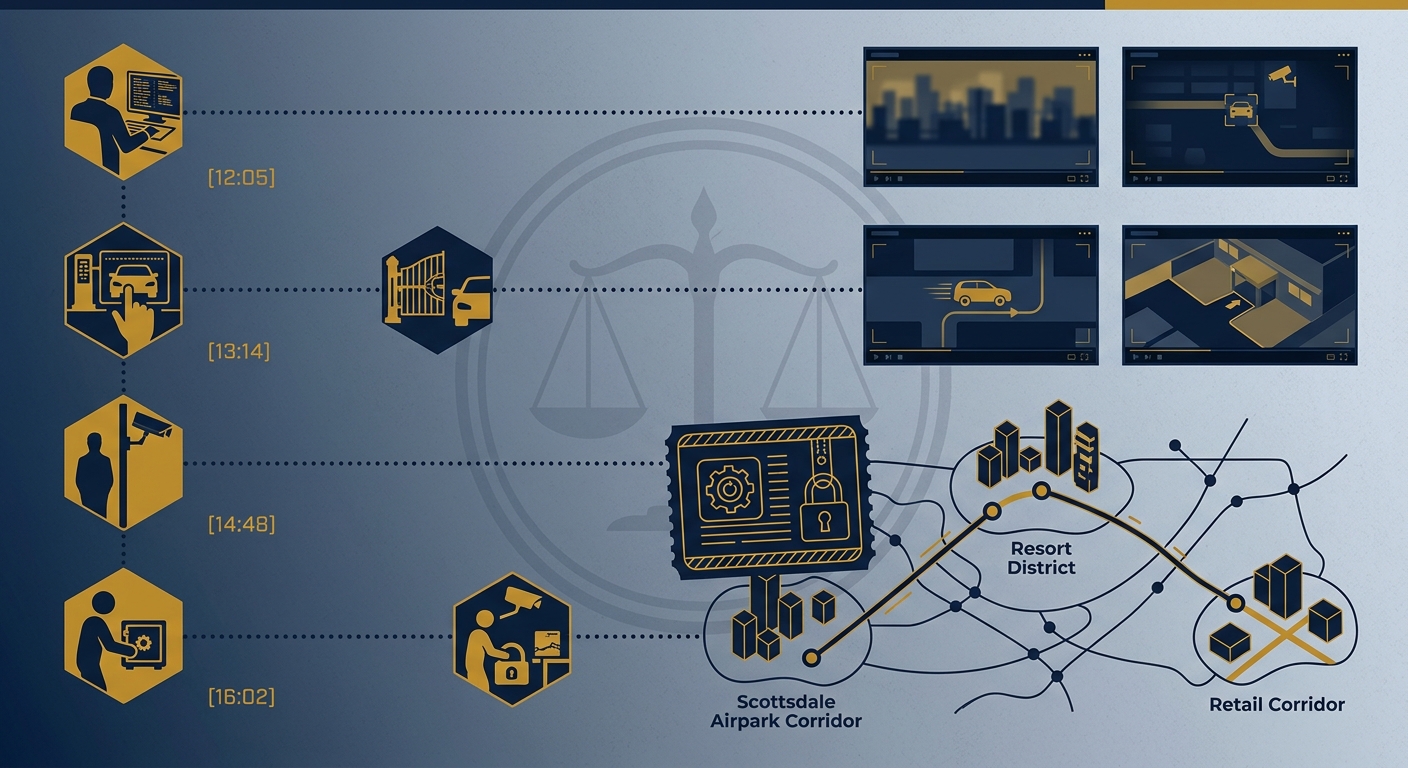
What about vendor fraud and due diligence for Scottsdale Airpark companies?
The Airpark corridor’s density of corporate headquarters, aerospace and aviation tenants, and professional-services firms produces a steady stream of vendor, contractor, and business-partner questions that never touch a courtroom until they do: a vendor whose invoices don’t match delivered scope, a contractor suspected of unauthorized subcontracting to cut corners, a prospective joint-venture partner whose background doesn’t match their pitch, or a departing executive who may be quietly building a competing operation before their non-compete expires. Discreet, lawful surveillance — paired where needed with financial-record review and open-source diligence — gives general counsel and procurement leadership a factual basis to act before a contract renews, a deal closes, or a dispute becomes public. This work is conducted the same way a workers’-comp case is: public-vantage observation, no trespass, and a report built to withstand scrutiny if the matter escalates to litigation.
What is the engagement process?
Every Scottsdale business surveillance engagement follows the same disciplined sequence:
- Confirm the legal basis. HR documentation, a claims file, in-house counsel authorization, or a signed monitoring policy — the basis for the engagement is documented before fieldwork starts.
- Scope the objective. Define precisely what activity, behavior, or fact needs to be verified so the investigator isn’t fishing.
- Assign an in-house, AZ-licensed investigator. Complex or high-visibility Airpark and resort matters get multi-investigator coverage.
- Conduct lawful surveillance. One-party consent, no trespass, no recording in private areas, public or authorized vantage only.
- Deliver the report. Chronological activity log, time-stamped video, investigator declaration, and unbroken chain-of-custody documentation.
- Support the next step. Authentication and testimony support for an ICA hearing, an insurer’s SIU file, an HR termination decision, or Maricopa County litigation.
Representative scenario: the claim that didn’t match the file
Consider a representative matter. A third-party administrator handling a workers’-comp claim for a Scottsdale Airpark warehouse employer requested surveillance after a claimant reported an inability to lift more than a few pounds. Over three shifts, an investigator documented the claimant loading and unloading a personal vehicle and assisting with a residential move, all observed and recorded from public street vantage points with no property entered and no private conversation intercepted. The chronological log and time-stamped video, delivered with chain-of-custody documentation, gave the adjuster a factual record to present at the ICA hearing without any dispute over how the evidence was obtained. This is an illustrative scenario, not a named client or a claimed outcome, but it reflects how disciplined, lawfully bounded surveillance produces proof that holds up.
Does the WM Phoenix Open and Scottsdale’s event calendar change anything?
Scottsdale’s biggest annual commercial surge — the WM Phoenix Open at TPC Scottsdale, plus spring training and a steady calendar of resort conventions — does not change the legal framework, but it does change scheduling and staffing. Retailers and resorts see a spike in seasonal and temporary staff during these windows, which is exactly when internal-theft and inventory-shrink cases tend to surface, and corporate clients running vendor or security due diligence around a major event often need a faster turnaround than a routine engagement. We plan Scottsdale coverage with that seasonality in mind rather than treating every month of the year identically.
Coverage area and nearest Honeybadger office
Honeybadger Solutions serves Scottsdale and Maricopa County from our Phoenix office, roughly a 20–30-minute drive via Loop 101 or Scottsdale Road depending on traffic and the destination within Scottsdale — the closest of our three Arizona locations and the one that typically staffs Scottsdale business surveillance. Our Casa Grande headquarters (about 75–90 minutes south) directs statewide operations and case oversight, and our Oro Valley office (roughly two hours south, near Tucson) extends the same in-house investigator model to Southern Arizona. We also serve the broader Scottsdale/North Valley business corridor — Paradise Valley, Tempe, and the East Valley — through the same Phoenix-anchored team, coordinated statewide through our Scottsdale coverage area.
Frequently asked questions
Can a Scottsdale employer or insurer conduct video surveillance of a workers’ comp claimant?
Yes. Surveillance of a claimant’s activity in public or publicly observable spaces is a standard, lawful investigative tool for employers, third-party administrators, and insurers defending a claim before the Industrial Commission of Arizona. It must be conducted from a lawful vantage, without trespass and without recording in areas where the claimant has a reasonable expectation of privacy, and it should be performed by a licensed investigator who can authenticate the footage if the claim is contested.
Is GPS tracking a company vehicle legal in Arizona?
Tracking a vehicle the business owns, with a documented monitoring policy, is generally accepted practice for fleet and logistics management and differs legally from placing a tracker on a subject’s personal vehicle without authorization. If a matter involves personal-vehicle tracking, that decision should be made with counsel rather than as a default surveillance method.
Can retail or resort loss-prevention surveillance lead to criminal prosecution for employee theft?
It can, when the surveillance is conducted lawfully and produces a documented pattern rather than a single ambiguous incident. A chronological activity log, time-stamped video, and an investigator able to testify to methodology give both HR and, where the employer chooses to refer the matter, Scottsdale or Maricopa County law enforcement a defensible evidentiary record.
How much does business surveillance cost in Scottsdale?
Cost depends on the number of investigators, hours of coverage, and the complexity of the environment — an Airpark corporate campus, a resort property, or a multi-location retail chain each require a different staffing plan. We scope each engagement to the specific claim, policy, or dispute it needs to support. Call to discuss your situation.
About Honeybadger Solutions
Honeybadger Solutions is an Arizona-licensed security and investigations firm delivering full-spectrum investigations and security services, including business surveillance for employers, insurers, TPAs, and corporate counsel. In Arizona, our surveillance and field investigations are performed by our own in-house, AZ-licensed investigators — not subcontractors — supervised under documented methodology with chain-of-custody controls and hearing- and court-ready reporting. We operate three Arizona offices — Casa Grande (headquarters), Phoenix, and Oro Valley — serving Scottsdale and the entire Phoenix metro, all Arizona venues, and, through in-house teams and vetted partners, engagements nationwide.
Need lawful, defensible business surveillance in Scottsdale? Book a consultation online to brief an investigations lead and scope a claim, HR, or due-diligence engagement with your counsel or claims team. Confidential. Defensible. Arizona-owned.
This article is general information, not legal advice; laws vary and change — confirm specifics with qualified counsel before initiating any surveillance engagement. Authoritative references: A.R.S. § 13-3005, interception of communications (Arizona State Legislature) and Industrial Commission of Arizona.
Browse by topic
Security guard services · Private investigations · Cybersecurity · Digital forensics · Financial fraud investigation · Executive protection · All articles