
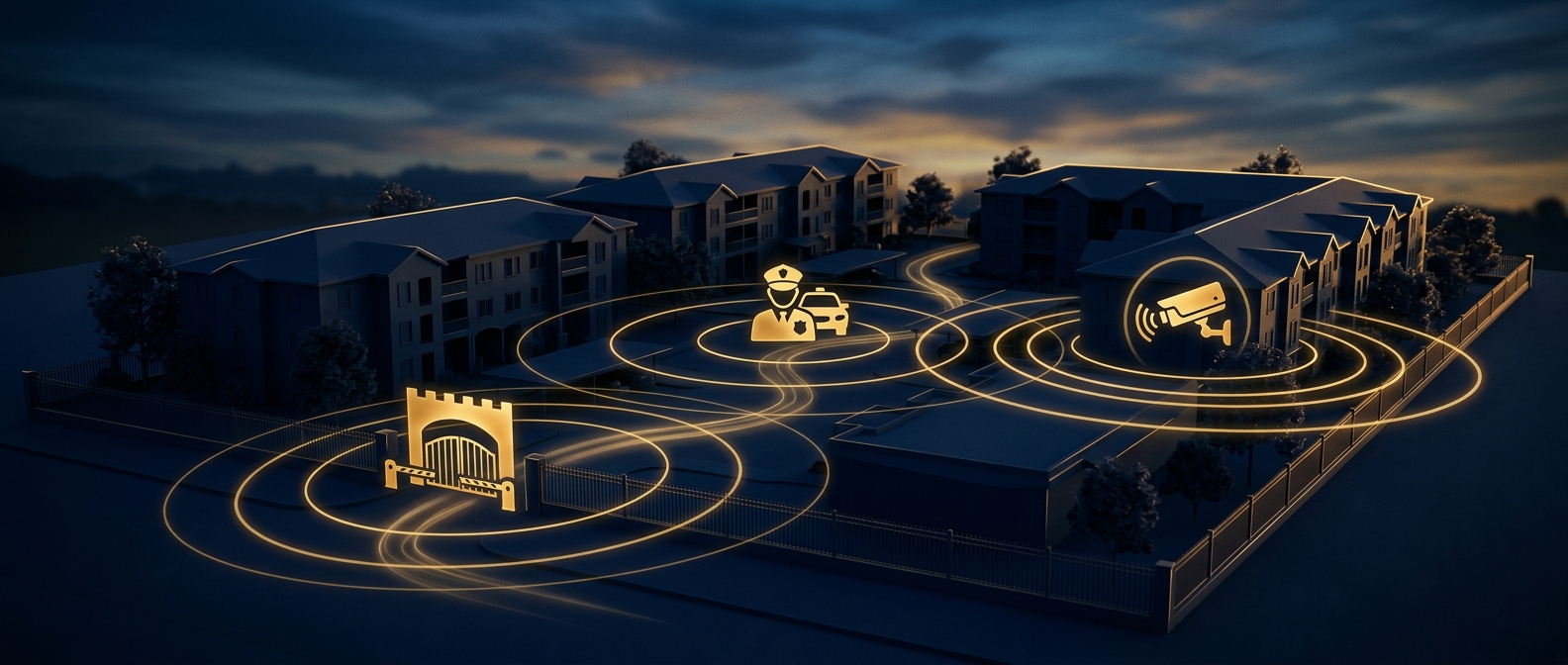
Multifamily apartment security is the layered system of access control, lighting, patrol, camera coverage, and resident-screening policy that a property owner or management company deploys to reduce foreseeable crime — and it is also, whether owners realize it or not, the single largest factor courts weigh in negligent-security and premises-liability lawsuits after a violent crime occurs on the property. Getting it right protects residents and the asset; getting it wrong routinely produces seven- and eight-figure jury verdicts.
Apartment communities occupy a strange position in American commercial real estate: they are simultaneously someone’s home and a dense, transient, cash-flowing asset with hundreds of strangers passing through parking lots, breezeways, and mail rooms every day. That combination is exactly what makes multifamily properties a recurring subject of both violent crime and the litigation that follows it. Property managers, regional owners, and their counsel increasingly treat “security” not as an amenity line item but as a liability-management discipline with its own body of case law, its own industry standards, and its own defensible-practice framework. This guide is written for the multifamily owner, asset manager, or risk manager who needs to understand what a real security program covers, how foreseeability and negligent-security claims actually work, and what separates a program that holds up in court from one that does not.
What does multifamily apartment security actually cover?
A mature multifamily security program is not a single control — it is a stack of overlapping layers, each closing a different gap. Perimeter and gated-access control governs who can drive or walk onto the property in the first place. Lighting and CPTED-informed landscaping remove the concealment and darkness that predatory crime depends on. Camera coverage at entries, mail kiosks, pools, laundry rooms, and parking areas creates both deterrence and an evidentiary record. Courtesy or roving patrol — foot and vehicle — puts a trained human presence into common areas, breezeways, and parking structures on a documented schedule. Visitor and vendor management controls who is on-site after a resident buzzes them in. And a resident-screening and lease-enforcement policy keeps known bad actors from ever getting a key in the first place.
None of these layers work in isolation, and none of them is optional at scale. A property with excellent cameras but no lighting simply records crimes in high definition rather than preventing them. A property with a gate but no enforced tailgating policy has spent capital on a control that residents defeat every day by holding the gate for the next car. The professional standard — the one recognized by ASIS International in its physical security and risk-assessment guidance — treats the property as a system of concentric rings, from the public street to the individual unit door, with a specific control assigned to each ring and a written post order describing how it is executed.
Why are apartment communities such a frequent target of negligent-security litigation?
Three structural facts make multifamily housing a recurring subject of premises-liability claims. First, density and turnover: hundreds of units means hundreds of key holders, guests, delivery drivers, and former residents whose access was never fully revoked. Second, semi-public common areas: parking lots, mailrooms, laundry facilities, stairwells, and breezeways are open enough for a stranger to enter unnoticed but isolated enough that a resident walking to their car late at night has no witnesses nearby. Third, an evidentiary trail that plaintiffs’ counsel can build from: police call logs, prior incident reports, maintenance tickets about broken gates and burned-out lights, and lease-file records of prior criminal activity by other residents all become discoverable evidence of what the ownership group knew — or should have known.
That last point is the legal crux. Negligent-security claims do not require proof that the property caused the crime; they require proof that the crime was foreseeable and that the ownership’s security measures were inadequate to that foreseeable risk. A single sexual assault, robbery, or shooting on a property with a documented history of similar incidents, broken access controls, and no patrol presence is close to the textbook fact pattern plaintiffs’ firms look for. Properties that can show a real risk assessment, working controls, and contemporaneous patrol documentation are in a fundamentally different — and far more defensible — position.
How does foreseeability actually get proven in an apartment crime case?
Courts generally look at the “totality of the circumstances” on and around the property: the crime history of the specific complex, the crime rate of the immediate neighborhood, the nature of prior incidents (a pattern of trespassing and vehicle burglary makes a later robbery or assault more foreseeable than an isolated, unrelated event), and any specific notice the owner received — a resident complaint about a prowler, a police report about a break-in, a maintenance ticket describing a gate that had been broken for months. Plaintiffs’ counsel will typically subpoena police call-for-service data for the property address and the surrounding block, request every incident and maintenance record the management company holds, and depose staff about what they knew and when they acted on it.
This is why “we didn’t know” is rarely a winning defense and is often precisely what plaintiffs disprove with the property’s own paperwork. The defensible position is not the absence of prior incidents — most communities of any size have some crime history — it is a documented, good-faith, continuously updated response to that history: a risk assessment that identified the pattern, a security plan that addressed it, and records proving the plan was actually executed rather than left on a shelf. This is educational information, not legal advice; owners facing an active claim or a specific incident should consult qualified counsel.
What are the physical and operational layers of a defensible program?
Access control starts at the gate or perimeter fence and extends to individual buildings and amenity spaces. Vehicle gates should be paired with pedestrian gates that cannot be propped or defeated by tailgating, and access credentials should be revoked promptly on move-out — a step many management companies handle inconsistently, leaving hundreds of former residents’ fobs and codes active for months. Lighting is the cheapest, highest-return control on the list: uniform, glare-free illumination across parking areas, walkways, breezeways, and entries removes the concealment that opportunistic crime depends on, and a documented lighting-inspection schedule closes the “the light was out for six weeks and nobody fixed it” fact pattern that shows up in nearly every parking-lot assault lawsuit.
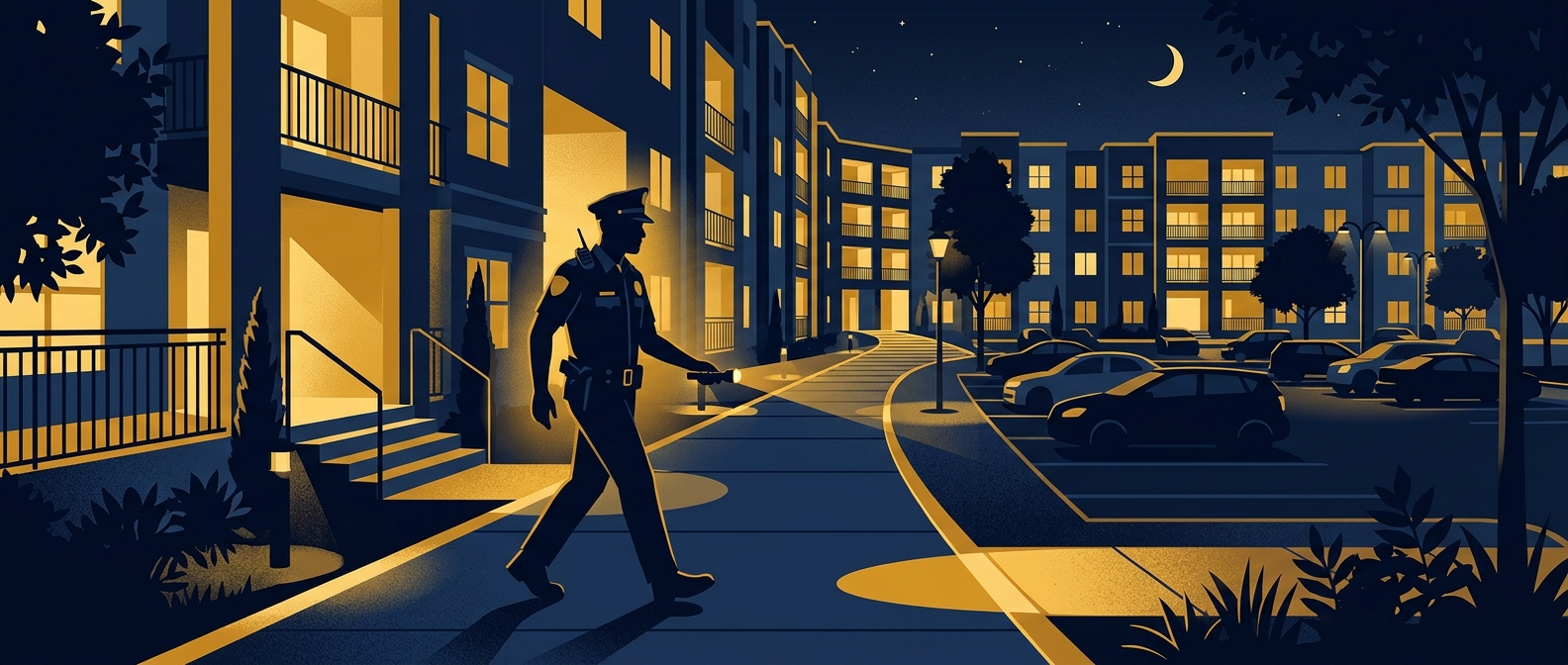
Camera coverage should prioritize entries, mail and package areas, pool and fitness amenities, laundry rooms, and parking — with retention long enough to matter for an insurance claim or a police investigation, and a written procedure for who reviews footage and how quickly. Patrol is the layer that converts static hardware into active deterrence: a marked vehicle or a uniformed officer walking documented routes through common areas, parking structures, and amenity spaces on a randomized schedule does what a camera alone cannot — it interrupts crime in progress and reassures residents that someone is actually present after dark.
Common crime patterns at apartment communities — and the control that addresses each
Package and mail-kiosk theft is the highest-volume complaint at most communities and is best addressed with camera coverage at the kiosk, resident notification systems, and a lease policy on package liability. Vehicle burglary and catalytic-converter theft cluster in poorly lit, low-visibility parking areas and respond directly to lighting upgrades, camera coverage, and randomized patrol timing. Domestic-violence incidents and disputes between residents or their guests are a distinct category that requires staff trained to recognize warning signs, a clear no-trespass and lease-enforcement process for a resident’s barred former partner, and a documented protocol for coordinating with law enforcement. Trespassing, loitering, and unauthorized “guests” who never appear on a lease are typically the precursor to more serious crime and are best controlled through consistent gate enforcement, visitor logging, and a firm, documented trespass-notice process rather than selective or inconsistent enforcement that itself becomes evidence of negligence.
How should visitor, vendor, and delivery access be managed?
Modern communities increasingly pair a gate or fob system with a visitor-management platform: residents issue time-limited codes to guests and delivery drivers, vendors check in and out through a logged process, and after-hours contractor access is scheduled rather than left to a shared master code that never gets changed. The goal is an auditable record of who was on the property and when — the same principle that governs commercial office security — applied to a residential population that expects convenience, not a checkpoint. Properties that rely on a single shared gate code that residents hand out freely have, in practice, no access control at all; the code becomes public within weeks and the gate becomes theater.
Minimal amenity vs. a defensible multifamily security program
| Dimension | Minimal / “amenity” security | Defensible security program |
|---|---|---|
| Basis for design | Whatever came with the last vendor contract | Documented risk assessment tied to actual incident history |
| Gate & access control | Shared code, rarely changed | Individual credentials, revoked at move-out, anti-tailgate enforcement |
| Lighting | Fixed at construction, rarely audited | Scheduled inspection log with prompt repair |
| Cameras | Present but unmonitored, short retention | Covers priority zones, defined retention, review protocol |
| Patrol | None, or unverified “drive-through” | Documented, randomized routes with electronic verification |
| Incident records | Scattered or undocumented | Centralized incident and maintenance log, retained |
| Trespass enforcement | Inconsistent, selective | Written policy, applied uniformly, documented |
| Litigation posture | Invites a foreseeability/adequacy finding | Demonstrates reasonable care against known risk |
What is the framework for building or upgrading an apartment security program?
- Pull the incident history. Request police call-for-service data for the property and the surrounding block, and compile every internal incident and maintenance report for the past 24–36 months.
- Assess the physical plant. Walk the property at night as well as during the day, scoring lighting, sightlines, gate function, camera coverage and blind spots, and landscaping that creates concealment.
- Benchmark against recognized standards. Compare current controls against ASIS International guidance and locally available Crime Prevention Through Environmental Design (CPTED) and Crime Free Multi-Housing frameworks offered through many municipal police departments.
- Design layered controls. Map specific fixes to specific findings — lighting repairs, camera repositioning, gate hardware upgrades, patrol routes and frequency, visitor-management rollout.
- Write the post orders and policies. Document patrol routes, incident-response and trespass-enforcement procedures, credential-revocation timelines, and reporting standards so the program is repeatable and auditable.
- Staff and verify. Deploy licensed, trained, supervised officers where patrol is warranted, and use electronic tour verification so coverage is proven rather than assumed.
- Reassess on a cadence. Revisit the risk picture annually and immediately after any significant incident, feeding new findings back into staffing, design, and enforcement.
What does security coordination with law enforcement and municipal programs look like?
Many police departments run Crime Free Multi-Housing programs that certify properties meeting a defined set of CPTED, lease-enforcement, and management-training standards, and coordination with local law enforcement on trespass enforcement, crime-trend briefings, and off-duty patrol resources is a recognized best practice reflected in guidance from bodies like the International Association of Chiefs of Police. Properties that maintain an active working relationship with their local precinct — sharing incident data, participating in certification programs, and inviting periodic security walk-throughs — tend to catch emerging patterns (a spike in vehicle burglaries, a known trespasser cycling back through the area) earlier than properties that treat the police only as an after-the-fact 911 call.
What drives the cost of multifamily security, and how should owners evaluate it?
Coverage hours, unit count and site footprint, whether patrol is foot, vehicle, or both, the number and condition of access points, and the depth of camera and lighting infrastructure all drive cost. Armed versus unarmed posts and specialized after-hours coverage add further variance. The number that matters most, though, is not the hourly patrol rate — it is the total risk-adjusted cost, weighing patrol and hardware spend against the far larger cost of a single negligent-security verdict, the reputational damage of a publicized violent incident, and the leasing impact of a community that residents no longer feel safe in. Insurers increasingly ask for evidence of a documented security program when underwriting multifamily general-liability policies, which makes an investment in a defensible program a premium consideration as well as a litigation one.
How does Honeybadger secure Arizona multifamily and apartment communities?
Within Arizona, Honeybadger Solutions staffs multifamily and apartment communities with our own in-house, Arizona DPS-licensed, supervised security officers — not subcontracted labor. Because the property is in Arizona, the officers patrolling your breezeways, monitoring your gate, and covering your parking areas after dark are our own personnel, trained, licensed, and directly supervised. We build every program from a real risk assessment grounded in the property’s actual incident history, design layered controls sized to that risk, and produce the electronically verified patrol documentation and incident records that give ownership a defensible position — not just a patrol schedule.
Operating from offices in Casa Grande, Phoenix, and Oro Valley, we serve multifamily owners and management companies across the entire state, and we extend our reach nationwide and internationally through a commanded network of vetted partners where owned officers are not available. Whether you manage a single 150-unit community or a statewide multifamily portfolio, we design and run the program that protects your residents and puts your risk posture on solid ground — and this content is educational, not legal advice; for a specific claim or incident, consult qualified counsel.
Frequently asked questions
Are Honeybadger’s apartment-community security officers your own employees in Arizona?
Yes. Within Arizona, our multifamily patrol and security officers are our own in-house, AZ DPS-licensed, supervised personnel — not subcontractors. We handle hiring, training, post-order design, and field supervision directly. Nationwide coverage outside Arizona is delivered through a commanded network of vetted partners.
What makes an apartment community a target for a negligent-security lawsuit?
A documented history of similar prior incidents, combined with known, unrepaired security gaps — a broken gate, burned-out lighting, an unmonitored camera system — creates the foreseeability-and-inadequacy fact pattern plaintiffs’ counsel look for. Properties with a real risk assessment, working controls, and documented patrol are in a far more defensible position than those relying on hardware alone.
Is this article legal advice about a specific incident or claim?
No. This guide is educational information about how multifamily security programs are typically designed and how negligent-security liability generally works. It is not legal advice, and it does not address the facts of any specific incident. Owners facing an active claim, investigation, or lawsuit should consult qualified counsel before taking action.
What is the single highest-return security upgrade for most apartment communities?
Lighting and access-control discipline consistently deliver the most risk reduction per dollar: uniform, glare-free lighting with a real inspection schedule, paired with prompt credential revocation and anti-tailgating enforcement at gates, closes the most common gaps that show up in litigation. Patrol and camera investment then reinforce those base-layer controls.
About Honeybadger Solutions
Honeybadger Solutions is an Arizona-licensed security and investigations firm. Within Arizona, our multifamily and apartment-community security officers are our own AZ DPS-licensed, supervised in-house guards — not subcontracted labor — protecting residents and property across the state. We extend nationwide and international coverage through a commanded network of vetted partners. This content is educational and is not legal advice; consult qualified counsel regarding any specific incident or claim.
Offices: Casa Grande (HQ), Phoenix, and Oro Valley, Arizona.
Phone: Book a consultation online
Confidential consultation: speak with a security advisor about a risk assessment and program design for your community.
Browse by topic
Security guard services · Private investigations · Cybersecurity · Digital forensics · Financial fraud investigation · Executive protection · All articles