
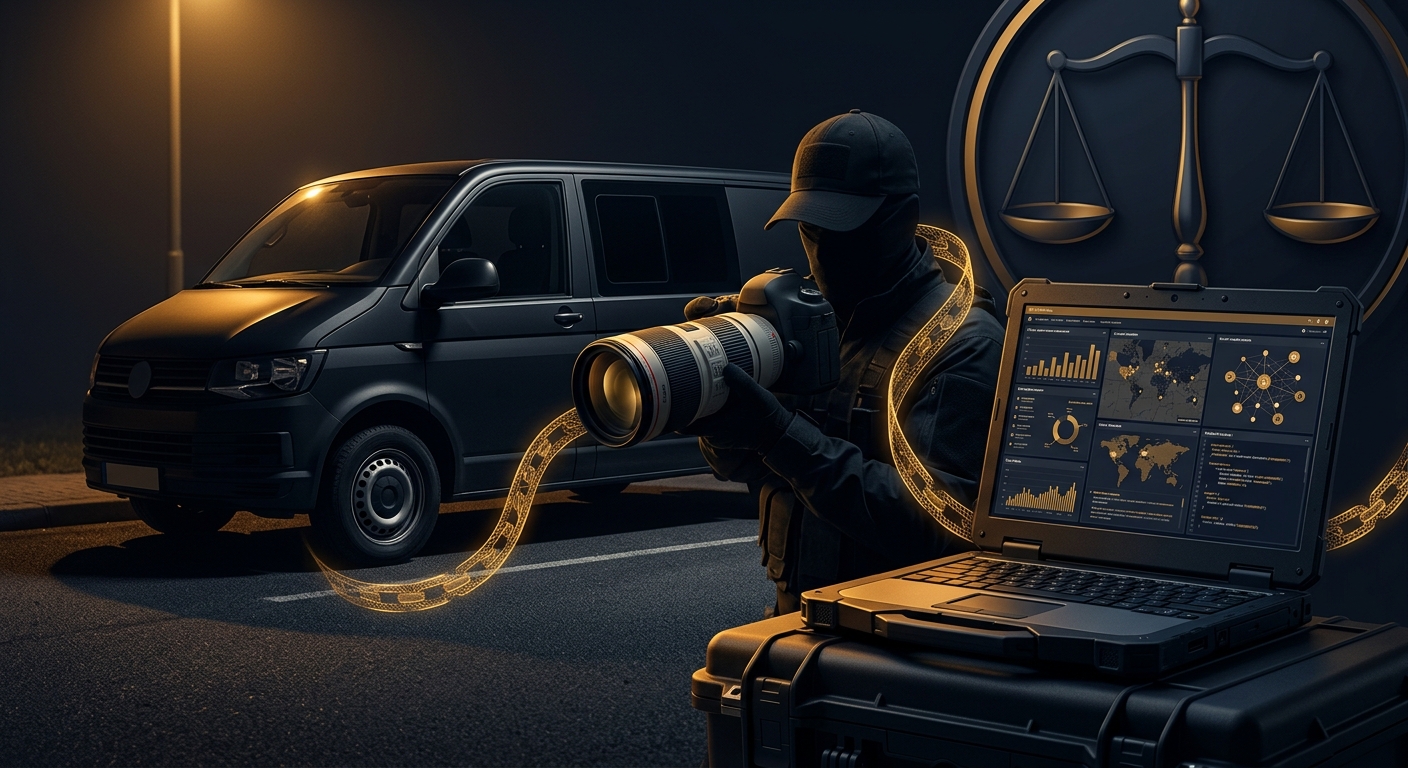
Surveillance investigation methods fall into four categories — fixed/static, mobile, technical (GPS and device-based), and digital/OSINT — and each is governed by a different mix of federal wiretap law, state consent and stalking statutes, private-investigator licensing rules, and, for aerial work, FAA regulation. Lawful surveillance stays in public vantage points, avoids intercepting private conversations without required consent, and is performed by a licensed investigator so the resulting evidence is admissible rather than a liability.
Surveillance is one of the oldest investigative tools and one of the easiest to execute badly. The difference between a case-winning record and an inadmissible mess — or a civil claim against the client who ordered it — is not the equipment; it is knowing which method fits the facts and which law applies to it. This guide surveys the surveillance methods used across corporate, insurance, family-law, and litigation matters, the federal and state legal framework that governs each one, and how a licensed investigative team keeps a case on the right side of that line. It is general information for businesses, attorneys, and individuals evaluating an investigation, not legal advice for a specific matter — confirm jurisdiction-specific questions with counsel.
What are the main types of surveillance methods?
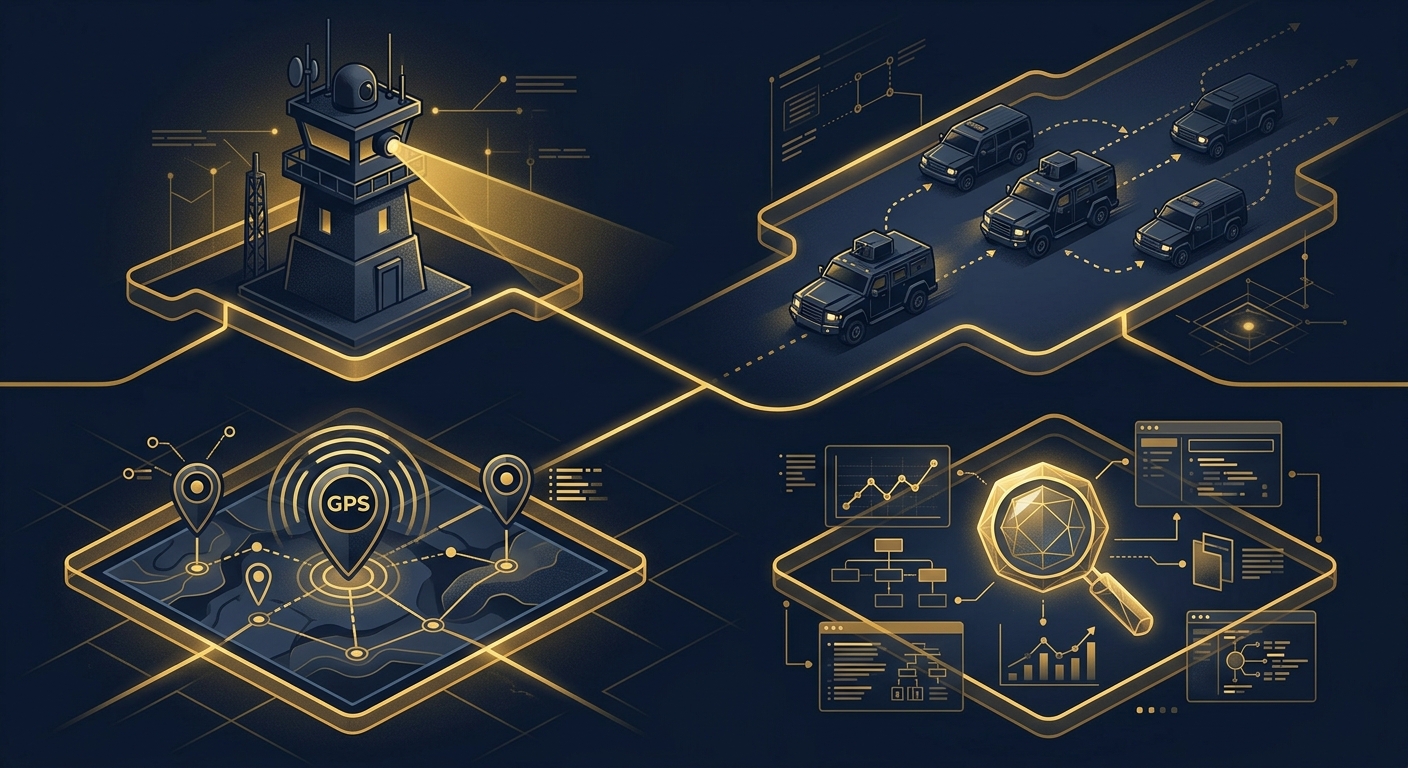
Every surveillance assignment is built from some combination of four method families. Understanding what each one actually establishes — and its legal footing — is the starting point for scoping any engagement correctly.
- Fixed/static surveillance — a stationary observation post (a parked vehicle, a rented unit, a fixed camera) covering a residence, business, or job site to document patterns of activity over time.
- Mobile surveillance — following a subject’s vehicle or on-foot movement using single- or multi-operator formations to document where they go and who they meet.
- Technical surveillance — lawful GPS tracking of a vehicle the client owns or has authority over, and monitoring of company-owned devices and systems under policy.
- Digital and open-source surveillance (OSINT) — monitoring and archiving a subject’s public social-media activity, public records, and public digital footprint.
What federal laws govern surveillance investigations?
Two federal statutes sit underneath almost every surveillance question in the United States. The Federal Wiretap Act (18 U.S.C. § 2511, part of the Electronic Communications Privacy Act) makes it a crime to intercept wire, oral, or electronic communications without the consent required by law — it is the reason audio recording of a conversation you are not part of is treated far more strictly than silent video of public conduct. The Act sets a federal floor of one-party consent, but states are free to require more, which is why the state layer below matters just as much as the federal one. Separately, the Federal Aviation Administration regulates drone-based surveillance under Part 107, requiring a certified remote pilot and imposing altitude, airspace, and privacy-adjacent operating limits on any aerial platform used in an investigation.
How does state consent law change what is legal?
State recording-consent law is the single biggest variable in whether a given surveillance method is lawful. The table below summarizes the two regimes and what each means in practice for an investigator.
| Consent regime | What it requires | Practical effect on surveillance |
|---|---|---|
| One-party consent (most states, including Arizona) | Only one party to the conversation must consent to a recording | An investigator or client who is a party to a call or meeting may record it; covert bugging of a conversation you are not part of is still illegal |
| Two-party / all-party consent (e.g., California, Florida, Illinois, Washington) | Every party to the conversation must consent | Recording a phone call or private conversation without every participant’s consent is a crime, regardless of the investigator’s own participation |
| Video without audio (all states) | Generally governed by expectation-of-privacy rules, not wiretap law | Silent video from a public vantage point is broadly permissible where no reasonable expectation of privacy exists |
Multi-state matters compound this quickly: a subject who is recorded on a call while in a two-party-consent state is protected by that state’s law even if the investigator is calling from a one-party-consent state. A disciplined firm checks the consent regime for every jurisdiction touched by the case before any audio is captured — not after.
Where is surveillance never legal, regardless of consent rules?
Consent law governs conversations; a separate body of privacy and anti-stalking law governs where and how a subject can be observed at all. These limits apply nationwide, not just in strict-consent states.
- Areas with a reasonable expectation of privacy — restrooms, locker rooms, changing areas, and the interior of a private residence not visible from a public vantage point.
- Trespass — entering private property without permission to gain a vantage point, regardless of what is then recorded.
- Conduct that meets a state’s stalking or harassment definition — surveillance so persistent, proximate, or confrontational that it would cause a reasonable person to fear for their safety, which most states criminalize independent of the investigation’s legitimate purpose.
- Covert audio in a two-party-consent state — recording a private conversation without every participant’s consent, which is a criminal offense in those jurisdictions.
- GPS tracking of a vehicle the client does not own or control — placing a tracker on a vehicle without legal authority over it is illegal in nearly every state and, per the U.S. Supreme Court’s reasoning in United States v. Jones, is treated as a Fourth Amendment search when done by the government.
Do investigators need to be licensed to conduct surveillance?
In nearly every U.S. state, conducting surveillance for hire — observing, following, or recording a subject on behalf of a client — requires a private-investigator license, and operating without one exposes both the operator and the client who hired them. In Arizona, private investigators are regulated by the Department of Public Safety under A.R.S. Title 32, Chapter 24. Licensing requirements, and the specific exemptions for insurance adjusters or in-house corporate security staff, vary by state, so any multi-state engagement should confirm licensing coverage in every jurisdiction where fieldwork occurs before the engagement begins.
How do investigators decide which method to use?
Method selection follows the question the case actually needs answered, not habit or convenience. A disciplined intake process runs through the same sequence on every matter.
- Define the specific question. Is the client trying to establish a pattern (fixed), a destination or contact (mobile), a location history on an owned asset (technical), or a public digital footprint (OSINT)?
- Map the legal terrain first. Identify every state whose consent, stalking, and licensing law could apply before selecting a method.
- Scout before committing hours. Use public-records and OSINT research to establish patterns and target the most productive observation windows.
- Deploy the least intrusive method that will answer the question. Silent video from a public vantage point is preferred over audio wherever it can carry the case.
- Corroborate across methods. Field observation paired with digital forensics or OSINT produces a stronger, harder-to-dispute record than any single method alone.
- Preserve forensically. Retain native files, hash-verify digital evidence, and maintain a contemporaneous log and unbroken chain of custody from capture through delivery.
- Report objectively. Document what was observed, not legal conclusions, so the record stands on its own facts.
How do surveillance methods apply across different case types?
The same four method families show up across very different practice areas, with the legal sensitivity shifting by context. In corporate and workplace investigations, surveillance typically documents time theft, moonlighting, or workers’ compensation fraud, and is strongest when paired with company-device forensics performed under a written monitoring policy. In domestic and family-law matters, mobile and fixed surveillance document a pattern of conduct relevant to custody or support, always from public vantage points and never inside a residence. In insurance-defense matters, surveillance corroborates or contradicts a claimed injury, typically for delivery to a carrier’s Special Investigation Unit. And in pre-litigation or due-diligence matters, digital and OSINT surveillance of a counterparty or witness supplements background investigation work without ever touching a private account.
What if you suspect you are the one under surveillance?
The same methods that make surveillance effective against a subject can be turned against a business or executive by a competitor, a hostile party, or a criminal actor. Physical surveillance-detection routes and electronic sweeps for covert recording and tracking devices are the countermeasure discipline, handled through our technical surveillance countermeasures (TSCM) team, and are frequently paired with executive protection planning for principals who have reason to believe they are being tracked or monitored.
What separates an elite surveillance investigator from a mediocre one?
Two investigators can run what looks like the same assignment and produce very different results. Elite operators map the legal terrain of every jurisdiction involved before fieldwork begins; they choose the least intrusive method capable of answering the question; they maintain unbroken, timestamped documentation and a clean chain of custody; and they report what they observed without editorializing or overreaching into legal conclusions. Mediocre operators skip the legal mapping, default to whatever equipment they already have, and produce footage or captures that a competent attorney can pick apart on cross-examination — turning a case-winning tool into the other side’s best exhibit.
Representative scenario: a multi-state mobile assignment
Consider a representative matter involving a subject who traveled between two states in the course of a single week — one a one-party-consent state, the other a two-party-consent state. Before fieldwork began, the investigative team mapped the consent, stalking, and licensing rules of both states, confirmed coverage through a licensed local operator in the second state, and built the collection plan around silent, continuous video from public vantage points, with no audio capture planned in either jurisdiction. Public OSINT research narrowed the productive surveillance windows before any hours were spent in the field. The resulting record — unbroken, timestamped, and legally clean in both states — supported the client’s case without creating new exposure of its own. This is an illustrative scenario, not a named client or claimed outcome, but it captures the discipline the method requires: know the law in every state touched by the case before deciding what to point a camera at.
Honeybadger Solutions conducts surveillance investigations for corporate, insurance, family-law, and litigation clients — in Arizona through our own in-house, AZ-licensed field investigators, and nationwide through a commanded network of vetted field-surveillance partners paired with our in-house digital-forensics and OSINT teams. For related reading, see our guides on mobile surveillance investigations and corporate surveillance legality.
Frequently asked questions
Is it legal to record someone without their knowledge?
It depends on what is being recorded and where. Silent video of conduct occurring in public, from a public vantage point, is broadly legal nationwide. Recording audio of a conversation is governed by the state’s consent law: in one-party-consent states, including Arizona, a participant in the conversation may record it; in two-party-consent states such as California and Florida, every participant must consent, and covert audio recording without that consent is a criminal offense.
Can a GPS tracker legally be placed on a vehicle?
Only if the person authorizing it owns or has legal authority over the vehicle — for example, a company tracking a vehicle it owns, or a parent tracking a vehicle registered to a minor child. Placing a tracker on a vehicle owned by someone else without their consent is illegal in nearly every state, and, when done by government actors, the U.S. Supreme Court has held it constitutes a Fourth Amendment search requiring a warrant.
Do private investigators need a license to conduct surveillance?
In nearly every state, yes. Conducting surveillance for hire requires a private-investigator license, and the specific requirements and any exemptions vary by state. In Arizona, private investigators are licensed and regulated by the Department of Public Safety under A.R.S. Title 32, Chapter 24. Using an unlicensed operator undermines the admissibility of the resulting evidence and can expose both the operator and the client who hired them.
Can drones be used for surveillance investigations?
Drones can be used, but they are governed by FAA Part 107, which requires a certified remote pilot and imposes altitude, airspace, and operating restrictions, in addition to the same privacy and trespass limits that apply to any other observation method. A drone does not get a legal pass to observe areas with a reasonable expectation of privacy simply because the recording happens from the air.
About Honeybadger Solutions
Honeybadger Solutions is a licensed security and investigations firm delivering full-spectrum surveillance investigations, digital forensics, and technical surveillance countermeasures to businesses, attorneys, insurers, and individuals across Arizona and nationwide. In Arizona, field surveillance is performed by our own in-house, AZ-licensed investigators — not subcontractors. We operate three Arizona offices — Casa Grande (headquarters), Phoenix, and Oro Valley — and support clients nationwide through our in-house digital-forensics and OSINT teams paired with a commanded, vetted field-partner network wherever fieldwork is required outside Arizona.
Need a lawful, court-ready surveillance investigation? Book a consultation online to brief an investigations lead and scope a method and jurisdiction-appropriate approach with your counsel. Confidential. Defensible. Court-ready.
This article is general information, not legal advice; recording, stalking, and licensing law vary by state and change over time — confirm specifics with qualified counsel before any surveillance begins. Authoritative references: the Legal Information Institute’s text of 18 U.S.C. § 2511 (Wiretap Act) and the Federal Aviation Administration’s Part 107 drone certification rules.
Browse by topic
Security guard services · Private investigations · Cybersecurity · Digital forensics · Financial fraud investigation · Executive protection · All articles