
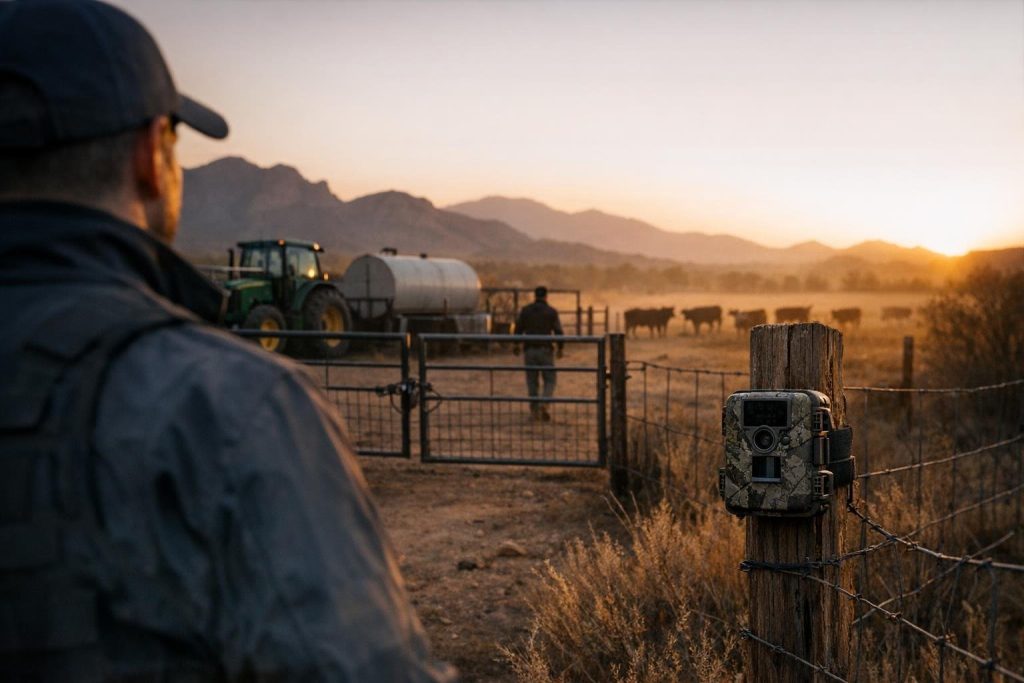
Most farm and ranch theft in Arizona is prevented with groundwork done before anything goes missing: record and mark your equipment, keep brands and head counts current, lock up keys and fuel, protect remote wells and pumps, post your land the way Arizona law requires, and put cameras and patrols where people have to pass. When something is taken, report it fast to the county sheriff, and for livestock, to an Arizona Department of Agriculture livestock officer, with serial numbers, photos and brand records in hand.
Arizona operations face a particular set of problems: huge acreage, grazing on state and federal leases, wells miles from the house and response times that can stretch long. This guide covers equipment, fuel, livestock, wire, pumps and water, what Arizona’s brand and fence laws actually say, and how to document a loss for the sheriff and your insurer. For patrol and deterrence built around your property, see our agriculture and ranch security service.
Key takeaways
- Equipment that cannot be identified is hard to recover. Record serial numbers and PINs, photograph everything and add hidden marks.
- Arizona requires owners of range livestock to adopt and record a brand, and brands must be rerecorded every five years or they can be lost.
- Livestock generally cannot be sold or hauled without an inspection by a state livestock officer or inspector, plus the right paperwork.
- Arizona’s “open range” rules are about livestock wandering, not about people. Trespass by people is a separate question.
- Posting signs to keep hunters out has specific Arizona requirements, and state or federal land cannot be posted without the Game and Fish Commission’s consent.
- Copper wire stripped from a well pump can cost far more to repair than it brings at a scrap yard, and Arizona law counts that damage.
What gets stolen on Arizona farms and ranches
Rural theft rarely looks like a smash-and-grab. It is a trailer hooked up and towed off at night, diesel siphoned from a field tank, a GPS receiver pulled from a tractor cab, or copper wire cut out of a pump panel at a well nobody visits for a week. Livestock can be loaded at a remote corral and sold before the loss is noticed.
Recovery is hard once equipment is gone. In the 2016 equipment theft report by the National Equipment Register and the National Insurance Crime Bureau, the most recent edition of that joint report we could find, NICB compiled 11,574 reports of stolen construction and farm machines and 2,442 recoveries that year. Prevention and identification are where owners have the most control.
| Asset | How it is usually lost | Best prevention | Record to keep |
|---|---|---|---|
| Tractors, UTVs, trailers | Keys left in cab, trailer unlocked | Key box, hitch and wheel locks, GPS tracker | Serial number or PIN, VIN, photos, hidden marks |
| GPS receivers and displays | Removed from cab overnight | Remove and store when parked, lock cabs | Serial numbers, photos |
| Fuel | Siphoned from field tanks | Locking caps, tanks in view of cameras, meter logs | Delivery tickets, weekly level readings |
| Livestock | Loaded at remote pens or gathered off open range | Recorded brands, counts, watch on loading areas | Brand certificate, head counts, photos of distinctive animals |
| Pumps, wire, solar well panels | Copper stripped from panels and pump wiring | Cages, tamper alarms, patrol stops | Photos, equipment lists, marked wire |
Mark it and inventory it before it walks
An inventory you can hand to a deputy the same day is the single most useful thing you can build. Use this inventory checklist:
- Write down the serial number or product identification number (PIN) of every tractor, implement, UTV, trailer, generator, welder and pump
- Photograph each item from four sides, plus the serial plate
- Add a hidden owner mark, such as an engraved number in a spot only you know, so equipment can be identified if plates are removed
- Record GPS receivers, displays and other removable electronics separately, by serial number
- Keep a copy of the inventory off the property, such as in cloud storage
- Update it after every purchase, sale or trade, and match it to your insurance schedule
Construction contractors face many of the same risks with the same machines. Our guide on construction equipment theft prevention and recovery goes deeper on trackers and immobilizers.
Livestock: brands, bills of sale and inspection
Arizona’s livestock laws give ranchers strong tools, but only if the records are kept up. This is general information, not legal advice.
- Brands are required for range livestock. Under A.R.S. 3-1261, every person owning range livestock in Arizona must adopt and record a brand, applied by hot iron, freezing, acid or another permanent method. A recorded brand is the owner’s property and can be sold or leased.
- A recorded brand is evidence. Under A.R.S. 3-1267, an owner’s recorded brand on an animal is prima facie evidence in Arizona courts that the animal belongs to that owner.
- Brands expire if you ignore them. Recorded brands must be rerecorded every five years under A.R.S. 3-1264. A brand not rerecorded within three years after the due date is deemed abandoned under A.R.S. 3-1265.
- Bills of sale. A.R.S. 3-1291 requires a written, acknowledged bill of sale to go with livestock on a sale or transfer, except dairy calves under 30 days old.
- Inspection before sale or hauling. Under A.R.S. 3-1336, most livestock other than horses and swine cannot be slaughtered, sold, purchased, transported or shipped until a livestock officer or inspector has inspected them for health, brands and marks. Hauling livestock without an inspection record, validated auction invoice or bill of sale is a class 2 misdemeanor under A.R.S. 3-1341.
- Livestock officers. Under A.R.S. 3-1331, Department of Agriculture livestock officers are certified peace officers. They can stop people hauling livestock when they have probable cause or reasonable suspicion, and they arrest for livestock crimes.
- Penalties. Knowingly killing or selling another person’s livestock, or buying it from someone without the right to sell, is a class 5 felony under A.R.S. 3-1307, and the owner can recover three times the animals’ value.
Keep head counts after every gather, photograph distinctive animals, and file your brand certificate where you can find it. An accurate count lets you report a loss in days, not months.
Fences, open range and trespass: what Arizona law actually says
People often say Arizona is an “open range” state. That phrase is about livestock, not trespassers. Under A.R.S. 3-1427, a landowner generally cannot recover for damage done by trespassing animals unless the land is enclosed by a lawful fence. The exception is a no-fence district formed under A.R.S. 3-1421, where an owner who recklessly lets livestock run at large is liable for the damage.
A.R.S. 3-1426 defines a lawful fence as posts set no more than 30 feet apart with at least four tightly stretched barbed wires, the top wire 50 inches above the ground, or another fence equally strong and effective at turning livestock. Fencing to that standard protects your crops and also marks your boundary for people.
Trespass by people falls under the criminal code:
- A.R.S. 13-1502 makes it criminal trespass to knowingly enter or remain on land after a reasonable request to leave or reasonable notice prohibiting entry.
- A.R.S. 13-1503 covers unlawful entry into a fenced commercial yard. Arizona’s definition of a fenced commercial yard includes fully enclosed property where livestock, produce or other commercial items are located.
- A.R.S. 13-1506 makes entering a fenced commercial yard with intent to steal third-degree burglary, a class 4 felony.
- Hunting and posting. A.R.S. 17-304 says owners or lessees of private land who want to close it to hunting must post signs at least 8 by 11 inches with letters at least one inch high, at every vehicle access point, at property or fence corners and at least every quarter mile along the boundary. Posts with at least 100 square inches of orange paint can serve as the in-between markers. For hunters, entry is criminal trespass only if the signs also say “no trespassing” or the person ignores a request to leave or other reasonable notice. State and federal land, including leased grazing land, cannot be posted without the Game and Fish Commission’s consent.
This is general information, not legal advice. Ask counsel how these rules apply to your deeded land and your leases.
Fuel, wire, pumps and water
Water infrastructure is a growing target because pump panels, well wiring and solar well setups hold copper and electronics far from anyone’s view. The repair bill is often many times the scrap value, and a dry well in July can cost animals.
- Cage pump panels and lock well houses; use tamper switches that send an alert
- Photograph each well site setup so you can prove what was there
- Add wells and remote tanks to patrol routes and camera coverage
- Use locking fuel caps, keep field tanks within view of a camera, and read levels weekly
- Remove keys from equipment every night and keep them in a locked box
- Change gate combinations after seasonal crews leave
Arizona law backs this up. Under A.R.S. 13-1802, the value of stolen metal includes the damage caused by the theft, so the repair bill counts. Scrap metal dealers must record sellers’ identification, report most purchases to the Department of Public Safety within 24 hours and hold copper for seven days under A.R.S. 44-1642 and 44-1644. A.R.S. 13-1602 also makes it criminal damage to recklessly block a passageway so livestock lose access to the only reasonably available water, and because Arizona’s criminal damage chapter defines a utility to include irrigation providers, damaging their canals, gates and pumps is treated as damage to utility property.
Cameras and patrol on big ground
No one can watch every acre. Cover the choke points instead: main gates, the roads into the property, the equipment yard, fuel tanks, loading corrals and the wells you depend on most. Cellular cameras with alerts work where there is no internet, and solar power keeps them running at remote sites. Check them after monsoon storms, which can knock out power and coat lenses with dust.
Marked patrol adds a visible presence that a camera cannot. Randomized checks of gates, wells and corrals, with time-stamped photos, keep the pattern unreadable and give you a record of what was normal before a loss. Scale patrol up for harvest, shipping and calving, when crews, cash crop and trailers raise the stakes. Our mobile vehicle patrol service covers dispersed rural properties.
Installation work is performed and contracted by our licensed Arizona ROC contractor partner. Honeybadger Solutions LLC is not a licensed contractor.
Reporting a theft to the sheriff, livestock officer and insurer
The first hours matter. Equipment and animals can be moved, sold or re-marked quickly. Follow these steps:
- If the theft is happening now, call 911. Do not confront anyone.
- Report the loss to the county sheriff and get a report number.
- For livestock, also contact the Arizona Department of Agriculture’s livestock services so livestock officers know about the loss.
- Give investigators serial numbers, PINs, photos, hidden marks, brand records and head counts.
- Save camera footage from before and after the theft, not just the moment it happened.
- Tell neighbors and nearby sale barns what to watch for.
- Notify your insurer promptly with the report number, your inventory, photos, receipts and repair estimates.
How Honeybadger Solutions helps
Honeybadger Solutions is a veteran-led security firm based in Casa Grande, in Pinal County farm country. Our farm and ranch security program maps how your property is entered and worked, then places randomized patrol, remote camera monitoring and checks where value is concentrated: equipment yards, fuel, wells and loading areas. We scale coverage up for harvest and shipping season and back down afterward.
Our officers are private security, not law enforcement. They deter, observe and document, and they get the sheriff clear information to act on. Patrol, drone and officer services are delivered in-house in Arizona. When a loss has already happened, our licensed private investigators (Arizona DPS agency license No. 1759795) can help document it for the sheriff and your insurer. If your operation includes a family residence, our estate and ranch security program covers the living side of the property.
Quotes are written and given before any work starts. Request farm and ranch security online, or book a confidential consultation.
Frequently asked questions
Is Arizona an open range state?
In the sense that matters for livestock, generally yes. Outside no-fence districts, a landowner usually cannot recover for damage by wandering livestock unless the land is enclosed by a lawful fence under A.R.S. 3-1427. It does not give people a right to enter your land.
Do I have to brand my cattle in Arizona?
If they are range livestock, yes. A.R.S. 3-1261 requires owners of range livestock to adopt and record a brand, and the brand must be rerecorded every five years. This is general information, not legal advice.
Who investigates stolen cattle in Arizona?
The county sheriff takes theft reports, and Arizona Department of Agriculture livestock officers, who are certified peace officers, enforce livestock laws. Report to both.
Can I post my state grazing lease against trespassers?
Not for hunting closures without permission. A.R.S. 17-304 says state or federal lands, including leased land, may not be posted except with the Game and Fish Commission’s consent. Ask the land agency about other access rules.
What will my insurer want after equipment is stolen?
Expect to provide the sheriff’s report number, serial numbers or PINs, photos, purchase records and repair or replacement estimates. A current inventory makes the claim faster and harder to dispute.
Sources: A.R.S. 3-1261, A.R.S. 3-1264, A.R.S. 3-1265, A.R.S. 3-1267, A.R.S. 3-1291, A.R.S. 3-1307, A.R.S. 3-1331, A.R.S. 3-1336, A.R.S. 3-1341, A.R.S. 3-1424, A.R.S. 3-1426, A.R.S. 3-1427, A.R.S. 13-1501, A.R.S. 13-1502, A.R.S. 13-1503, A.R.S. 13-1506, A.R.S. 13-1601, A.R.S. 13-1602, A.R.S. 13-1802, A.R.S. 17-304, A.R.S. 44-1644, Arizona Department of Agriculture, Livestock Inspections, NER and NICB, 2016 Equipment Theft Report
Browse by topic
Security guard services · Private investigations · Cybersecurity · Digital forensics · Financial fraud investigation · Executive protection · All articles