
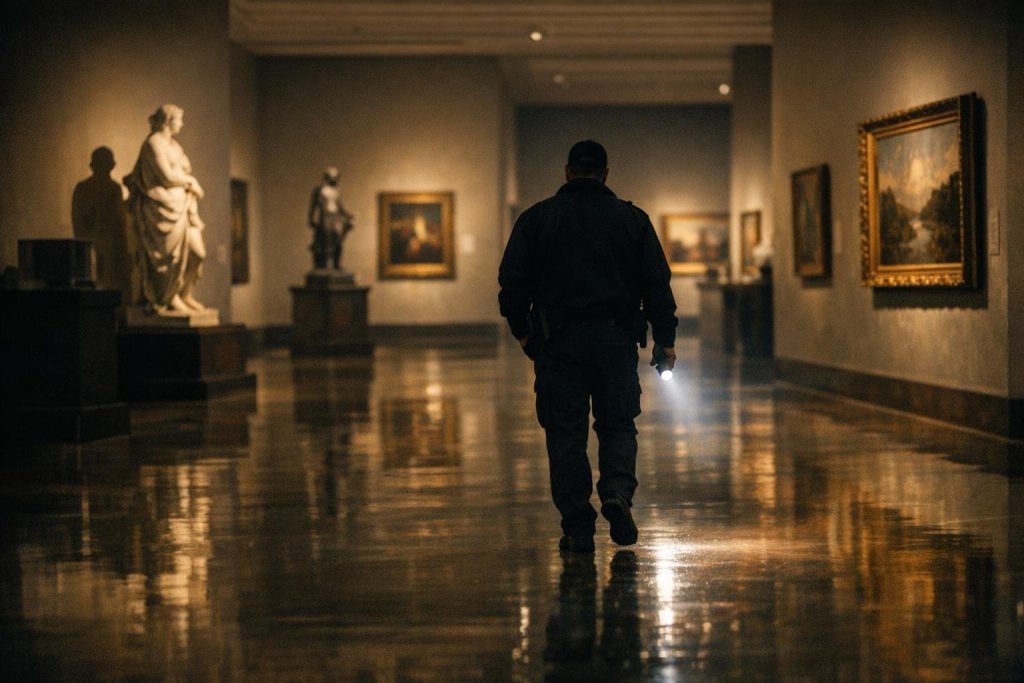
A practical security plan for a small or mid-sized museum answers six questions in writing: who watches the galleries and when, how the building opens and closes, who may enter collections storage, how borrowed objects are protected, how events among the collection run, and what every person does in an emergency. You do not need a large security department to do this well. You need clear rules, a short daily routine and the discipline to follow both.
This guide is for directors, registrars, facilities managers and boards of museums, galleries and historic sites. It draws on the suggested practices adopted by the American Alliance of Museums (AAM) and the ASIS International Cultural Properties Council, and on Arizona law where it applies. If you want officers, an assessment or event coverage, see our museum and cultural venue security service.
Key takeaways
- Assign every gallery and storage room a risk level first. AAM and ASIS use four levels, with medium as the default when nothing is assigned.
- Post galleries before the doors open. Opening hour, closing hour and shift changes are the thinnest coverage of the day.
- Unescorted storage access should go only to people with an institution credential based on an adjudicated background investigation, including interns, volunteers and contractors.
- Collections keys stay under one person’s control, are signed out daily and never leave the building.
- Rental contracts for galas and weddings should set guest counts, food and drink zones, distance from objects and who staffs the doors.
- AAM treats a dated, written disaster preparedness and emergency response plan with floorplans and named roles as a core document.
Start with risk levels, not equipment
The 2013 Suggested Practices for Museum Collections Space Security sort objects into four risk categories based on their value or significance, including intrinsic, cultural and research value and the effect a loss would have on the museum’s reputation and mission. Collections staff assign the levels, with help from whoever handles security. In the absence of an assignment, the default is medium risk.
The document itself says smaller museums may find full compliance difficult. That is a reason to use the risk levels, not to skip them. Spend the most effort on the few objects and rooms where a loss would hurt most.
| Risk level | What it means (AAM/ASIS) | Practical step for a small museum |
|---|---|---|
| Low | Loss would not significantly harm the museum’s reputation; items may be replaceable | Locked room, door contacts, motion detection |
| Medium (default) | Loss would significantly harm the museum’s image or reputation | Add an access list, sign-out keys and a visitor log |
| High | Loss would be highly harmful and could affect the mission | Card access with audit trail, cameras on everything leaving the room |
| Very high | Owning or showing the item is newsworthy; a loss could affect future loans and gifts | Separate cabinet or vault, two-factor entry, posted officer when on display |
Loaned objects may carry conditions that require more protection than the museum would give its own collection. Check every loan agreement against your levels.
Gallery staffing with a small team
Many small museums run galleries with a front desk attendant, a few docents and volunteers. That can work, but only if each person knows which rooms they can see from their post, which objects to watch and how to call for help without leaving the room.
Arizona has a well-known example of what an unwatched gallery costs. According to the University of Arizona, on the day after Thanksgiving in 1985 a man and woman entered the University of Arizona Museum of Art as it opened. While the woman made small talk with staff, the man went to an upstairs gallery, cut Willem de Kooning’s “Woman-Ochre” from its frame and walked out with it. The painting was recovered in 2017 and returned to the museum in 2022 after extensive restoration.
The lessons for a small staff are practical:
- Have every gallery covered, by a person or a monitored camera, before the first visitor enters.
- Treat a visitor who keeps staff talking at the desk while a companion goes elsewhere as a reason to check the galleries, politely and quickly.
- Stagger breaks and shift changes so two rooms never go dark at the same time.
- Rotate gallery posts about every hour so attention stays sharp.
- Give volunteers a radio or a phone tree, a short script for touch and photography rules, and a clear rule that they report and do not confront.
- Brief the day’s staff on the highest-risk objects in each room, especially after an install.
Opening and closing checks
Most losses that go unnoticed for days could have been caught at closing. A written routine, signed by the person who did it, turns “I think it was there” into a record.
Opening checklist:
- Disarm the alarm and note the time and person in the log.
- Walk every gallery before the public enters. Check case locks, frames, mounts and labels against the object list for that room.
- Check exterior doors, the loading dock and fire exits for signs of tampering.
- Confirm cameras are recording and the monitoring view is live.
- Post staff to galleries, then open the doors.
Closing checklist:
- Sweep every gallery, restroom, stairwell and closet so no one remains inside.
- Confirm every object on the room checklist is in place. Note anything moved, damaged or missing.
- Lock cases, storage and the dock. Close and check every exterior door.
- Arm the alarm and confirm with the monitoring center that the building shows armed.
- Sign the closing log and report anything unusual to the director or registrar that night.
Collections storage access
Collections storage is where many museum losses start, because the people inside are trusted and nobody watches them. The AAM and ASIS suggested practices set out a model that small museums can scale down:
- Limit access to the fewest staff whose duties require frequent, regular access.
- Grant unescorted access only to people with an official institution credential issued on the basis of an appropriate, adjudicated background investigation. That includes interns, volunteers, contract staff and visiting researchers. Everyone else is escorted at all times.
- Require written access requests signed by the requestor’s supervisor, the collections manager for that space, the director and the person responsible for security.
- Keep an access list for each storage room and review it on a set schedule. The document calls for review by security and collections staff twice a year.
- Keep keys under security’s control, issue them daily and never let them leave the building or pass to another person. Combinations go in sealed, numbered envelopes, with a separate issuance log.
- Have every visitor to storage sign a log with name, contact details, purpose, the collections accessed and the staff sponsor. Bags and briefcases stay outside.
- When a storage door stays open for a move, a staff member watches it the whole time.
- Keep intrusion detection armed whenever the space is empty, and confirm with whoever monitors it that the room is closed and armed at day’s end.
In a small museum, the “security chief” in these practices may be the director or facilities manager. What matters is that one named person owns the access list and the keys.
Card readers make the audit trail automatic. The suggested practices also call for camera recording of collections spaces around the clock, kept at least 30 days. When a museum adds readers or cameras, our access control and security system installation service designs the layout and coordinates the work. Installation work is performed and contracted by our licensed Arizona ROC contractor partner. Honeybadger Solutions LLC is not a licensed contractor.
Loans and traveling exhibitions
Lenders want to know how their objects will be protected before they agree to a loan. Most ask for a facility report. AAM publishes a General Facility Report, updated in 2019, that records a borrower’s building specifications and staff practices. An article on AAM’s site notes that facility reports cover physical details such as display cases, fire alarms and security monitoring, along with handling, security and display procedures.
That same article warns that facility reports contain floorplans, fire exits and security system details and should never be public. Share them only with lenders, insurers and couriers who need them, and keep a list of who received each copy.
For each loan, plan these security steps:
- Match the loan’s conditions to your risk levels and post coverage to match, even if that is higher than you would set for your own objects.
- Staff the loading dock during arrival and departure. The suggested practices call for collections staff to give security timely notice of any loading so the dock is covered.
- Use a written authorization form, reviewed by security, for any object leaving the building.
- Give security notice before large numbers of objects move through public areas.
- Keep install and deinstall areas closed to the public and to event guests.
The suggested practices do not cover objects in transit. Shipping security belongs in the loan agreement and the shipper’s plan.
Events among the collection
Galas, weddings and corporate rentals bring revenue and risk at the same time: crowds, food, drink and late hours next to objects. Write security terms into every rental contract, including guest count, food and drink zones, minimum distance from objects and cases, which galleries are closed, and who staffs the doors. Post someone at each open gallery, check bags and coats at entry, and run a full closing sweep and object check after the last guest leaves. Our event security teams plan posts around the objects on view that night.
Weapons need a decision before the event, not at the door. Under A.R.S. 13-3102.01, if the operator of a public establishment or the sponsor of a public event asks a person carrying a deadly weapon to remove it, the operator or sponsor must provide temporary, secure storage that is readily accessible on entry and allows immediate retrieval on exit. Arizona law defines a public establishment as a structure, vehicle or craft owned, leased or operated by the state or a political subdivision, which can include city, county and university museums. A public event is a named or sponsored event of limited duration conducted by a public entity, or by a private entity with a permit or license from a public entity. The storage rule does not apply to premises licensed under Title 4, the liquor statutes.
This is general information, not legal advice. Have counsel confirm which category your building and each event fall into.
Emergency plans that people can use
AAM lists a disaster preparedness and emergency response plan as a core document. Its required elements include plans for natural, mechanical, biological and human threats; the needs of staff, visitors, structures and collections; how to protect, evacuate and recover collections; evacuation routes and assembly areas; individual responsibilities; contacts for emergency and recovery services; floorplans; and the date of last revision.
In Arizona, summer monsoon storms bring roof leaks, power cuts and flash flooding. The suggested practices recommend water detection wherever pipes or plumbing run through collections space. Add leak-point checks to officer rounds after every storm. Name your security staff in the plan, give them a copy of the floorplans, and drill the evacuation and collection-salvage steps at least once a year.
How Honeybadger Solutions helps
Honeybadger Solutions is a veteran-led security firm based in Casa Grande with offices in Phoenix and Oro Valley. We staff Arizona museums, galleries and historic sites in-house with unarmed gallery officers trained to be helpful first and firm when needed. We write opening and closing checks, gallery rotations and storage access rules that fit the size of your staff.
For boards and directors who want an outside view, a security assessment walks the building the way a thief and a lender would and gives you a prioritized written list. We also staff galas and openings, and our licensed investigators can help document a loss for police and your insurer. Our officers do not handle or move art. Quotes are written and given before any work starts.
Read more about our museum security officers and planning, or request museum security online.
Frequently asked questions
Do small museums need to follow the AAM and ASIS suggested practices?
They are voluntary, and the document itself says smaller museums may find full compliance difficult. They are still the clearest published baseline for collections space security. Most small museums adopt the principles, such as access lists, key control and visitor logs, and scale the hardware to their risk levels.
Should volunteers have keys to collections storage?
Under the suggested practices, unescorted access goes only to people with an institution credential based on an adjudicated background investigation, and volunteers are included in that rule. A volunteer without that credential should be escorted. Keys should be signed out daily and returned.
What should we do if an object is missing at closing?
Secure the room, write down who was present, preserve camera footage and call police. Do not move or clean the area. Then notify the director, registrar and insurer, and the lender if the object is on loan.
Do we have to store visitors’ firearms at a museum event?
Under A.R.S. 13-3102.01, a public establishment or public event that asks a person to remove a deadly weapon must provide secure, accessible temporary storage. Whether your museum or event is covered depends on who owns or operates it and whether it holds a liquor license. Ask counsel before the event.
How often should a museum review its security plan?
Review it at least once a year, and again before every major exhibition, loan or change in staff. The access lists in the AAM and ASIS model are reviewed twice a year.
Sources: AAM and ASIS International Cultural Properties Council, Suggested Practices for Museum Collections Space Security (2013), AAM, Disaster Preparedness and Emergency Response Plan, AAM, General Facility Report, AAM, The Case for Digital Facility Reports, A.R.S. 13-3102.01, storage of deadly weapons, A.R.S. 13-3102, definitions of public establishment and public event, University of Arizona, Stolen painting returns home.
Browse by topic
Security guard services · Private investigations · Cybersecurity · Digital forensics · Financial fraud investigation · Executive protection · All articles