
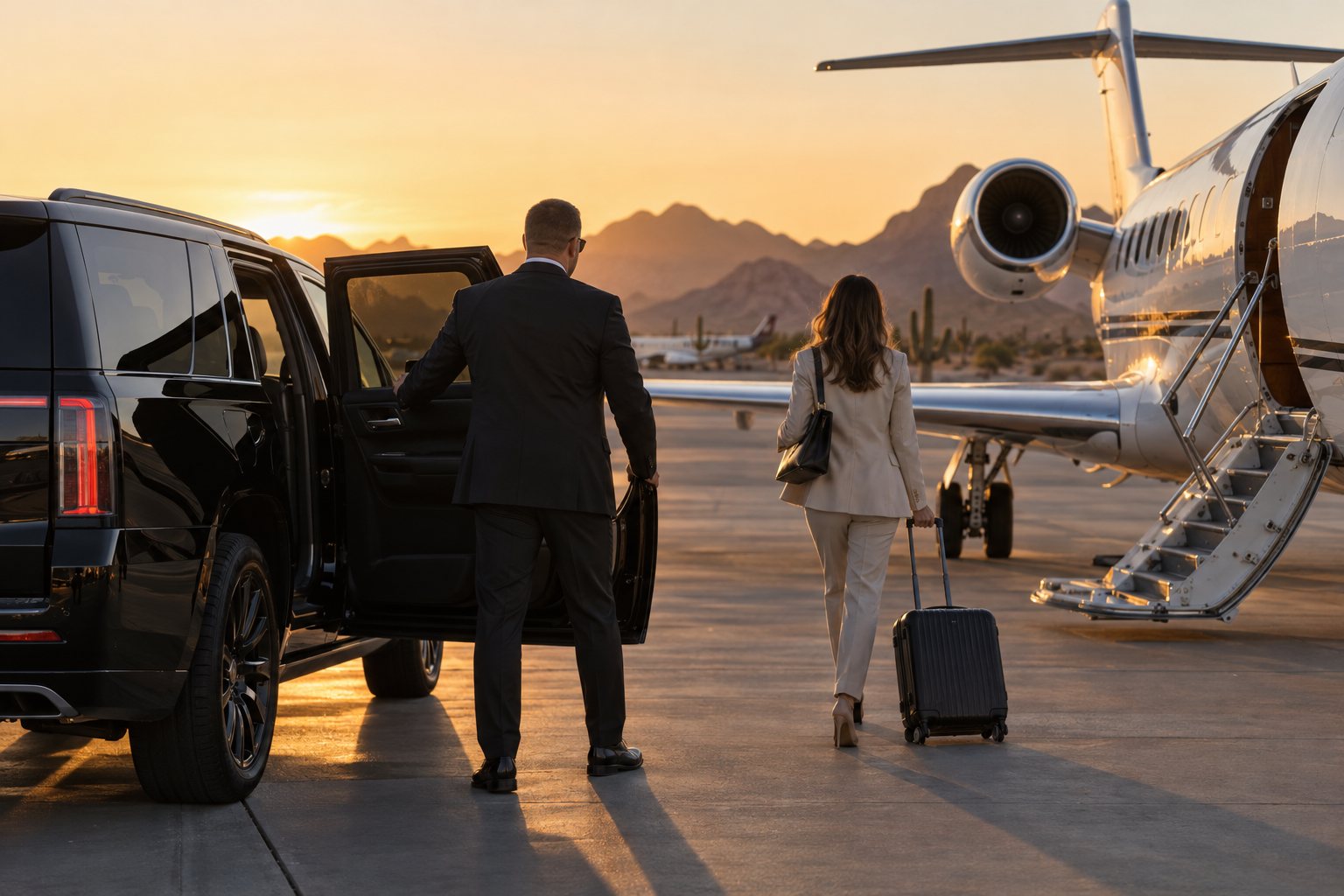
Executives are most exposed when they are away from the places they know. At home and in the office, routines, staff and access control do much of the protective work. On the road, the principal is in an unfamiliar city, on a published schedule, moving between airports, hotels and venues where anyone can wait for them. Executive travel security closes that gap with planning done before the trip and a small number of disciplined habits during it.
This guide covers how to assess a trip, what advance work should confirm, how to handle airports, hotels and ground moves, how to protect devices at the border, and what Arizona-based companies should know about travel into Mexico. Honeybadger Solutions provides executive protection, security drivers and travel risk planning from Arizona.
In an emergency, contact local emergency services first. U.S. citizens abroad can also contact the nearest U.S. embassy or consulate.
Key takeaways
- Every trip starts with a risk assessment: the destination, the principal’s profile, the purpose of the trip and how public it is.
- Advance work confirms routes, hotels, venues, hospitals and safe places before the principal arrives.
- Keep names off airport signs, room numbers out of conversation and schedules off social media.
- CBP searched 47,047 devices at U.S. ports of entry in fiscal 2024. Travel with clean loaner devices when the data matters.
- For Mexico, read the State Department advisory by state. In May 2026 Sonora and Baja California were Level 3, Reconsider travel, and Sinaloa was Level 4, Do not travel.
Start with a travel risk assessment
The level of protection should match the trip, not the job title. A short assessment answers four questions:
- Where? Read the U.S. State Department travel advisory for the country and, where it is broken down, the specific state or region. The four levels are Exercise normal caution, Exercise increased caution, Reconsider travel and Do not travel.
- Who? Is the principal widely known, the subject of recent news, a party to layoffs or litigation, or already the target of threats? Our OSINT monitoring answers this quickly.
- Why? A board dinner, a factory visit and a keynote speech carry different risks. Public appearances and announced schedules raise them.
- How visible? Conference agendas, press releases and social posts often publish exactly where a principal will be and when.
What advance work should confirm
| Item | What to confirm before arrival |
|---|---|
| Arrival | Terminal or private aviation FBO, curbside rules, meeting point, primary and backup vehicles |
| Routes | Primary and alternate routes between each stop, drive times at the actual hour, choke points and construction |
| Hotel | Entrances, elevator access control, room location, fire exits, security staffing and how the hotel handles VIP privacy |
| Venues | Back-of-house entry, holding room, stage access, crowd flow, who controls credentials |
| Medical | Nearest trauma center, travel medical coverage, the principal’s medical needs and medication |
| Safe havens | Places along each route to go if something happens: police stations, hospitals, secure hotels, the consulate |
| Contacts | Local drivers, venue security, hotel security manager, local police non-emergency line, embassy |
For corporate travel abroad, the Overseas Security Advisory Council (OSAC) and the American Hotel and Lodging Association publish a Hotel Security and Safety Assessment Form that security teams can use to survey a property.
Airports and arrivals
- Do not put the principal’s name or the company’s name on a pickup sign. Use a code name or a first-name-only sign agreed in advance.
- Keep the arrival short. The vehicle should be staged and the driver should know exactly where to meet.
- Private aviation reduces exposure in terminals, but FBO staff, flight trackers and tail numbers can still reveal movement.
- Assign one person to manage bags so the principal and the protection agent are not separated in a crowd.
Hotels
- Book under an assistant’s or company name where the hotel allows it, and ask the front desk not to confirm the guest to callers.
- Avoid ground-floor rooms and rooms with connecting doors. Know the two nearest fire exits and walk the route once.
- Do not say room numbers aloud in the lobby. Use the do-not-disturb sign and keep housekeeping visits to scheduled times.
- For sensitive meetings in a suite, consider a TSCM sweep before discussions start.
Ground transportation
Many attacks on traveling executives happen at the points where the principal gets in or out of a vehicle. A trained security driver manages those moments: staging the car, scanning the area, keeping doors locked and choosing alternate routes when something looks wrong. Vary departure times and routes where the schedule allows, and avoid street-hail taxis and rideshare in higher-risk locations, where the driver and vehicle cannot be vetted.
Phones, laptops and the border
U.S. Customs and Border Protection can search electronic devices at the border without a warrant. In fiscal 2024 it searched 47,047 devices, about 90 percent of them basic manual searches and 4,322 advanced searches using external equipment. CBP policy says an advanced search requires reasonable suspicion or a national security concern, and officers may examine only data stored on the device, not data held only in the cloud. Other countries apply their own rules, some far broader.
- Travel with loaner phones and laptops carrying only what the trip needs.
- Use full-disk encryption, strong passcodes and a VPN; avoid hotel and conference Wi-Fi for sensitive work.
- Talk with counsel before the trip about privileged or regulated data and how to handle a border search.
- Have devices checked on return if the trip involved a high-risk destination. Our digital forensics team can examine them for compromise.
Travel into Mexico from Arizona
Many Arizona companies have suppliers, plants or customers in Sonora. The State Department’s Mexico advisory, issued May 29, 2026, rates Mexico overall at Level 2 but rates Sonora and Baja California at Level 3, Reconsider travel, and Sinaloa at Level 4, Do not travel. It also restricts U.S. government employees in Sonora: for example, travel between Nogales and Hermosillo only in daylight on Federal Highway 15, no taxis, buses or rideshare in Nogales, and travel to Puerto Peñasco only on Federal Highway 8 from the Lukeville crossing. Those rules do not bind private travelers, but they are a useful baseline for corporate policy.
Our Mexico Security Threat Report 2026 covers cross-border risk in more depth, and our guide to kidnap and ransom preparedness explains how to plan for the worst case.
Keep a low profile online
Real-time posts from the principal, family or staff are one of the easiest ways for someone to find a traveling executive. Post after the trip, not during it. Remove location data from photos, ask event organizers not to publish arrival times, and check what is already public about the principal before departure.
Before you go: a short checklist
- Enroll the trip in the State Department’s free Smart Traveler Enrollment Program for alerts and embassy contact.
- Confirm travel medical and evacuation coverage and carry the policy details.
- Share the itinerary with one designated contact at home, with check-in times.
- Carry copies of passports and key documents separately from the originals.
- Agree on a simple duress word and what it triggers.
How Honeybadger plans executive travel
Honeybadger is a veteran-led Arizona firm. For executive travel we provide a written risk assessment, advance work at each stop, licensed protection agents and security drivers, OSINT checks before and during the trip, and device security support. We scale the plan to the trip: a single agent and driver for a domestic visit, a full advance team for a public event or higher-risk destination. In Arizona, a protection agent working for hire generally must be a registered security guard employed by a licensed agency under ARS 32-2621, so ask any provider for proof. For costs, see how much executive protection costs.
Talk to Honeybadger
Share the itinerary and who is traveling, and we will scope the right level of travel security, from a risk assessment to a full advance team.
Why the online intake is faster than a phone call: it takes about two minutes, and your answers are routed straight to the specialist team that handles your kind of matter, whether that is cyber and forensics, investigations or field security. That team sees the full picture before it replies, so you skip phone tag and get a real answer and next steps sooner. If it cannot wait for business hours, use the urgent intake form, which is read seven days a week.
Frequently asked questions
Does every executive trip need a protection agent?
No. Many trips need only good planning: a risk assessment, vetted transportation and sensible habits. Agents make sense for high-profile principals, known threats, public appearances and higher-risk destinations.
Can CBP search my phone when I return to the U.S.?
Yes. CBP can search electronic devices at the border. In fiscal 2024 it searched 47,047 devices, mostly through basic manual review. CBP policy limits searches to data stored on the device, not data held only in the cloud.
Is it safe for executives to travel to Sonora, Mexico?
Many do so regularly with planning. The State Department rated Sonora Level 3, Reconsider travel, in its May 2026 advisory and restricts U.S. government employees to certain routes and daylight travel. Build a plan around those routes, vetted drivers and check-ins.
What is advance work in executive protection?
Advance work means visiting or researching each location before the principal arrives to confirm routes, entrances, hotels, venues, hospitals, safe places and local contacts.
Should executives use rideshare when traveling?
In low-risk locations it can be fine. In higher-risk locations, use vetted drivers and vehicles instead, because a rideshare driver and car cannot be checked in advance.
Sources and further reading
- USA.gov: Travel advisories and STEP — the four advisory levels.
- U.S. State Department: Mexico Travel Advisory (May 29, 2026) — state levels and Sonora restrictions.
- Smart Traveler Enrollment Program — free trip registration.
- OSAC and AHLA: Hotel Security and Safety Assessment Form — hotel survey tool.
- CBP: Border Search of Electronic Devices — FY2024 figures and search standards.
- ARS 32-2621 — Arizona security guard registration.
Written and reviewed by the Honeybadger Solutions security and investigations team, a veteran-led Arizona firm (Arizona DPS private investigation agency license No. 1759795). Facts checked against the cited sources on October 22, 2026. This article is general information, not legal advice.
Browse by topic
Security guard services · Private investigations · Cybersecurity · Digital forensics · Financial fraud investigation · Executive protection · All articles