

Event and venue security planning is the structured process of assessing an event’s risk, then designing staffing, access control, crowd management, and emergency response before a single guest arrives. A professional plan starts with a written risk assessment specific to the venue and audience, sets staffing ratios by zone rather than a flat headcount, layers credentialing and screening at entry points, and pre-scripts the response to the incidents most likely to occur — medical emergencies, unruly crowds, unauthorized access, and evacuation. Done correctly, security becomes invisible until the moment it is needed.
Why does every event need a written security plan, not just “guards on the door”?
An event is a temporary, high-density environment with a defined start and end time, which is exactly what makes it different from securing a permanent facility. Crowd dynamics, alcohol service, VIP movement, vendor and staff access, and a compressed timeline for setup and teardown all create risk windows that don’t exist on an ordinary business day. A written plan forces the organizer and the security provider to agree, in advance, on exactly who is covering which zone, what triggers an escalation, and who has the authority to make a call — halting entry, evacuating a section, or calling police — before the pressure of a live incident makes that decision harder to make well. Venues, insurers, and increasingly municipal permitting offices now expect a documented plan, not a verbal assurance that “security will be there.”
How do you run a risk assessment for an event or venue?
The assessment should answer five questions before staffing numbers are ever discussed: What is the expected attendance and audience profile? What is the venue’s physical layout, including choke points and emergency egress? Is alcohol being served, and for how long? Is there a public figure, executive, or controversial subject involved that elevates targeted risk? And what does local law enforcement or the venue’s own security office already know about the surrounding area? The answers drive every downstream decision — a 200-person corporate reception has almost nothing in common, from a risk standpoint, with a 5,000-person outdoor festival, even if both are technically “events.”
How many security staff does an event actually need?
Industry staffing ratios are a starting point, not a substitute for the risk assessment above — a seated corporate dinner and a general-admission concert with the same headcount require very different coverage.
| Event type | Typical guest-to-guard ratio | Primary staffing driver |
|---|---|---|
| Seated corporate event, no alcohol or limited service | 1 per 75–100 guests | Access control, general presence |
| Reception/gala with open bar | 1 per 50–75 guests | Alcohol-related incidents, VIP movement |
| General-admission concert or festival | 1 per 25–40 guests | Crowd density, entry screening, medical response |
| High-profile event with a public figure present | Baseline ratio plus a dedicated close-protection element | Targeted risk, credentialed access, secure arrival/departure |
| Retail or brand activation with product on display | 1 per 40–60 guests | Theft/loss prevention, crowd flow |
These ratios should be adjusted upward for venues with limited egress, a history of incidents, or a guest list that includes a known elevated-risk individual.
It is worth budgeting a margin above the calculated ratio rather than staffing to the exact minimum: guests arrive in waves rather than evenly, weather can push an outdoor crowd indoors and concentrate density at entrances, and a single incident that pulls two officers away to manage it can leave the rest of the floor thinly covered at the worst possible moment. A staffing plan with no slack is a plan that fails under its first unplanned stress, which is precisely when it is needed most.
How do access control and credentialing work at an event?
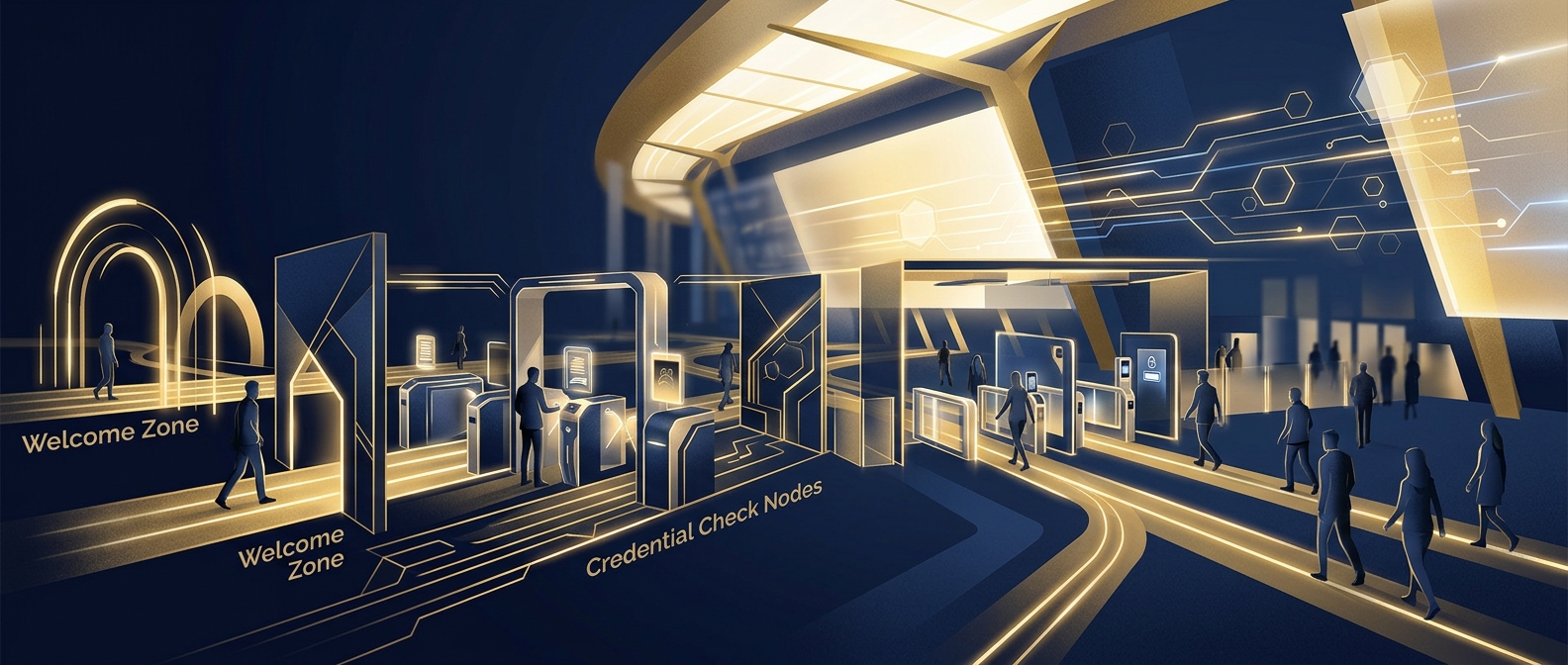
Access control is the discipline of making sure only the people who are supposed to be somewhere can get there — and it should be layered, not binary. A well-run event separates general admission, staff/vendor, backstage or VIP, and restricted operational areas (kitchens, mechanical rooms, loading docks), each with its own credential type and checkpoint. Wristbands, lanyards, and color-coded badges are only effective if staff are actually trained to check them and empowered to stop someone who doesn’t have the right one — a credentialing system that isn’t enforced is theater, not security. For higher-risk events, bag checks, walk-through or handheld screening, and a documented guest list at VIP checkpoints add real friction against unauthorized access rather than relying on visual recognition alone.
How do you plan for crowd management and de-escalation?
Crowd management is proactive, not reactive: it is about controlling flow and density before a problem develops, not just responding once one has. That means planning entry and exit flow to prevent bottlenecking, monitoring density in real time at high-traffic points like bars, stages, and merchandise areas, and training staff in de-escalation so a verbal conflict doesn’t require a physical response. Security personnel working an event should be briefed on the venue’s specific flashpoints — the choke point by the main bar, the narrow hallway to the VIP area — before doors open, not discovering them mid-shift. The Crowd Management chapter of NFPA life safety guidance and municipal special-event permitting requirements are useful baselines for occupancy limits and egress planning.
What incidents should an event emergency plan cover?
An emergency action plan is only useful if it is specific enough that staff can execute it under pressure, without waiting for someone to improvise. At minimum, it should cover:
- Medical emergencies. Location of on-site medical staff or nearest EMS response, and who calls it in.
- Severe weather (for outdoor events). A pre-set trigger point for delay or evacuation, not a judgment call made in the moment.
- Active threat or violence. A rehearsed lockdown/evacuation protocol aligned to CISA guidance for public venues, including designated rally points.
- Unauthorized access or credential breach. Escalation path when someone bypasses a checkpoint.
- Fire or structural evacuation. Clearly marked and unobstructed egress routes verified during setup, not assumed from a floor plan.
- Loss of power or venue systems. A backup communication plan (radios, not just phones) if cell networks are congested.
Every plan should name, by role rather than by individual, who has the authority to declare an evacuation or halt entry — ambiguity on that point costs precious minutes during a real incident.
Every plan should also specify how the response is communicated to guests in real time, not just to staff. A calm, pre-scripted announcement for a weather delay reads very differently to a crowd than an improvised one delivered under visible stress, and the difference directly affects whether a controlled response stays controlled. Staff working entry points and roaming posts should carry radios rather than relying solely on cell phones, since networks can become congested precisely when the volume of calls spikes during an incident.
How does event security coordinate with the venue and local police?
A security plan built in isolation from the venue’s own operations and local law enforcement is incomplete. Before the event, the security lead should walk the venue with the venue’s own facilities or security staff to confirm egress routes, camera coverage the venue already has, and any restrictions unique to that building. For larger or higher-profile events, a courtesy notification or coordination call with local police lets them know the event is happening, gives security a direct line if backup is needed, and in many jurisdictions is required for permitting. This coordination also clarifies, before the event, exactly where private security authority ends and public law enforcement authority begins — a line that should never be ambiguous when an incident is unfolding in real time.
Coordination should extend to vendors and staffing agencies as well. Caterers, valet and parking operators, bartenders, and load-in crews all move through the venue on their own schedules, often before the security team’s shift officially begins, and each represents a potential access-control gap if their credentials and arrival windows aren’t built into the master plan. A single point of contact on the client side who can authorize last-minute changes — a late VIP addition, an extended bar service, a delayed load-out — keeps the security plan from being undermined by decisions made elsewhere in the event’s operations that nobody thought to relay to the security lead.
What separates a professional event security provider from an unreliable one?
The gap between an adequate event security vendor and an elite one shows up long before doors open. A professional provider insists on a site walk and a written plan rather than quoting a headcount over email; staffs the event with officers who were briefed on that specific venue’s flashpoints, not a generic crowd-control script; and assigns a single on-site lead who has the authority to make real-time decisions rather than escalating every judgment call to someone off-site. They also carry adequate liability insurance naming the client and venue where required, and they debrief after the event — documenting what worked, what didn’t, and what should change for the next occurrence, rather than treating each event as a one-off with no institutional memory. A provider who cannot answer, specifically, how they would handle an unruly guest, a medical emergency, or an unauthorized-access attempt at your venue has not actually planned for your event; they have simply agreed to show up.
How do repeat and recurring events refine their security plan over time?
Organizations that run the same event annually or the same venue on a recurring basis — an annual gala, a weekly concert series, a seasonal festival — have an advantage most first-time event planners don’t: a documented history to learn from. Every post-event debrief should feed a running log of incidents, near-misses, and operational friction points, so the next iteration’s staffing ratios, checkpoint locations, and emergency plan are calibrated against what actually happened rather than what was assumed in advance. A venue that has never had a serious incident is not necessarily a low-risk venue; it may simply be one where a well-run security program has been quietly doing its job. Recurring clients who treat each event’s plan as a living document, updated after every occurrence, consistently see fewer incidents and faster resolution when something does go wrong than those who reuse an unchanged plan year after year.
How does Honeybadger structure an event and venue security program?
Every engagement begins with a site walk and written risk assessment specific to the venue, audience, and any elevated-risk attendees. From that assessment, Honeybadger builds a staffing plan by zone rather than a flat headcount, a credentialing and access-control layout for entry and restricted areas, and a pre-scripted emergency action plan reviewed with venue management and, where appropriate, local police before doors open. In Arizona, event security is staffed by Honeybadger’s own in-house, Arizona-licensed guards and, where the event calls for it, a dedicated close-protection element for an executive or public figure in attendance. Outside Arizona, Honeybadger commands a vetted-partner network of licensed regional providers so multi-city event calendars still run under one accountable plan and a single point of contact. If an incident does occur — a theft, an altercation, an unauthorized-access breach — Honeybadger’s in-house investigations team can pick up the post-event review directly, rather than the client starting from zero with a separate firm.
Frequently asked questions
About Honeybadger Solutions
Honeybadger Solutions is an Arizona-licensed security and investigations firm. In Arizona, our event and venue security teams — including uniformed guards and close-protection personnel — are our own in-house, Arizona-licensed, supervised officers, not subcontractors. Outside Arizona, we command a vetted-partner network of licensed regional providers so multi-city event programs run under one accountable plan. Digital forensics, cybersecurity, financial investigations, and background intelligence are handled in-house and delivered nationwide. We are headquartered in Casa Grande, with offices in Phoenix and Oro Valley.
Offices: Casa Grande (HQ), Phoenix, and Oro Valley, Arizona.
Phone: Book a consultation online
Confidential consultation: speak with our command team about a security plan for your next event or venue.
More questions
How far in advance should event security planning start?
For most corporate or private events, 4 to 6 weeks is enough time to complete a risk assessment, build the staffing and credentialing plan, and coordinate with the venue and, if needed, local police. High-profile events involving a public figure or attendance over a few thousand guests should start 8 to 12 weeks out to allow time for permitting and a dedicated protective plan.
What is the difference between event security and executive protection at an event?
Event security manages the overall venue — access control, crowd management, and general safety for all attendees. Executive protection is a dedicated detail assigned specifically to one principal, focused on threat assessment, secure movement, and advance work for that individual, and typically runs alongside general event security rather than replacing it.
Who has the authority to shut down or evacuate an event?
This should be defined in writing before the event, by role rather than by name — typically the security lead in coordination with venue management, with local police or fire officials able to override in a genuine emergency. Leaving this authority ambiguous is one of the most common planning failures and costs critical time during a real incident.
Does Honeybadger provide its own security guards for events in Arizona?
Yes. In Arizona, Honeybadger staffs event and venue security with its own in-house, Arizona-licensed, supervised officers — not a subcontracted staffing pool. Outside Arizona, we command a vetted-partner network of licensed regional providers so multi-city event calendars still run under one accountable plan.
Sources and further reading
- FinCEN — Legal Authorities — The Bank Secrecy Act, USA PATRIOT Act and Anti-Money Laundering Act authorities that govern financial and virtual-asset reporting.
- FBI Internet Crime Complaint Center — Annual Reports — Annual and state-level internet crime statistics, including dedicated reports on cryptocurrency fraud and elder fraud.
Honeybadger Solutions delivers Blockchain Forensics, Blockchain Consulting and Cyber Investigations from its Arizona office for clients across the United States and internationally. This casework is performed remotely under Arizona licensure, so there is no geographic limit on where a client can be based.
Browse by topic
Security guard services · Private investigations · Cybersecurity · Digital forensics · Financial fraud investigation · Executive protection · All articles