
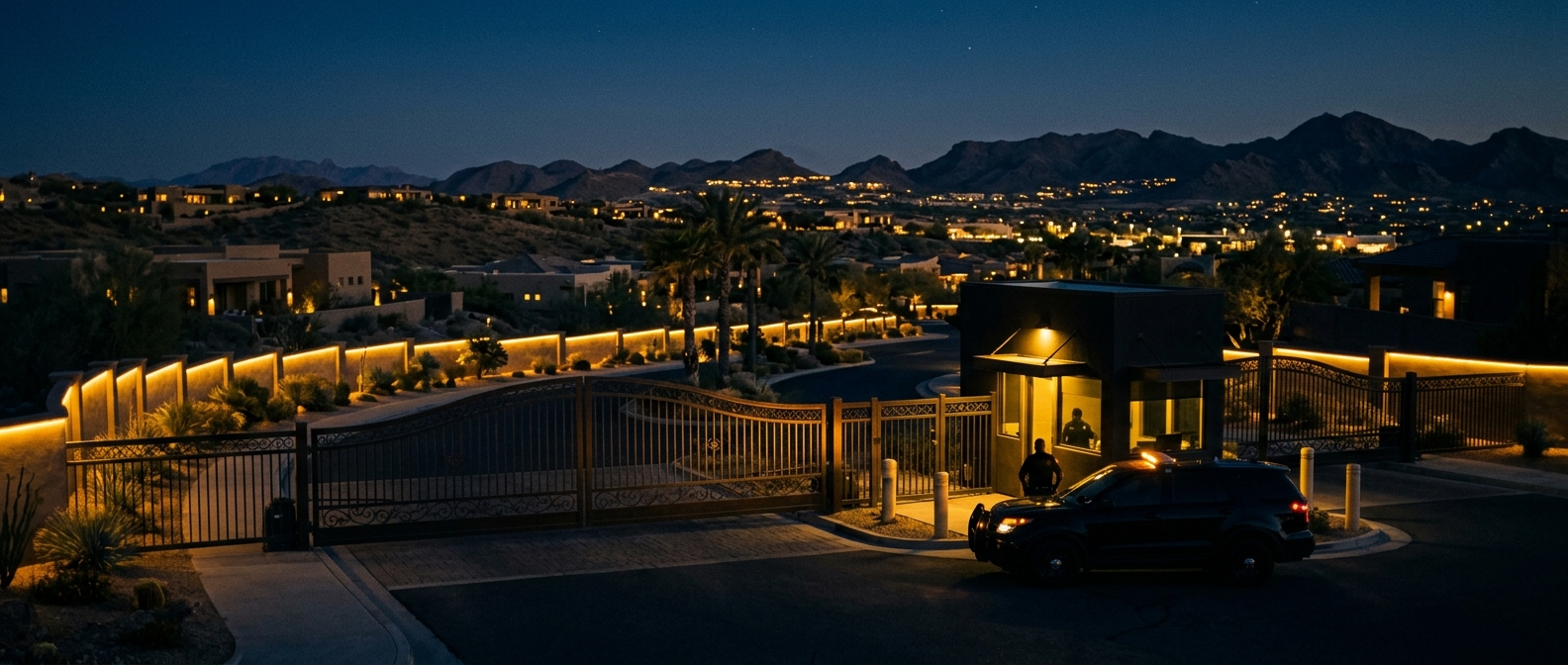
A defensible HOA or gated-community security program combines controlled access, randomized patrol, verified alarm response, camera and license-plate coverage, CPTED design, and documented post orders under a licensed, supervised provider — not a single guard sitting alone at a gate for one shift a day. Boards that treat security as a checklist item rather than a system expose residents to real risk and the association to real liability. This guide walks through the components, costs, vendor vetting, and legal considerations that separate a professional program from a commodity contract.
What does a complete gated-community security program actually include?
A residential security program is a system of interlocking functions, not a headcount. At minimum it should cover: access control and visitor management at every entry point; identity verification and credentialing for residents, vendors, and guests; randomized (not predictable) patrol of streets, common areas, and amenities; alarm monitoring and a defined verify-assess-escalate response protocol; camera and license-plate-recognition (LPR) coverage with retention and review discipline; environmental design (CPTED) that removes concealment and improves natural surveillance; and reporting that ties every event to a timestamp, an officer, and a written post order.
Remove any one of those functions and the program has a predictable gap — the shift-change window with no patrol, the vendor who was never actually verified, the camera that was never actually reviewed. Boards evaluating a professional security provider should expect all seven functions addressed in the proposal, not just the one that is easiest to sell: a body at the gate.
How much should an HOA budget for security, and what actually drives the cost?
Security spend for a gated community is driven less by square footage and more by risk profile: traffic volume through each entrance, number and value of homes, history of incidents, resident visibility (public figures, executives, high-value assets), amenity complexity (clubhouse, pool, trails, marina), and whether coverage needs to be 24/7 or peak-hours only. Two communities of identical size can have very different cost profiles once those variables are scored.
The largest lever is staffing model. A single manned gate staffed around the clock is the most expensive line item in most budgets; a hybrid model — manned coverage during peak and higher-risk hours, virtual or camera-monitored access overnight, and roving patrol connecting the interior — typically delivers comparable or better coverage at a lower blended rate. Technology (LPR, cameras, gate automation) has a capital cost up front but reduces the ongoing labor bill and produces the audit trail boards need if an incident is ever challenged. Boards should ask any vendor to model at least three staffing configurations against the community’s actual traffic and incident data before signing a multi-year contract.
Manned guards, off-duty police, virtual gatehouse, or technology-only: which model fits your community?
There is no universal answer — the right model depends on traffic, asset value, and board risk tolerance, and most professional programs land on a hybrid rather than any single option. The comparison below outlines how the common models actually differ once you look past the hourly rate.
| Model | Strength | Limitation | Best fit |
|---|---|---|---|
| Manned gatehouse (licensed guard) | Visible deterrent, real-time verification, first responder on site | Highest labor cost; quality depends entirely on training and supervision | High-traffic entries, prominent residents, prior incidents |
| Off-duty police contract | Law-enforcement authority and presence | Limited availability, inconsistent scheduling, no CPTED/patrol program, higher liability ambiguity | Occasional event or high-visibility coverage, not full-time programs |
| Virtual/remote gatehouse | 24/7 coverage at lower cost, consistent logging | No physical deterrent or on-site response; depends on camera/audio quality | Lower-traffic entries, overnight hours, secondary gates |
| Technology-only (LPR/cameras, no patrol) | Strong audit trail, scalable, lower recurring cost | No active deterrence or response capability; reactive, not preventive | Communities layering technology onto an existing patrol program |
| Hybrid program (guard + patrol + tech) | Coverage as a system: deterrence, response, and documentation | Requires a program manager and integration, more complex to stand up | Communities that have outgrown a single-vendor gate contract |
What access-control and technology layers actually reduce risk?
Technology should support the program, not replace judgment. The layers that consistently earn their keep: license-plate recognition at every vehicle entry with a resident/vendor whitelist and alert-on-mismatch; camera coverage of entries, amenities, and common-area chokepoints with a retention policy long enough to support an investigation, not just a glance-back; gate and access-credential systems that log every open event to an individual credential rather than a shared code; and a centralized dashboard that lets both the guard force and board leadership see access activity in one place. Communities considering a licensed guard program should confirm the provider integrates these systems into daily post orders, not just installs them and walks away.
How do you vet and select a security or guard vendor for your community?
Most HOA security failures trace back to a vendor-selection process that stopped at price. A defensible selection process should work through these steps in order:
- Commission an independent risk assessment of the perimeter, entries, interior roads, amenities, and any estate-level exposures before soliciting bids — baseline the actual threats, not assumptions.
- Verify state licensing and insurance for the agency and every individual officer who will work the property, not just the company name on the contract.
- Request post orders and supervision structure in writing — ask how officers are trained to the site specifically, how often supervisors audit posts, and how patrol randomization is enforced.
- Confirm employment model — are officers direct employees of the agency (supervised, accountable, trained to a standard) or subcontracted labor with high turnover and thin oversight?
- Review documentation and reporting samples — a professional provider can show you what a shift log, incident report, and patrol-verification record actually look like before you sign anything.
- Check technology integration — confirm cameras, LPR, and access systems feed into the same reporting the guard force uses, rather than sitting on a separate, unreviewed system.
- Pilot before a multi-year commitment — a 90-day evaluation period with defined KPIs (response time, patrol compliance, incident documentation) protects the board from a long contract with an underperforming vendor.
What are the legal and liability considerations for HOA boards?
Once an association provides security — a gate, a patrol, a camera system — courts in many jurisdictions can hold it to a standard of reasonable care for the program it advertised. Marketing a “guard-gated, secure” community that has an unstaffed gate half the time, or cameras that were never actually recording, can create exposure that a community with no security claims at all would not have. Boards should work with counsel to reconcile the CC&Rs, the association’s budget, resident expectations, and state premises-liability law into a written security standard the board can point to and defend — and then hold the vendor to it in writing. This is educational information, not legal advice; consult counsel licensed in your state before finalizing a security standard or vendor contract.
How does CPTED fit into a gated-community program?
Crime Prevention Through Environmental Design (CPTED) is the physical layer that makes every other control work better: lighting that removes shadow zones near entries and walkways, landscaping trimmed to preserve sightlines instead of creating concealment, clearly defined territorial boundaries between public, semi-private, and private space, and natural surveillance built into amenity and parking design. A community that pairs CPTED improvements with a patrol and access-control program typically sees a better return than one that simply adds guard hours to an environment still full of blind corners and dead zones.
What incident-response and reporting standard should you require from a provider?
A program is only as good as its documentation. Boards should require, in the contract, a defined verify-assess-escalate protocol for every alarm and incident; timestamped patrol-verification records (not a guard’s memory of the shift); a monthly reporting package the board can actually read and use in budget and risk discussions; and a clear chain of command for after-hours escalation, including which incidents get a phone call to the board president versus a note in the log. Providers who resist putting this in writing are telling you something about how the program actually runs day to day.

What should be in the written contract, and what do boards commonly leave out?
A well-built HOA security contract is a risk-management document, not a rate sheet. Beyond price and schedule, boards should insist on: named post orders specific to the property (not a generic template reused across the vendor’s client list); a defined minimum staffing level with a remedy if the vendor falls short (credit, make-up hours, or termination rights); insurance certificates naming the association as an additional insured; a data-retention and privacy clause covering camera footage and LPR data, since residents’ movements are being logged; and a termination-for-convenience clause with a reasonable notice period so the board is never locked into an underperforming provider for years because of an auto-renewal clause buried on the last page.
What boards commonly leave out: a requirement that the vendor report near-misses and unusual activity, not just completed incidents; a defined escalation matrix naming who on the board gets called for what severity of event; and an annual review clause requiring the vendor to re-present staffing and technology recommendations as the community’s risk profile changes, rather than quietly renewing the same scope for a decade. Communities working with counsel on governing documents should also confirm the security contract does not conflict with obligations already described in the CC&Rs or reserve-study assumptions.
How should seasonal and event-driven risk change the security plan?
Static staffing plans miss the reality that risk in a gated community is rarely flat across the year. Holiday periods bring package theft and higher vendor/delivery traffic; snowbird and seasonal-resident communities see vacancy spikes that change what “normal” activity looks like on camera and patrol logs; community events (holiday parties, HOA elections, contractor-heavy renovation seasons) temporarily raise both traffic and the number of unfamiliar faces on the property. A professional provider builds a seasonal staffing and messaging calendar into the annual plan — extra patrol passes and vendor-verification emphasis around the holidays, adjusted vacancy checks during low-occupancy months — instead of running the identical program in July and December and hoping the gap doesn’t get found by someone looking for it.
What role does resident communication play in a security program’s success?
The best-designed program still fails if residents don’t use it correctly: propping gates open for convenience, sharing access codes with delivery services, or waving through unverified vendors because confrontation feels awkward. Boards should pair any security investment with a short, recurring resident communication plan — how to register guests and vendors in advance, what to do if a gate malfunctions, and why the officer at the gate is enforcing a rule the resident finds inconvenient that day. Programs that skip this step routinely see their access-control investment eroded within months by the community’s own habits, regardless of how good the guard force or technology actually is.
What separates a professional provider from a commodity guard vendor?
The tell is rarely the hourly rate on page one of the proposal. It shows up in whether officers are direct employees or subcontracted labor with high turnover; whether patrol is randomized and verified or a fixed loop a resident (or an intruder) can predict within a week; whether the provider can produce a real sample incident report and post order before you sign, not after; whether supervision means a documented site visit and audit or a phone call once a month; and whether the provider is licensed and insured for every officer on the property, not just the agency name on the invoice. A community evaluating a broader investigations and security partner should ask these questions before the first walkthrough, not after the first incident.
How do you build or audit a security program in phases?
Communities without an existing program, or boards inheriting one they didn’t design, generally succeed by sequencing the work rather than trying to fix everything in one contract cycle: start with the risk assessment and CPTED walkthrough, define the standard of care with counsel, select the access model per entrance based on data rather than habit, layer in technology with a retention and review policy, then bring on a licensed patrol and gate provider with written post orders and a 90-day pilot. Communities that already have a program in place can run the same sequence as an audit — most gaps surface in the first two steps, long before a new vendor is even needed.
About Honeybadger Solutions
Honeybadger Solutions is an Arizona-licensed security and investigations firm serving HOAs, gated communities, and residential associations across the state. Within Arizona, patrol and gate officers are our own AZ DPS-licensed, supervised in-house guards — not subcontracted labor — trained to site-specific post orders and accountable to a documented chain of supervision. We provide nationwide and international coverage through a commanded network of vetted partners.
Offices: Casa Grande (HQ), Phoenix, and Oro Valley, Arizona.
Phone: Book a consultation online
Confidential consultation: Contact us to schedule a discreet HOA or gated-community security assessment.
Frequently asked questions
Do we need a manned gate, or is a virtual gatehouse enough for our HOA?
It depends on traffic volume, asset value, resident profile, and incident history. Many communities are best served by a hybrid: manned coverage during peak and higher-risk hours, virtual or camera-monitored access overnight, and roving patrol connecting the interior. The decision should follow a risk assessment, not the lowest hourly rate.
Can providing security actually increase our HOA’s liability?
Yes. Once an association provides security, it can be held to a standard of reasonable care for what it advertised. Marketing a “secure, gated” community with an unstaffed gate or non-functional cameras can create more exposure than having no security program at all. The protection is a documented, enforced program reviewed with counsel, not the marketing claim.
How long should our HOA commit to a security vendor before signing a long-term contract?
A 90-day pilot with defined KPIs, such as response time, patrol compliance, and incident documentation quality, lets the board evaluate real performance before a multi-year commitment. Professional providers should be comfortable with a defined evaluation period.
Are patrol and gate officers on our property directly employed by the security company?
Ask directly, and get it in writing. Direct-employee, licensed, and supervised officers are accountable to a documented chain of training and oversight. Subcontracted, high-turnover labor is the most common source of the gaps boards discover only after an incident.
Sources and further reading
- FinCEN — Legal Authorities — The Bank Secrecy Act, USA PATRIOT Act and Anti-Money Laundering Act authorities that govern financial and virtual-asset reporting.
- FBI Internet Crime Complaint Center — Annual Reports — Annual and state-level internet crime statistics, including dedicated reports on cryptocurrency fraud and elder fraud.
Honeybadger Solutions delivers Blockchain Forensics, Blockchain Consulting and Cyber Investigations from its Arizona office for clients across the United States and internationally. This casework is performed remotely under Arizona licensure, so there is no geographic limit on where a client can be based.
Browse by topic
Security guard services · Private investigations · Cybersecurity · Digital forensics · Financial fraud investigation · Executive protection · All articles