
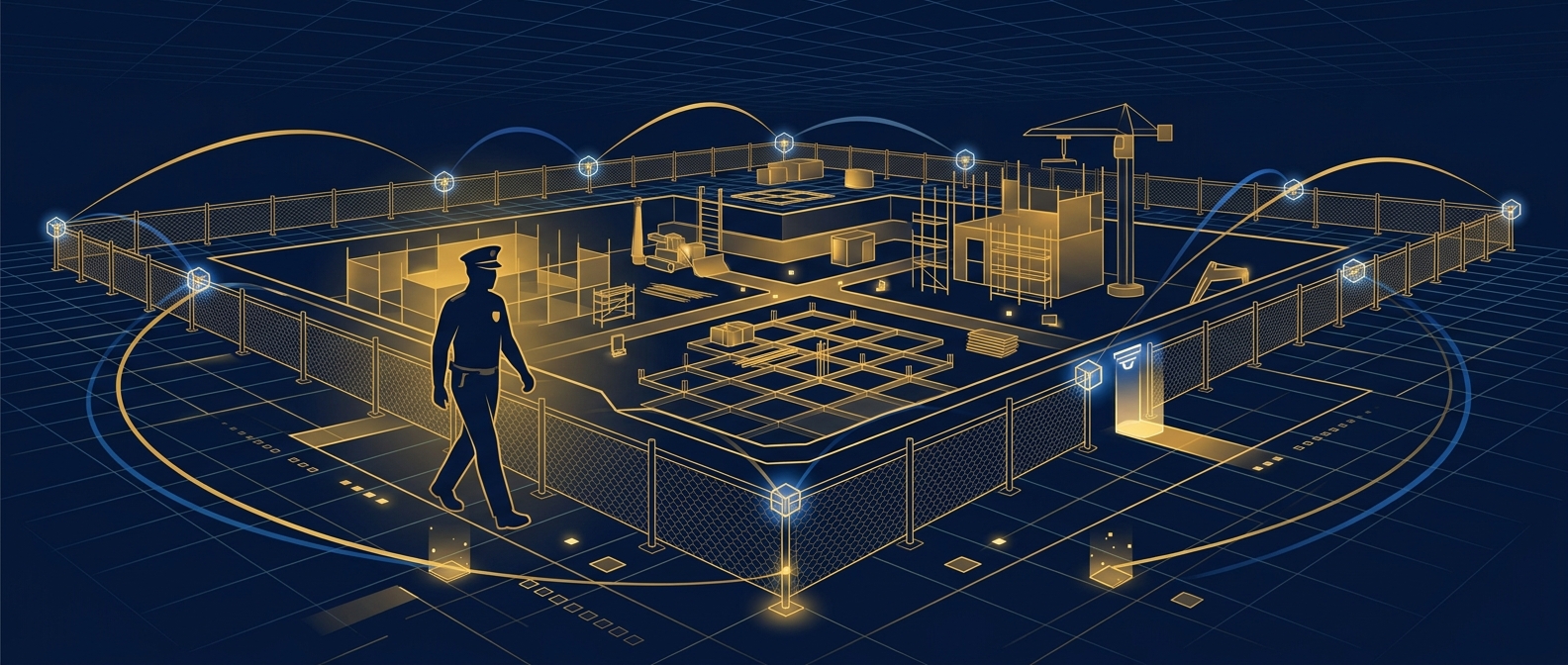
Construction site security guard services combine licensed, uniformed patrol officers with post orders, access control, and reporting to protect a jobsite during the unmanned hours when theft and vandalism are most likely. The service is only as good as three things: who actually employs the guard, how the post orders are written, and whether the guard program is paired with surveillance technology that extends coverage across a site no fixed headcount could watch alone. Done well, it is a documented, auditable program — not a body standing at a gate.
If you are hiring for a site in Arizona, here is how we staff construction site security services.
What do construction site security guard services actually include?
A properly scoped construction guard contract is a program, not a headcount. At minimum it defines who staffs the post, what hours are covered, and what the guard is required to do during each shift — not just that someone is physically present. The core components are:
- Perimeter and access control — logging every vehicle, delivery, and visitor in and out of the site, and enforcing that only authorized subcontractors and deliveries pass the gate.
- Roving patrol — scheduled and randomized walkthroughs of staging areas, trailers, and the building envelope, timed so patrol routes are not predictable to anyone surveilling the site.
- Incident documentation — time-stamped activity logs, photo documentation of damage or forced entry, and same-shift incident reports the general contractor and insurer can rely on.
- Emergency response — first response to alarms, intrusion, fire-watch duties where required, and a documented escalation path to police and site leadership.
- Coordination with technology — guards responding to camera and sensor alerts rather than working in isolation from the site’s surveillance system.
A contract that only promises “a guard on site” without specifying these functions is buying presence, not protection.
In-house guards vs. subcontracted security companies — why the staffing model determines accountability
This is the single most consequential decision a project executive makes when hiring construction site security, and it is the one most buyers never ask about. Many guard companies operating on Arizona jobsites do not employ their own officers — they broker a contract to a subcontracted staffing pool, sometimes several layers removed from the company whose name is on the invoice. When an incident happens at 2 a.m., the general contractor needs to know exactly who was on post, who trained them, and who is accountable — not spend the first hours of an investigation figuring out which subcontractor’s subcontractor staffed the shift.
In Arizona, Honeybadger Solutions staffs its jobsite posts with its own in-house, Arizona-licensed guards — supervised, trained, and accountable to a single chain of command, not a staffing broker. That matters for three practical reasons: consistent post orders across every shift, verifiable training and licensing records if a claim or lawsuit follows an incident, and a single point of contact when the schedule needs to flex around a project’s changing phases. Outside Arizona, Honeybadger commands a vetted-partner network of licensed regional providers, so multi-state builders get one accountable point of contact even where guards are delivered through partner theaters rather than owned Honeybadger personnel.
How many guards does a jobsite actually need?
Staffing levels should follow the project’s risk profile, not a flat industry rule of thumb. The table below is a starting framework general contractors and developers can use to scope a request for proposal before a guard company ever walks the site.
| Project profile | Typical coverage | Primary risk driver |
|---|---|---|
| Small commercial build, fenced, low material value | Roving patrol 2–3x nightly, no fixed post | Opportunistic trespass, minor vandalism |
| Mid-size residential/commercial, active deliveries | 1 fixed gate guard overnight + camera coverage | Delivery theft, unauthorized access |
| Large commercial/industrial, high-value MEP staging | 2+ guards overnight, dedicated gate + roving | Copper/wire theft, organized crews |
| Mega-project (data center, fab, distribution campus) | 24/7 multi-post coverage + supervisor | High-value equipment, multiple access points, schedule-critical loss |
| Any site post-incident or in a high-crime corridor | Elevated coverage + surveillance tower + rapid patrol response | Repeat targeting, insurance/claims exposure |
The right number is the output of a site walk and risk assessment — perimeter length, number of access points, material staging locations, and the surrounding area’s crime pattern — not a guess made from a brochure.
What belongs in a construction site guard post order?
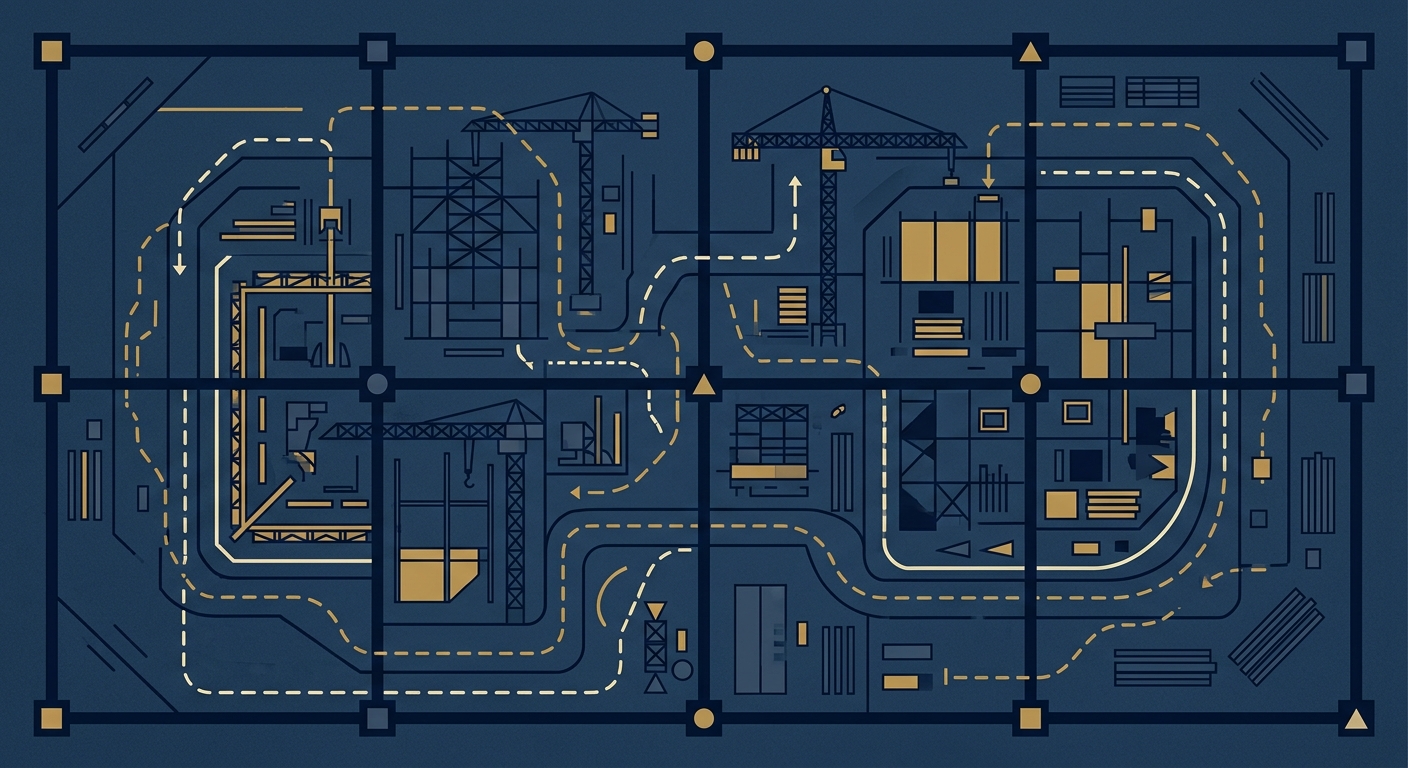
The post order is the document that separates a professional guard program from a person standing near a gate. It should specify, in writing, exactly what the guard does during every hour of the shift: patrol frequency and route variation, the access-control procedure for deliveries and subcontractors, the log format for entries and incidents, the response protocol for an alarm or intrusion, who to call and in what order (police, site superintendent, project executive), and the shift-change handoff procedure so nothing is lost between officers. A general contractor should be able to request the post order in advance and confirm it addresses the site’s actual vulnerabilities — not a generic template reused across every client.
Guards alone, technology alone, or both?
Guard companies that also sell technology have an incentive to recommend one over the other. The honest answer is that guards and technology solve different problems, and the strongest programs use both.
| Approach | Strength | Gap |
|---|---|---|
| Guards only | Judgment, deterrence by visible presence, immediate physical response | Can only be in one place at a time; coverage gaps on a large or multi-building site |
| Technology only (cameras, towers, sensors) | Continuous, wide-area coverage; documented evidence | No physical intervention without a monitored response tied to it |
| Integrated (guards + technology) | Guards respond to verified camera/sensor alerts instead of patrolling blind; documentation supports both deterrence and any claim or prosecution | Requires a single provider or coordinated protocol so guard and technology do not operate as two disconnected vendors |
An integrated program is very often the difference between a theft that is deterred or interrupted in progress, and one that is simply recorded on video after the loss has already occurred.
What do construction site security guard services cost?
Pricing varies with coverage hours, number of posts, whether the guard is armed or unarmed, and regional labor costs, so any number quoted without a site walk should be treated as a placeholder. What buyers should compare is not just the hourly bill rate but what is bundled into it: supervision and spot-checks, licensing and insurance the vendor actually carries, reporting and photo documentation, and whether technology coordination is included or billed separately. A lower hourly rate from a company that subcontracts staffing and provides no supervision is frequently the more expensive option once a preventable loss, a liability claim, or a failed post is factored in. Request an itemized proposal that separates labor, supervision, equipment, and any technology add-ons so the true cost of the program — not just the guard’s wage — is visible before signing.
It is also worth pressure-testing the proposal against the cost of doing nothing. A stolen transformer, a burglarized tool crib, or a stripped run of feeder wire rarely costs only the replacement price of the material — it also costs procurement lead time, idle subcontractor crews billing by the day, and in schedule-critical contracts, liquidated-damages exposure that can run into the tens of thousands of dollars for a single missed milestone. A general contractor who frames the guard budget purely as an added line item, rather than as insurance against a much larger downstream cost, will almost always undervalue the program until the first serious loss forces a recalculation.
How do you vet and select a construction security guard company?
Use this checklist before signing a contract for jobsite guard services:
- Confirm who employs the guard. Ask directly whether officers are the company’s own employees or sourced through a subcontracted staffing pool, and get the answer in writing.
- Verify licensing. In Arizona, guard companies and officers must be licensed under Arizona Department of Public Safety rules per A.R.S. Title 32; ask for license numbers and confirm them independently.
- Request the post order template. A vendor that cannot produce a sample post order specific to construction sites is likely reusing a generic retail or office template.
- Ask about supervision. Confirm there is a supervisor who conducts unannounced spot-checks, not just a dispatcher who schedules shifts.
- Check insurance and bonding. Confirm general liability coverage limits and that the certificate names your project as an additional insured where required.
- Review reporting format. Ask for a sample incident report and daily activity log so you know what documentation you will actually receive.
- Confirm technology integration. If the site has or will have cameras or surveillance towers, confirm the guard company’s protocol for responding to alerts from that system.
- Ask for references from active jobsites — not just completed projects — so you can confirm current performance, not historical reputation.
What licensing and training should construction guards actually have?
In Arizona, private security guards and the companies that employ them are licensed and regulated by the Arizona Department of Public Safety under Arizona Revised Statutes Title 32. That licensing framework covers background screening, required training hours, and (for armed posts) firearms qualification and renewal. A general contractor evaluating a guard company should ask for the company’s AZDPS license number and confirm it is current and in good standing before signing a contract — not simply accept a claim of licensure at face value. Outside Arizona, licensing requirements vary by state, which is exactly why a commanded partner network with verified, state-licensed regional providers matters for multi-state builders: each jurisdiction’s rules are actually followed, not assumed.
How does Honeybadger structure a construction guard program?
Every engagement starts with a site walk to map the perimeter, access points, staging areas, lighting, and the phase schedule that determines when value concentrates on site. From that assessment, Honeybadger builds a written post order specific to the project, staffs it with in-house Arizona-licensed guards for Arizona sites (or a vetted, licensed partner for out-of-state builds), and pairs coverage with mobile surveillance towers or camera systems where the site’s size or value density warrants it. Supervisors conduct unannounced spot-checks, and every shift produces a documented activity log the general contractor and insurer can rely on if a claim ever needs to be filed. As the project moves through phases — site prep, foundation, structural, MEP rough-in, finish — the coverage plan is revisited, because the risk profile of a jobsite is not static.
This same command structure is what lets Honeybadger step in cleanly after an incident, not just prevent one. If a theft or break-in does occur, the same firm that staffed the post can open an investigation — reviewing camera footage, guard activity logs, and access records, then coordinating with local law enforcement and the project’s insurer on a documented loss report. A general contractor working with a guard-only vendor that has no investigative capability is left starting that process from scratch, often after the trail has gone cold; a client working with an integrated security and investigations firm gets continuity from prevention through resolution under one accountable roof.
What are the most common mistakes general contractors make when hiring jobsite security?
The recurring failure pattern is treating guard services as a commodity purchased on price alone. In practice, four mistakes account for most preventable jobsite losses. First, awarding the contract to the lowest hourly bidder without confirming who actually employs the guard, which frequently means an unsupervised, high-turnover subcontracted pool with no consistent training. Second, accepting a generic post order that was never adapted to the specific site’s access points, staging areas, and phase schedule. Third, treating the guard contract as “set and forget” rather than revisiting coverage as the project moves from foundation to structural to finish work, when the concentration of high-value material shifts dramatically. Fourth, running guards and surveillance technology as two disconnected vendors that don’t share alerts or reporting, which leaves gaps precisely where an integrated program would have caught an intrusion in progress. Avoiding these four mistakes closes the majority of the exposure most jobsites carry.
Frequently asked questions
About Honeybadger Solutions
Honeybadger Solutions is an Arizona-licensed security and investigations firm. In Arizona, our uniformed jobsite guards and patrol officers are our own in-house, Arizona-licensed, supervised personnel — not subcontractors — paired with surveillance technology and post orders built for the site’s actual risk. Outside Arizona, we command a vetted-partner network of licensed regional providers so multi-state builders get one accountable point of contact. Digital forensics, cybersecurity, financial investigations, and background intelligence are run in-house and delivered nationwide. We are headquartered in Casa Grande, with offices in Phoenix and Oro Valley.
Offices: Casa Grande (HQ), Phoenix, and Oro Valley, Arizona.
Phone: Book a consultation online
Confidential consultation: speak with our command team about a construction site guard program scoped to your project.
More questions
Does Honeybadger use its own guards or subcontractors on Arizona construction sites?
Our own. In Arizona, Honeybadger staffs jobsite guard posts with in-house, Arizona-licensed, supervised officers — not a subcontracted staffing pool. Outside Arizona we command a vetted-partner network of licensed regional providers so multi-state builders still get one accountable point of contact.
How many guards does a typical construction site need?
It depends on the project’s size, value concentration, and phase. A small fenced commercial build may need only roving patrol a few times nightly, while a mega-project with high-value MEP staging can require 24/7 multi-post coverage. A site walk and risk assessment should set the number, not a flat industry rule.
Is it cheaper to use technology instead of guards on a jobsite?
Technology extends coverage across a large site more cost-effectively than staffing every acre, but cameras and sensors alone don’t physically intervene. Most cost-effective programs pair licensed patrol guards with surveillance towers or cameras so guards respond to verified alerts instead of patrolling blind.
What licensing should a construction security guard company have in Arizona?
Arizona guard companies and their officers must be licensed by the Arizona Department of Public Safety under A.R.S. Title 32, which covers background screening, training hours, and firearms qualification for armed posts. Always request and independently verify the company’s AZDPS license number before signing a contract.
Sources and further reading
- FinCEN — Legal Authorities — The Bank Secrecy Act, USA PATRIOT Act and Anti-Money Laundering Act authorities that govern financial and virtual-asset reporting.
- FBI Internet Crime Complaint Center — Annual Reports — Annual and state-level internet crime statistics, including dedicated reports on cryptocurrency fraud and elder fraud.
Honeybadger Solutions delivers Blockchain Forensics, Blockchain Consulting and Cyber Investigations from its Arizona office for clients across the United States and internationally. This casework is performed remotely under Arizona licensure, so there is no geographic limit on where a client can be based.
Browse by topic
Security guard services · Private investigations · Cybersecurity · Digital forensics · Financial fraud investigation · Executive protection · All articles