
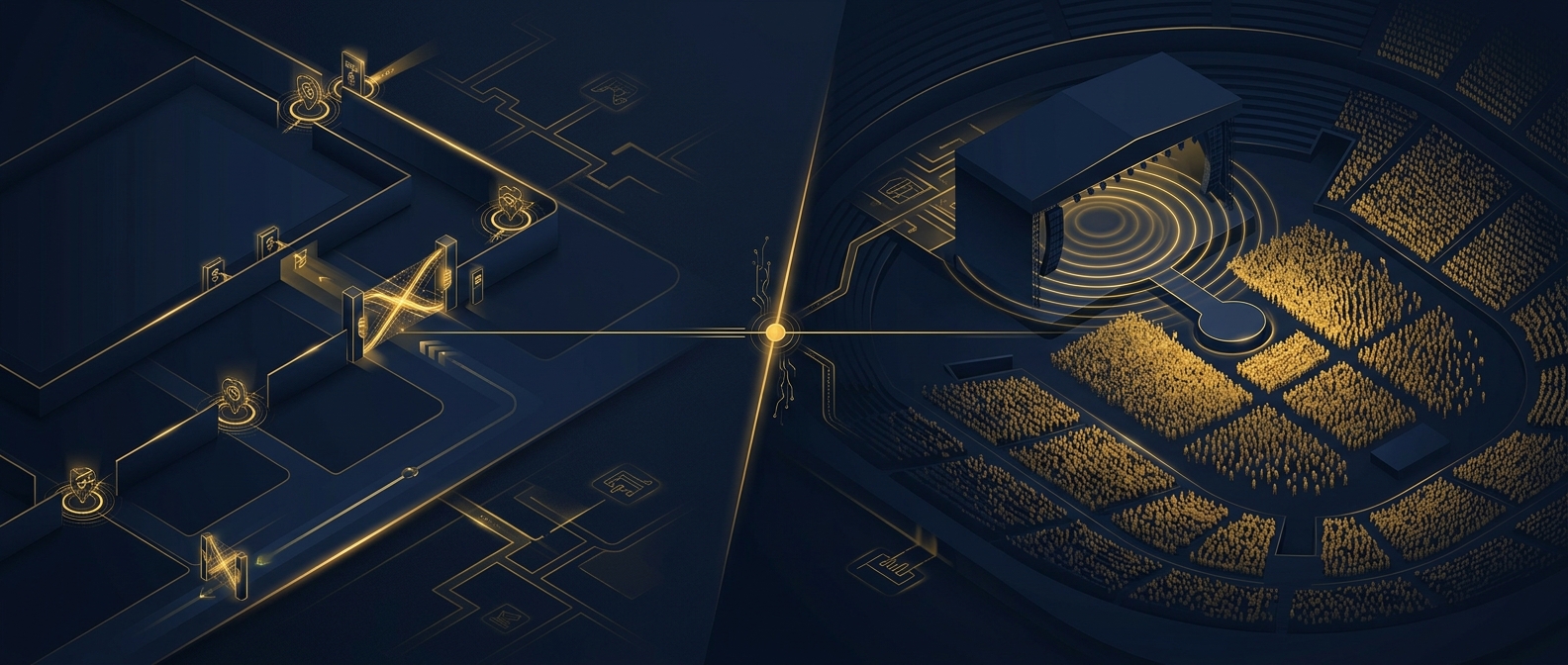
On-set and tour security protects talent inside two very different controlled environments — a closed film or television production and a moving concert tour — by managing access control, crew and extras vetting, venue advances, and fan interaction, rather than the daily-life protection a celebrity needs off the job. Both disciplines share a foundation of credentialing, threat assessment, and unified command, but the physical environment, the client (production or promoter), and the specific risks differ sharply.
General celebrity protection covers a public figure’s daily life — residence security, travel, public appearances, and the fixated-individual threats that follow a person regardless of where they are. On-set and tour security is a different, more specialized problem: it is production security, built around a temporary, high-value operation with its own access points, its own workforce of hundreds of crew and vendors, its own client relationship with a studio or promoter, and its own compressed timeline that repeats in a new city every few days on tour, or resets with every new location on a production. This guide is written for the unit production manager, tour manager, or talent representative who needs to understand what a real production and touring security program actually contains — not a bodyguard following an artist around, but a coordinated operation covering the set, the crew, the venue, and the fans.
How is on-set and tour security different from personal celebrity protection?
Personal protection is client-centered: it follows one principal through an unpredictable daily schedule and is built to defeat fixated individuals, stalkers, and opportunistic threats wherever the principal goes. Production and tour security is environment-centered: it secures a defined physical space — a soundstage, a backlot, a venue — and a defined population moving through it, for a finite and often repeating engagement. The threat picture shifts accordingly. A film set’s dominant risks are unauthorized access, information and footage leaks, and insider threats from a large temporary crew; a touring concert’s dominant risks are crowd dynamics, fan-access breaches, and venue-specific hazards that reset with every new city and every new local workforce.
The two disciplines still share the same protective backbone: a threat assessment that classifies the talent’s specific risk profile, credentialing that controls who is physically near them, a command structure that can escalate instantly, and coordination with whoever legally controls the space — the production company or the venue and promoter. What changes is where that backbone gets applied: a fixed set of stages and departments for a production, or a new venue, new local crew, and a new load-in every stop on a tour.
How does production security work on a film or television set?
A working set is one of the most access-controlled environments in entertainment precisely because it has to be: a soundstage or location holds proprietary scripts, unreleased footage, expensive equipment, and talent, all inside a space that a large rotating crew, background performers, and vendors move through every day. Production security starts with perimeter control — fencing, checkpoints, and controlled entry points for the lot or location — and layers inward toward tighter zones: general crew areas, a restricted set zone limited to essential personnel, and talent-specific spaces such as trailers and honeywagons that only cleared individuals may approach. Security coordinates directly with the unit production manager and line producer, because on a production, security operates as a department reporting into the same chain of command as every other production discipline, not as an independent detail bolted on from outside.
Day-to-day, that means managing base camp and trailer security, controlling who has line-of-sight to the set during sensitive scenes, coordinating with stunt and weapons coordinators on any scene involving simulated weapons or hazardous action, and maintaining a visible but professional presence that protects without disrupting the actual work of making the show. The goal is a set where the crew barely notices security is there — because nothing unauthorized ever gets close enough to require a visible intervention.
Who handles credentialing, and how are crew and background extras vetted?
Credentialing is the single control that makes every other layer of set security possible: a badge system, checked at every access point, that ties a specific person to a specific, verified role and a specific set of zones they are permitted into. On a production of any size, that population is large and constantly changing — core crew, day players, background extras, vendors, and visitors — and every one of them needs a background check appropriate to their level of access before a credential is issued, not after. Background extras deserve particular attention because they are hired in bulk, often through a casting agency, and can end up in close physical proximity to talent with comparatively little individual vetting unless the security program specifically requires it.
A disciplined credentialing program also governs visitors — studio executives, press, family members, VIP guests — who require their own escort protocol rather than open set access, and it reconciles the credential list daily against the actual call sheet, so a badge that should have expired when someone wrapped does not quietly remain active for the rest of the shoot.
How is script and footage leak risk managed on a production?
For high-profile productions, an intellectual-property leak — a leaked script page, a set photo, unreleased footage — is a security failure with direct financial and reputational consequences for the studio, and it is treated as a distinct workstream from physical protection. Controls include watermarked and numbered scripts distributed on a strict need-to-know basis, restricted or prohibited personal-device policies in sensitive areas, controlled digital dailies workflows with access logging, and physical measures such as blackout coverings on set windows and no-photography zones enforced as firmly as any access checkpoint. Any suspected leak is investigated immediately, because the watermark and distribution log that seemed like an inconvenience on day one is what identifies the source once something surfaces publicly.
This workstream sits closest to a firm’s broader investigations and digital-forensics capability, because a leak investigation after the fact draws on the same document-tracing, device-forensics, and interview discipline used in any corporate insider-threat case — applied to a production instead of a boardroom.
What does tour security involve across venues, cities, and countries?
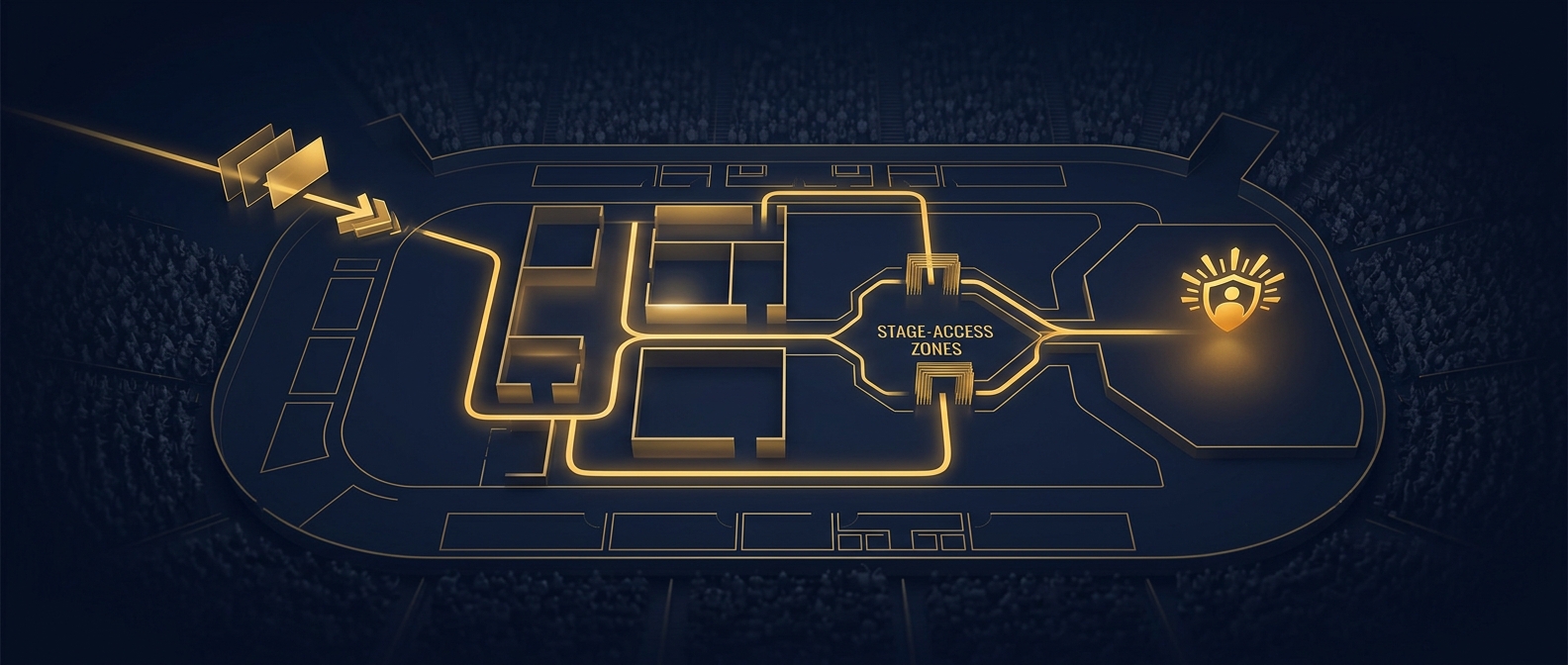
Touring security solves a different problem: the same artist, the same threat profile, but a new physical environment, a new local workforce, and often a new jurisdiction every few days. A tour security program is built around a repeatable process applied at every stop — venue risk assessment, load-in and load-out security, backstage and dressing-room access control, stage-access and barricade planning with the venue’s own security team, transport between the hotel and venue, and hotel security including floor control and room-key discipline. International legs add destination intelligence, customs and equipment logistics coordination, and awareness of local laws around firearms, protective personnel licensing, and public assembly that vary sharply from country to country.
Crowd dynamics are the dominant physical-safety variable on tour, and they scale differently by venue type: an arena show, a stadium show, and a festival slot each carry distinct barricade, medical, and egress requirements, and a program that treats them identically is under-prepared for at least two of the three. The table below outlines how the standard posture shifts by venue format.
| Venue format | Primary risk focus | Standard security posture |
|---|---|---|
| Arena / theater | Fixed access points, backstage breach, meet-and-greet exposure | Credentialed access, dedicated backstage perimeter, escorted meet-and-greet protocol |
| Stadium | Large-crowd egress, extended perimeter, vehicle access | Multi-zone perimeter, coordinated venue and local law-enforcement liaison, vehicle-route planning |
| Festival | Shared multi-act infrastructure, uncontrolled general-admission crowd | Dedicated artist compound, promoter-coordinated stage security, independent transport off-site |
How are meet-and-greets, backstage access, and fan interactions secured?
Fan-facing moments are where the highest volume of uncontrolled public contact happens, and they require their own protocol distinct from general venue security. A sound meet-and-greet process pre-verifies every attendee against a confirmed list, controls the physical line and photo-op choreography so no one closes distance unsupervised, and stations a dedicated agent whose only job is reading the interaction itself — not managing the line, watching it. Backstage access follows the same credentialing discipline used on a film set: a tiered badge system, an escort requirement for anyone without standing access, and a hard boundary around dressing rooms and any space where talent is unguarded and approachable.
Fixated-individual and stalker threats that follow an artist from city to city are managed through the same protective-intelligence discipline used in general celebrity protection — monitoring direct contact attempts, social-media threats, and venue-specific tip lines — but applied against a touring schedule, so a concerning pattern identified in one city is flagged to the security lead before the tour arrives at the next.
How are local crew, promoters, and venue security vetted and coordinated city to city?
A tour cannot bring its entire workforce to every city, so local stagehands, riggers, drivers, and venue security are engaged fresh at nearly every stop — and vetting that local workforce, quickly and consistently, is one of the least visible but most important disciplines in touring security. Effective programs pre-qualify local security and transport vendors through the touring company’s own vetted-partner network rather than accepting whatever the venue provides by default, confirm licensing and insurance for any local protective personnel before load-in day, and run a short pre-show briefing with venue security and local promoter staff so everyone is operating against the same plan rather than improvising a handoff on arrival.
Coordination with the promoter is a relationship, not a one-time contract review: the promoter typically owns venue-level security staffing and local law-enforcement liaison, while the touring security lead owns the artist’s direct protective coverage, and the two have to agree, before doors open, on exactly where that line sits so nothing falls into a gap between them.
The sequence below is the pre-show advance checklist a touring security lead runs at essentially every stop, regardless of venue size or country.
- Confirm the venue risk assessment. Review crime, crowd-history, and jurisdictional factors specific to that city and venue before load-in week.
- Vet local personnel. Qualify local security, drivers, and stagehands through the touring company’s vetted-partner network rather than accepting default venue staff.
- Walk the venue in person. Confirm access points, backstage layout, dressing-room locations, and egress routes physically, not from a floor-plan PDF.
- Set the credential and access plan. Define backstage zones, badge tiers, and escort requirements for that specific venue’s layout.
- Finalize barricade and crowd plans. Coordinate stage-access and barricade configuration with venue security for that show’s expected crowd size.
- Brief venue security and the promoter. Run a joint pre-show briefing so local staff and the touring team share one plan before doors open.
- Confirm medical and emergency coverage. Verify on-site medical staffing and the nearest capable hospital for that city.
- Debrief after load-out. Capture what worked and what did not before the same plan repeats at the next stop.
What insurance, bonding, and liability considerations apply to productions and tours?
Both environments carry contractual and liability exposure that security planning has to account for directly. Productions typically require security vendors to carry general liability and workers’ compensation coverage that meets the studio’s or completion bond’s minimum requirements, and any security personnel involved in scenes with simulated weapons or hazardous action must be coordinated with the production’s insurer and safety officer, not just the stunt team. Touring security contracts should clearly define which party — artist, promoter, or venue — carries liability for crowd-related incidents, and international dates add the question of whether protective personnel are licensed to operate in that jurisdiction at all, since armed or licensed close-protection work is regulated country by country and, in many, cannot legally be performed by personnel who are not locally licensed.
Because of that legal reality, no credible provider claims to field its own licensed protective agents in every country on a tour route. The honest and durable model is a home-jurisdiction team — licensed where the firm actually operates — commanding a vetted local partner network everywhere else, so every city’s protective personnel are properly licensed for that jurisdiction while the standard of care and the command structure stay constant.
How does Honeybadger deliver on-set and tour security?
Honeybadger Solutions delivers on-set and touring protection through the same commanded structure behind our executive protection work: threat assessment, credentialing design, venue advances, and program command are ours and centralized, while physical coverage is executed by rigorously vetted personnel — our own AZ-licensed agents at home in Arizona, and a commanded vetted-partner network beyond it, with established theaters in California, Texas, and Florida and mandate-driven coverage wherever a production or tour needs us, domestically and internationally. Background vetting of crew, extras, and local venue or promoter-supplied personnel, along with any leak or insider-threat investigation, is handled by our own investigations team, so the same command that plans the set or venue advance also owns the response if something goes wrong.
For the broader personal-protection picture — residence, daily-life, and fixated-individual coverage — that this production and touring work complements, see our guide to celebrity and talent protection services. Command is anchored from our Arizona base — the Casa Grande headquarters and the Phoenix and Oro Valley offices — directing established-theater operations and coordinating protection for productions and tours wherever they go, under one accountable chain of command from advance through wrap.
Frequently asked questions
What is the difference between a bodyguard and on-set or tour security?
A bodyguard is one agent following a principal through daily life. On-set and tour security is a coordinated operation covering a defined environment, a soundstage, a venue, or a whole tour, including access control, crew and extras vetting, venue advances, and coordination with the production or promoter who legally controls that space. The personal protective agent assigned to talent is one component of a much larger program, not the whole of it.
Who is responsible for security on a film set, the production or the talent?
Set security typically operates as a department within the production itself, reporting to the unit production manager or line producer, and covers the whole cast, crew, and location. Talent-specific personal protection, when an individual actor or artist requires it, is a separate, additional layer coordinated with, but not replacing, the production’s own security department.
How far in advance should a venue security advance happen before a tour date?
A proper advance is conducted well before load-in, ideally weeks ahead for the paperwork and coordination and again in person in the days immediately before the show, so the security lead can walk the venue, confirm access points, backstage layout, and egress routes, and finalize the plan with venue security and the local promoter before the touring party arrives.
Can a US-based security firm provide licensed protective agents on an international tour?
Licensed close-protection and armed security work is regulated on a country-by-country basis, so a US firm’s own licensed agents generally cannot legally perform that role abroad. The credible model is a home-jurisdiction command team directing a vetted local partner network of properly licensed protective personnel in each country, so the standard of care and command structure stay consistent while every agent on the ground is licensed where they actually operate.
About Honeybadger Solutions
Honeybadger Solutions is an Arizona-licensed security and investigations firm delivering intelligence-led executive and talent protection, on-set and touring security, investigations, and cyber services to productions, artists, executives, and organizations nationwide and internationally. Physical protection is delivered by our own AZ-licensed agents in Arizona and through a commanded vetted-partner network beyond it, with established theaters in California, Texas, and Florida and mandate-driven coverage wherever a production or tour travels, all directed from Arizona home command. Background vetting, threat assessment, and investigations are handled in-house and delivered globally — so every set and every tour date is scoped honestly, planned to the assessed risk, and backed by a single accountable chain of command.
Offices: Casa Grande (HQ), Phoenix, and Oro Valley, Arizona.
Phone: Book a consultation online
Confidential consultation: discuss production or touring security planning with our command team.
Sources and further reading
- FinCEN — Legal Authorities — The Bank Secrecy Act, USA PATRIOT Act and Anti-Money Laundering Act authorities that govern financial and virtual-asset reporting.
- FBI Internet Crime Complaint Center — Annual Reports — Annual and state-level internet crime statistics, including dedicated reports on cryptocurrency fraud and elder fraud.
Honeybadger Solutions delivers Blockchain Forensics, Blockchain Consulting and Cyber Investigations from its Arizona office for clients across the United States and internationally. This casework is performed remotely under Arizona licensure, so there is no geographic limit on where a client can be based.
Browse by topic
Security guard services · Private investigations · Cybersecurity · Digital forensics · Financial fraud investigation · Executive protection · All articles