
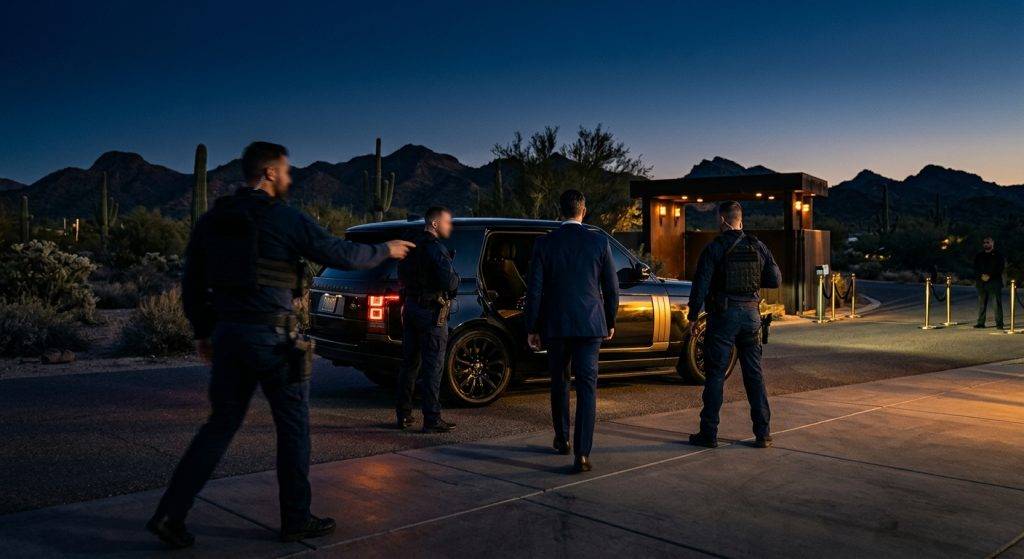
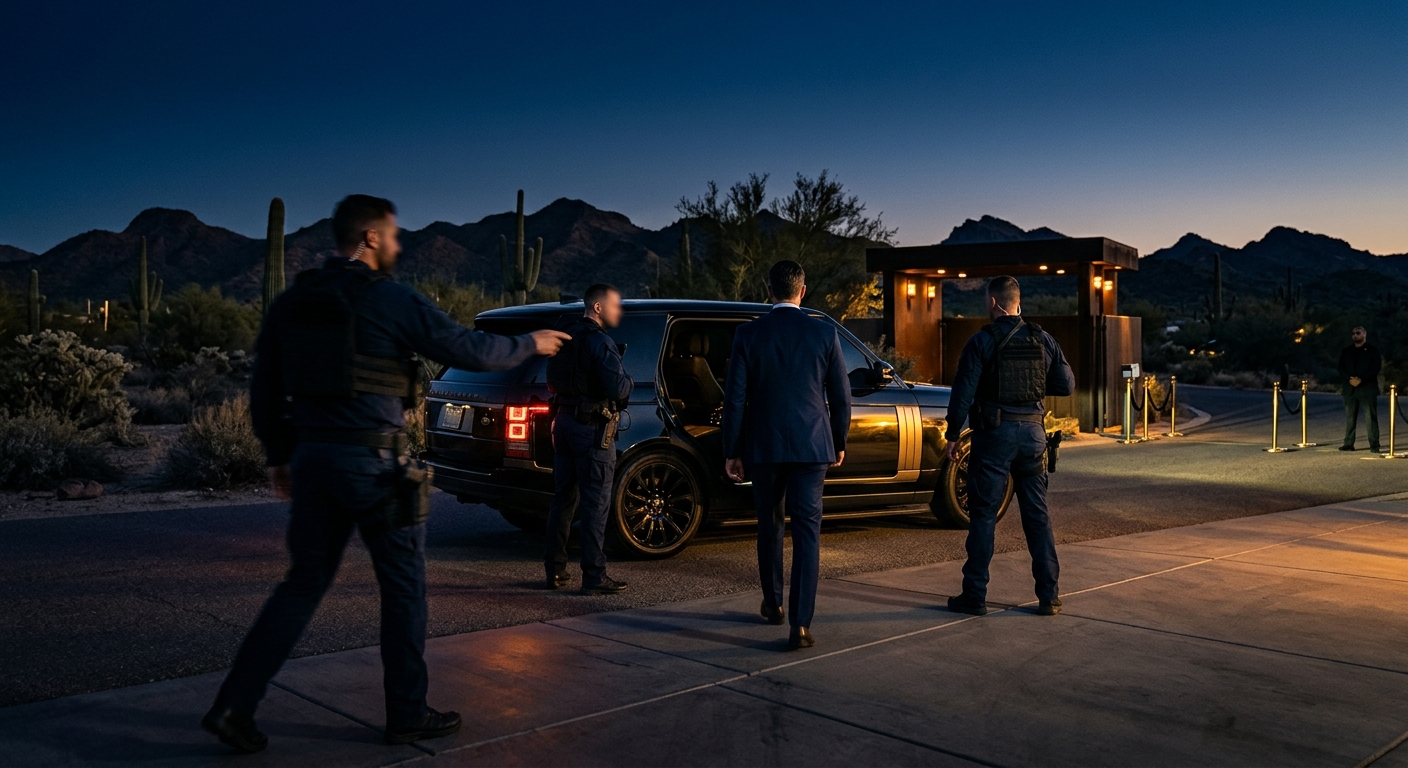
Event security for executives and VIPs is a time-boxed protective operation built around a specific place and moment, not a standing detail. It fuses an advance and site survey, access control and credentialing, crowd and threat screening, secure arrival and departure, and liaison with venue and law-enforcement partners — all engineered so a principal can appear in public, on schedule, without becoming a target or a spectacle.
A gala, a keynote, a shareholder meeting, a product launch, an awards ceremony, a groundbreaking, a private wedding, or a courtside seat at a championship game all share one uncomfortable property: they place a high-value principal in a fixed, publicized location, at a known time, surrounded by people the principal does not control. That is the inverse of good protective doctrine, which prizes unpredictability and controlled space. Event protection exists to buy back the control the event gives away. It is among the most demanding disciplines in the field precisely because it is public, compressed, and unforgiving — the work either holds for the few hours it must, or it fails in front of an audience. This guide is written for the general counsel, chief of staff, family-office director, or corporate security lead who must ensure a principal appears flawlessly and safely, and who needs to understand how elite event protection is actually planned and run.
How is event security for executives different from a standing protective detail?
A standing detail protects a person as they move through their ordinary life — home, office, routine travel — where the protectors help shape the environment and can vary routes and timing. An event strips those advantages away. The location is fixed and often published. The arrival window is known. The principal is expected to be visible, accessible, and photographed, frequently while shaking hands, giving remarks, or moving slowly through a crowd. Anyone who wishes the principal harm knows exactly where they will be and roughly when.
Event protection therefore inverts the normal emphasis. Instead of relying on unpredictability, it relies on saturating a known environment with advance planning: mapping every entrance, egress, sightline, and chokepoint before the principal arrives; controlling who gets close and how; and rehearsing the movements that carry the highest risk — the walk from a vehicle to a door, the transit through a lobby, the moment on and off a stage. It is also a coordination discipline. At any significant event the protective team is one actor among many: venue security, event production, ushers, valet and transport, possibly local police, fire marshals, and other principals’ details. World-class event protection looks effortless from the audience precisely because an enormous amount of friction was resolved in the days before the doors opened.
What does the event advance and site survey actually cover?
The advance is the event. Everything the audience sees on the day is the visible tip of work done beforehand, and the depth of that advance is the single clearest signal of whether a provider is elite or merely present. A serious advance walks the venue in person — ideally more than once, including at the same time of day as the event — and produces a working security picture rather than a checklist.
That picture includes the full geometry of the space: primary and alternate entrances and exits, the route the principal will actually travel, the loading dock or discreet entrance that avoids a public arrival, the stage and its access, the greenroom or holding area, restrooms the principal may use, elevator and stairwell control, and the nearest trauma-capable hospital with a driving route and time. It maps sightlines and elevated positions, identifies where a crowd will bottleneck, and locates a defensible safe room and a primary and secondary evacuation path. It confirms medical coverage and the location of the nearest automated external defibrillator. Critically, it establishes points of contact: the venue’s security manager, the event producer, the parking and transport leads, and any law-enforcement presence. The advance also reaches into the intelligence domain — monitoring for online chatter about the event and the principal, reviewing the guest or attendee posture where appropriate, and flagging any known fixated individuals or active threats before the day arrives. When advance work is funded and done properly, the on-site team is executing a rehearsed plan; when it is skimped, the team is improvising with a principal’s safety in a building they are seeing for the first time.
How do access control and credentialing work at an executive event?
Access control is the mechanism that converts an open, publicized event back into a space with a defensible perimeter. The governing idea is layered access: the further into the environment a person moves — from the street, to the general event floor, to the reserved area, to the stage or the principal’s immediate proximity — the higher the credential and the tighter the screening required to be there. A well-run event has a clear, enforced answer to a single question at every layer: who is allowed past this point, and how do we know?
In practice this means a credentialing scheme designed and controlled in advance — tiered badges or wristbands that are difficult to counterfeit, matched to a vetted guest list, with a documented process for staff, vendors, press, and production crews who legitimately need back-of-house access. Vendor and staff vetting matters more than clients expect: catering, audiovisual, and temporary event labor move freely through spaces the public never sees, and an insider or an unvetted contractor is a classic soft entry point. Press and photographers are managed to a defined position and briefed on what is permitted. The principal’s own party — assistants, family, colleagues — is accounted for so the team knows precisely who belongs in the inner circle. Access control fails most often not through dramatic breaches but through quiet erosion: propped doors, “just this once” exceptions, and unmanned side entrances. Holding the line on the unglamorous details is the discipline.
Which event postures fit which occasions?
Not every event warrants the same footprint, and matching posture to occasion is where cost and effectiveness meet. The table below maps common executive and VIP events to the protective posture they typically require. These are planning archetypes; the actual posture always follows a risk assessment of the specific principal, venue, and threat picture.
| Event type | Dominant risk | Typical protective posture |
|---|---|---|
| Private gala / fundraiser | Uncontrolled guest mingling, alcohol, opportunistic approach | Discreet close protection plus access control at the inner tier and secure arrival/departure |
| Keynote / conference | Publicized appearance, stage exposure, Q&A proximity | Advance, stage and greenroom security, managed audience access, egress rehearsal |
| Shareholder / annual meeting | Activist disruption, hostile attendees, protest | Screening, credentialed entry, disruption-management plan, law-enforcement liaison |
| Product launch / public event | Large mixed crowd, media, open access | Layered perimeter, crowd management, medical plan, coordinated venue security |
| Red carpet / awards | Paparazzi crush, fans, fixated individuals | Arrival choreography, buffer management, threat-assessment support, low-profile close cover |
| Sporting / entertainment outing | Dense public venue, recognition, no control of space | Advance with venue, discreet cover, seat and route planning, extraction path |
The through-line is proportionality. A discreet dinner among vetted guests does not need a visible cordon, and imposing one damages the principal’s experience and draws the very attention it should avoid. A public product launch with thousands of strangers demands a genuine layered perimeter. Reading the event correctly — and resisting both over- and under-protection — is the craft.
How do you screen crowds and manage threats at a live event?
Crowd screening at events is as much behavioral as it is physical. Where the venue and event support it, entry screening — bag checks, magnetometers or handheld wands, and controlled entry lanes — raises the cost of bringing a weapon into the space. But the more durable protective skill is behavioral threat assessment applied in real time: protective agents positioned to read the crowd, watching for the person whose attention, movement, or affect is out of pattern with everyone around them. Most people at an event are looking at the stage, the food, or their phones; the individual fixated on the principal behaves differently, and trained eyes catch it.
This is where the protective-intelligence layer earns its place. Before the event, in-house intelligence analysts review the online threat picture, identify any known fixated or previously threatening individuals associated with the principal or the organization, and brief the on-site team on who and what to watch for. Photographs and behavioral indicators of specific persons of concern are circulated to the detail. During the event, the team manages proximity — keeping the principal in controlled space, choreographing handshake lines and photo opportunities so approaches are funneled and observable, and maintaining an unobtrusive buffer that a would-be attacker cannot cross without being seen. The goal is never a visible show of force; it is to detect and interrupt a problem early and quietly, ideally before the principal is ever aware of it.
How does event protection integrate with venue security and law enforcement?
At almost every meaningful event, the protective team does not own the building and does not command every asset in it. Effectiveness depends on integration — on arriving with relationships, not just personnel. The venue has its own security manager, house rules, camera system, and control of the physical plant. The event producer controls the run of show, the timing, and back-of-house access. For larger or higher-profile events, local law enforcement, fire marshals, and emergency medical services are involved, and at official or dignitary-adjacent events, government protective services may hold primacy.
The protective team’s job is to de-conflict all of this before the day: to agree on who does what, to align on communications, to confirm that the venue’s plan and the detail’s plan do not contradict each other, and to establish a clear escalation path if something goes wrong. Guidance from bodies such as ASIS International and the U.S. Cybersecurity and Infrastructure Security Agency’s soft-target and crowded-places resources at CISA reflect the same principle: security at a public venue is a coordinated system, and the protective team must slot into it cleanly rather than operate as an island. When integration is done well, the venue and law-enforcement partners become force multipliers; when it is neglected, they become sources of friction at the worst possible moment.
What is the framework for securing an executive appearance?
Elite event protection follows a recognizable sequence. The steps below describe how a professional team moves from an invitation on the principal’s calendar to a clean departure, applicable whether the event is an intimate dinner or a public keynote.
- Assess the event and the threat. Establish the principal’s exposure, the nature and audience of the event, and any specific or credible threats before committing to a posture. The assessment sizes everything that follows.
- Conduct the advance. Walk the venue in person, map entrances, egress, routes, the holding area, the stage, medical resources, and the nearest hospital; identify chokepoints, safe rooms, and evacuation paths.
- Build the intelligence picture. Monitor online chatter about the event and principal, screen for known persons of concern, and brief the team on specific behavioral and photographic indicators to watch.
- Design access control. Set the credentialing tiers, vet vendors and staff, define press and guest positions, and confirm who is permitted at each layer up to the principal’s immediate proximity.
- Coordinate with partners. De-conflict roles and communications with venue security, event production, transport, and any law-enforcement or emergency-services presence.
- Plan arrival and departure. Choreograph the highest-risk moments — the vehicle-to-door transit, the lobby, the stage on and off — with a discreet entrance where possible and a rehearsed extraction route.
- Rehearse contingencies. Walk the team through medical emergency, evacuation, aggressive-approach, and lost-principal scenarios so the response is trained, not invented on the day.
- Execute and debrief. Run the plan on the day, adapt calmly to change, and capture lessons afterward so the next appearance is stronger.
The discipline is that none of these steps is optional at scale. A team that skips the advance or the contingency rehearsal may get away with it a dozen times — and then face the one moment for which it was never prepared.
How does Honeybadger deliver event security for executives and VIPs?
Honeybadger Solutions delivers event and executive protection under unified command, scoping each occasion to its real risk rather than to a rate card. Threat assessment, protective-intelligence direction, advance planning, and single-point accountability are centralized, while on-the-ground protective operations are executed by rigorously vetted, licensed teams. In Arizona — across our Casa Grande headquarters and the Phoenix and Oro Valley offices — event protection is delivered by our own in-house, AZ-licensed agents. Outside Arizona, coverage is provided through a commanded vetted-partner network, with California, Texas, and Florida as established theaters and nationwide reach coordinated from Arizona home command, so a principal is covered wherever the event takes them without the fiction that any single firm staffs an armed office in every city.
What distinguishes the program is the fusion of protective operations with in-house intelligence. Because our background and protective intelligence, cybersecurity, and digital-forensic disciplines are handled internally and delivered nationwide and internationally, the advance behind an event — screening for a fixated individual, catching escalating online chatter tied to a shareholder meeting, vetting an unfamiliar vendor, or reducing a principal’s location exposure — is worked by the same command that runs the physical security and any related investigations. That integration is where event protection is won: the problem resolved quietly during the advance is the incident that never happens on the day.
Frequently asked questions
What is the difference between event security and a bodyguard?
A bodyguard, or close-protection agent, stays with a person as they move through daily life. Event security is a time-boxed operation built around a specific place and occasion, combining an advance and site survey, access control and credentialing, crowd and threat screening, secure arrival and departure, and coordination with venue and law-enforcement partners. Close protection is usually one element within a properly planned event operation, not the whole of it.
How far in advance should event security be planned?
As early as the appearance is confirmed. Serious advance work — walking the venue, mapping routes and medical resources, building the intelligence picture, designing credentials, and coordinating with venue and law-enforcement partners — takes days, not hours. For high-profile or large public events, weeks of lead time is normal. Late engagement forces a team to improvise, which is precisely what event protection exists to avoid.
Can event security be discreet so it does not disrupt the occasion?
Yes, and for most executive events discretion is the goal. Much of the work — the advance, intelligence, access-control design, and partner coordination — happens before guests arrive and is never seen. On the day, close cover can be low-profile, and proximity is managed through choreography rather than visible cordons. A well-run event feels seamless to attendees while a rehearsed plan operates beneath the surface.
Do you coordinate with the venue’s own security and local police?
Always. At almost every meaningful event the protective team does not own the building or command every asset in it, so integration is essential. We de-conflict roles and communications with venue security, event production, transport, and any law-enforcement or emergency-services presence before the day, and establish a clear escalation path. Coordinated partners become force multipliers; neglected coordination becomes friction at the worst moment.
About Honeybadger Solutions
Honeybadger Solutions is an Arizona-licensed security and investigations firm delivering intelligence-led executive and event protection, investigations, and cyber services to executives, high-net-worth families, general counsel, and organizations nationwide and internationally. In Arizona, physical and executive protection is delivered by our own in-house, AZ-licensed agents; outside Arizona it is delivered through a commanded vetted-partner network with established theaters in California, Texas, and Florida, directed from Arizona home command. Digital forensics, cybersecurity, financial investigations, and background intelligence are handled in-house and delivered globally — so every event is scoped honestly, planned rigorously, and backed by a single accountable chain of command.
Offices: Casa Grande (HQ), Phoenix, and Oro Valley, Arizona.
Phone: Book a consultation online
Confidential consultation: discuss an event security advance and protective plan with our command team.
Browse by topic
Security guard services · Private investigations · Cybersecurity · Digital forensics · Financial fraud investigation · Executive protection · All articles