


A global supply chain is only as secure as its least-controlled vendor, lane, and handoff. Real protection combines rigorous third-party due diligence, cargo-theft and in-transit visibility controls, cyber hardening of the systems that move orders and designs, and a program mapped to recognized frameworks like CBP’s C-TPAT. Honeybadger Solutions delivers investigative-grade supply-chain risk defense for enterprises operating nationwide and across borders.
Your own facility may be a fortress — cameras, access control, mature internal procedures. But your exposure does not stop at your property line. In a modern supply chain, parts, materials, capital, and intellectual property pass through manufacturers, subcontractors, brokers, freight forwarders, warehouses, and last-mile carriers before anything reaches you. Each of those parties is a door into your enterprise, and most of them you have never audited. This is the discipline of treating the entire chain — not just the four walls you own — as a single security perimeter.
Why Is the Supply Chain the Enterprise’s Largest Attack Surface?
Adversaries — whether an organized cargo-theft ring, a nation-state actor, or a fraudulent supplier — follow the path of least resistance. They rarely assault a hardened headquarters when a tier-three subcontractor with weak controls offers the same access to your product, your data, and your customers. The supply chain concentrates risk precisely because it is distributed: authority is fragmented, visibility is thin, and accountability blurs at every handoff.
The consequences compound upstream. A single compromised partner can trigger financial loss, exposure of proprietary designs, regulatory penalties, forced-labor or sanctions violations, product-quality failures, and brand damage — and the liability often lands on the largest, most visible name in the chain, not the vendor that failed. The U.S. Cybersecurity and Infrastructure Security Agency treats supply chain security as a national-priority risk for exactly this reason: the interconnection that makes global sourcing efficient is the same interconnection that lets one failure cascade.
What Are the Real Threats Across a Global Supply Chain?
“Supply chain risk” is not one problem. It is a stack of distinct threat classes, each requiring a different control set. Treating them as a single line item on a risk register is how enterprises end up protected against the threat they imagined and blindsided by the one that hits.
| Threat Class | How It Manifests | Primary Defense |
|---|---|---|
| Cargo theft & diversion | Straight theft, pilferage, fictitious pickups, driver collusion, warehouse loss | Carrier vetting, in-transit visibility, chain-of-custody controls |
| Third-party / vendor risk | Insolvency, fraud, hidden subcontractors, unethical or forced labor | Financial and background due diligence before and during contract |
| Cyber & data exposure | Compromised vendor systems, stolen designs, business email compromise | Cyber hardening of order/design data flows, vendor access controls |
| Geopolitical disruption | Sanctions, port closures, regional instability, sudden regulatory shifts | Supplier mapping, contingency sourcing, jurisdiction risk analysis |
| Counterfeiting & substitution | Fake components, gray-market parts, tampered goods in transit | Provenance verification, seal integrity, inspection at handoffs |
Cargo theft deserves particular attention because it has professionalized. What was once opportunistic pilferage now includes strategic cargo theft — criminal crews using stolen carrier identities, spoofed load-board postings, and fraudulent paperwork to pick up freight legitimately and simply drive away. The FBI and industry cargo-theft bureaus have repeatedly flagged the rise of these identity-based and “fictitious pickup” schemes; the point for an enterprise is that a locked trailer is no defense when the criminal presents valid-looking credentials at your dock.
How Do You Vet a Vendor Before You Sign?
Selecting a manufacturer, assembler, or component supplier is not a procurement decision with a security footnote — it is a security decision with a price tag. The glossy capability deck and the audited financials a vendor volunteers are the story they want told. Elite due diligence establishes the story they did not tell. Honeybadger’s in-house background intelligence and financial investigations teams build that picture before your signature commits you.
- Financial health and solvency. Is the vendor stable, or one bad quarter from insolvency that halts your line overnight? We examine financial signals, litigation exposure, liens, and payment behavior — the indicators a stability failure telegraphs before it happens.
- Beneficial ownership and hidden ties. Who actually controls the entity? Shell structures, undisclosed affiliates, sanctioned parties, or conflicts of interest surface only through corporate-registry and open-source intelligence work, not a credit report.
- Reputation, compliance, and legal history. A pattern of lawsuits, regulatory violations, recalls, or quality failures is a leading indicator of the disruption you will inherit.
- Labor and ethical exposure. Forced-labor, environmental, and human-rights violations in a supplier’s operation are now enforcement and detention risks under U.S. import law — and a brand crisis waiting to happen.
- Physical and information security posture. Does the vendor control facility access, protect prototypes and molds, and manage visitor and employee activity — or is your intellectual property sitting on an open loading dock?
- Hidden subcontractors. The tier-two and tier-three parties your direct vendor quietly relies on are often the real weak link. Mapping them is where credible due diligence separates from a checkbox.
Vetting is not a one-time gate. A supplier that was sound at signing can deteriorate — ownership changes, finances erode, a factory relocates to a higher-risk jurisdiction. Continuous monitoring of critical suppliers is what turns due diligence from a snapshot into a control.
How Do You Protect Cargo While It Is in Motion?
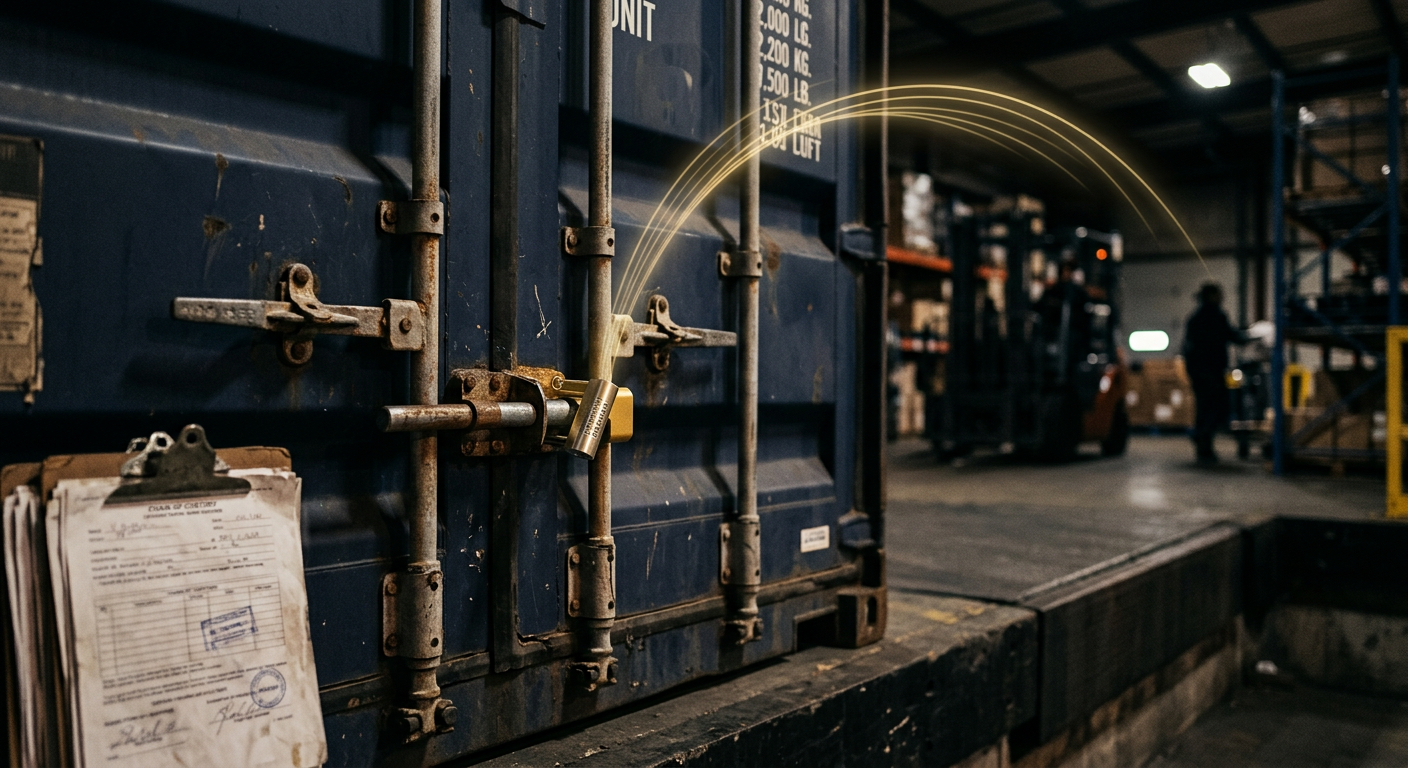
Even when your facility and your vendors are secure, your product spends days or weeks in trucks, warehouses, ports, cross-docks, and someone else’s hands. In-transit is where a disproportionate share of loss and tampering occurs, because custody changes repeatedly and no single party owns the whole journey. Closing that gap requires auditing the parties who move your freight, not just trusting the rate quote.
- Carrier and broker verification. Confirm that the trucker, drayage provider, freight forwarder, and customs broker are who they claim to be — the direct countermeasure to fictitious-pickup and identity-theft cargo schemes.
- Chain-of-custody discipline. Documented handoffs, tamper-evident seals with logged seal numbers, and driver-verification protocols so a substitution or diversion cannot pass unnoticed.
- In-transit visibility. GPS and telematics on high-value loads, geofencing with alerting on unplanned stops or route deviation, and covert tracking on the highest-risk shipments.
- Facility hardening at rest. Transload, warehouse, and cross-dock points are theft hotspots; access control, surveillance, and vetted personnel at these nodes matter as much as the road segments.
Where a matter requires physical security, protective coverage, or on-the-ground presence at a facility or lane, Honeybadger commands a vetted-partner network with established operational theaters in California, Texas, and Florida — three of the highest-volume freight corridors in the country — coordinated from our Arizona home command. Elsewhere, we deploy through the same vetted network on a mandate basis, so coverage scales to where your cargo actually moves.
What Is C-TPAT and Why Does It Matter?
The Customs Trade Partnership Against Terrorism (C-TPAT) is U.S. Customs and Border Protection’s voluntary supply-chain security program. Members commit to a set of minimum security criteria across their international supply chain — business-partner screening, physical and access controls, personnel and procedural security, cybersecurity, and container and conveyance integrity — in exchange for benefits like reduced inspections, priority processing, and front-of-line treatment during disruptions. For any enterprise importing at scale, CBP’s C-TPAT framework is both a competitive advantage and a de facto standard your trading partners increasingly expect.
C-TPAT matters strategically even for firms that never formally enroll, because its minimum security criteria are a ready-made blueprint for a defensible program. Mapping your controls to C-TPAT — and to broader guidance such as the NIST framework for cyber supply chain risk management — gives you an auditable posture that regulators, insurers, and enterprise customers recognize. Honeybadger helps clients assess against these criteria, close the gaps, and document the evidence, whether the goal is certification or simply a program that would survive scrutiny.
Reactive vs. Program-Grade Supply Chain Security
Most enterprises do not lack concern about supply-chain risk; they lack a program. The difference between reacting to incidents and running a defensible security program is the difference between absorbing losses and preventing them.
| Dimension | Reactive Posture | Program-Grade Posture |
|---|---|---|
| Vendor vetting | References and a credit check | Ownership, financial, legal, and labor due diligence with monitoring |
| Cargo in transit | Trust the carrier, insure the loss | Verified carriers, seals, visibility, and route-deviation alerting |
| Data & IP | Assume the vendor is secure | Vendor access controls and hardened order/design data flows |
| Framework alignment | None; ad hoc | Mapped to C-TPAT and recognized C-SCRM standards |
| Disruption | Scramble when a supplier fails | Supplier mapping and pre-planned contingency sourcing |
How Do Cyber and Geopolitical Risk Enter the Chain?
The modern supply chain moves data before it moves a single pallet. Purchase orders, CAD files, bills of material, and payment instructions travel through vendor email and portals that you do not control. That flow is a favored vector: a compromised supplier mailbox enables business email compromise and fraudulent payment redirection, and stolen design files hand a competitor or counterfeiter your product. Our cybersecurity practice hardens these data handoffs, and when a breach or fraud has already occurred, our digital forensics team reconstructs how it happened and preserves evidence for recovery or litigation.
Geopolitical risk is the layer above all of it. Sanctions regimes shift, ports close, regional instability strands freight, and new import-enforcement rules can detain a shipment for a supplier violation you never saw. Managing this requires knowing your supplier map several tiers deep, understanding the jurisdictions your goods transit, and building contingency sourcing before — not during — a disruption. Intelligence, not optimism, is the control.
What Does a Honeybadger Engagement Look Like?
Consider a representative scenario: a manufacturer sourcing precision components from suppliers in Mexico and Asia, shipping finished goods through West Coast and Gulf ports to domestic distribution. The engagement typically runs in phases — assess, harden, monitor — so that the highest-severity gaps are closed first and the program becomes self-sustaining.
- Map the chain. Identify every tier-one supplier, their critical subcontractors, the carriers and brokers moving the freight, and the jurisdictions and lanes involved.
- Diligence the parties. Financial, ownership, legal, and labor investigation on critical vendors; verification of carriers and brokers; open-source and corporate-registry intelligence on hidden ties.
- Assess the controls. Benchmark physical, personnel, procedural, and cyber security against C-TPAT criteria and recognized C-SCRM standards; document the gaps.
- Harden the weak points. Chain-of-custody and seal protocols, in-transit visibility on high-value loads, hardened data flows, and, where required, physical coverage through the vetted-partner network.
- Monitor continuously. Ongoing surveillance of critical suppliers’ stability, sanctions and litigation exposure, and cargo-theft trends on the client’s active lanes.
The same evidentiary rigor our investigations and security teams apply to any matter governs this work: document relentlessly, verify before trusting, and never assume a partner’s security is your security.
Nationwide and International Reach
Supply chains do not respect borders, and neither does our coverage. Honeybadger’s in-house digital forensics, cybersecurity, financial investigations, and background-intelligence practices are remote-by-design and operate globally, so vendor due diligence in another country and cyber hardening of a cross-border data flow proceed without a physical office at either end. From our headquarters in Casa Grande and offices in Phoenix and Oro Valley, we serve enterprises across all of Arizona, nationwide, and internationally — coordinating physical and protective work through our vetted-partner network wherever your cargo and suppliers actually are.
Frequently Asked Questions
What is the biggest supply chain security risk companies overlook?
Hidden lower-tier suppliers. Enterprises vet their direct vendors but rarely map the subcontractors those vendors rely on — where financial instability, forced-labor exposure, or weak data security often actually live. A defensible program maps the chain several tiers deep and monitors critical suppliers continuously, not just at contract signing.
How does modern cargo theft actually happen?
Increasingly through fraud rather than force. Strategic cargo theft uses stolen carrier identities, spoofed load-board postings, and fraudulent paperwork to pick up freight legitimately and disappear. Locks and cameras do not stop a criminal who presents valid-looking credentials at the dock — carrier verification, chain-of-custody controls, and in-transit visibility do.
Do we need C-TPAT certification to be secure?
Not necessarily, but you should use its standard. C-TPAT membership offers real benefits — fewer inspections, priority processing — yet even firms that never enroll benefit from mapping controls to its minimum security criteria. It is a recognized, auditable blueprint that regulators, insurers, and enterprise customers understand.
Can you vet suppliers located overseas?
Yes. Our background-intelligence and financial-investigations practices are in-house and remote-by-design, built for cross-border work. We examine beneficial ownership, financial stability, legal history, sanctions exposure, and labor risk on international vendors using corporate registries and open-source intelligence, then monitor critical suppliers for change over the life of the contract.
About Honeybadger Solutions
Honeybadger Solutions is an Arizona-licensed security and investigations firm delivering elite digital forensics, cybersecurity, financial investigations, and background intelligence in-house and by design for remote, cross-border engagement. We maintain three offices — our headquarters in Casa Grande, plus Phoenix and Oro Valley — and serve clients across all of Arizona, nationwide, and internationally. Physical and protective operations are commanded through a vetted-partner network with established theaters in California, Texas, and Florida, coordinated from our Arizona home command.
To assess your supply chain or engage a vendor-risk investigation, call Book a consultation online or visit our security practice. Your chain is only as strong as its weakest link — find it before an adversary does.
Browse by topic
Security guard services · Private investigations · Cybersecurity · Digital forensics · Financial fraud investigation · Executive protection · All articles