
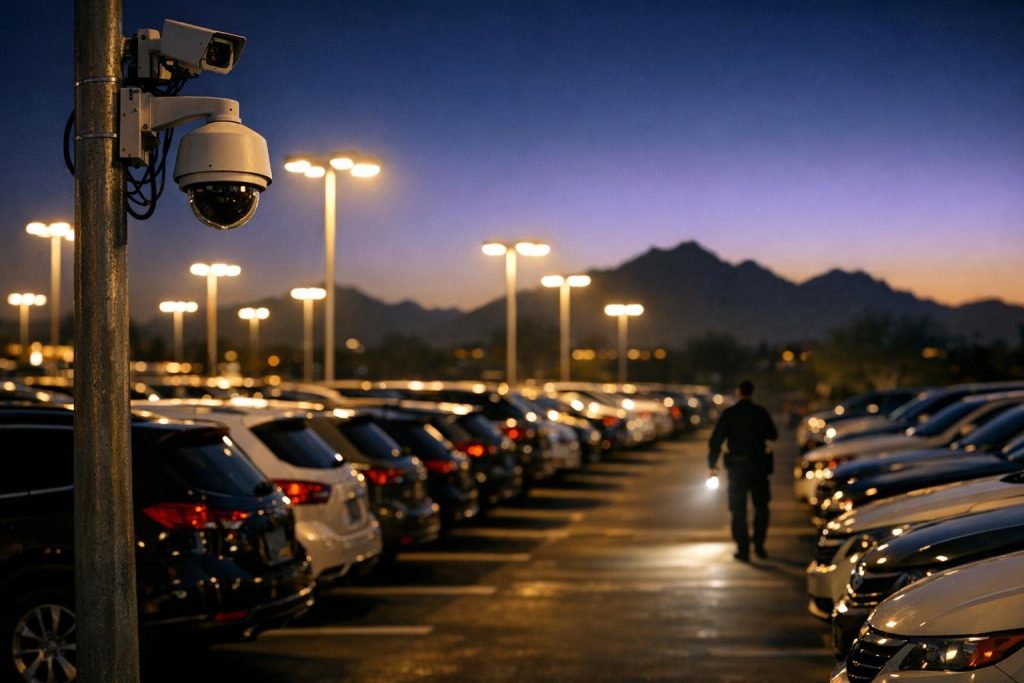
Arizona car dealers lose inventory in four main ways: whole vehicles driven off the lot (often with a key that should have been locked up), catalytic converters cut from parked units, wheel and tire packages stripped overnight, and test drives that never come back. Each one has a different weak point, so the dealers who lose the least use layers: tight key control and test drive rules during the day, a lot layout that slows thieves down at close, and live monitoring overnight.
This guide covers each layer with checklists your managers can use, the Arizona laws that matter when something goes missing, and current theft data. For the service itself, see our auto dealership security page.
Key takeaways
- Arizona vehicle thefts fell 25 percent in 2025, but the Chevrolet Silverado still topped the state’s most-stolen list and pickups held four spots. Dealer lots concentrate exactly those units.
- A missing vehicle with no forced entry is usually a key problem. Count keys every night and reconcile them to inventory.
- Under A.R.S. 13-1814, obtaining a vehicle by material misrepresentation is theft of means of transportation, and the dealer must sign a theft affidavit or the record can drop out of national databases.
- Arizona’s catalytic converter law, A.R.S. 13-3728, squeezes the resale market but does not stop a crew with a saw. Layout, lighting and cameras do.
- Overnight, remote video with live talk-down suits most lots. Add officers for holidays, big deliveries and active theft trends.
What the numbers say, and what they do not
The Arizona Automobile Theft Authority reported 12,686 vehicle thefts statewide in 2025, down 25 percent from 17,010 in 2024 and the third straight yearly decline. The Chevrolet Silverado was the most stolen vehicle in Arizona, Kia and Hyundai models held four of the top six spots, and pickup trucks held four places on the list.
Nationally, the National Insurance Crime Bureau counted 659,880 vehicle thefts in 2025, a 23 percent drop from 2024, or roughly one every 48 seconds. Its national top five were the Hyundai Elantra, Honda Accord, Hyundai Sonata, Chevrolet Silverado 1500 and Honda Civic.
Two cautions for dealers. First, statewide declines say little about a single lot that holds dozens of high-demand trucks in one place. Second, these counts track stolen vehicles. They do not tell you how many converters or wheel sets were taken, and those losses hit dealers hard because they come in batches.
Key control: where most lot losses start
When a unit disappears overnight and there is no broken glass and no cut fence, look at the keys first. Keys leak out through unlocked desk drawers, service drive cabinets, after-hours drop boxes, porters and detailers, and departed employees. A key program is less about hardware than about a routine everyone follows.
| Key point | Control | Check |
|---|---|---|
| Sales inventory keys | Locked cabinet or electronic key system with sign-out by person, time and stock number | Count and reconcile to inventory at close |
| Service customer keys | Locked cabinet, never on the service desk overnight | Count at close against open repair orders |
| After-hours drop box | Bolted down, slot that cannot be fished, inside camera view | Empty and log first thing each morning |
| Spare and blank fobs, key programming tools | Locked separately, use logged | Weekly audit by a manager |
| Departing employees and vendors | Keys, codes and system access ended the same day | Part of the separation checklist |
Two small habits help. Use key tags that do not show the stock number or model in plain text, so a stolen key does not point to its truck. And treat any unexplained key count gap as an incident that gets written up the same night, not a mystery to solve on Monday.
Test drives: stopping the car that never comes back
Arizona treats test drive theft seriously. Under A.R.S. 13-1814, theft of means of transportation, a class 3 felony, includes obtaining another person’s vehicle by any material misrepresentation with intent to permanently deprive the owner, and converting a vehicle entrusted for a limited, authorized use to an unauthorized term or use. A fake identity or a “test drive” that turns into a disappearance can fit either one.
The same statute has a step dealers miss. The person reporting the theft must sign an affidavit provided by police. If the report is not taken in person, the affidavit must be notarized and delivered to the local agency within seven days, and if police do not receive it within 30 days, the vehicle is removed from the national and state crime databases. Decide in advance which manager signs, and make sure that person knows the clock is running. This is general information, not legal advice.
Test drive checklist:
- Scan the driver’s license front and back, and compare the photo to the person in front of you
- Confirm proof of insurance and keep a copy with the deal jacket
- Set a default that a salesperson rides along, and decide in writing who may approve exceptions
- Set a route and a time limit, and note the departure time and fuel level
- Allow one vehicle per customer at a time, with the key signed out to the salesperson
- Use written agreements with a return time for any overnight or extended demo
- If a vehicle is late, call the customer once, then escalate to a manager and police
When a car does not return, preserve everything at once: the license scan, the sign-out record, the lot and showroom video, and any telematics or GPS data the unit carries.
After-hours layout, lighting and cameras
At close, the lot itself becomes the security system. Thieves want fast access, cover and an easy exit onto a frontage road or freeway. Take those away.
- Park high-demand units deep. Put pickups and frequently stolen models in interior rows, with lower-value units forming the outer ring.
- Block the exits. Close curb cuts at night with chains, gates, bollards or parked units so a vehicle cannot drive straight out.
- Protect wheel packages. Use wheel locks, park premium-wheel units nose to nose and tight to curbs or walls, and keep them in camera range.
- Make converters harder to reach. Park high-clearance trucks close together so no one can crawl under quietly, and consider etching stock numbers or VINs on converters of high-risk units so police can tie a recovered part to your lot.
- Light the edges. Fence lines, the back of the service building and the body shop yard are where cutting and jacking happen. Walk the lot after dark monthly and after every monsoon storm, and fix outages within a day.
- Aim cameras to identify. Wide shots of rows detect movement. You also need tight views of every gate and entrance that capture faces and plates.
- Plan for the desert. Heat shortens the life of camera housings and batteries, dust coats lenses, and monsoon storms knock out power. Put recorders and network gear on battery backup and surge protection.
Arizona has squeezed the converter resale market. A.R.S. 13-3728 makes it unlawful to buy, solicit, advertise, possess or sell a used detached catalytic converter, with limited exceptions for licensed automotive recyclers, qualifying scrap transactions and parts and repair businesses. Buyers must report each transaction to the Department of Public Safety. A violation is a class 1 misdemeanor, and possessing ten or more is a class 6 felony. That helps prosecutors after the fact. It does nothing at 3 a.m. without eyes on the lot.
Camera, lighting and speaker changes are usually part of the plan. Installation work is performed and contracted by our licensed Arizona ROC contractor partner. Honeybadger Solutions LLC is not a licensed contractor.
Choosing the overnight layer
Most dealers do not need an officer every night. They need the right mix for the lot, the season and current activity nearby.
| Option | Best for | Limits |
|---|---|---|
| Remote video guarding with talk-down | Nightly coverage of most lots with good cameras, lighting and speakers | Only as good as camera placement, power and connection |
| On-site officer | Holiday closures, large inventory deliveries, active theft trends, big lots | One person cannot see every row at once |
| Mobile patrol | Used car lots and dealer groups with several rooftops | Gaps between visits |
| Combined | High-risk stores: video every night, officers on high-risk dates | Needs one set of escalation contacts |
With remote video guarding, an operator watching live can speak to an intruder through on-site speakers and call police while the person is still on the lot, which gives officers a chance to arrive before the person leaves.
Know what officers will and will not do. Under A.R.S. 13-3884, a private person may arrest someone who commits a felony, or a misdemeanor amounting to a breach of the peace, in their presence. Our post orders still favor observing, reporting and guiding police in. Officers are private persons, not police, and they do not chase suspects between parked cars or step in front of moving vehicles.
When the loss looks like an inside job
Some patterns point inside: no forced entry, a key that was signed out and never returned, video gaps at the wrong moment, losses that cluster on one person’s shifts, or inventory adjustments nobody can explain. Handle these quietly. Confronting a suspect before the evidence is preserved can end with deleted messages and a resignation.
- Preserve video before the recorder overwrites it. Our guide to recovering CCTV and DVR footage explains why export method matters.
- Pull key system logs, alarm arm and disarm records, and access control reports for the same window.
- Limit who knows about the review.
- Bring in a licensed investigator before any interview. Our guide on investigating employee theft discreetly walks through the process.
How Honeybadger Solutions helps
Honeybadger Solutions is a veteran-led security firm serving dealers across Arizona with in-house officers, mobile patrol and remote video guarding. We survey the lot after dark, recommend the mix of video and officers that fits it, review key control and test drive procedures with your managers, and send morning reports with times, clips and actions taken. When inventory goes missing and the evidence points inside, our investigators work under Arizona DPS private investigation agency license No. 1759795.
Every engagement starts with a written quote before any work begins. See our car dealership security services, or request dealership security online and tell us about the store, the lot and what has gone missing.
Frequently asked questions
What vehicles are thieves targeting in Arizona?
The Arizona Automobile Theft Authority listed the Chevrolet Silverado as the state’s most stolen vehicle in 2025, with Kia and Hyundai models in four of the top six spots and pickups holding four places. Park those units deepest and keep them in the best camera coverage.
Is remote video guarding enough for a car lot?
For many lots it is the right nightly layer, if cameras, lighting, speakers and backup power are in good shape. Large lots, holiday closures and active theft trends often justify adding an officer.
What should we do if a test drive does not come back?
Call the customer once, then report it to police without delay. Preserve the license scan, sign-out record and video, and make sure the right manager signs the theft affidavit police provide, since Arizona law sets deadlines for it.
Can a security officer stop someone cutting a catalytic converter?
Officers observe, report, call police and guide them in. Arizona law allows a private arrest in limited cases, but chasing suspects through a lot puts people and inventory at risk, so it is not part of our standard post orders.
How do we tighten key control without slowing sales?
Use one locked system for every key, sign keys out to a person and a stock number, and count at close. Once it becomes routine, the nightly count is a short task for the closing manager.
Sources: NICB, Arizona Automobile Theft Authority reports 25% decrease in 2025 vehicle thefts, NICB, U.S. Vehicle Thefts Experience Historic Decline, A.R.S. 13-1814, Theft of means of transportation, A.R.S. 13-3728, Used detached catalytic converters, A.R.S. 13-3884, Arrest by private person.
Browse by topic
Security guard services · Private investigations · Cybersecurity · Digital forensics · Financial fraud investigation · Executive protection · All articles