
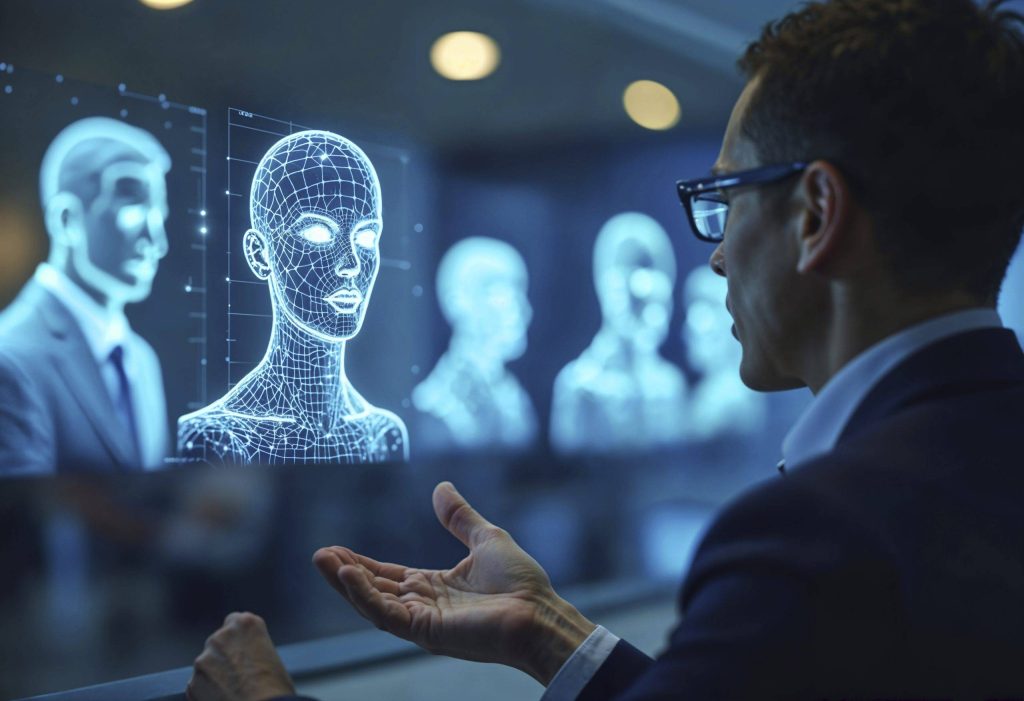

The Short Answer: What AI Actually Does in a Modern Investigation
Artificial intelligence has become the force multiplier of the modern investigation — not its replacement. Elite firms use AI to triage millions of records, scan hours of surveillance footage in minutes, map hidden relationships between people and entities, and flag synthetic media. But every lead is verified by a licensed investigator, and admissibility still turns on human method, documentation, and chain of custody. Speed comes from the machine; credibility comes from the professional.
By Honeybadger Solutions
The romantic image of the private investigator — a lone operator idling in a car for twelve hours — still describes a real part of the work. But it no longer describes the decisive part. The modern investigation is a data problem before it is a field problem. The subject of a fraud inquiry leaves a footprint across thousands of records, dozens of platforms, and years of transactions long before anyone conducts physical surveillance. Whoever can read that footprint faster, more completely, and more defensibly wins the case. That is what artificial intelligence in private investigations has quietly changed, and it is why the gap between world-class firms and everyone else has widened rather than narrowed.
This is a candid account of how AI is genuinely deployed at the elite level — what it accelerates, where it fails, and the ethical and legal guardrails that separate an admissible finding from an expensive liability. It is written for the general counsel, the corporate security director, and the principal who needs to understand the tool before they trust it.
How Is AI Used in Investigations Today?
AI does not conduct investigations. It compresses the parts of an investigation that used to consume the most time, so that trained judgment can be spent where it matters. Five applications now do the heaviest lifting.
OSINT at Scale
Open-source intelligence is the connective tissue of nearly every case. A single subject may surface across social platforms, corporate registries, court dockets, property records, breach data, and the dark web. Manually assembling that picture once took weeks. AI-assisted collection now monitors thousands of sources continuously, clusters mentions of the same entity across aliases and misspellings, and surfaces the handful of results that actually advance the matter. Our intelligence and OSINT services use this capability to build a comprehensive subject profile in hours — then hand it to a human analyst to validate before a single conclusion is drawn.
Video and Surveillance Analytics
Reviewing twenty-four hours of footage for a single event is precisely the kind of task machines do better than people. Object- and behavior-detection models can scan long-form surveillance for defined targets — “person present,” “silver sedan,” “package exchanged” — and reduce review from a full shift to a few minutes of high-probability clips. The investigator still confirms every hit; the model simply removes the empty hours.
Link Analysis and Network Mapping
Financial fraud, asset concealment, and organized-harassment cases are rarely about one person. They are about the network — the shell companies, the intermediaries, the recurring phone numbers and shared addresses that connect ostensibly unrelated parties. AI-driven link analysis ingests transaction records, communication metadata, and corporate filings and renders the relationships as a graph, exposing the central node a human eye would take months to isolate. This is where AI earns its place in complex investigations: it makes the invisible structure visible.
Predictive and Behavioral Risk
In skip tracing and threat work, historical patterns carry signal. Models trained on movement, association, and behavioral data can prioritize where a subject is likely to surface or flag an escalation pattern — a stalker’s tightening cadence, an insider’s anomalous access — before it becomes a crisis. These outputs are leads and probabilities, never verdicts. Treated as a triage layer, they let attorneys, executives, and families act preventatively instead of reactively.
Document and Evidence Triage
Large financial and corporate matters can involve tens of thousands of documents. AI-assisted review classifies, deduplicates, and ranks material by relevance, surfacing the transactions and communications an analyst should examine first. In digital forensics, the same triage narrows a terabyte-scale image to the artifacts that answer the legal question — without altering the evidence itself.
Where AI Helps — and Where a Human Must Decide
The discipline of elite practice is knowing exactly where the machine’s authority ends. The table below maps the division of labor that governs every matter we run.
| Investigative task | What AI accelerates | Where the human decides | Risk if left unmanaged |
|---|---|---|---|
| OSINT collection | Continuous multi-source gathering, entity resolution across aliases | Source reliability, relevance, false-match rejection | Acting on a wrong-person profile or stale data |
| Facial / vehicle recognition | Candidate matches from large image sets | Identity confirmation, context, lighting and demographic error checks | Misidentification; documented accuracy gaps across demographics |
| Deepfake / media authenticity | Detection scoring, artifact and metadata flags | Forensic verification and expert opinion for court | Admitting fabricated or altered evidence |
| Link analysis | Relationship graphs from records and metadata | Interpreting intent, causation, and legal significance | Correlation mistaken for proof |
| Predictive risk | Prioritization and escalation flags | Judgment, proportionality, duty-of-care response | Bias amplification; unjustified action against a person |
Why Are Facial and Vehicle Recognition Not Enough on Their Own?
Recognition technology is powerful and genuinely useful for generating candidates — but it is a lead generator, not an identification. Independent government testing has repeatedly documented that facial-recognition accuracy varies with image quality, angle, and, critically, across demographic groups; the U.S. National Institute of Standards and Technology has published extensive findings on these differentials through its Face Recognition Vendor Test program. A responsible firm treats every algorithmic match as a hypothesis to be confirmed by corroborating evidence — a timeline, a second data point, direct observation — never as a conclusion. The same holds for automated license-plate and vehicle recognition: a probable read on a partially obscured plate in poor light is a starting point for verification, not a fact to be entered into a report. Firms that skip that verification step do not just risk being wrong; they risk being wrong about a real person, with real consequences.

How Does AI Change the Threat — Deepfakes and Synthetic Evidence
The most consequential shift AI brings to investigations is not on the analyst’s side of the table — it is on the adversary’s. Generative tools have made convincing synthetic audio, video, and documents cheap and fast to produce. Fabricated voice notes are used to authorize fraudulent wire transfers; manipulated images surface in custody disputes; forged records appear in insurance and liability claims. U.S. authorities including CISA, the NSA, and the FBI have jointly warned organizations to expect deepfakes as a routine element of fraud and social engineering; see the federal guidance on CISA. For victims of impersonation and financial fraud, the Federal Trade Commission maintains reporting and consumer guidance as well.
This is precisely why forensic verification now matters more, not less, in the AI era. Detecting synthetic media requires analysis of compression artifacts, metadata provenance, sensor-level inconsistencies, and biological plausibility — work that combines detection tooling with the trained eye of a forensic examiner. Our digital forensics team approaches every questioned file as potentially adversarial, authenticating provenance before it is ever relied upon. The rule of the moment is simple: as fabrication gets easier, the burden of proof on authenticity gets heavier.
Is AI-Assisted Evidence Admissible in Court?
An investigation that cannot withstand a courtroom is a report, not evidence. AI complicates admissibility in two ways: the reliability of the method must be defensible, and the chain of custody must be unbroken. Under the federal standard for expert evidence — Federal Rule of Evidence 702 and the Daubert line of cases — a technique’s error rate, testability, and general acceptance all come under scrutiny. A black-box model that produces a match with no explainable basis, no documented error rate, and no reproducible process is an invitation to exclusion.
The disciplines that make AI-derived findings survive challenge are unglamorous and non-negotiable: preserve original evidence without alteration; document every tool, version, and parameter used; ensure a qualified human independently verifies each machine-generated lead; and be able to explain, in plain language, how a conclusion was reached. Firms that automate the analysis but neglect the documentation build cases that collapse under cross-examination. The machine can find the needle; only a rigorous, human-owned process makes it usable in front of a judge.
The Honeybadger Protocol: Deploying AI Responsibly in Seven Steps
World-class results come from governing the tool, not merely owning it. The following framework governs how AI enters every matter we handle, from a single-subject skip trace to a multinational corporate fraud.
- Define the legal question first. The admissibility standard and jurisdiction are set before any tool is chosen, so the method is built to survive challenge from the outset.
- Scope the data lawfully. Collection respects privacy law, platform terms, and licensing; unlawfully gathered data poisons the entire case.
- Automate collection, not conclusions. AI gathers and clusters; it is never permitted to close a finding on its own.
- Verify every lead by hand. A licensed investigator corroborates each machine-generated hit against independent evidence before it advances.
- Preserve the chain of custody. Originals are protected, actions are logged, and every tool and version is documented for the record.
- Test for bias and error. Recognition and predictive outputs are checked against known accuracy limits and demographic differentials before they inform any action.
- Deliver an explainable report. Conclusions are written so a court, a board, or opposing counsel can follow exactly how the firm reached them.
What Does This Mean for Clients Across Arizona and Nationwide?
Honeybadger Solutions is an Arizona-licensed security and investigations firm operating from three offices — our Casa Grande headquarters, Phoenix, and Oro Valley — and serving clients throughout Arizona, nationwide, and internationally. Our digital forensics, cybersecurity, financial investigations, and background-intelligence capabilities are remote-by-design and global in reach, which means the analytical horsepower described here is available to a family in Phoenix, a general counsel in New York, or a principal operating across borders. Whether the matter is a fraud inquiry, an executive-protection threat assessment, or a questioned piece of media, the standard is identical: AI to move faster, human expertise to be right. For clients weighing providers, our guide on how to choose a background-check and investigations service and our digital forensics evidence guide expand on the standards that matter.
Frequently Asked Questions
Will AI replace private investigators?
No. AI replaces the repetitive, high-volume parts of investigative work — collection, triage, and pattern detection — but not the licensed judgment, ethics, and courtroom-defensible method that make a finding usable. The strongest outcomes come from pairing data science with seasoned investigators, not from choosing one over the other.
Can AI reliably detect deepfakes and altered evidence?
Detection tools can flag likely synthetic media, but they are not infallible and the technology on both sides evolves constantly. Reliable authentication combines automated detection with forensic examination of metadata, provenance, and sensor-level artifacts by a qualified examiner — which is what makes a conclusion defensible in court.
Is AI-generated investigative evidence admissible in court?
It can be, when the method is reliable and documented and the chain of custody is intact. Courts scrutinize the technique’s error rate, reproducibility, and explainability under standards such as Federal Rule of Evidence 702. Findings that a human investigator has independently verified and can explain hold up; unexplained black-box outputs generally do not.
How does Honeybadger protect against AI bias and error?
We treat every algorithmic output — a facial match, a predictive flag, an OSINT cluster — as a hypothesis, not a fact. Each is corroborated against independent evidence, checked against known accuracy and demographic limitations, and reviewed by a licensed investigator before it informs any action or appears in a report.
About Honeybadger Solutions
Honeybadger Solutions is an Arizona-licensed security and investigations firm delivering intelligence-grade investigations, digital forensics, cybersecurity, and protective services to clients across Arizona, the nation, and internationally. We operate from three offices — our headquarters in Casa Grande, and locations in Phoenix and Oro Valley — with in-house, remote-by-design capabilities in digital forensics, financial investigation, and background intelligence, supported by a vetted network of field and protective partners. Our practice pairs advanced AI-driven analytics with licensed human expertise so that findings are not only fast, but accurate, ethical, and court-defensible.
Speak with our team confidentially: Book a consultation online. Explore our digital forensics, intelligence, and cybersecurity services, or request a consultation to discuss your matter.
Browse by topic
Security guard services · Private investigations · Cybersecurity · Digital forensics · Financial fraud investigation · Executive protection · All articles