
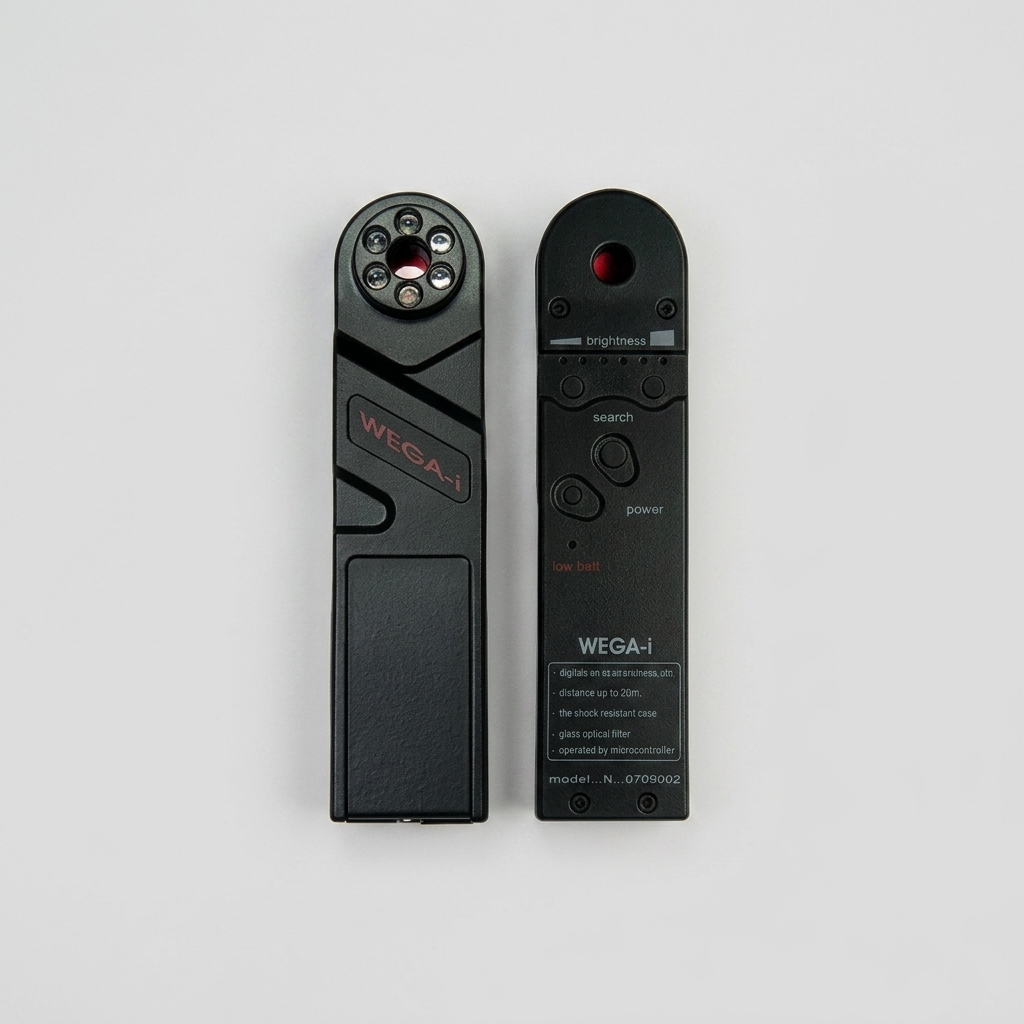
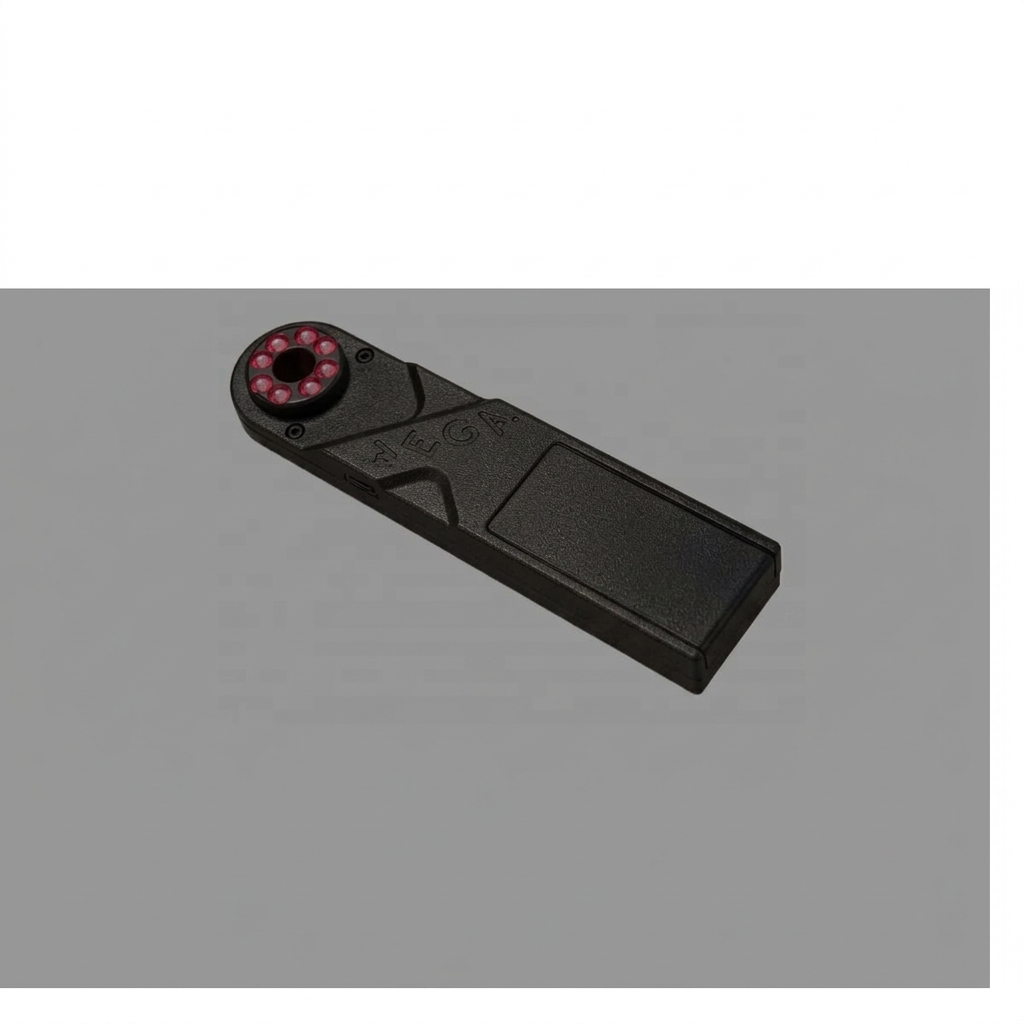
The DD1200 WEGA is the long-range lens finder — detection out to roughly 60 feet, against the 15 to 30 feet typical of pocket units. It is favoured by our government clientele, built into an aluminium housing, and it does one thing that no RF detector can do at any price.
Favored by our govement clientele the DD1200 WEGA is made with a durable aluminuim housing and has the longest range of any lens finder.
- Detection of all types of hidden video cameras not depending on their working state
- Distance of detection between 2 and 10 meters
- IR filter for rejection of natural reflections
- Adjustable brightness with bargraph
- Powered by 2 AAA batteries
- Low battery indicator
- Durable metal case
- Detection distance up to 60 Feet
The property that makes a lens finder indispensable
A lens finder works on retroreflection: light from the unit enters a camera lens, reflects off the sensor and returns straight to its source as a hard bright point. The consequence is the important part — it detects cameras regardless of their working state. Powered off, recording silently to an internal card, dormant and waiting on a timer: none of it matters, because a lens is a lens.
That is precisely the class of device an RF detector cannot see. A camera that transmits nothing is invisible to any amount of spectrum analysis, and card-recording cameras are extremely common. Optical detection is not an alternative to RF sweeping; it is the half of the problem RF cannot reach.
Where the range and the IR filter earn the price
Detection between 2 and 10 metres, up to about 60 feet, changes what you can sweep. A 15-foot pocket finder means working a large room in overlapping sections from close range; at 60 feet you clear a conference room, a warehouse bay, a church hall or an auditorium from a handful of standing positions. On a professional sweep, that is the difference between an hour and ten minutes.
The IR filter is the feature that separates a professional unit from a consumer one. Glass, polished trim, screw heads, small mirrors and glossy plastic all throw back reflections that look like hits, and on a cheap finder you chase every one. The filter rejects natural reflections so what remains is far more likely to be an actual lens — fewer false positives is what makes a long sweep tolerable.
The adjustable brightness with bargraph lets you tune output to the room. Too much light in a small dark space washes out the very contrast you are looking for; dialling it down sharpens the return.
Sweeping properly
Kill the lights and close the blinds — the retroreflection is bright but it needs contrast. You must be roughly in the camera’s line of sight for the reflection to return, so scan from the positions a camera would plausibly be watching: from the bed, from the chair, from the doorway. Work a grid, one wall at a time, floor to ceiling, and pay particular attention to anything at seated eye level facing a bed, a desk or a doorway. Smoke detectors, alarm clocks, USB chargers, air purifiers and picture frames are the usual housings.
A real lens reflection is sharp, stays bright across a narrow angle, and does not smear as you move. Learning that difference takes about one room.
If you find one
Do not unplug it and do not handle it further. It is potential evidence and how it was preserved will matter. Photograph it in place, note the time, and call. Powered by two AAA batteries with a low-battery indicator, in a durable metal case.
See also camera and lens finders, RF and GPS detection, or have us run the sweep — TSCM services.
More in this category
- DD1216 Pro 3 Band RF Detector and Spy Finder Pro
- DD1216 Elite 3 Band RF Detection and Wega Camera Finder
- DD1206 Elite RF Signal and Hidden Camera Detector
- DD1207 Pro Multi-Channel Detector + Spy Finder
Browse all Hidden Camera Detectors →


Reviews
There are no reviews yet.