Hidden Camera Detectors
Hidden camera detectors work on one of two physical principles, and most people buy the wrong one because the listings do not explain the difference.
Optical lens finders
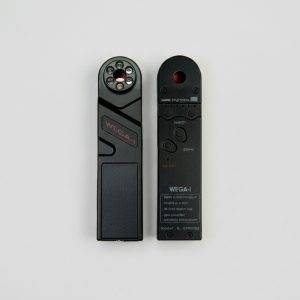
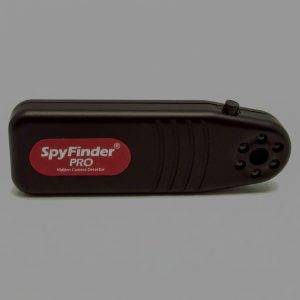
A lens finder surrounds a viewfinder with bright LEDs. Any lens pointed back at you reflects that light straight to its source — the retroreflection effect — and shows up as a hard bright point when you scan the room through the eyepiece. The Spy Finder Pro and PRO Camera Finder work this way. The critical advantage: this finds a camera whether it is powered on, powered off, transmitting or recording to a local card. A lens is a lens. Nothing else in counter-surveillance has that property.
The limits are honest ones. You have to be roughly in the camera’s line of sight for the reflection to come back, which means scanning slowly and from the positions a camera would actually be watching. Glass, polished trim, screw heads and small mirrors all produce false positives until your eye learns the difference — a real lens reflection is sharper, stays bright across a narrow angle, and does not smear as you move.
RF detectors and combination units
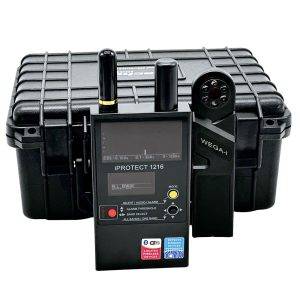
An RF detector finds the transmission rather than the optics, so it catches a wireless camera streaming to a phone or recorder elsewhere — but it is blind to any camera that stores to an SD card and transmits nothing. The DD1206, DD1207, DD1216 Pro and DD1216 Elite combine both: multi-band RF detection plus an optical finder in one unit. That combination is what a professional carries, because either method alone leaves a category of device undetected.
Multi-band matters more than raw sensitivity. Devices now sit on 2.4 and 5 GHz Wi-Fi, Bluetooth, and cellular bands including 5G. A single-band detector from a few years ago simply does not see much of what is sold today.
How to sweep a room properly
Kill the room lights and close the blinds — the optical scan depends on contrast. Work a grid rather than wandering: one wall at a time, floor to ceiling, and pay attention to anything at seated eye level facing a bed, a desk or a doorway. Smoke detectors, alarm clocks, USB chargers, air purifiers and picture frames are the usual housings. Then run the RF pass with your own phone and Wi-Fi switched off, so you are not chasing your own signal.
When to stop and call someone
If you find a device, do not unplug it and do not handle it any more than you already have. It is potential evidence, and how it was preserved will matter. Photograph it in place and call us. If you have a specific reason to believe a space is compromised and a consumer sweep comes up empty, that is exactly the point at which professional TSCM earns its cost — the equipment and the methodology are both a step beyond what a handheld unit can do. See also RF and GPS bug detection, or book a consultation to talk through what you are seeing.
Showing all 6 results
-
Counter-Surveillance & TSCM
DD1216 Elite 3 Band RF Detection and Wega Camera Finder
$1,529.99 Add to cart