


Most facilities that call themselves “security-assessed” have only ever been walked by an insurance adjuster or a well-meaning operations manager with a clipboard. That is a site audit, not an assessment, and the difference matters the day something goes wrong. A genuine physical security assessment is a structured, evidence-based discipline: it scores threat, vulnerability, and consequence; validates those scores on foot, room by room and door by door; benchmarks the built environment against recognized design principles; and converts the findings into a funded, sequenced roadmap rather than a list of vague suggestions.
A physical security assessment is a structured evaluation that scores Threat, Vulnerability, and Consequence (TVC) for a facility, validates those scores through an on-site walk-through survey, benchmarks the built environment against Crime Prevention Through Environmental Design (CPTED) principles, and produces a prioritized, cost-ranked remediation roadmap with a defined re-assessment cadence. It is a repeatable methodology, not a one-time checklist.
This is a methodology masterclass — the actual mechanics of how an assessment is scoped, scored, surveyed, and delivered. If you are looking for a broader view of advisory engagements, program design, and executive briefings, our security consulting practice covers that ground; this piece stays inside the assessment itself. Honeybadger Solutions performs this exact process for clients across Arizona and nationwide, from single-tenant headquarters to multi-building industrial and healthcare campuses.
What separates a physical security assessment from a walk-around site audit?
A site audit checks boxes: is there a camera at the loading dock, yes or no. An assessment asks a harder set of questions: who is likely to target this facility, what specifically lets them succeed, what happens if they do, and how much does it cost to close that gap relative to the risk it removes. The output of an audit is a pass/fail list. The output of a real assessment is a risk-ranked, cost-weighted roadmap that a facilities director, general counsel, and CFO can all act on from the same document.
That distinction is not academic. Boards, insurers, and courts increasingly ask facility owners to demonstrate a defensible security process after an incident — not just that cameras existed, but that risk was identified, prioritized, and addressed on a reasonable timeline. A checklist protects no one in that conversation. A documented TVC methodology, survey record, and roadmap does.
The Threat-Vulnerability-Consequence (TVC) model: how elite assessors actually score risk
Every credible assessment methodology, from federal critical-infrastructure guidance to private-sector ASIS International standards, reduces to the same three variables scored independently and then combined:
- Threat — who or what could target the facility, and how capable and motivated are they? Sourced from local crime statistics, industry incident data, workplace-violence history, prior claims, activist or protest exposure, and the facility’s own profile (cash on-site, high-value inventory, litigation history, controversial tenants).
- Vulnerability — what specific physical, procedural, or technological weaknesses let a threat succeed? This is where the walk-through survey does its work: a gap in the fence line, a propped fire door, an unmonitored loading dock, a visitor policy nobody enforces.
- Consequence — if the threat exploits the vulnerability, what is the actual impact? Life safety always ranks first, followed by operational downtime, regulatory exposure, reputational damage, and loss of intellectual property or high-value assets.
Each variable is scored on a simple 1–5 scale by trained assessors, then combined into a composite priority. The value of the model is not the arithmetic — it is that it forces every finding to answer three separate questions instead of collapsing everything into a single gut-feel “high/medium/low” that no two reviewers would score the same way.
| Priority tier | Composite TVC score | Representative finding | Required action window |
|---|---|---|---|
| Critical | 20–25 | Unsecured server room door, no access log, high-value data on-site | Immediate — 0 to 30 days |
| High | 15–19 | Perimeter gate left unlocked outside monitored hours | 30 to 90 days |
| Moderate | 9–14 | CCTV coverage gap at a secondary entrance, low foot traffic | 90 to 180 days |
| Low | 4–8 | Faded signage on a rarely-used emergency exit | Next capital or maintenance cycle |
| Minimal | 1–3 | Cosmetic lighting inconsistency with no access-control function | Monitor; no scheduled action |
This is the scoring backbone that every finding in the survey below gets run through before it ever reaches the roadmap.
Inside the walk-through survey: what a rigorous on-site assessment actually covers
The walk-through survey is where the TVC model meets concrete, glass, and steel. A serious assessor does not tour a facility once at 10 a.m. on a Tuesday and call it complete — coverage is tested at multiple times of day, including after hours and during shift changes, because that is precisely when procedural discipline erodes. The survey is organized in zones, moving from the outside in:
Zone 1: Perimeter and approach
Property line, fencing height and condition, vehicle and pedestrian approach routes, standoff distance from parking to the building envelope, exterior lighting uniformity (not just brightness — dark-to-light contrast ratios are what actually create blind spots), and natural surveillance lines from the street and neighboring properties.
Zone 2: Building envelope and access points
Every door, dock, window, and roof access is inventoried — not just the front entrance. Assessors specifically test for the two most common real-world failures: doors propped for convenience and tailgating tolerance at badge-controlled entries. Visitor management, delivery and loading-dock protocols, and mailroom screening are reviewed here.
Zone 3: Interior zoning and critical assets
Not every square foot deserves equal protection. This zone maps interior areas by sensitivity — server rooms, executive suites, cash-handling areas, R&D labs, pharmacy vaults — and checks whether the layered controls around them actually match that sensitivity, or whether a supply closet is guarded better than the data center next to it.
Zone 4: Technology and cyber-physical convergence
CCTV coverage, camera resolution and retention period, alarm and intrusion-detection functionality, access-control system logs and default-credential hygiene, and — increasingly the overlooked gap — whether the badge and camera network sits on a segmented network or is exposed on the same infrastructure as corporate IT.
Zone 5: Security force posture and procedure
Guard post orders, patrol patterns and predictability, shift-change discipline, incident-reporting practice, and — the part most audits skip entirely — whether written policy matches observed behavior. A beautifully written post order that no officer actually follows is a paper vulnerability disguised as a control.
- Confirm the property line and fence integrity end to end, not just at the main gate.
- Walk every vehicle and pedestrian approach at both daylight and after-dark hours.
- Measure lighting uniformity, not just fixture count.
- Inventory every door, dock, window, and roof access point — no exceptions.
- Test tailgating tolerance at each badge-controlled entry.
- Map interior zones by asset sensitivity, not by floor plan convenience.
- Audit CCTV coverage, resolution, and retention against actual incident-response needs.
- Review access-control logs for stale credentials and unassigned badges.
- Verify guard post orders against observed, real-time behavior.
- Confirm alarm and intrusion-detection response times against the monitoring contract.
- Check emergency egress, lockdown procedure, and life-safety code compliance.
- Interview facilities and security staff to surface the gaps no document reveals.
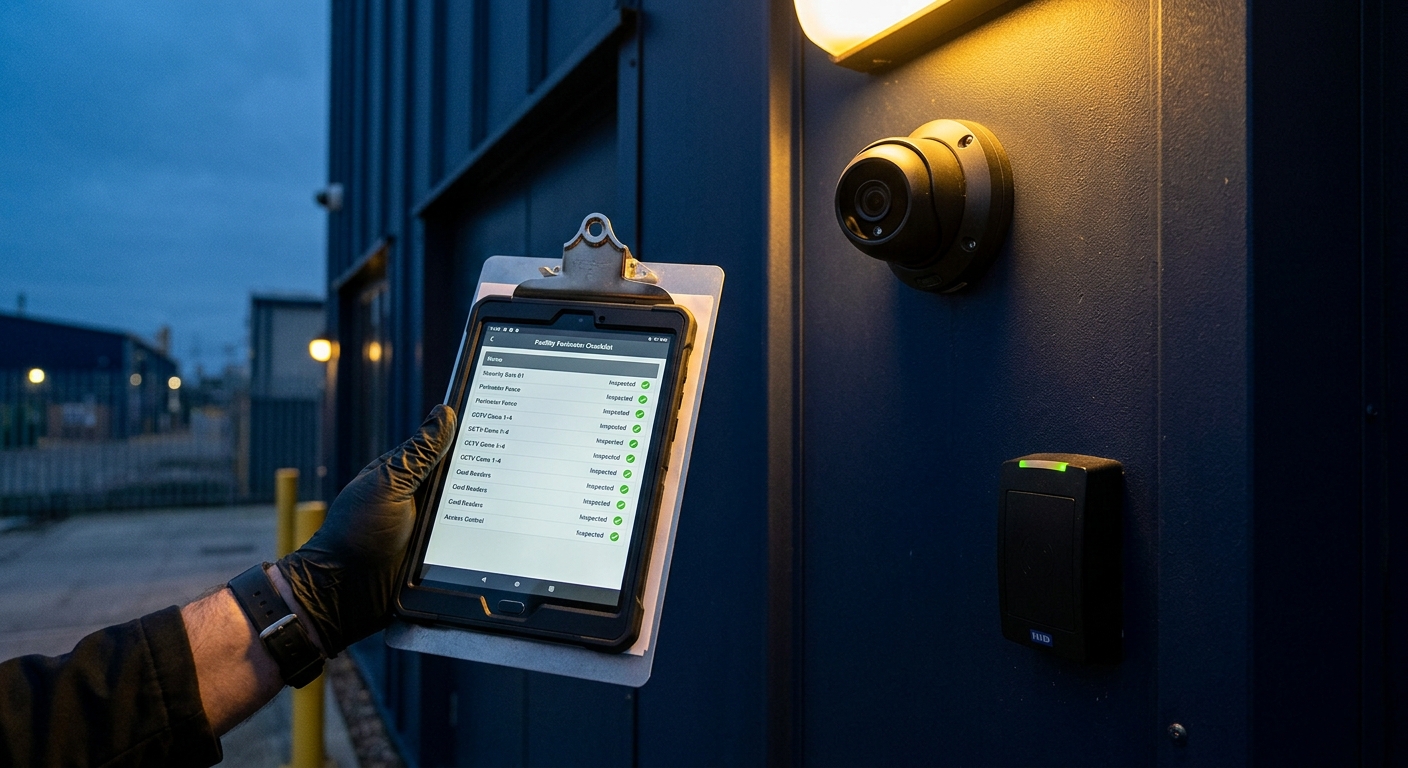
CPTED: designing facilities that deter threats before they reach the door
Crime Prevention Through Environmental Design (CPTED) is the framework that separates a facility built to invite compliance with the fewest guards and cameras from one that simply piles hardware onto a poorly designed space. CPTED rests on four principles, and a competent assessor scores each one independently during the walk-through:
- Natural surveillance — can legitimate occupants see, and be seen, throughout the property? Trimmed landscaping below window-sill height, unobstructed sightlines from reception, and windows facing parking areas all extend the eyes of ordinary people into a security control, for free.
- Natural access control — does the physical layout itself funnel visitors toward a single, monitored entry, or does the design leave five ambiguous ways into the building? Landscaping, bollards, and signage should guide behavior before a guard or badge reader ever has to intervene.
- Territorial reinforcement — do clear ownership cues (fencing, signage, pavement changes, defined property boundaries) signal that a space is watched and cared for, discouraging the casual trespasser who is testing the waters?
- Maintenance and management — the broken-windows principle applied to facilities: burned-out lights, graffiti, and litter left unaddressed signal that no one is paying attention, which lowers the perceived risk of offending for everyone who notices.
CPTED findings often produce the highest return on investment in the entire assessment because the fixes — hedge trimming, a repositioned reception desk, a repainted curb line — cost a fraction of a camera system and reduce risk at the design layer rather than the reactive layer.
Layered controls: why world-class facilities build depth, not a single perimeter
No single control — a fence, a camera, a guard — stops a determined adversary on its own. Elite assessments score a facility against the full deter-detect-delay-respond-recover model, because the most common catastrophic failure in physical security is not the absence of any control, but a facility that invested heavily in one layer while leaving the others empty.
| Layer | Objective | Example controls | Common failure mode |
|---|---|---|---|
| Deter | Discourage the attempt before it starts | Fencing, lighting, signage, visible patrols, CPTED design | Confused with actual protection; deterrence alone stops only opportunists |
| Detect | Identify the intrusion as early as possible | CCTV, intrusion alarms, access-control alerts, guard observation | Cameras recording but unmonitored in real time |
| Delay | Slow the adversary long enough for a response | Reinforced doors, mantraps, layered access zones, safes | Delay engineered for burglary but not for an insider with valid credentials |
| Respond | Get a capable response to the point of intrusion | Guard force, law-enforcement liaison, alarm monitoring SLAs | Response time never actually measured or tested |
| Recover | Restore operations and preserve evidence | Incident-response plan, backup systems, chain-of-custody protocol | No documented plan until the day it’s needed |
The assessment’s job is to identify exactly where the layers are thin — and, just as importantly, where a facility has over-invested in one layer at the expense of the others.
From findings to funding: building the prioritized remediation roadmap
A pile of findings is not a deliverable — it is raw material. The roadmap is what turns scored findings into a document a CFO will actually approve. Every finding is placed into one of four phases based on its TVC priority tier and its cost-to-remediate:
- Immediate (0–30 days): Critical, low-cost fixes — re-locking a gate, disabling a stale badge, repositioning a camera. No capital approval required.
- Short-term (31–90 days): High-priority items needing minor procurement or vendor scheduling — additional lighting, updated post orders, access-control firmware updates.
- Mid-term (91–365 days): Moderate-priority items requiring budget cycles — CCTV expansion, door hardware upgrades, guard-force restructuring.
- Capital cycle (12+ months): Structural or design-level changes — perimeter redesign, new access-control platform, building-envelope hardening — bundled into the facility’s normal capital planning.
Each roadmap line carries the TVC score, the estimated cost, the risk reduction expected, and an accountable owner. That format is what lets a facilities director defend the budget in the same meeting where a general counsel is assessing liability exposure — everyone is reading the same risk language.
What separates a world-class assessment from a box-checking audit?
Four things consistently distinguish an elite assessment from a vendor walkthrough that ends in a sales pitch for more cameras:
Credentialed, adversarial-minded assessors. Look for board certifications such as ASIS International’s Certified Protection Professional (CPP) or Physical Security Professional (PSP) — credentials that require demonstrated methodology, not just years on the job. The best assessors think like an adversary during the walk-through, actively testing tailgating tolerance and door discipline rather than passively observing.
Calibration against real incident data. A generic checklist applies the same twenty items to a bank branch and a warehouse. A real assessment calibrates threat scoring against the facility’s own claims history, local crime data, and industry-specific incident patterns — a data center’s threat profile is not a retail storefront’s.
Defensible documentation. The final report needs to survive scrutiny from an insurer, opposing counsel, or a board audit committee — which means every finding traces back to a specific observation, a specific score, and a specific citation, not an assessor’s unsupported opinion.
Cost drivers scaled to the engagement. Pricing is driven primarily by facility size and complexity, number of sites, asset sensitivity (a standard office versus a pharmaceutical vault or a data center), and whether the scope includes covert testing — such as tailgating attempts or social-engineering probes of the front desk — layered on top of the standard walk-through survey.
How often should a facility be reassessed — and what triggers an off-cycle review?
A baseline assessment is not a one-time event. For higher-risk facilities — data centers, healthcare, financial services, critical infrastructure — an annual reassessment is the sound default. Lower-risk office and light-industrial sites can often run on a 24- to 36-month cycle. But calendar cadence alone is not enough; several events should trigger an off-cycle review regardless of where the facility sits in its normal schedule:
- A security incident or a documented near-miss at the facility.
- Leadership, tenant, or floor-plan change — a new executive suite, a new high-value tenant, or a reconfigured loading dock.
- Merger, acquisition, or new-site onboarding into the security program.
- A shift in the local threat landscape — civil unrest, a documented activist campaign, or a workplace-violence trend in the sector.
- Post-remediation validation, to confirm a prior critical or high finding was actually closed and not just marked closed.
- An insurance or regulatory requirement tied to a policy renewal or compliance audit.
Facilities that treat the assessment as a living document — updated on cadence and after triggering events — consistently outperform those that treat it as a one-time deliverable filed away after the walkthrough.
Arizona facilities, nationwide reach: how Honeybadger delivers this assessment
Across Arizona, our own in-house, state-licensed assessors run the full TVC scoring, walk-through survey, and CPTED evaluation on-site — from our Casa Grande headquarters through the Phoenix and Oro Valley metro areas — with no subcontracted middlemen between the client and the assessor standing in the building. Findings feed directly into recommendations for our own licensed guard force and patrol deployments where the roadmap calls for staffed control, and into venue-advance work for executive protection assignments where a principal’s residence or travel itinerary is in scope.
Outside Arizona, the same TVC methodology and roadmap format apply, with on-site survey work commanded through our vetted field-partner network in established theaters — currently California, Texas, and Florida — and extending to additional states as engagements require. Every partner-delivered survey is held to the same scoring rigor and documentation standard set at our home command in Arizona, so a multi-state client receives one consistent risk language across every site.
Representative scenario, not a specific client or outcome: a mid-market logistics operator with a single Arizona distribution center commissions an assessment after a theft at a competitor’s facility down the road. The walk-through survey finds a loading-dock door regularly propped for airflow during shift changes — a Critical-tier finding under the TVC model, closed within a week at near-zero cost — alongside a Moderate-tier CPTED gap in exterior lighting uniformity that gets folded into the facility’s next capital cycle. The roadmap gives ownership a single document to brief both operations and the insurer.
Frequently asked questions
How long does a physical security assessment take?
A single-site walk-through survey and TVC scoring typically runs one to three days on-site, with the full report, CPTED analysis, and prioritized roadmap delivered within two to three weeks. Multi-site or multi-building campuses, or engagements that add covert testing such as tailgating probes, extend that timeline proportionally.
How is a physical security assessment different from a general security consulting engagement?
A physical security assessment is a specific, bounded methodology: score threat, vulnerability, and consequence; validate on-site; benchmark against CPTED; deliver a roadmap. Broader security consulting can include program design, policy development, staffing models, and board-level advisory work — the assessment is often the fact-finding engagement that a larger consulting program is built on top of.
Do we need a penetration test in addition to the walk-through survey?
Not always. A standard survey observes and tests controls without actively attempting to defeat them. A physical penetration test — attempted tailgating, badge cloning attempts, or social-engineering probes of front-desk staff — is a heavier, higher-value add-on best reserved for high-consequence facilities such as data centers, financial institutions, or sites holding regulated or classified material.
What does a physical security assessment cost?
Cost scales with facility size and complexity, the number of sites, asset sensitivity, and whether covert testing is added to the standard survey. A single mid-size commercial site runs meaningfully less than a multi-building campus or a facility housing regulated data, but every engagement is scoped and quoted against the specific site rather than a flat rate — request a scoped quote for an accurate number.
About Honeybadger Solutions
Honeybadger Solutions is an Arizona-licensed security and investigations firm delivering physical security assessments, CPTED-based facility reviews, and licensed guard and patrol services to clients across Arizona and nationwide. Our assessors operate in-house and are directly credentialed for the Arizona jurisdiction, with fieldwork outside Arizona commanded through a vetted, standards-controlled partner network. We maintain three Arizona offices — Casa Grande (HQ), Phoenix, and Oro Valley — and serve all of Arizona, nationwide, and abroad. Discreet consultations: Book a consultation online. Learn more about our security consulting practice or request a scoped assessment today.
Authoritative references: ASIS International — Physical Security Standards & Guidelines and the Cybersecurity & Infrastructure Security Agency (CISA) — Critical Infrastructure Security and Resilience.
Working with a professional: our team performs security assessments for Arizona businesses — walk-through, systems review, procedures, and a prioritized written report you can act on.
Browse by topic
Security guard services · Private investigations · Cybersecurity · Digital forensics · Financial fraud investigation · Executive protection · All articles