

Honeybadger Solutions provides in-house digital forensics for Mesa, Arizona businesses, litigants, and families — recovering and authenticating evidence from phones, cloud accounts, aerospace and manufacturing systems, and medical and point-of-sale records for litigation, corporate fraud, employment, and family law matters. Every examination is forensically imaged, hash-verified, and carried under a documented chain of custody built to withstand challenge in Maricopa County Superior Court or federal court. Our nearest office, Phoenix, sits roughly 25 minutes west via US-60, with our Casa Grande headquarters about 50 minutes south.
Mesa is Arizona’s third-largest city and a distinct East Valley economic center in Maricopa County, not a Phoenix suburb in any functional sense. It carries an aerospace and defense-manufacturing base anchored by Boeing’s helicopter final-assembly plant and MD Helicopters’ headquarters near Falcon Field Airport, a fast-growing hyperscale data-center corridor along Elliot Road east of Signal Butte Road, a major hospital corridor built around Banner Desert Medical Center and Cardon Children’s Medical Center, and a stadium-scale spring-training and retail economy around Sloan Park and the Riverview district. Each of those environments produces its own flavor of digital-evidence problem, and a forensic partner who only understands generic “computer crime” misses most of what actually shows up on a Mesa engagement.
What makes Mesa’s digital-evidence landscape distinct?
Mesa’s east side runs on aerospace and technology. Falcon Field Airport anchors a cluster of aviation and defense-adjacent manufacturers, most visibly Boeing’s helicopter plant, which finishes AH-64 Apache airframes, and MD Helicopters, headquartered a short distance away. Contractors and suppliers in that corridor routinely carry export-control and background-vetting obligations, which raises the stakes on any suspected data leak or departing-employee incident. A few miles south, the Elliot Road Technology Corridor has become one of the busiest hyperscale data-center footprints in the Southwest, anchored by large-scale cloud and social-platform operators, drawing a dense ecosystem of construction, facilities, and IT-services vendors whose own disputes — contractor data theft, subcontractor billing fraud, vendor incident response — generate real forensic work even though the hyperscale operators themselves are not our clients.
Central and south Mesa run a different pattern. The city’s historic downtown, Mesa Community College, and ASU’s Polytechnic campus sit alongside a large residential base spanning master-planned communities toward Eastmark and Las Sendas, and a retirement and active-adult population concentrated in neighborhoods such as Dobson Ranch and Leisure World. Banner Desert Medical Center and Cardon Children’s Medical Center, along the Southern Avenue corridor, anchor a hospital and outpatient system that raises its own healthcare-adjacent forensic questions. And Sloan Park, the Chicago Cubs’ spring-training home, plus the Riverview retail and entertainment district along Loop 202, generate a stadium-scale, event-driven retail economy with its own fraud fingerprint. That mix — aerospace and defense manufacturing, a hyperscale tech corridor, a major hospital system, and an event-driven retail district — means Mesa forensic engagements skew toward departing-employee and trade-secret theft near Falcon Field and the tech corridor, vendor and subcontractor disputes tied to the data-center build-out, healthcare-adjacent data incidents around the Banner corridor, and event and retail fraud around Riverview and Sloan Park, on top of the routine volume of Maricopa County family law matters this population produces.
How does forensic evidence hold up in Maricopa County courts?
Arizona courts evaluate expert and forensic testimony under Arizona Rule of Evidence 702, which mirrors the federal Daubert standard: the expert must be qualified, the methodology reliable and testable, and the analysis reliably applied to the case’s facts. Mesa disputes that proceed to litigation are typically filed in Maricopa County Superior Court, and matters that cross state or federal lines — common given the number of national aerospace and technology employers operating in the city — can land in the U.S. District Court for the District of Arizona, where Federal Rule of Evidence 702 controls.
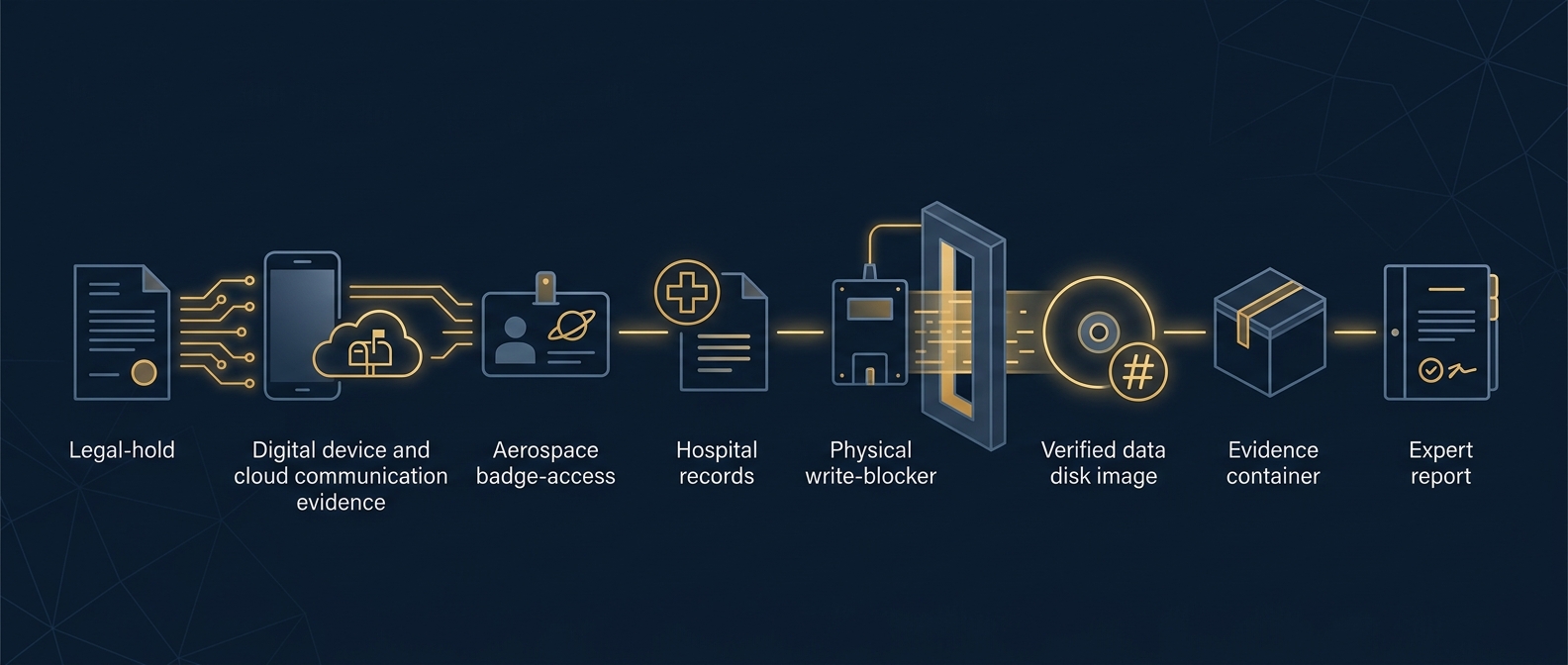
Both standards reward the same discipline: a bit-for-bit forensic image captured through a write-blocker, a cryptographic hash generated at collection and re-verified at every handoff, and a chain-of-custody log without a gap. Under Federal Rule of Evidence 902(14), a properly hashed copy of electronic data can self-authenticate, closing off a common line of attack. What actually loses Mesa cases is rarely the underlying conduct; it is a device that was powered on and browsed, a hash that was never recorded, or a custody log with a missing entry.
What evidence sources matter most in a Mesa matter?
| Source | What it typically yields | Mesa wrinkle |
|---|---|---|
| Mobile devices (BYOD) | Texts, call logs, location history, app data, deleted content | Off-channel coordination in departing-engineer and vendor-kickback cases near Falcon Field and the tech corridor |
| Cloud tenancies (M365, Google Workspace) | Mail, files, chat, access and audit logs | Aerospace and data-center subcontractors often run thin IT, so audit logs can roll off within days |
| Badge / access-control logs | Entry and exit timestamps, escort records | Central to export-control-adjacent investigations for contractors near Falcon Field and Boeing’s campus |
| Point-of-sale / ticketing systems | Transaction logs, refund and comp records, vendor-payment data | Spring-training and Riverview event surges can mask irregular refund and chargeback activity |
| Healthcare practice-management systems | Scheduling, billing, and access records | Relevant to Banner Desert / Cardon Children’s corridor billing-fraud and unauthorized-access matters |
| Financial and banking records | Wire trails, ACH, ledgers, vendor master files | Ties electronic activity to the actual flow of funds in embezzlement and vendor-fraud matters |
No single source tells the whole story. A recovered message is corroborated by a cloud provider’s access log, a badge record, or a point-of-sale timestamp, which is why an examiner who can work mobile, cloud, and business-system data under one roof builds a far more defensible timeline than a vendor limited to a single layer.
How does trade-secret and departing-employee forensics work in Mesa’s aerospace corridor?
Aerospace and defense-adjacent employers near Falcon Field guard engineering drawings, supplier lists, and program data that carry real commercial value and, frequently, export-control sensitivity. When an engineer or program manager departs for a competitor, the forensic question is almost always the same: what left the organization, through what channel, and when. Analysis typically correlates USB device-connection artifacts, personal cloud-sync activity, email forwarding rules, and badge or VPN access logs to reconstruct a defensible timeline of data movement in the weeks before a resignation. Because export-control and background-vetting obligations often apply in this corridor, this work pairs directly with our background intelligence and vetting capabilities for organizations that need both the forensic answer and the personnel-risk picture.
What about the Elliot Road Technology Corridor and East Valley data-center vendors?
Mesa’s hyperscale data-center build-out runs on a deep layer of construction, facilities-management, and IT-services subcontractors, and disputes inside that ecosystem are common even though the operators themselves are not the parties involved. Vendor billing fraud, contractor data theft, and incident-response engagements for smaller technology firms serving the corridor turn on the same evidence sources as any corporate matter: cloud tenancy logs, financial and vendor-master records, and device forensics, collected and hashed to a standard that will hold up if the dispute escalates to litigation.
How does event and retail fraud around Riverview and Sloan Park get investigated?
Sloan Park and the Riverview retail and entertainment district turn Mesa into an event city each spring and on recurring event weekends — Cactus League games, concerts, and the retail and restaurant surge that follows every one of them. That volume creates recurring fraud patterns: refund and chargeback abuse at concessions and retail kiosks, vendor overbilling for event-day staffing, ticket-resale manipulation, and insurance claims tied to event-related incidents. Each of these lives in point-of-sale logs, ticketing-platform data, and vendor-payment records that are typically retained for a limited operational window before being purged or overwritten. Our approach treats event-cycle data as perishable from day one: a legal hold and preservation request should go out to the venue, ticketing platform, or payment processor as soon as an irregularity is suspected, not after the next home stand has already overwritten the relevant window.
Healthcare-adjacent data questions in the Banner medical corridor
The Southern Avenue corridor’s concentration of medical offices, Banner Desert Medical Center, and Cardon Children’s Medical Center creates a healthcare-adjacent forensic need distinct from retail or aerospace work: suspected unauthorized access to patient scheduling or billing systems, departing-employee data exfiltration from a practice-management platform, or insurance billing-fraud investigations. These engagements require an examiner who understands both standard forensic methodology and the heightened sensitivity of records that may intersect with HIPAA-covered systems, coordinating closely with the practice’s own compliance and legal counsel rather than operating in isolation.
How does digital forensics support Mesa family law matters?
Mesa’s large suburban population in neighborhoods such as Dobson Ranch, Las Sendas, and Eastmark produces a steady volume of Maricopa County family law matters where text messages, social media, location history, and shared financial accounts become central evidence in custody and divorce disputes. Authenticity matters enormously here: a screenshot presented without metadata or provenance is easy for opposing counsel to challenge, while a forensically extracted and hash-verified message thread, timestamped and tied to the originating account, is far harder to dispute. Because these matters are personal and often high-conflict, discretion is as important as technical rigor; our examiners work at the direction of counsel, document methodology precisely enough to survive cross-examination, and never overstate what the data shows.
How do you preserve evidence before it disappears?
The single most common reason a strong Mesa case falls apart is not the underlying conduct; it is a failure to preserve electronic proof before it is overwritten, auto-deleted, or wiped. The sequence below reflects how we approach every Mesa matter, whether the trigger is a suspected departing-engineer theft, a data-center vendor dispute, an event-day fraud, or a family law filing.
- Recognize the trigger early. The duty to preserve attaches once litigation, an internal investigation, or a regulatory question is reasonably anticipated, not when a complaint is formally filed.
- Issue a written legal hold. Notify every relevant custodian and system owner, and suspend auto-deletion, retention purges, and routine device resets.
- Map the data landscape. Identify every device, cloud tenant, badge/access system, and point-of-sale or ticketing system that may hold relevant evidence.
- Confirm lawful authority to collect. Verify the right to access each source, particularly personal devices and shared family accounts.
- Preserve perishable sources first. Prioritize phones, chat platforms, and event-cycle system data that may be overwritten or reset within days.
- Acquire forensically. Capture a bit-for-bit image through a write-blocker; never operate directly on an original device or live account.
- Hash and verify. Record the cryptographic hash at acquisition and confirm it matches at every subsequent handoff.
- Document the chain of custody. Log every person who touched the evidence, when, and why, with no unexplained gap.
- Analyze and correlate. Cross-reference device, cloud, financial, and system data into one coherent, defensible timeline.
- Prepare for testimony. Maintain contemporaneous notes and a reproducible methodology from the first hour of the engagement.
How does Honeybadger deliver digital forensics to Mesa?
Honeybadger Solutions runs digital forensics in-house, statewide and nationwide, so the same accountable team that scopes a Mesa matter carries it through legal hold, preservation, acquisition, analysis, and reporting under a single chain of custody. We are not a referral desk that hands your case to a subcontracted lab; our examiners, equipment, and command structure sit inside our own three Arizona offices — Casa Grande (headquarters), Phoenix, and Oro Valley — with Phoenix anchoring coverage for Mesa and the wider East Valley. That same in-house command also runs our security and investigations practices, so a Mesa client facing a physical incident, an employee-theft case, or a background-vetting need can escalate without changing vendors. See our Arizona security guard services for our physical-security capability, and our Mesa security guard services for coverage in the East Valley market.
Frequently asked questions
Does Honeybadger have an office near Mesa, Arizona?
Our nearest office to Mesa is Phoenix, roughly a 25-minute drive west via US-60, and our Casa Grande headquarters is about 50 minutes south. Because our digital forensics laboratory is in-house and remote-by-design, most preservation, acquisition, and analysis work does not require an on-site visit, and we coordinate any needed local steps, such as device pickups or interviews, directly through our Phoenix team.
Can you recover deleted texts, emails, or aerospace design files after a suspected departing-employee incident?
Often, yes, if action is taken before the data is overwritten. Deleted messages, files, and design or CAD data frequently persist in device storage, cloud backups, or system journals until they are reclaimed by ordinary use. Recovery is performed through validated forensic tools on a bit-for-bit image, never by bypassing security or improperly accessing an account, and the sooner a source is forensically preserved, the more can typically be recovered.
What court standard applies to digital evidence in Mesa and Maricopa County matters?
Arizona courts, including Maricopa County Superior Court, evaluate expert and forensic testimony under Arizona Rule of Evidence 702, aligned with the federal Daubert standard requiring a qualified expert, a reliable and testable methodology, and a reliable application to the facts. Matters that proceed federally fall under the U.S. District Court for the District of Arizona and the same Daubert framework via Federal Rule of Evidence 702.
Do you handle family law digital evidence in Mesa custody and divorce cases?
Yes. We forensically extract and authenticate text messages, social media content, location data, and shared financial account records for Maricopa County family law matters, working at the direction of counsel with a documented chain of custody so the evidence can withstand a challenge to its authenticity in court.
About Honeybadger Solutions
Honeybadger Solutions is an Arizona-licensed security and investigations firm serving Mesa and the greater Phoenix metro. Digital forensics, cybersecurity, financial investigations, and background intelligence are run in-house from our own Arizona laboratory and delivered statewide, nationwide, and internationally. In Arizona, our uniformed security officers and investigators are our own in-house, licensed personnel.
Offices: Casa Grande (HQ), Phoenix, and Oro Valley, Arizona.
Phone: Book a consultation online
Confidential consultation: speak with our command team about a Mesa digital forensics, fraud, or evidence-preservation matter.
Related Mesa digital forensics resources
Honeybadger handles every Mesa digital forensics case with one court-ready, in-house Arizona lab—no evidence is shipped to a third-party subcontractor. You can also reach Honeybadger in Mesa, Arizona for local, in-person coordination. When a matter needs field investigation as well, our examiners coordinate with Mesa private investigations & surveillance. Businesses and counsel in nearby cities engage our digital forensics services in Chandler. If you are still comparing providers or need background reading, see how to choose a digital forensics firm. For phone-specific evidence, we frequently pair a full exam with Mesa cell phone forensics.
Sources and further reading
- NIST SP 800-86 — Guide to Integrating Forensic Techniques into Incident Response — Federal guidance on acquiring and handling digital evidence from files, operating systems, network traffic and applications.
- ASIS International — Standards and Guidelines — ANSI-accredited standards covering physical asset protection, security risk assessment, investigations, executive protection and workplace violence prevention.
Honeybadger Solutions delivers Computer & Hard Drive Forensics, Mobile & Tablet Forensics and Cloud Account Extraction from its Arizona office for clients across the United States and internationally. This casework is performed remotely under Arizona licensure, so there is no geographic limit on where a client can be based.
Browse by topic
Security guard services · Private investigations · Cybersecurity · Digital forensics · Financial fraud investigation · Executive protection · All articles