

Digital forensics for Scottsdale matters most often centers on departing-employee trade-secret theft at Airpark technology, aerospace, and health-tech companies; device and cloud evidence in high-net-worth divorce and asset disputes; and internal investigations for resort, hospitality, and gallery businesses. Honeybadger Solutions’ in-house examiners preserve devices with a documented, write-blocked process and deliver a hash-verified, chain-of-custody report built to authenticate under Federal Rules of Evidence 901 and 902(14) in Maricopa County Superior Court or federal court.
Scottsdale’s digital-evidence questions come from a narrower, more specific set of sources than a generic city page would suggest. The Scottsdale Airpark corridor concentrates corporate headquarters, aerospace and aviation tenants, and a dense cluster of health-tech and professional-services firms — industries where a departing employee’s laptop, cloud drive, or personal phone is often the first place a trade-secret dispute gets decided. Scottsdale’s high-net-worth resident base drives a steady stream of divorce and asset-discovery matters where a phone backup or financial app tells the real story. And the resort/hospitality corridor and the Old Town gallery and art-dealer district each generate their own internal-investigation and fraud questions — a property-management system, an email account, or a provenance record that needs to be preserved before it disappears. Honeybadger Solutions runs all of this in-house, from device seizure through report and testimony, with a statewide and nationwide lab — not outsourced to a third-party vendor.
Who performs digital forensics for Scottsdale matters?
Honeybadger Solutions’ digital forensics work is performed by our own in-house examiners, operating a statewide and nationwide lab rather than routing evidence to an outside vendor. That matters for Scottsdale cases specifically because trade-secret, divorce, and internal-investigation matters routinely turn on whether the person who touched the evidence can be identified, can explain the acquisition method, and can testify to it under Federal Rule of Evidence 702 or its Arizona counterpart. Our examiners follow a documented, repeatable methodology aligned with NIST’s Computer Forensics Tool Testing program, and every acquisition is logged from the moment a device is received through final report delivery. This work pairs directly with our investigations team when a matter also needs physical surveillance, background work, or asset tracing.
What kinds of Scottsdale cases need digital forensics?
Five case types account for most of what we see out of Scottsdale specifically:
| Case type | Local context | Typical evidence source |
|---|---|---|
| Trade secret & departing-employee data theft | Airpark technology, aerospace, and health-tech companies | Company laptop, personal cloud drive, USB/external media, email exfiltration logs |
| High-net-worth divorce & asset discovery | Scottsdale family-law matters | Phone backups, cloud accounts, financial and messaging app data |
| Corporate & resort internal investigations | Hospitality and resort operators, property management | Corporate email, property-management/POS systems, access logs |
| Gallery & art-business fraud | Old Town Scottsdale galleries and dealers | Provenance and transaction records, email, invoicing systems |
| Executive misconduct & harassment claims | Corporate HR and general counsel | Mobile device, messaging-app data, corporate email |
Is it legal to forensically examine a company laptop or phone in Arizona?
Generally yes for employer-owned devices with a documented monitoring or acceptable-use policy on file; the analysis changes for a personal device, which typically requires the owner’s consent, a court order, or a subpoena before examination. Arizona’s computer-tampering statute, A.R.S. § 13-2316, criminalizes unauthorized access to and use of computers, devices, and networks — which is exactly why the acquisition authorization for any forensic examination is documented in writing before an examiner touches the device. For a departing-employee laptop that is company property, an employer’s own policy generally supports examination. For a spouse’s personal phone in a divorce matter, or a business partner’s personal cloud account in a partnership dispute, the correct authorization path — consent, subpoena, or court order — should be confirmed with counsel first.
How does trade-secret forensics work for Scottsdale’s Airpark companies?
A departing employee at an Airpark technology, aerospace, or health-tech company is one of the most time-sensitive matters we handle, because the evidence window closes fast: cloud-sync history gets overwritten, a reissued laptop gets wiped for the next hire, and a personal device walks out the door with the employee. The moment a company suspects a departing employee copied source code, customer lists, design files, or regulated health-tech data, the priority is preserving a forensic image of the company laptop and any company-managed cloud account before reassignment or wipe, and documenting USB, cloud-sync, and email activity in the weeks before departure. A proper forensic timeline — file access, transfer, and deletion events tied to specific timestamps — is what turns a suspicion into an actionable trade-secret claim under Arizona’s Uniform Trade Secrets Act. We coordinate directly with in-house or outside counsel so preservation begins the same day a concern is raised, before a demand letter or lawsuit puts the former employee on notice.
How is digital evidence handled in a Scottsdale high-net-worth divorce or asset dispute?
Scottsdale’s concentration of high-net-worth households means a meaningful share of our forensics work supports family-law matters — not surveillance itself, which we cover separately, but the device and account evidence that often accompanies it: a phone backup showing undisclosed communications, a cloud account revealing an unreported asset or business interest, or financial-app data inconsistent with a sworn disclosure. This work is performed on devices the requesting spouse owns or has lawful access to, or pursuant to a discovery order or subpoena in the family-law case — we do not access a device without a documented lawful basis. Where the matter also involves physical observation, our Scottsdale surveillance team coordinates on the same file so the evidentiary picture is built to one standard.
How do resort, hospitality, and gallery businesses use digital forensics?
Scottsdale’s resort corridor and Old Town gallery district each raise distinct digital-evidence questions. A resort or property-management operator investigating an internal fraud, a vendor kickback, or an executive-misconduct complaint typically needs corporate email, property-management or point-of-sale system logs, and messaging-app data preserved and reviewed under a documented scope so the investigation itself does not create a spoliation problem. A gallery or art dealer facing an authenticity or provenance dispute needs transaction records, email correspondence, and invoicing-system data preserved in a form that can withstand a challenge to its integrity. In both settings, the forensic process is the same: identify the systems in scope, preserve a forensically sound copy before anything is altered, and examine against a defined set of questions rather than an open-ended fishing expedition.
What forensic process keeps evidence court-ready?
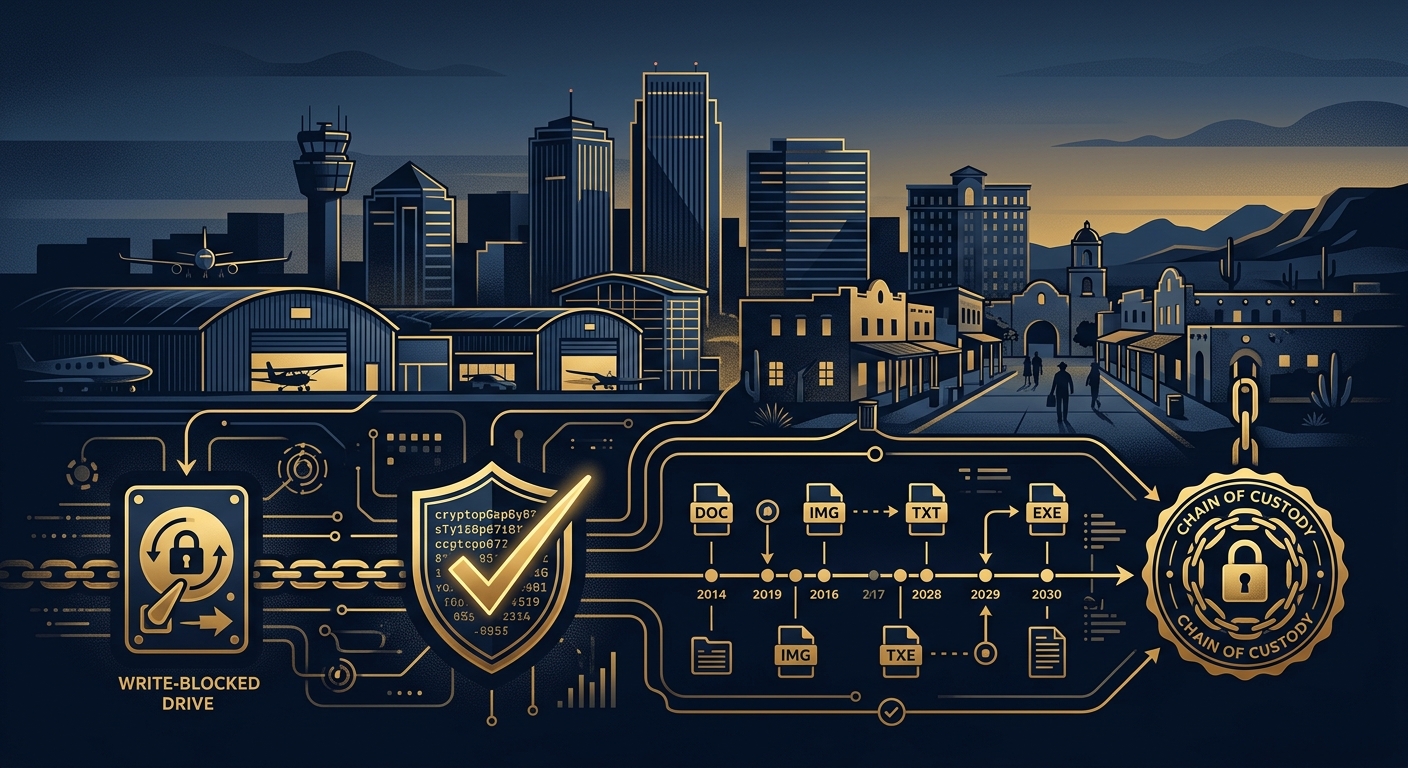
Every Scottsdale digital forensics engagement follows the same six-step discipline, regardless of whether the matter is a trade-secret dispute, a divorce, or an internal investigation:
- Preserve first. A write-blocked, bit-for-bit forensic image is created before any analysis touches the original device or account.
- Verify with hashing. Cryptographic hash values confirm the image is an exact, unaltered copy of the source.
- Log chain of custody. Every transfer, storage location, and person who handled the evidence is documented from intake to report.
- Examine against a defined scope. Analysis is scoped to the specific questions the matter requires — not an unbounded search of the entire device.
- Authenticate the report. Findings are documented to satisfy FRE 901 and, where applicable, the self-authentication provisions of FRE 902(14).
- Support testimony. The examiner who performed the work is available to explain methodology and defend the findings in a deposition or hearing.
What separates a court-ready forensics provider from a data-recovery shop?
A consumer data-recovery service can often pull back a deleted file; it is rarely built to survive a Daubert-style challenge or a deposition. The distinction that matters to Scottsdale counsel and corporate clients comes down to a handful of decision criteria: does the provider create a forensic image before touching the original evidence, or work directly on the source device and risk altering metadata? Is there a documented, repeatable methodology the examiner can describe under oath, or an ad hoc process that changes case to case? Is chain of custody logged continuously from intake, or reconstructed after the fact when a report is requested? And can the examiner who did the work actually appear for testimony, or does the report arrive with no one able to defend it? Elite-level forensic work treats every engagement as if it will end up in front of a judge — because in a trade-secret, divorce, or corporate-misconduct matter, it often does — while a mediocre provider optimizes only for getting the data back.
Representative scenario: the laptop that almost got reissued
Consider a representative matter. An Airpark technology company’s HR department flagged that a senior engineer had resigned with two weeks’ notice and, during the exit interview, seemed unusually eager to keep the company laptop until the final day. Counsel authorized same-day forensic preservation of the laptop and the employee’s company-managed cloud account rather than waiting for the standard IT wipe-and-reissue process. The forensic image showed a spike in file-download activity from the company’s design repository in the final week of employment, along with a transfer to a personal cloud account documented in the sync logs. A hash-verified image, a documented chain of custody, and a clear activity timeline gave counsel a factual basis to act immediately rather than months later after the evidence had been overwritten. This is an illustrative scenario, not a named client or a claimed outcome, but it reflects why forensic preservation has to begin the same day a concern surfaces.
Coverage area and nearest Honeybadger office
Digital forensics is a remote-capable, in-house lab discipline, so most Scottsdale engagements begin with a secured device shipment or a scheduled on-site acquisition rather than requiring an examiner physically at your Airpark office. Our Phoenix office is the closest of our three Arizona locations — roughly a 20–30-minute drive via Loop 101 or Scottsdale Road — and typically coordinates on-site acquisitions and evidence intake for Scottsdale matters. Our Casa Grande headquarters (about 75–90 minutes south) directs the statewide and nationwide forensics lab, and our Oro Valley office (roughly two hours south, near Tucson) extends the same in-house model to Southern Arizona. We also serve digital forensics matters statewide and nationwide, coordinated through our Scottsdale coverage area.
Frequently asked questions
Can a company examine a departing employee’s laptop before litigation starts in Arizona?
Generally yes, when the laptop is company property covered by a documented acceptable-use or monitoring policy. Preservation should begin as soon as a concern is raised, before the device is wiped or reissued, because file-access, transfer, and deletion evidence degrades quickly once normal IT processes resume. A personal device or personal cloud account requires a separate lawful basis — consent, subpoena, or court order — which counsel should confirm before any examination.
Is deleted data recoverable for a Scottsdale trade-secret or divorce case?
Often, depending on the device, how much time has passed, and whether the storage has been overwritten. Deleted files, browser history, and app data frequently remain recoverable for a meaningful window after deletion, which is why fast, forensically sound preservation matters more than the recovery technique itself — the earlier a device or account is imaged, the more is typically recoverable.
Do you need to be physically located in Scottsdale to conduct forensics for our company?
No. Digital forensics is largely a remote-capable lab discipline: devices can be securely shipped for imaging, and cloud-account and email evidence can often be preserved and collected without physical device access at all. Our Phoenix office coordinates on-site acquisitions for Scottsdale and Airpark matters when physical chain-of-custody handoff is preferred.
How is digital evidence authenticated in Maricopa County court?
Authentication generally requires showing the evidence is what it purports to be — typically through hash verification confirming the forensic image matches the original, an unbroken chain-of-custody log, and an examiner who can testify to the acquisition and analysis methodology under Federal Rule of Evidence 901 or its Arizona counterpart. Self-authenticating certification under FRE 902(14) can reduce the need for live testimony in some federal matters.
About Honeybadger Solutions
Honeybadger Solutions is an Arizona-licensed security and investigations firm delivering full-spectrum digital forensics and investigations services, including trade-secret, divorce/asset-discovery, and internal-investigation forensics for Scottsdale companies, families, and businesses. Our digital forensics lab is entirely in-house — not outsourced — and operates statewide and nationwide, backed by documented chain-of-custody controls and expert-testimony support. We operate three Arizona offices — Casa Grande (headquarters), Phoenix, and Oro Valley — serving Scottsdale and the entire Phoenix metro, all Arizona venues, and engagements nationwide.
Need court-ready digital forensics for a Scottsdale matter? Book a consultation online to brief an examiner and scope preservation before evidence is lost. Confidential. Defensible. In-house.
This article is general information, not legal advice; laws vary and change — confirm specifics with qualified counsel before initiating any forensic examination or preservation hold. Authoritative references: Federal Rule of Evidence 901 and NIST Computer Forensics Tool Testing Program.
Related Scottsdale digital forensics resources
Honeybadger handles every Scottsdale digital forensics case with one court-ready, in-house Arizona lab—no evidence is shipped to a third-party subcontractor. When a matter needs field investigation as well, our examiners coordinate with Scottsdale private investigations & surveillance. Businesses and counsel in nearby cities engage our digital forensics services in Tempe. For phone-specific evidence, we frequently pair a full exam with Scottsdale cell phone forensics.
Browse by topic
Security guard services · Private investigations · Cybersecurity · Digital forensics · Financial fraud investigation · Executive protection · All articles