
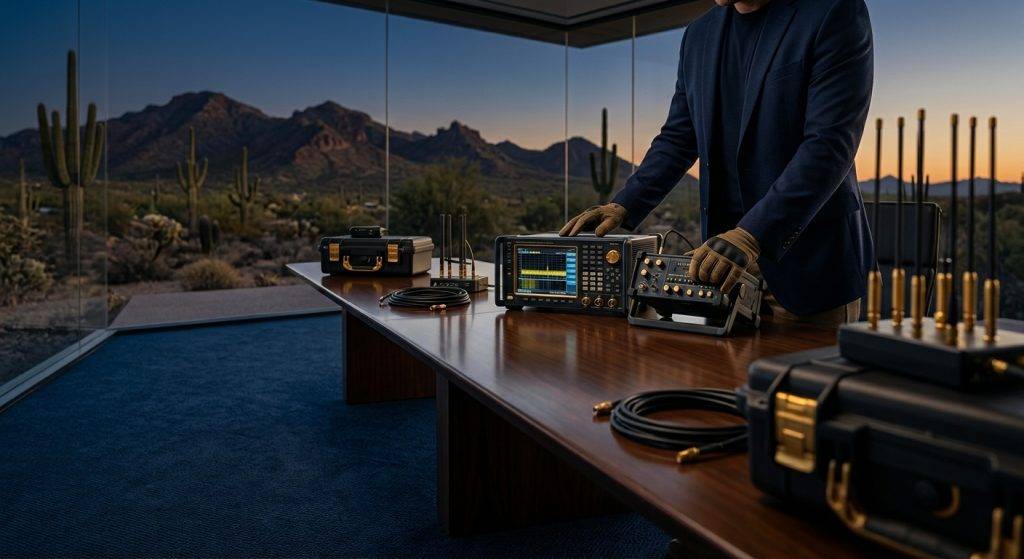
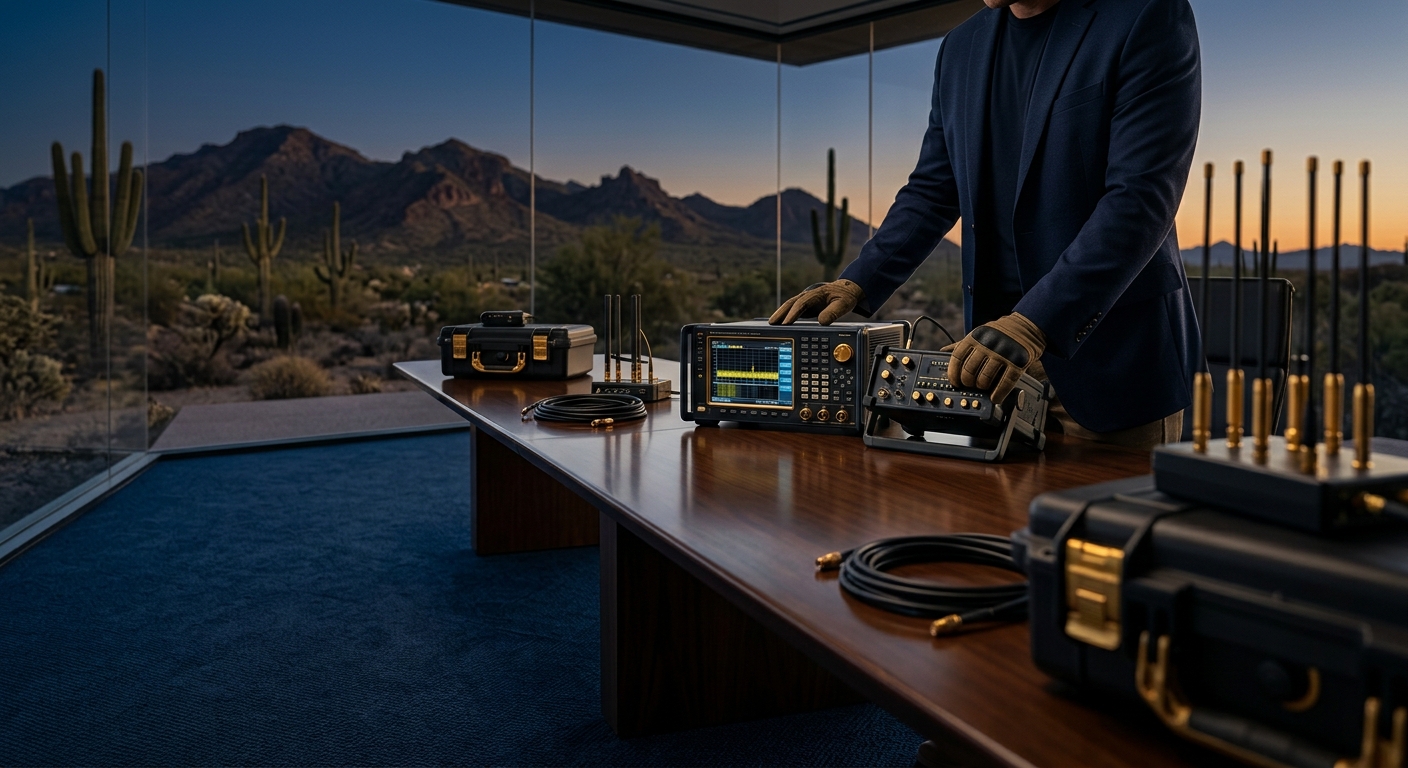
A corporate bug sweep in Scottsdale is a professional Technical Surveillance Countermeasures (TSCM) inspection that detects and neutralizes covert listening devices, hidden cameras, phone and network taps, GPS trackers, and rogue data-exfiltration hardware inside your offices, boardrooms, and executive vehicles. Honeybadger Solutions performs Scottsdale sweeps with its own in-house, Arizona-licensed technicians and delivers court-ready documentation.
Scottsdale concentrates a dense population of exactly the organizations hostile surveillance targets: wealth-management and private-equity firms, venture-backed technology and med-device companies clustered around the Scottsdale Airpark, commercial real-estate and development groups, aesthetic and specialty medical practices, and the family offices of principals who live in the surrounding foothills. When a single conversation can move a valuation, a term sheet, or a settlement, the room those words are spoken in becomes an asset worth attacking. This guide explains what a corporate bug sweep actually covers, how a credible engagement is run, who in the Scottsdale market genuinely needs one, and how to separate a professional TSCM provider from an operator with a hardware-store detector. It is general information, not legal advice.
What does a corporate bug sweep in Scottsdale actually cover?
A corporate sweep is a systematic, documented inspection of a defined business environment for the full range of technical surveillance threats — not a walk-through with a single gadget. Those threats are broader than most executives assume: concealed audio transmitters, passive audio recorders that emit no signal, covert cameras hidden in smoke detectors or USB chargers, taps on desk phones, VoIP handsets and conferencing systems, rogue Wi-Fi and cellular devices bridged onto your network, GPS trackers on fleet and executive vehicles, and implants drawing parasitic power from a building’s wiring.
A professional engagement fuses several disciplines into one pass: radio-frequency (RF) spectrum analysis, non-linear junction detection (NLJD) to find electronics whether or not they are powered, thermal imaging, methodical physical search, and a telecommunications and IT-infrastructure inspection. The reason the modern threat defeats amateur “sweeps” is simple physics: many devices transmit only in short bursts, some store data with no emission at all, and others sit dormant until remotely activated. Detecting that range inside the noisy RF environment of the Scottsdale corridor requires calibrated instruments and a technician trained to interpret ambiguous signals — not a hopeful pass across the ceiling.
Which Scottsdale organizations most need a corporate sweep?
TSCM is proportionate risk management, not paranoia. The profiles that concentrate in Scottsdale share one trait: they hold information others have a strong financial incentive to obtain.
| Scottsdale sector | What is at risk | Typical trigger for a sweep |
|---|---|---|
| Wealth management & private equity | Client positions, deal terms, LP conversations | Pending transaction, suspected leak, partner dispute |
| Technology & med-device (Airpark) | Product roadmaps, IP, funding negotiations | Financing round, board conflict, departing engineer |
| Commercial real estate & development | Bid strategy, acquisition targets, pricing | Competitive bid, terms leaking to a rival |
| Medical & specialty practices | Protected health information, partner buyouts | HIPAA concern, ownership dispute, litigation |
| Family offices & executive suites | Personal wealth, security, private deliberations | Divorce, insider threat, extortion attempt |
The common thread across these matters is that the most valuable conversations happen in a small number of predictable rooms — the boardroom, the managing partner’s office, the deal room. Those are the highest-value acoustic targets in any company, and clearing them before a sensitive session is a standard, low-drama control rather than an extraordinary measure.
How is a professional corporate sweep run, step by step?
A credible sweep follows a repeatable methodology, documented from start to finish. Honeybadger’s technicians work to a disciplined operating framework:
- Discreet pre-sweep intelligence. Before arrival we establish the threat model, the information at risk, the likely adversary, and the floor plan — and coordinate cover so the sweep does not tip off a possible insider.
- RF spectrum analysis. Calibrated analyzers survey the electromagnetic environment across a wide band, characterizing transmitters and separating real threats from ambient corridor RF.
- Non-linear junction detection. NLJD locates semiconductors inside walls, furniture, and fixtures whether or not a device is powered or transmitting — exposing dormant and switched-off implants.
- Physical and semi-destructive search. Technicians inspect outlets, smoke detectors, wall plates, ceiling voids, furniture, and décor by hand, opening likely concealment points.
- Telecommunications & IT inspection. Desk phones, VoIP handsets, conferencing systems, cabling, and network gear are examined for taps, unauthorized devices, and configuration anomalies.
- Thermal and optical inspection. Thermal imaging reveals heat from concealed active electronics; optical methods locate camera lenses that leave no RF trace.
- Findings, neutralization, and reporting. Any device is documented, its capability assessed, and — guided by the client and counsel — handled to preserve evidence. The engagement closes with a written report of what was inspected, what was found, and recommended countermeasures.
The report matters as much as the sweep. A finding is only useful if it is documented to a standard that supports a decision — quiet remediation, an internal investigation, or litigation. This is precisely where brokered, undocumented “sweeps” fail their clients.
What separates a credentialed provider from an amateur?
The TSCM market is uneven, and the gap between a professional engagement and a gadget-waving “sweep” is usually invisible to the client until it matters. Five factors separate the two. First, instrumentation: genuine TSCM requires calibrated spectrum analyzers, NLJDs, thermal cameras, and telephone/line analyzers — not one consumer detector. Second, methodology and training: a credentialed technician follows a documented protocol and can interpret ambiguity, because the discipline is as analytical as it is technical. Third, independence: a provider who also sells you the “counter-surveillance” gadgets has an incentive to find a threat, while a professional’s loyalty is to an accurate result. Fourth, licensing and discretion: in Arizona this work belongs inside a licensed security and investigations practice, accountable for its conduct. Fifth, defensible documentation: if the sweep may feed an investigation or lawsuit, evidence must be handled with chain-of-custody discipline and reporting that survives cross-examination.
Why do in-house, Arizona-licensed technicians matter?
In Arizona, Honeybadger conducts corporate bug sweeps with its own in-house, Arizona-licensed technicians — not subcontractors, and not a referral handed to a stranger. Scottsdale is served directly from our Phoenix office, with our headquarters in Casa Grande and a third office in Oro Valley. That ownership is not a marketing line; it is what makes the work trustworthy. A sweep grants a person intimate access to your most sensitive spaces and precise knowledge of where your vulnerabilities lie. When that person is our trained, supervised employee working to documented methodology, the trust is warranted and accountable. When it is an anonymous operator dispatched by a broker, you have surrendered that access with no assurance of who received it.
Owned capability also means the sweep connects to the rest of the firm. When a device is found, the matter frequently becomes an investigation, a digital-forensics question, or a broader security problem. Honeybadger integrates TSCM with in-house investigations, cybersecurity, and corporate security resources and coordinates the response end to end. You can review our Phoenix-area coverage and broader Arizona footprint for the full picture, and pair a corporate sweep with an executive-office sweep where leadership offices carry the highest risk.
How often should a Scottsdale company sweep, and what drives cost?
Frequency is a function of risk, not calendar habit. A one-time sweep is appropriate when there is a specific trigger — a suspected leak, a contentious executive departure, a high-stakes negotiation, or litigation. A recurring program suits standing risk: firms with continuous deal flow, sensitive IP, or a history of disputes benefit from a scheduled, documented cadence, because a room is only verifiably clean at the moment it is inspected. Cost is driven principally by the size and complexity of the environment, the number of rooms and devices, the depth of physical search, and whether in-place monitoring during a sensitive meeting is in scope. A credible provider scopes transparently to the threat model rather than quoting a flat rate divorced from the space being protected.
What does a clean sweep report actually give a company?
Executives often assume the only valuable outcome of a sweep is finding a device. In practice, a documented “all clear” is frequently the more valuable result. A written report stating exactly which rooms, phones, and network points were inspected, by which methods, and on what date gives leadership something concrete: the ability to proceed with a sensitive negotiation, board deliberation, or investigation knowing the environment was professionally verified. For a general counsel or CFO, that documentation is a governance artifact — evidence that reasonable steps were taken to protect confidential information, which matters if a dispute later turns on whether the firm safeguarded its own data.
A clean report also establishes a baseline. Once the normal RF and network signature of a space is recorded, a future sweep can be compared against it, and anomalies stand out faster. This is why organizations with recurring exposure treat sweeps as a program rather than a one-off: each engagement both clears the space and sharpens the reference point for the next. The report should be plainly written, name the methods used, and translate findings into specific, prioritized countermeasures — not a checkbox, but a decision-support document a busy executive can act on in minutes.
Representative scenario: the leaking term sheet
Consider a representative matter. A Scottsdale advisory firm negotiating a sensitive transaction grew concerned when terms discussed only in its conference room appeared to reach a counterparty. Rather than accuse anyone, leadership commissioned a discreet corporate sweep, timed and covered so a possible insider would not be alerted. Technicians ran RF spectrum analysis, non-linear junction detection, a physical search, and a telecommunications inspection of the room and its conferencing system, then implemented in-place monitoring for the next round of meetings. The finding, an assessment of its capability, and recommended countermeasures were documented in a report the firm could act on with counsel. This is an illustrative scenario — not a named client or claimed outcome — but it reflects the discipline: methodical inspection, discretion, and defensible documentation, not theatrics.
How do smart offices and hybrid work widen the exposure?
The modern Scottsdale office is denser with networked electronics than any boardroom of a decade ago, and each device is a potential collection point. Smart displays, video-conferencing bars, voice assistants, networked printers, occupancy sensors, and connected thermostats all contain microphones, cameras, or network access, and most were installed by a vendor and never security-reviewed afterward. A hostile actor no longer needs to smuggle in a purpose-built bug when a misconfigured conference-room camera or an assistant left on an open guest network can do the same work. A professional sweep therefore treats the connected-device inventory as part of the threat surface, not a separate IT problem — confirming what is actually on the network, what carries a microphone or lens, and what can be reached from outside the building.
Hybrid and remote work has stretched the perimeter further. Sensitive conversations now happen on home networks, in vehicles, and over conferencing platforms a company does not fully control, and executives carry the most valuable information between all of them. The practical implication for a Scottsdale company is that clearing the boardroom is necessary but no longer sufficient; the sweep scope should follow the conversation — to the executive’s home office, phone, and vehicle where the risk profile warrants — which is exactly why an owned TSCM capability that can extend into residential and vehicle work matters more than a single-room checkup.
Frequently asked questions
Are corporate bug sweeps legal in Arizona?
Yes. Commissioning a professional sweep of premises or vehicles your business owns or lawfully controls is legal in Arizona — TSCM defends your privacy, it does not intrude on anyone else’s. The regulated conduct is surveillance itself: Arizona is a one-party-consent state for recording communications, and unlawful interception is governed by state and federal law. A licensed provider works squarely within those boundaries.
Will a sweep disrupt our business day?
It is scoped to minimize disruption. Many corporate sweeps are conducted after hours or over a weekend, and a single executive office or boardroom can often be cleared in a few hours. Larger floors are staged so that critical rooms are prioritized. Discretion is built into the plan, including cover for the visit where an insider threat is a concern.
Do you use your own technicians in Scottsdale?
Yes. In Arizona our sweeps are performed by our own in-house, Arizona-licensed technicians and investigators — supervised end to end, never subcontracted. Scottsdale is served directly from our Phoenix office, with additional offices in Casa Grande (headquarters) and Oro Valley.
What should we do if we suspect our office is already compromised?
Do not conduct your own search or discuss the concern in the suspect space — either can alert whoever placed a device and destroy your options. Contact a licensed TSCM team from outside the room, preserve normal routines, and let professionals plan a discreet, documented sweep. If a device is found, proper handling preserves evidence for any later investigation or legal action.
Can you coordinate the sweep with our IT or security team?
Yes, and for a connected office it is often advisable. With the client’s authorization we align the technical sweep with the network and device review, so anomalies found on the RF and physical side can be reconciled against what IT expects to see on the network. Where an insider concern extends to IT staff, we scope the coordination narrowly and keep the engagement strictly need-to-know.
About Honeybadger Solutions
Honeybadger Solutions is an Arizona-licensed security and investigations firm delivering full-spectrum security, TSCM, investigations, and cyber services. In Arizona, our bug sweeps are performed by our own in-house, AZ-licensed technicians — not subcontractors — working to documented methodology with chain-of-custody discipline and court-ready reporting. We operate three Arizona offices — Casa Grande (headquarters), Phoenix, and Oro Valley — with Phoenix serving Scottsdale and the wider Valley, and we support engagements nationwide and internationally.
Concerned about surveillance in a Scottsdale office, boardroom, or executive vehicle? Book a consultation online to brief a TSCM lead and scope a discreet, defensible sweep. Confidential. Credentialed. Arizona-owned.
This article is general information, not legal advice; laws vary and change — confirm specifics with qualified counsel. Authoritative references: A.R.S. § 13-3005, interception of communications (Arizona State Legislature), the Federal Wiretap Act, 18 U.S.C. § 2511 (Cornell Law LII), and the National Counterintelligence and Security Center (NCSC) on economic espionage.
Browse by topic
Security guard services · Private investigations · Cybersecurity · Digital forensics · Financial fraud investigation · Executive protection · All articles