
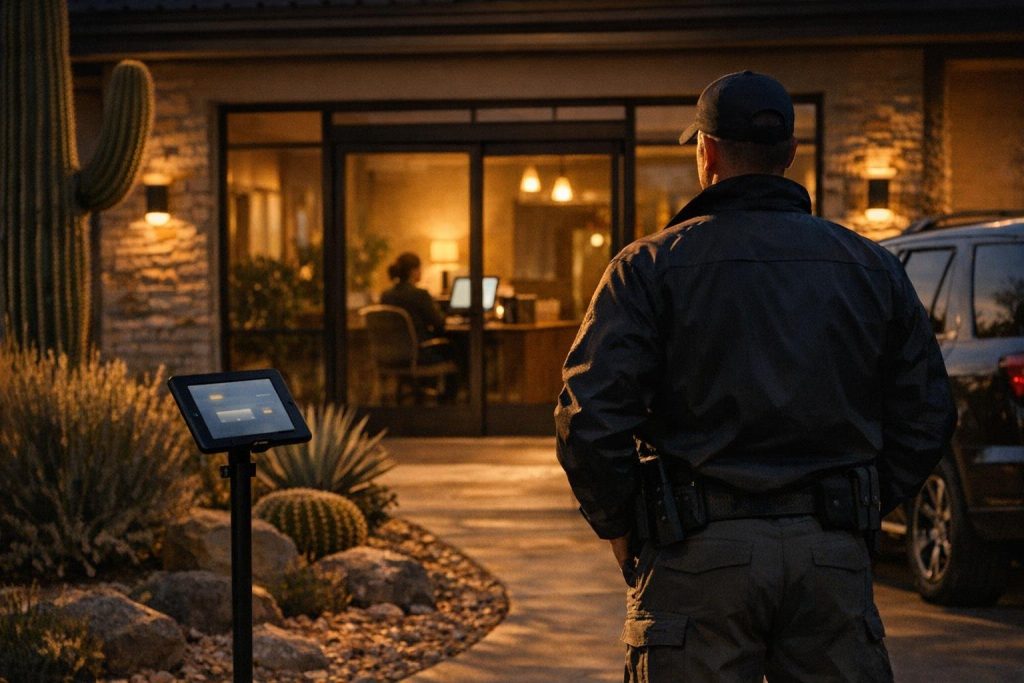
A security plan for an Arizona assisted living or memory care community should be built on the rules the Arizona Department of Health Services already holds you to: wandering policies and controlled exits for directed care, drills on every shift, residents’ rights that include freedom from restraint, and the state’s duty to report abuse, neglect and exploitation. Security’s job is to keep doors, visitors and the night shift under control so caregivers can stay with residents.
That also defines what officers do not do. They support caregivers, they do not provide care, and they never restrain residents. This guide shows how to turn the rules into a working plan, with checklists for elopement, visitors and nights. For the service overview, see our senior living security page.
Key takeaways
- Map each security task to an Arizona rule you are already surveyed on, so the plan supports your license instead of competing with it.
- The Alzheimer’s Association advises calling 911 if a person with dementia is not found within 15 minutes. In an Arizona summer, your policy may need to move faster.
- Residents have a right to privacy in visitation. Visitor management means knowing who is in the building and enforcing restrictions the administrator or a court has set.
- Assisted living rules require indoor temperatures between 70 and 84 degrees Fahrenheit. A night officer who checks and escalates HVAC failures protects residents during monsoon outages.
- Ask your security provider how its officers are screened, including Arizona guard registration and, where duties call for it, fingerprint clearance cards.
Start from the rules you are already inspected on
Arizona licenses assisted living facilities under Title 9, Chapter 10, Article 8 of the Arizona Administrative Code. Several of those rules shape what security should do. Tie each post order to one of them.
| Rule | What it requires | What security contributes |
|---|---|---|
| R9-10-815(F), directed care | Policies for residents who may wander, and an exit to an outside area at least 30 feet from the building that controls or alerts staff, or special egress-control devices under the building code | Response to door alarms, courtyard gate checks, an exterior search role |
| R9-10-818, emergency and safety | A disaster drill for employees on each shift every three months and an evacuation drill every six months, documented with evacuation times | Night officer takes part in night drills and helps with the headcount outside |
| R9-10-810, residents’ rights | Residents are not subjected to restraint or seclusion, and have privacy in visitation | Hands-off redirection only; visitor rules applied as written |
| R9-10-819, environmental standards | Heating and cooling keep the facility between 70 and 84 degrees Fahrenheit at all times, unless a resident controls their own unit | Night temperature checks and fast escalation of HVAC or power failures |
| A.R.S. 46-454, duty to report | People responsible for a vulnerable adult’s care must report a reasonable basis to believe abuse, neglect or exploitation occurred | A written path from the front desk to the administrator, police or Adult Protective Services |
Under A.R.S. 46-454, an employee or agent of a health care institution whose procedures require reporting to Adult Protective Services is treated as complying by reporting through those procedures. Make sure your officers know that path, and that a concern never stops at the front desk. In an emergency, call 911. This is general information, not legal advice.
Wandering and elopement: a minute-by-minute plan
The Alzheimer’s Association reports that six in 10 people living with dementia will wander at least once, and many do so repeatedly. Many are found within 1.5 miles of where they disappeared, and the Association advises calling 911 to file a missing person report if the person is not found within 15 minutes. It also notes that wandering often follows the direction of a person’s dominant hand, and that people experiencing sundowning may be most restless from early evening.
Early evening is also when visitors leave, doors open more and day shift hands off to night shift. Plan coverage around that window, not just around midnight.
Exits are not only the doors with alarms. Arizona’s physical plant rule (R9-10-820) requires resident bedrooms to have a window or door that can be used for direct egress to the outside. Exterior checks should include patios and ground-floor windows outside memory care rooms.
A sample elopement sequence (adapt it to your policy):
- Alarm or report. The officer goes to the door that alarmed while a caregiver starts an immediate count of residents.
- First minutes. The officer checks the assigned exterior zone: courtyard, parking lot, nearest streets, and any place the resident talks about.
- Found. The officer stays with the resident, speaks calmly, uses their name, offers water and walks with them while a caregiver comes. No grabbing, blocking or holding.
- Not found. Call 911 at the point your policy sets, and no later than 15 minutes. On a hot afternoon, set that point earlier.
- Help police. Have a current photo, description, clothing, diagnosis and a list of familiar places ready. Arizona’s Seek and Find Alert under A.R.S. 41-1728 covers missing people with dementia or age 65 and older, but the investigating police agency requests it, not the community.
- Afterward. Caregivers document the incident under your incident and quality management process, and leadership reviews what the door, the alarm and the staff did.
The Association also suggests removing access to car keys, because a person with dementia may try to drive. Officers should know which residents no longer drive and watch the parking lot accordingly. For more on prevention design, see our guide to patient elopement prevention.
Visitor management that respects residents’ rights
Residents have the right to privacy in visitation under R9-10-810. A visitor process is not a way to screen residents’ relationships. It is how you know who is in the building, keep out people the community or a court has restricted, and spot pressure on residents early.
Visitor checklist:
- Every visitor signs in and out, including vendors and contractors
- After-hours arrivals follow a defined process, and delivery drivers do not walk in unescorted
- The restricted-visitor list is kept by the administrator, dated, and includes copies of orders of protection, guardianship letters or other court orders on file
- Officers check the list, deny entry politely, and call the administrator, and police if an order is being violated or someone is threatened
- Family disputes are referred to the administrator or social services staff, not decided at the desk
- Staff know the warning signs of financial exploitation: visitors pushing a resident to sign papers, new “friends” handling money, repeated trips to the bank
The decision to restrict a visitor belongs to the community, the resident’s legal representative or a court. The officer enforces the decision and documents it. When a family or community needs facts about suspected exploitation, our elder financial exploitation investigations team can help after the required report is made.
A trained evening receptionist does a lot of this quietly. Our front desk and concierge officers can cover reception during evening visiting hours and weekends.
Night coverage: keeping caregivers on the floor
At night, every knock at the door pulls a caregiver away from residents unless someone else answers it. A night officer takes those tasks:
- Answering the door and meeting pharmacy deliveries and late arrivals
- Meeting paramedics at the entrance and walking them to the right room
- Responding first to door alarms while caregivers count residents
- Checking exterior doors, courtyard gates, fence lines and the parking lot on a set route
- Checking common-area temperatures and escalating any HVAC failure that threatens the 70 to 84 degree range
- Logging what happened so the morning shift sees it
Plan for the monsoon. Southwest National Weather Service offices define June 15 through September 30 as the monsoon and warn that power and communications outages can last longer than the storm. Your disaster plan under R9-10-818 must already say when, how and where residents would be relocated. The night officer should know that plan, where emergency lighting and any generator controls are, and who to call when cooling fails. Maricopa County health officials note that fans alone are not effective once temperatures pass 95 degrees.
Night officer’s round:
- Every exterior door latched, with alarm state confirmed at the panel
- Courtyard gates closed and fence lines intact
- Temperature recorded in common areas and memory care hallways
- Parking lot walked, with resident and staff cars checked
- Deliveries and visitors after hours logged with times
- Anything a caregiver should follow up on written in the shift report
Screening and briefing the officers you bring in
Arizona security guards must hold a registration certificate from the Department of Public Safety. Under A.R.S. 32-2622, applicants are disqualified by any felony conviction and, within the prior five years, by misdemeanor convictions involving violence, theft, dishonesty or fraud, domestic violence and several other categories.
Health care rules add another layer. A.R.S. 36-411 requires employees and contracted persons of residential care institutions, which include assisted living facilities, to hold a valid fingerprint clearance card if they provide certain services, including “direct supportive services” such as transportation or work in a resident’s room. An officer who stays in common areas may fall outside that definition, but an officer who drives the van or enters rooms may not. Decide the rule with your counsel and put it in the security contract. The same statute requires facilities to check potential employees against the Adult Protective Services registry, and you can ask your vendor to confirm the same for assigned officers.
Before the first shift, officers should be briefed on:
- Dementia communication basics: slow speech, names, one instruction at a time, redirection
- The rule that officers never restrain, block or physically guide a resident
- Your wandering policy, door alarm panel and exterior search zones
- Your escalation chain, with names and radio channels
- Resident privacy, including how resident photos may be used for identification
- A uniform that fits the setting, often a polo or blazer instead of a patrol look
How Honeybadger Solutions helps
Honeybadger Solutions is a veteran-led security firm with officers delivered in-house across Arizona. For assisted living and memory care communities we meet the administrator and director of nursing, walk every door in day and night lighting, write post orders that follow your wandering, visitor and emergency policies, brief officers on the setting, and report each shift to leadership. We can review door alarms and camera coverage and coordinate changes. Installation work is performed and contracted by our licensed Arizona ROC contractor partner. Honeybadger Solutions LLC is not a licensed contractor.
Every engagement starts with a written quote before any work begins. Learn more on our assisted living security service page, or request senior living security online. If a resident is missing right now, call 911 first.
Frequently asked questions
Will security officers physically stop a resident from leaving?
No. Arizona’s assisted living rules protect residents from restraint, and physical intervention is a clinical and policy decision for your care staff. Officers stay with the resident, talk calmly, redirect where they can and call a caregiver.
When should we call 911 for a missing resident?
Follow your policy, and do not wait longer than 15 minutes if the resident is not found, as the Alzheimer’s Association advises. In summer heat, consider setting an earlier trigger. Tell police the resident has dementia.
Do security officers need fingerprint clearance cards?
Arizona requires them for employees and contracted persons who provide certain services in residential care institutions, including direct supportive services like transportation or work in resident rooms. Whether that covers a particular post depends on its duties, so settle the rule with your counsel and write it into the contract.
Who decides which visitors are restricted?
The community, the resident’s legal representative or a court. Officers check visitors against the list your administrator keeps, deny entry politely and call the administrator, and police if a court order is being violated.
Should the night officer take part in drills?
Yes. Arizona requires a disaster drill for employees on each shift every three months, and an officer working nights should be part of that shift’s drill so roles at the door and the outside headcount are practiced.
Sources: A.A.C. R9-10-815, Directed Care Services, A.A.C. R9-10-818, Emergency and Safety Standards, A.A.C. R9-10-810, Residents’ Rights, A.A.C. R9-10-819, Environmental Standards, A.A.C. R9-10-820, Physical Plant Standards, A.R.S. 46-454, Duty to report, A.R.S. 36-411, Fingerprinting requirements, A.R.S. 32-2622, Security guard registration qualifications, A.R.S. 41-1728, Seek and find alert notification system, Alzheimer’s Association, Wandering, National Weather Service Tucson, Monsoon Safety, Maricopa County Department of Public Health, heat safety tips.
Browse by topic
Security guard services · Private investigations · Cybersecurity · Digital forensics · Financial fraud investigation · Executive protection · All articles