

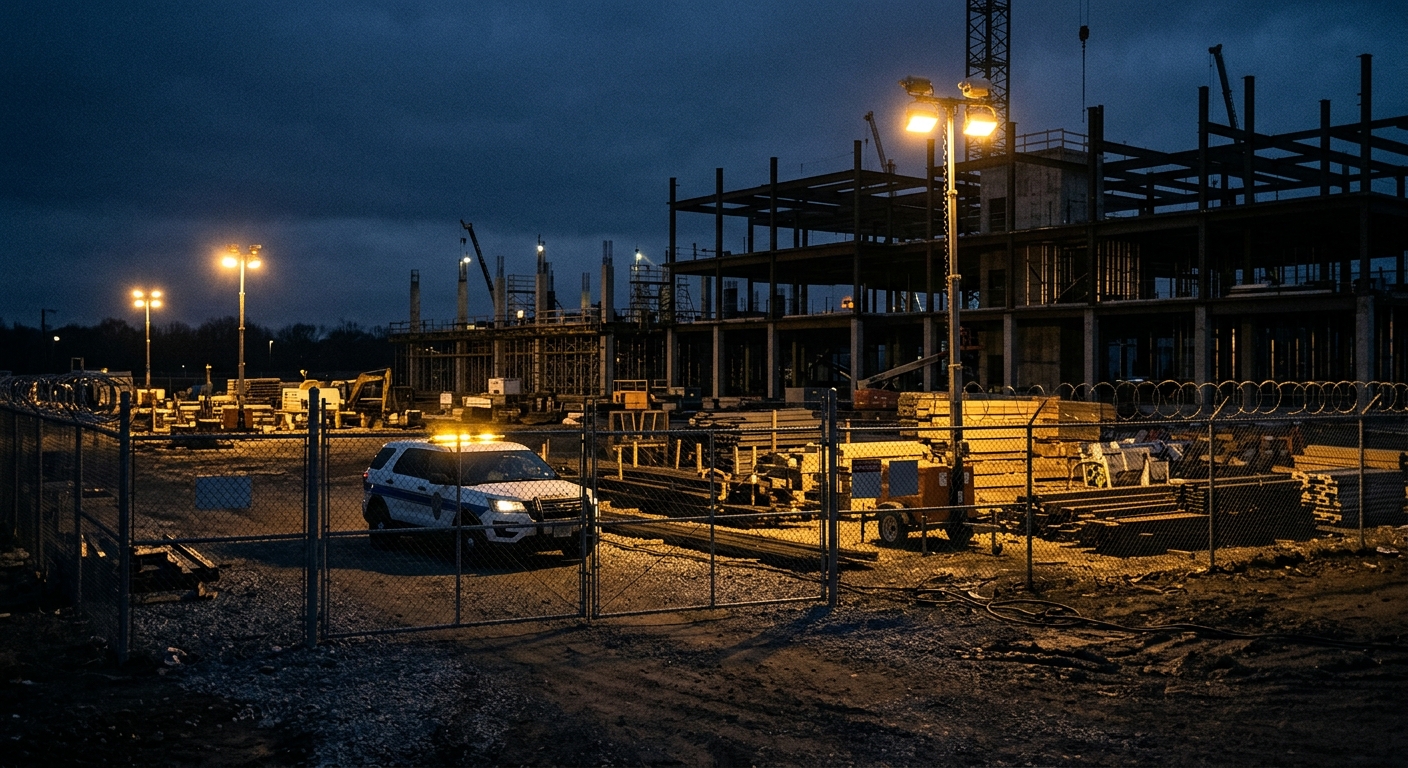
Arizona construction sites lose materials, tools, and equipment to theft and vandalism at a rate that regularly outpaces the general population’s crime trend, and unsecured sites also carry after-hours trespass liability a general contractor cannot insure away. The proven countermeasure is a layered program — licensed officers, mobile patrol, monitored video with analytics, controlled access, CPTED-informed lighting, and asset tracking — matched to the site’s actual phase of construction, not a single static guard shack.
For guards, patrol and camera coverage on an active build, see our construction site security services in Arizona.
Why Arizona Job Sites Are a Preferred Target
A construction site is, by design, an open, unstaffed, high-value environment for most of every 24-hour cycle. Materials sit exposed. Equipment keys are often left in ignition switches for daytime efficiency. Fencing is temporary, sightlines are broken by stacked material and framing, and the workforce that could act as informal deterrence goes home every evening. Arizona compounds this with rapid horizontal growth in the Phoenix metro, Pinal County, and Tucson corridors, where new subdivisions and commercial pads sit adjacent to open desert, unlit frontage roads, and highway access that make a fast in-and-out theft run easy to execute and hard to witness.
Understanding the threat model in specific terms — not a generic "theft happens" warning — is the first step toward pricing the right countermeasure instead of over- or under-buying security.
The Five Threats That Actually Drive Losses
- Copper and wire theft. Rough-in electrical, HVAC condenser coils, and grounding wire are the single most frequently targeted assets on an active build because copper resells quickly and is difficult to trace once stripped. Losses are rarely a single incident — sites hit once are hit again within weeks because the same access weakness remains.
- Equipment and tool theft. Skid steers, generators, welders, and pneumatic tools are portable, resalable, and frequently under-secured overnight. Heavy equipment theft nationally runs into the hundreds of millions annually, and recovery rates for stolen equipment remain low once it crosses a state line or enters a private resale channel.
- Vandalism. Spray-painted framing, smashed fixtures, and sabotaged systems create direct repair cost and schedule slippage — and unlike theft, vandalism damage often isn’t fully recoverable through insurance deductibles.
- Trespass and premises liability. An open excavation, unsecured scaffold, or accessible partially framed structure is an attractive nuisance under Arizona premises-liability principles. A trespasser injured on an unsecured site — including, in some circumstances, a minor — can expose the GC and owner to liability exposure disproportionate to the cost of a fence and a patrol contract.
- After-hours intrusion and squatting. Vacant framed structures and unoccupied model homes attract unauthorized occupation, which creates fire risk, further theft risk, and a legal removal process that is slower and more complex than prevention would have been.
What Does Effective Construction Site Security Actually Look Like?
No single control stops all five threats above. Cameras deter but don’t physically intervene. A guard deters and intervenes but can’t watch 40 acres alone. The programs that actually move the loss number are layered — each control compensates for the next one’s blind spot. A properly scoped Arizona job site program combines the following six elements, weighted differently depending on site size, phase, and prior loss history.
- Licensed on-site security officers. A uniformed, AZ-licensed officer during the highest-risk window (dusk to dawn, weekends) is the only control that can challenge an intruder in real time, log site activity, and manage subcontractor and delivery access without slowing daytime operations.
- Mobile patrol. For sites too large or too early-phase to justify a fixed post, randomized marked-vehicle patrol passes create unpredictable presence — the single biggest deterrent variable in target-selection research on opportunistic theft.
- Live and remote video surveillance with analytics. Modern job site camera systems paired with motion and object-classification analytics (person, vehicle, loitering) let a remote operations center verify and respond to an alarm in seconds rather than relying on a passerby to call it in.
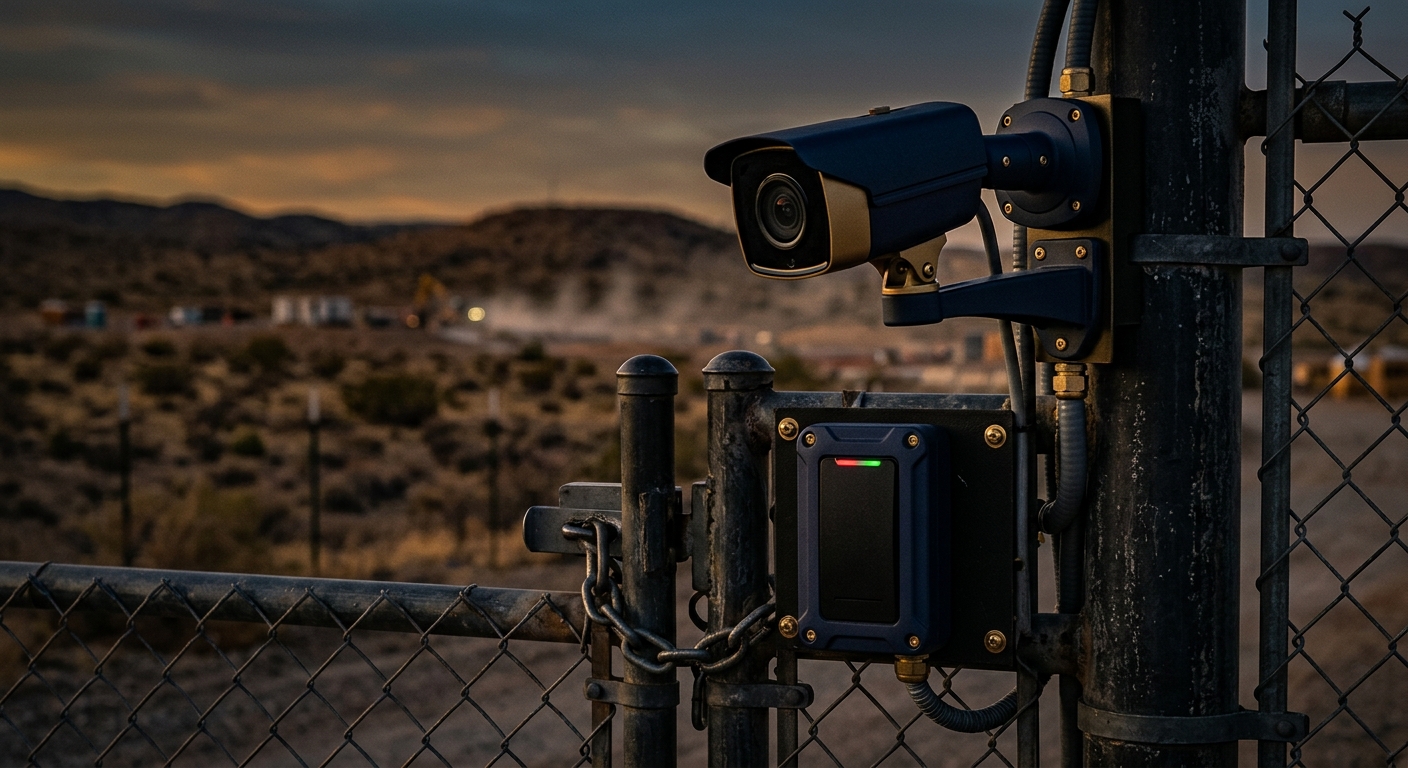
- Access control. Gated, logged entry — even a simple keypad or credentialed gate log — establishes who was on site and when, which matters as much for incident investigation and subcontractor accountability as for keeping out unauthorized visitors.
- Lighting and CPTED site design. Crime Prevention Through Environmental Design principles — clear sightlines, eliminating concealment points around material staging, and lighting the perimeter rather than just the trailer — reduce the site’s attractiveness before a single guard or camera is even deployed.
- Asset tracking. GPS and Bluetooth tags on high-value equipment turn a theft from a total loss into a recoverable one, and the deterrent value of visible anti-theft tagging is well documented in equipment-theft prevention guidance from insurers and equipment manufacturers alike.
These controls are not interchangeable substitutes — see how they compare on the dimensions that actually matter to a GC building a budget.
| Control | Primary Strength | Primary Gap | Best-Fit Phase |
|---|---|---|---|
| Licensed on-site officer | Real-time intervention, visitor/sub management | Cost at scale; single-post blind spots on large sites | Vertical build, MEP rough-in, finish-out |
| Mobile patrol | Unpredictable deterrence across multiple sites/acres | Gaps between passes; no continuous presence | Mobilization, site prep, low-value early phases |
| Video surveillance + analytics | 24/7 coverage, recorded evidence, remote verification | No physical intervention without a response partner | All phases, especially unmanned overnight |
| Access control / gate logging | Accountability, sub/delivery management | Doesn’t stop determined perimeter breach | All phases once fencing is up |
| Lighting / CPTED design | Reduces target attractiveness before an incident | Passive only; no response capability | Site design/mobilization, ongoing |
| Asset/GPS tracking | Recovery after theft; insurer-favored control | Doesn’t prevent the initial theft | Equipment-heavy phases (earthwork, MEP) |
Risk Changes by Project Phase — So Should the Security Plan
A static security contract signed at mobilization and left unchanged through turnover is the most common budget mistake we see reviewing GC security spend. The threat profile shifts as the building does, and the correct control mix shifts with it.
- Mobilization and site prep: Perimeter fencing, initial lighting, and mobile patrol are typically sufficient — asset value on site is still low, but equipment (excavators, graders) is highly mobile and a top theft target.
- Foundation and vertical framing: Material staging (lumber, steel, rebar) grows fast; this is when access control and increased patrol frequency start paying for themselves against material loss.
- MEP rough-in: The single highest-risk phase for copper and wire theft — exposed conductor and coil are now on site in volume and are the easiest commodity to move quickly. This is the phase that most justifies a licensed on-site officer during dark hours.
- Finish-out: Fixtures, appliances, and finish materials introduce a new, resalable target category and typically coincide with more subcontractor traffic — access logging and video verification both earn their keep here.
- Punch list and turnover: Vacant, near-complete structures are prime targets for squatting and vandalism precisely because visible construction activity has slowed; maintaining coverage through this phase, not easing off, prevents last-mile losses on a project that’s otherwise nearly de-risked.
The ROI Math: What a Loss Actually Costs Versus What Security Costs
Security spend on a job site is frequently evaluated against the wrong baseline — the line-item cost of a guard or camera system, compared to nothing. The correct comparison is against the fully loaded cost of an incident, which is rarely just the replacement value of what was taken.
A single significant copper theft on an active MEP rough-in doesn’t just cost the material — it costs the labor to re-rough, the schedule delay while the electrical subcontractor remobilizes, potential re-inspection fees, and in many cases a builder’s-risk insurance deductible that can run tens of thousands of dollars before coverage engages at all. A stolen skid steer isn’t just a depreciated asset loss; it’s downtime on a rented or backfilled replacement while the original claim processes. Vandalism to framing or systems often triggers a full re-inspection cycle. When GCs run the real comparison — total incident cost, including schedule float, against the monthly cost of a right-sized security program — the security spend consistently comes out as the cheaper line, and that’s before accounting for the trespass-liability exposure a security presence also mitigates.
Insurance Implications: Security Isn’t Just a Cost Center, It’s a Deductible Lever
Builder’s-risk carriers increasingly price theft and vandalism sub-limits based on documented on-site security controls. A site with a logged access-control system, monitored video, and a licensed patrol or guard contract on file is a materially different underwriting profile than an unsecured site — and that difference shows up in premium, in sub-limit terms, and in how smoothly a claim gets paid when something does happen despite the controls in place. Carriers want to see, at minimum: fencing, lighting, an access log, and evidence of active monitoring. Sites that can produce time-stamped patrol logs and video retention after an incident settle claims faster and with fewer disputes over whether reasonable precautions were taken — a factor that also matters directly in any subsequent premises-liability defense.
GCs should request their builder’s-risk policy’s specific security requirements and sub-limits in writing before finalizing a site security plan — a program built to satisfy the underwriting checklist, not just deter theft, pays for itself twice.
What Separates an Elite Program from a Commodity Guard Contract
Most job site security failures aren’t a control failure — they’re a design failure. A guard posted at the trailer while the material yard sits 400 feet away and unlit isn’t a security program, it’s a checkbox. The programs that actually hold losses down share a few traits that separate them from commodity guard-service vendors:
- Site-specific post orders, not a generic patrol script — written around this site’s material staging, access points, and known local theft patterns.
- Documented, time-stamped activity logs for every patrol pass and access event — the same records that satisfy insurers and support any subsequent claim or investigation.
- A named licensed command structure, not rotating anonymous contract guards with no accountability to the GC or the site superintendent.
- Integration with the project schedule — coverage that scales up ahead of MEP rough-in and stays engaged through punch-list, rather than a flat contract that ignores phase risk.
- A real investigations capability if a loss does occur — the ability to actually work a theft or vandalism incident, not just file a report and hand it to police with no follow-through.
How Honeybadger Solutions Secures Arizona Job Sites
Honeybadger Solutions fields its own licensed, in-house Arizona physical security and armed/unarmed guard capability — we are not brokering your site coverage to a third-party subcontractor and hoping their standards match ours. Our officers and mobile patrol teams work directly under Honeybadger command out of our Casa Grande, Phoenix, and Oro Valley offices, which means post orders, supervision, and accountability stay in-house from mobilization through turnover.
For GCs and developers building across the state, that means one point of contact who can scope a phase-aware security consulting plan at the pre-construction stage, staff licensed officers and patrol coverage as the build progresses, and — if a loss occurs despite the controls in place — move directly into a real investigations engagement to work the theft or vandalism incident rather than simply filing a report. That continuity between prevention and response is the difference between a vendor and a security partner.
Frequently Asked Questions
How much does construction site security cost in Arizona?
Cost depends on site size, phase, and control mix — mobile patrol alone runs far less than a full-time licensed officer post, and most GCs blend the two, scaling up coverage during MEP rough-in and finish-out when theft risk peaks. A scoped consultation against your project schedule gives an accurate number rather than a flat per-site rate.
What’s the single most effective control against copper and wire theft?
No single control fully solves it — copper theft is best addressed by combining a licensed on-site officer during dark hours (the highest-risk window) with access-logged entry and video coverage of the specific staging areas where rough-in material sits, since that combination both deters and creates evidence if a theft still occurs.
Can a construction site be held liable if a trespasser is injured after hours?
Yes — under Arizona premises-liability principles, an unsecured site with hazards like open excavations or unsecured scaffolding can be treated as an attractive nuisance, exposing the owner and GC to liability, particularly for minors. Fencing, lighting, and documented access control are the baseline defenses insurers and courts expect to see in place.
Does better site security actually lower builder’s-risk insurance premiums?
Many builder’s-risk carriers price theft and vandalism sub-limits based on documented controls — fencing, monitored video, and logged access are commonly required or rewarded terms. GCs should confirm their specific policy’s security requirements in writing, since a program built to satisfy underwriting can lower premium exposure and speed claims if a loss occurs.
About Honeybadger Solutions
Honeybadger Solutions is a licensed Arizona private investigation and security firm with offices in Casa Grande (headquarters), Phoenix, and Oro Valley. Our Arizona physical security, guard, and mobile patrol teams are our own in-house, state-licensed personnel — not outsourced labor — while our digital forensics, cybersecurity, and financial investigations capabilities serve clients nationwide. Beyond Arizona, our physical field work is supported through a vetted partner network in established theaters including California, Texas, and Florida. To scope a construction site security plan for your next Arizona project, book a consultation online.
Further reading: OSHA’s construction industry safety standards outline the jobsite hazard obligations that intersect with premises-liability exposure, and the Arizona Department of Public Safety publishes statewide crime-reporting resources relevant to theft trend awareness for builders operating across the state.
Browse by topic
Security guard services · Private investigations · Cybersecurity · Digital forensics · Financial fraud investigation · Executive protection · All articles