
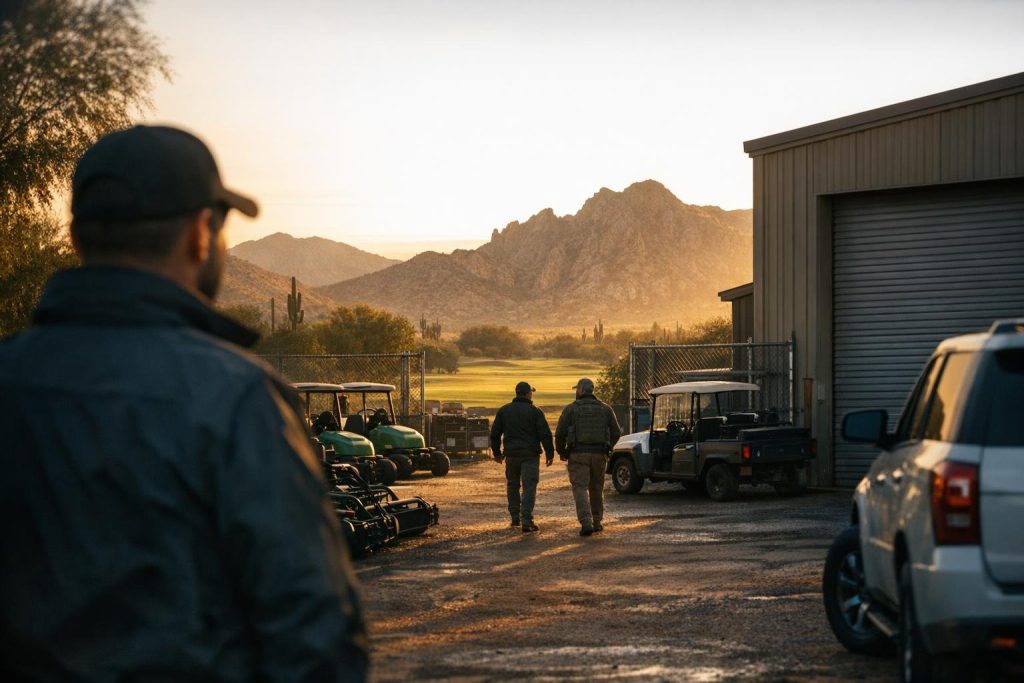
The fastest way to stop theft at a golf course maintenance yard is to make every valuable item traceable, control every key, light and watch the yard all night, and time patrols around the hours when the yard sits empty before the crew arrives. A drive-by patrol alone rarely does it. Thieves who target a yard usually know the course, know when the crew leaves and know the yard is dark and far from the clubhouse.
This guide is for superintendents, general managers and club owners in Arizona. It covers the maintenance yard, the cart barn and the irrigation pump station, which hold most of a course’s replaceable value. It also explains the Arizona scrap metal and trespass laws that help after a loss, and how to plan for monsoon lightning during events. For the full service, see our page on golf course and country club security.
Key takeaways
- Build an equipment register with serial numbers, photos and owner-applied markings before anything is stolen. Police and scrap records need something to match against.
- Cart and equipment keys belong in a locked cabinet with a sign-out log, not in ignitions or on a nail by the barn door.
- Cameras with live monitoring watch the yard all night. A patrol checks it a few times. Most courses need both.
- The hour before the crew arrives is a high-risk window in Arizona summers, when work starts before dawn. Schedule a patrol check inside it.
- Arizona scrap metal dealers must photograph metal and record seller identity under A.R.S. 44-1642, and report most purchases to DPS within 24 hours under A.R.S. 44-1644.
- Tournaments from July through September need a written lightning plan that names who calls the stop and where people go.
Why the yard, cart barn and pump station are the targets
A maintenance yard holds mowers, utility vehicles, trimmers, blowers, batteries, hand tools and often a fuel tank. Most of it is portable, resellable and hard to tell apart from the same model at another course. The yard is usually tucked away from the clubhouse so members do not see it, which also means nobody sees it at night.
The cart barn is a different problem. Carts are less often resold whole and more often taken for joyrides, driven across greens or dumped in a lake. The damage to turf and the cost of pulling a cart out of water can exceed the cart’s value.
The pump station draws scrap thieves after copper wire, brass fittings and backflow preventer valves. A stripped pump station can stop irrigation in the middle of an Arizona summer and turn a small theft into a turf loss.
All three sit near the edge of the property, border washes, roads or homes, and go empty on a predictable schedule.
Mark and record equipment before it walks
When stolen equipment is recovered, the first question is whether anyone can prove it is yours. Factory serial numbers are a start, but they are often on a plate that can be removed. Owner-applied marks give police and pawn or scrap staff a second way to identify an item.
Keep the register where the superintendent and general manager can both reach it, and update it with every purchase or trade-in.
| Item | What to record | Owner marking idea |
|---|---|---|
| Mowers and utility vehicles | Make, model, serial and engine numbers, purchase date, photos from four sides | Club name or ID number engraved in a hidden spot, plus a visible decal |
| Golf carts | Fleet number, serial number, battery type, key type | Fleet number on the body and under the seat |
| Hand tools and trimmers | Brand, model, serial where present, quantity | Engraved course ID; paint band in a club color |
| Pump station parts | Photos of wiring runs, valves, backflow preventers and controllers, with sizes and brands | Stamped or engraved ID on brass fittings where the manufacturer allows |
| Batteries and fuel | Count, type, tank capacity, monthly fuel reading | Paint marks on batteries; locked fuel nozzle |
GPS trackers on high-value equipment the club owns are worth pricing. A tracker will not stop a theft, but it can speed a recovery.
Key control for carts, equipment and gates
Many yard and barn losses involve no forced entry. The thief used a key left in an ignition, hung on a hook or never returned by a former employee. Key control is cheap and closes that gap.
- Store every cart and equipment key in a locked key cabinet, with a sign-out log showing who took which key and when.
- If one key starts every cart in the fleet, treat that key like a master key and limit who holds it.
- Collect keys, gate remotes and fobs on an employee’s last day, and change gate codes when a supervisor leaves.
- Rekey padlocks on the yard gate, fuel tank and pump station after any lost key, not just after a theft.
- Do a monthly count of keys in the cabinet against the log, and note any that are missing.
Where the club wants card or keypad access on the yard gate or barn, an audit trail shows who opened which door and when. Our remote and virtual guarding team can tie those events to the camera view so an after-hours opening gets a look in real time.
Lighting and cameras with live monitoring
A dark yard invites a slow, careful thief. Lighting the yard gate, the barn doors, the fuel area and the pump station removes that advantage and gives cameras the light they need to capture faces and plates.
Recorded-only cameras tell you what happened after the fact. Cameras with live monitoring can do something while it is happening. A monitoring operator who sees a person climb the fence can speak through a yard speaker, tell the person they are on camera and that police are being called, and then call police with a live description.
Placement matters more than camera count. Put one at the yard gate at an angle that captures a face and a plate, cover the barn doors, fuel tank and pump station, and keep one wide view of the approach from the nearest road or wash.
Set a written rule for who can view and export footage and how long recordings are kept, so police and the insurer get clean copies quickly.
Time patrols around crew start times
Arizona courses run on an unusual clock. In summer, play starts at dawn and the maintenance crew starts earlier, often in the dark, to finish mowing before heat and golfers arrive. In winter, the crew may start later and leave earlier. Thieves learn these patterns as quickly as anyone.
The weak hours are usually after the last crew member leaves, the middle of the night, and the hour before the crew returns. That last window is often ignored, but it is when a thief who has watched the yard knows nobody is coming yet. A mobile patrol check timed inside that hour, at a different minute each night, closes it.
A practical nightly patrol checklist for a course:
- Yard gate locked and chained, no fresh cuts in the fence line.
- Barn doors closed and locked, carts plugged in and accounted for by fleet count where visible.
- Fuel tank nozzle locked, no spills or open caps.
- Pump station enclosure locked, no exposed or cut wire, controller cabinet closed.
- Clubhouse doors, pro shop door and cash office door checked.
- Parking lots and known entry points from washes and neighboring streets checked for vehicles that do not belong.
- Any finding photographed, time-stamped and reported to the superintendent and general manager before the crew arrives.
Officers observe, report and call police. They are private persons, not police, and they do not chase or detain anyone on the course.
Arizona laws that help after a theft
Two sets of Arizona statutes change what you should record before a loss.
Scrap metal records. Under A.R.S. 44-1642, every scrap metal dealer must record the date, time and place of each purchase, a photograph and description of the metal and its weight, the seller’s name, description, address and identification, the plate of the delivery vehicle, a photo or video of the seller and a right index fingerprint. Dealers must keep those records for two years in total, and they are open to inspection by a peace officer. Under A.R.S. 44-1644, most purchases must also be reported electronically to the Arizona Department of Public Safety within 24 hours.
A.R.S. 44-1642.01 bars dealers from knowingly buying certain items, including brass or bronze commercial potable water backflow preventer valves and brass or bronze valves and fittings used for firefighting water access, unless the item comes from an industrial account, another dealer or police release. If your pump station or clubhouse uses those parts, photograph them with their sizes and brands. A photo gives detectives something to compare against a dealer’s records.
Trespass and signage. Under A.R.S. 13-1502, criminal trespass in the third degree includes knowingly entering or remaining on property after a reasonable request to leave or after reasonable notice prohibiting entry. Clear signs at walking paths, wash crossings and the yard gate that state course hours and that the yard is closed to the public are a form of that notice. A.R.S. 13-1503 makes entering or remaining unlawfully in a fenced commercial yard criminal trespass in the second degree, and A.R.S. 13-1506 treats doing so with intent to commit theft as burglary in the third degree, a felony. A fully fenced yard with a locked gate and posted signs puts the club in a stronger position than an open lot.
This is general information, not legal advice. Ask the club’s attorney how these statutes apply to your property and signage.
Monsoon lightning plans for tournaments and events
Summer and early fall events in Arizona run into monsoon storms. The National Weather Service says organized outdoor events should have a lightning safety plan and follow it without exception. Its plan questions are simple: when to stop, where people go, when to resume, who monitors the weather, and what to do if someone is struck.
Several NWS points matter for a golf course:
- Small outdoor buildings, including rain shelters and sheds, are not safe during lightning. Safe places are substantial buildings or hard-topped metal vehicles with the windows closed. An open golf cart does not meet that description.
- Wait at least 30 minutes after the last thunder before resuming play.
- The person who monitors lightning should not be the person running play, because that person is too busy. Name a separate weather monitor with the authority to stop the event.
- If someone is struck, call 911. Victims do not carry an electrical charge, and CPR or an AED may be needed.
Security officers at an event should know the suspension signal, the shelter buildings and the parking lot plan. They help move spectators off the course and keep shelter doors clear. The NWS Phoenix office also warns that monsoon winds blow loose outdoor items around, so tents and banners at an evening event need to be secured. Our event security services team builds the weather plan into post orders before the event.
How Honeybadger Solutions helps
Honeybadger Solutions is a veteran-led security firm based in Casa Grande, with offices in Phoenix and Oro Valley. We staff Arizona courses in-house with patrol officers, event officers and remote monitoring operators. We start with a walk of the course with the superintendent, preferably at dusk, then write post orders that cover the yard, the barn, the pump station and the clubhouse.
For most courses, the plan combines live camera monitoring on the yard with timed patrol checks of the wider property and officers at events. Where new cameras, lighting or gate hardware are needed, we design the layout and coordinate the work. Installation work is performed and contracted by our licensed Arizona ROC contractor partner. Honeybadger Solutions LLC is not a licensed contractor.
If a staff member may be involved in losses, we handle that quietly through our licensed investigators rather than with a uniformed officer. Quotes are written and given before any work starts. Learn more about our golf course security service, or request golf course security online. If a break-in is in progress, call 911 first, then use our urgent intake form.
Frequently asked questions
What gets stolen most from golf course maintenance yards?
Portable, resellable items such as trimmers, blowers, batteries, hand tools and fuel are common targets, along with mowers when a thief brings a trailer. Pump stations draw copper and brass thieves. Carts are more often joyridden and damaged than resold.
Do cameras alone stop yard theft?
Recorded cameras help after a loss but rarely stop one in progress. Live monitoring lets an operator talk to the intruder through a speaker and call police while the person is still there.
Can a security officer remove a trespasser from the course?
An officer acting for the club can ask a person to leave and report what happened, and A.R.S. 13-1502 treats remaining after a reasonable request to leave as trespass. Officers are private persons, not police. If the person refuses or the situation escalates, the officer calls police.
Why does the scrap metal law matter to a golf course?
Arizona scrap dealers must photograph metal, record seller identity and vehicle plates, and report most purchases to DPS within 24 hours. If you have photos and descriptions of your pump station parts and wire runs, detectives have something to match against those records.
Who should call a lightning stop at a tournament?
The National Weather Service recommends a designated weather monitor who is not the person running the activity and who has the authority to stop it. Security officers then carry out the plan by moving people to safe buildings and keeping parking areas orderly.
Sources: A.R.S. 44-1642, scrap metal dealer records, A.R.S. 44-1642.01, prohibited scrap metal transactions, A.R.S. 44-1644, electronic reporting to DPS, A.R.S. 13-1502, criminal trespass in the third degree, A.R.S. 13-1503, criminal trespass in the second degree, A.R.S. 13-1506, burglary in the third degree, National Weather Service, Lightning Safety for Sports and Organized Activities, National Weather Service, Lightning Safety Outdoors, National Weather Service Phoenix, Monsoon Safety.
Browse by topic
Security guard services · Private investigations · Cybersecurity · Digital forensics · Financial fraud investigation · Executive protection · All articles