
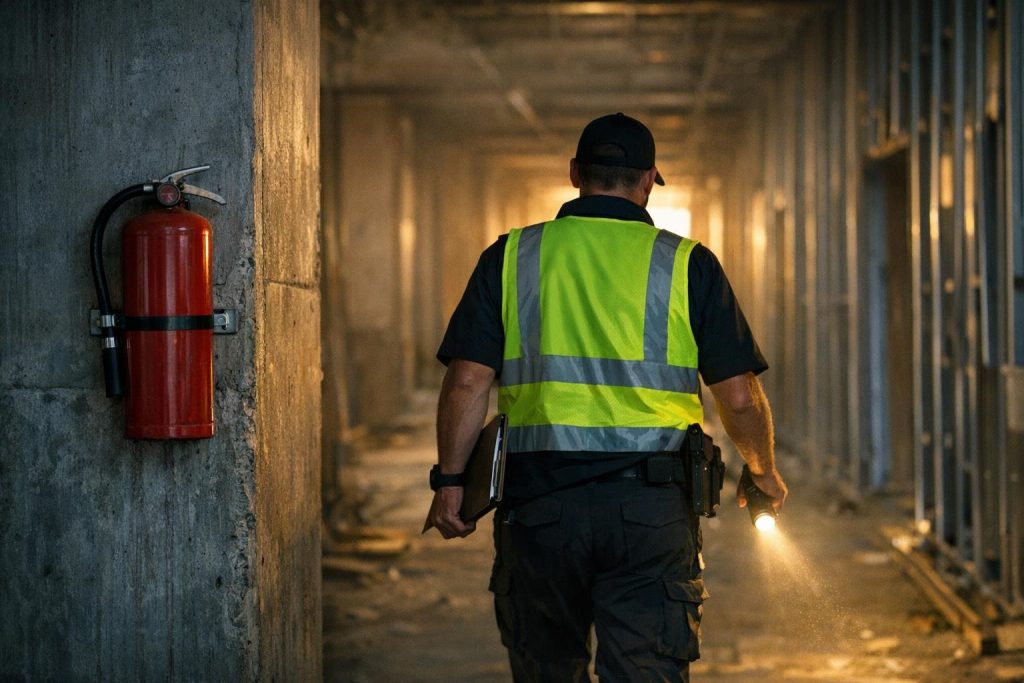
In Arizona, a fire watch is required when the local fire code official orders one. That most often happens when a required sprinkler or fire alarm system is out of service, during hot work such as welding and cutting, and on construction sites during non-working hours. Most Arizona cities enforce a version of the International Fire Code (IFC) with local amendments, so the exact trigger, patrol rules and paperwork depend on which fire department or fire district has jurisdiction over the building.
The core rule is the same nearly everywhere. Under IFC Section 901.7, when a required fire protection system is out of service, the fire department and the fire code official must be notified immediately, and where the fire code official requires it, the building must be evacuated or an approved fire watch provided until the system is back in service. This guide explains the triggers, what Phoenix and Tucson expect, what a fire watch officer does and documents, and the mistakes that cause trouble with inspectors and insurers. For staffing, see our fire watch service.
Key takeaways
- A fire watch is ordered by the fire code official (the authority having jurisdiction), not chosen by the owner. Call the fire department first when a system goes down.
- NFPA 25 calls for evacuation, a fire watch or another approved measure when a sprinkler system is impaired for more than 10 hours in a 24-hour period.
- Tucson Fire’s guidelines say fire watch personnel do fire watch only, with no security or maintenance work, and only Tucson Fire can release the watch.
- Under the 2021 IFC construction rules, fire watch officers must log every patrol and every structure entered, and records must be available to the fire code official.
- Hot work fire watches run at least 30 minutes after work ends under OSHA and the IFC, and one hour under the 2019 edition of NFPA 51B.
- Fire watch officers detect, alert and evacuate. Honeybadger officers call 911 and do not fight fires.
What a fire watch is under the fire code
The IFC defines a fire watch as a temporary measure intended to ensure continuous and systematic surveillance of a building or portion of it by one or more qualified individuals, to identify and control fire hazards, detect early signs of fire, raise an alarm and notify the fire department.
The 2021 IFC adds that fire watches must have at least one approved means of notifying the fire department, and that their only duty is to perform constant patrols of the protected premises and keep watch for fires. A fire watch is a stopgap. It does not repair the system, and it does not make an impaired building as safe as a working one.
When a fire watch is required
The trigger is almost always a gap in fire protection or an activity that creates more fire risk than the building was designed for.
| Situation | Code or standard | Who decides |
|---|---|---|
| Required sprinkler, alarm or other fire protection system out of service | IFC Section 901.7 | Fire code official |
| Sprinkler system impaired more than 10 hours in a 24-hour period | NFPA 25, Chapter 15 (Section 15.5.2 in recent editions) | Owner’s impairment coordinator arranges evacuation, a fire watch, a temporary water supply or an approved ignition-control program |
| Fire alarm system out of service more than 8 hours | NFPA 72 (service provider reports it to the AHJ) | AHJ may require mitigating measures |
| Welding, cutting, grinding and other hot work | IFC Chapter 35; OSHA 29 CFR 1910.252 | Hot work permit issuer under the site’s hot work program |
| Construction and demolition | IFC Chapter 33 (Section 3303.5 in the 2021 edition); NFPA 241 | Fire code official or the site safety plan |
| Temporary fire pump during a pump impairment (Phoenix) | Phoenix Fire Prevention policy and the 2024 Phoenix Fire Code | Phoenix Fire Marshal |
For construction, the 2021 IFC requires a fire watch during non-working hours for new construction more than 40 feet above the lowest adjacent grade, or as required by the fire code official. NFPA 241, the Standard for Safeguarding Construction, Alteration, and Demolition Operations, was reorganized in its 2022 edition and revised its fire prevention program requirements, including the role of the owner’s fire prevention program manager. If your contract or insurer cites NFPA 241, follow it as well as the permit.
Section numbers move between code editions and local amendments. Phoenix now enforces the 2024 Phoenix Fire Code, so confirm the current section with the department before you cite it in a plan. This is general information, not legal advice.
Who orders it: Phoenix, Tucson and elsewhere
Phoenix. The Phoenix Fire Department’s Fire Prevention policy manual, written to the 2024 Phoenix Fire Code, spells out what an impairment coordinator must confirm before a preplanned impairment begins:
- The extent and expected duration of the impairment are known.
- The affected areas have been inspected and the increased risks determined.
- Recommendations have gone to management or the building owner.
- The Phoenix Fire Department has been notified, along with the insurance carrier, the alarm company, the owner or manager and other authorities.
- Occupants in the affected areas have been told.
- An impairment tag system is in place, and tools and materials are on site.
When the system is restored, the coordinator confirms that tests were done, occupants and the fire department were told, the insurer and alarm company were advised, and the impairment tag was removed. For an impaired fire pump replaced by a temporary pump that is not listed or cannot be fully monitored, the policy requires an appeal to the Fire Marshal and a fire watch for the duration, with a written fire watch plan naming who performs it and what it covers.
Tucson. The Tucson Fire Department’s 2023 fire watch guidelines say only Tucson Fire inspectors can require a fire watch, when fire protection systems fail or there are excessive accidental activations. Personnel must patrol constantly and keep walking all floors and areas on the form. They do fire watch only: no security work and no maintenance work. A stand-in must cover breaks. Each person needs at least one approved means of notifying the fire department, and if they find fire they call 911 and get people out. The watch continues until the system is repaired and Tucson Fire’s Fire Prevention Division releases it.
Elsewhere in Arizona. Other cities, towns and fire districts adopt their own code editions and amendments. In Pinal County and other areas outside the big cities, ask the fire district or department that inspects the building which code it enforces and what it expects in a fire watch log.
What a fire watch officer does and does not do
Before the first round, the officer should be briefed on the reason for the watch, the areas left unprotected, the location of every exit, pull station and extinguisher, the fire department access points and the people to call.
On each round, the officer looks and smells for smoke, heat and burning odors, checks that exits and corridors are clear, looks for open flames, overloaded cords and smoking in prohibited areas, and checks rooms where the impairment leaves no detection. If the officer finds fire or smoke, the order is: call 911, activate the building alarm if it works, and start evacuation.
What the officer does not do matters just as much. Honeybadger fire watch officers do not fight fires, do not reset or silence fire alarm panels, and do not repair or operate sprinkler valves. Those jobs belong to the fire department and licensed fire protection contractors.
Whether a fire watch can be combined with security patrol depends on the trigger and the jurisdiction. The 2021 IFC construction rules say the primary duty is constant patrol for fire and that combining fire watch and site security duties is acceptable. Tucson’s impairment guidelines say no security work. Ask the fire code official before you assign one person both jobs.
What a fire watch log should record
The 2021 IFC construction rules require fire watch personnel to record all periods of duty, including an entry for each patrol and each time a structure was entered and inspected, and to make records available to the fire code official on request. Insurers ask for the same record after a loss.
A practical log includes:
- Property address, the reason for the watch and the system or area impaired.
- Who ordered the watch, with the date and time of the fire department notification.
- Officer name, start time and the means of notification carried.
- The time of each round, the areas covered and what was observed.
- Any hazard found and what was done about it, with the time.
- Relief and break handoffs, with both names and times.
- Calls made to the fire department, owner, alarm company or contractor.
- End time and who released the watch.
Write entries as they happen, in ink or a time-stamped app.
Hot work fire watches
Hot work is the most common cause of a short, one-shift fire watch. Under OSHA 29 CFR 1910.252, fire watchers are required when welding or cutting is done where more than a minor fire could develop, including where appreciable combustibles are within 35 feet, where openings within 35 feet expose combustibles, or where combustibles sit on the other side of a metal wall or roof. OSHA requires the fire watch to continue at least half an hour after the work ends, and bars cutting or welding in sprinklered buildings while the sprinkler protection is impaired.
The Phoenix Fire Department’s sample hot work program uses the same 30-minute minimum and calls for the fire watch to call 911 first. NFPA 51B, the hot work standard, extended the post-work fire watch to one hour in its 2019 edition, and some owners and insurers require that longer period.
Under OSHA, hot work fire watchers must have extinguishing equipment at hand and be trained to use it. That role usually belongs to a trained member of the contractor’s crew under its hot work permit. A security officer who does not fight fires is not a substitute for that person, but can patrol the surrounding floors and stay on site after the crew leaves.
Common fire watch mistakes
- Not calling the fire department. IFC 901.7 requires immediate notification of the fire department and fire code official. The insurer and alarm company should hear too.
- A chair by the door. A person sitting at the entrance is not a patrol. The code calls for constant patrol of the protected areas.
- Backfilled logs. Rounds written up at the end of a shift undercut the log as proof.
- No means of notification. A dead phone or a dead zone in a basement leaves the watch unable to do its one job.
- No relief. Tucson’s guidelines require a stand-in during breaks.
- Mixing duties without asking. Some departments allow security and fire watch together; others forbid it.
- Ending the watch early. The watch ends when the system is restored and the fire code official releases it, not when the contractor leaves.
- Hot work during an impairment. OSHA bars welding or cutting in a sprinklered building while sprinklers are impaired.
How Honeybadger Solutions handles fire watch
Honeybadger Solutions is a veteran-led security firm based in Casa Grande, with offices in Phoenix and Oro Valley. We staff fire watch across Arizona with our own officers. Before the first round, the officer is briefed on the reason for the watch, the layout, the exits and pull stations, and the patrol interval or route the fire code official expects. Every round is logged as it happens, and the log is handed over when the watch ends.
Our officers detect, alert and evacuate. They call 911 and do not fight fires. On construction projects, fire watch often runs alongside construction site security, where the fire code official allows it. When a system fails without warning and you need several officers on short notice, our emergency surge staffing team can help. Our construction site security guard guide covers how site coverage is planned.
Quotes are written and given before any work starts. Learn more about our fire watch officers, request fire watch coverage online, or use our urgent intake form if a system just went down. If there is fire or smoke, call 911 first.
Frequently asked questions
Who can order a fire watch in Arizona?
The fire code official, usually the local fire marshal or fire prevention division, orders it. In Tucson, the fire department’s guidelines say only Tucson Fire inspectors can require one. Owners and insurers can also require a fire watch through contracts and policies, but the official requirement comes from the authority having jurisdiction.
How often does a fire watch officer have to patrol?
The IFC and Tucson’s guidelines call for constant patrol, and many departments set a maximum time between rounds. Ask the fire code official for the interval and the areas to cover, write them into the post orders and log each round.
Can a security guard do fire watch and security at the same time?
It depends. The 2021 IFC construction rules say combining fire watch and site security duties is acceptable, while Tucson’s impairment guidelines say fire watch personnel do no security work. Get the answer from the fire code official in writing.
When does a fire watch end?
When the system is repaired, tested and accepted, and the fire code official releases the watch. In Tucson, only the Fire Prevention Division can release it.
Do fire watch officers put out fires?
Honeybadger fire watch officers do not fight fires. They call 911, sound the alarm and help people evacuate. Hot work fire watches under OSHA require a person trained to use extinguishers, which is usually a member of the contractor’s crew.
Sources: Tucson Fire Department, Fire Watch Guidelines (2023), City of Phoenix Fire Prevention, Explanatory Policy Manual (2026), Matanuska-Susitna Borough, Fire Watch Log Sheet quoting 2021 IFC 901.7, Washington State adoption of 2021 IFC Section 3303.5, fire watch during construction, Everett Fire Department, Fire Watch Guide (IFC fire watch definition), OSHA, 29 CFR 1910.252, welding, cutting and brazing, Bates College EHS, NFPA 25 and NFPA 72 impairment rules, California HCAI, Fire Watch code application notice (NFPA 25 15.5.2), NFPA 241 (2022 edition) summary, Code Red Consultants, Updated Fire Watch Requirements (NFPA 51B 2019).
Browse by topic
Security guard services · Private investigations · Cybersecurity · Digital forensics · Financial fraud investigation · Executive protection · All articles