
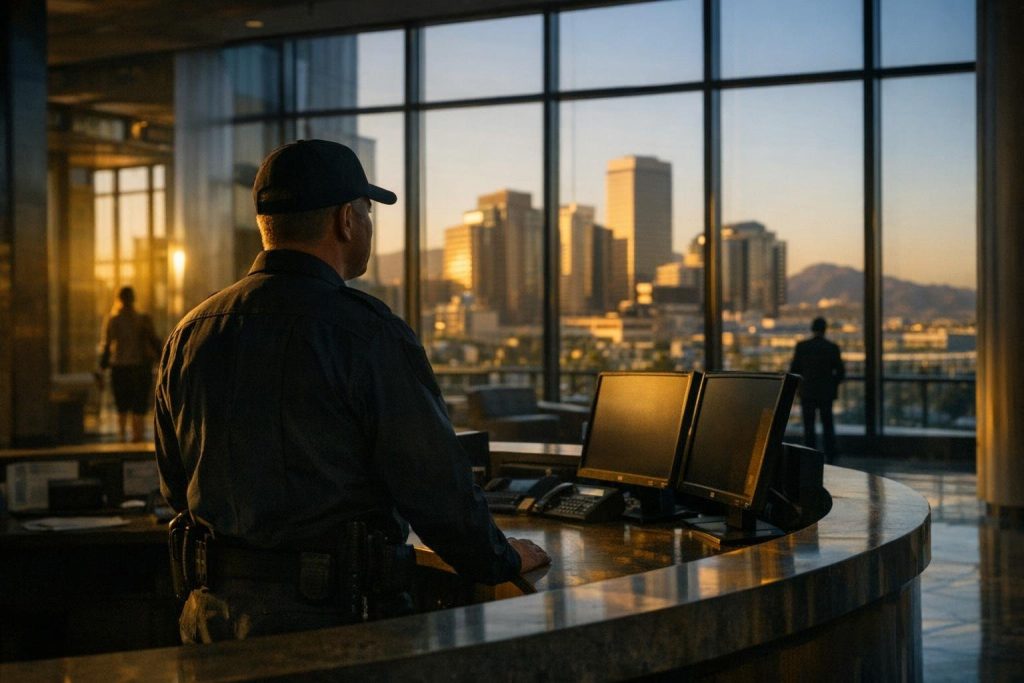
A multi-tenant office building needs a security program with seven parts: a lobby and visitor process, control over the full life of every access badge, after-hours rules, garage coverage, a ready fire control room, written post orders, and reports the owner can audit. When a property manager brings us a problem, it almost always traces back to a gap in one of those seven, not to a shortage of officers.
This guide walks through each part with checklists you can use at your own building. It also covers the Arizona issues that change how the plan is written: summer heat, monsoon power loss and the state’s trespass statute. For an overview of the service itself, see our office building and high-rise security page.
Key takeaways
- Write down who decides what (owner, property manager, chief engineer, each tenant) before you write a single post order.
- Give every badge an end date tied to the lease or the contract, and run a monthly report of badges that have not been used.
- Arizona’s third-degree trespass law depends on a reasonable request to leave or reasonable notice prohibiting entry, so posted hours and written authority matter.
- Phoenix fire crews go straight to the fire control room or alarm panel for keys, phones and floor maps. Officers should be able to hand those over without searching.
- Test how every electrified door behaves when power drops before monsoon season, not during it.
Start with who decides what
In a single-company headquarters, one security director makes the calls. In a multi-tenant building, authority is split. The owner sets policy, the property manager runs the building, the chief engineer controls systems, and each tenant controls its own suite under its lease. Officers get caught in the middle when nobody has written down where one person’s authority ends.
Before you change staffing, build a simple responsibility table and put it in the front of the post orders. Here is a starting version most buildings can adapt.
| Decision | Who owns it | What the officer does |
|---|---|---|
| Visitor rules for a suite | Each tenant, in writing | Applies the tenant’s rules at the desk |
| Issuing or ending a badge | Property manager, on request from an authorized tenant contact | Processes and logs the change if assigned |
| Asking someone to leave common areas | Property manager, through post orders | Makes the request, calls police if refused |
| After-hours HVAC or door schedule changes | Property manager or chief engineer | Logs the request and passes it on |
| Emergency announcements | Building emergency plan | Follows the plan, does not improvise |
| Telling a tenant about an incident | Property manager | Writes the incident report the same shift |
One point often gets missed. Inside a leased suite the tenant usually controls the space, while common areas fall under the property manager. Check your leases, because asking a tenant’s guest to leave a suite differs from asking a stranger to leave the lobby.
Lobby and visitor management tenants will accept
Tenants complain that lobby security is either too loose or too slow for their clients. Let each tenant choose a visitor model, then apply it consistently. Most buildings run three side by side.
- Announce every visitor. The officer calls up and waits for a yes. Common for law firms, medical practices and finance tenants.
- Pre-registration. The tenant enters guests in advance. Registered guests get a day badge; unregistered guests get announced.
- Open floors during business hours. Visitors may go up unannounced during posted hours, with elevator floor locks and suite doors doing the work after hours.
Put each tenant’s choice on a one-page tenant sheet at the desk, with the names of people who may approve visitors and change the rules. A lobby officer should never be guessing what a tenant wants.
Couriers should not get elevator access by default: the tenant comes down or the courier is escorted. Contractors are checked against the approved vendor list, given a temporary badge and logged out when it comes back.
Lobby checklist:
- A current tenant sheet for every suite, dated and signed by the tenant contact
- Day badges that expire automatically at the end of the day
- A written rule for couriers, food delivery and rideshare drivers
- A polite script for stopping tailgating at turnstiles or doors
- A visitor log retention period the property manager has approved
- A known escalation path when a visitor becomes angry at the desk
Customer-facing posts are a skill of their own. Our front desk and concierge officers are briefed for that setting, not only for guard duty.
The badge lifecycle: issue, change, revoke, audit
Former tenants’ badges that still open the front door are a common finding in office building reviews. Treat each badge as having a defined beginning and end.
- Issue on written request only. Each tenant names the people who may request badges. Requests from anyone else are refused politely and referred to the property manager.
- Use access templates. Build a standard level for each tenant: suite door, elevator floor, garage, after-hours. New badges get the template, not a custom set of doors.
- Set an end date at issue. Employee badges end no later than the lease expiration. Contractor badges end when the job ends. Day badges end at close.
- Revoke the same day. Leases should require tenants to report departing employees and lost badges promptly. Deactivate first, then ask questions.
- Audit monthly. Pull a report of badges unused for 60 or 90 days and send each tenant its list to confirm. Compare total active badges to each tenant’s known headcount.
- Close out at move-out. When a tenant leaves, disable its whole template and collect badges and keys during the move-out walk.
After hours and the parking garage
After-hours security starts with posted hours. Under A.R.S. 13-1502, a person commits criminal trespass in the third degree, a class 3 misdemeanor, by knowingly entering or remaining on property after a reasonable request to leave from the owner or another person with lawful control, or after reasonable notice prohibiting entry. Signs that state public hours, and post orders that say the officer speaks for the property manager, support every request an officer makes. This is general information, not legal advice. Ask your attorney how it applies to your building.
Officers are private persons, not police. They ask, explain the rule, and if someone refuses, they call police. They do not physically remove people.
A useful after-hours patrol covers more than the lobby:
- Every stairwell, top to bottom, including the roof access door
- Each garage level and the pedestrian doors between the garage and the stairs
- The loading dock, trash area and any exterior doors that are rarely used
- Lobby restrooms and vestibules
- Suites left unlocked, with a lock-up procedure the property manager has approved and a note to the tenant
Garages deserve their own post order section. Report lighting outages the same night, check that garage-to-stair doors close and latch, and offer escorts to cars after dark.
Arizona heat changes what officers find. In a Phoenix summer, people look for shade and air conditioning in vestibules, garages and stairwells. Maricopa County confirmed 608 heat-related deaths in 2024, and more than three-quarters of them happened outdoors. An officer who finds someone unresponsive in a hot stairwell should treat it as a possible medical emergency and call 911 first.
Smaller buildings often do not need an officer all night. A short evening post followed by remote video guarding overnight can cover the garage and entrances at lower cost.
Fire control room readiness
The Phoenix Regional high-rise procedure (M.P. 202.11) defines a high-rise as a building with 6 or more elevator stops or 75 feet or more in height. The first arriving company goes to the fire control room or the fire alarm panel and meets with the building engineer if one is available. Crews that follow report there for assignments, keys and fire phones. A building systems sector then manages building keys, fire phones, floor maps, elevators, ventilation and door lock controls. A lobby sector controls lobby elevator access and works with police to keep evacuated occupants from going back in.
That tells you what officers will be asked for in the first minutes. Where a fire command center is required, model codes place elevator status displays, stair door unlock controls and schematic building plans there.
Stair doors are where security and fire safety collide. The International Building Code allows interior stair doors in a high-rise to be locked on the stair side only if they can be unlocked all at once from the fire command center, and high-rise stairs with locked doors need a two-way communication system at least every fifth floor. Those locks are normally fail-safe, so they release when power is lost. Officers should never add a lock or chain to a stair door to keep people off a floor. Report the problem and let the property manager and fire marshal decide.
Monthly fire control room check:
- Responders can get into the room the way your fire department expects, and it is not being used for storage
- Building keys are labeled and in the key box, with a count on the log
- Floor maps are current and show tenant names and suite numbers
- The building information card matches the building today, not the building at opening
- Officers can point to the elevator recall key, the fire phones and the stair labels
- Officers know the outside meeting place in the evacuation plan
- The property manager holds a voluntary list of occupants who asked for evacuation help
Officers do not fight fires or run building systems unless trained and assigned. Their job is to meet the first engine with what the crew needs.
Monsoon power loss: test how the building fails
Southwest National Weather Service offices define June 15 through September 30 as the monsoon, and warn that power and communications outages can be more widespread and last longer than the storm itself. A dark lobby at 6 p.m. is the wrong time to learn how your doors behave.
Before June, walk the building with the chief engineer and test:
- Which electrified doors unlock when power drops (fail-safe) and which stay locked (fail-secure)
- How long the access control panels and cameras run on battery or UPS, and whether recording continues
- How the front doors get locked by hand if the system goes down at night
- Whether radios work in the garage and stairwells when cell service is overloaded
- The elevator entrapment procedure: keep talking to passengers on the car phone, call the elevator contractor, call 911 for any medical issue, and never pry doors
- Whether dust storm winds can blow lobby doors open or hold them ajar
If testing turns up doors or panels that need work, that becomes an access control upgrade project. Installation work is performed and contracted by our licensed Arizona ROC contractor partner. Honeybadger Solutions LLC is not a licensed contractor.
Post orders and reports the owner can audit
Post orders are the contract between the property manager and the officer on the floor. Good ones cover:
- Post hours and duties by time of day
- Patrol routes with checkpoints
- The tenant sheets and the responsibility table
- A statement that officers act for the property manager when asking people to leave
- A call tree for after-hours problems (engineer, property manager, elevator contractor, alarm company)
- Emergency procedures that match the building’s evacuation plan
- What officers do not do: use force, detain people, fight fires or give legal advice
- A version date and the property manager’s signature
A daily activity report should open with items that need a decision, such as a propped door, a broken light or a tenant complaint, before the list of rounds. Incident reports get written the same shift. A monthly summary of incidents by type and location, badge changes, doors found open and lighting outages lets you move hours to where trouble actually happens.
How Honeybadger Solutions helps
Honeybadger Solutions is a veteran-led security firm with officers delivered in-house across Arizona. For multi-tenant office properties we walk the building with the property manager or chief engineer, read what the leases promise tenants, write post orders for each post, train officers on the building before their first solo shift, and send daily and incident reports in a format the owner can audit. We design and coordinate access control and camera work, and we can pair evening posts with remote guarding overnight.
Every engagement starts with a written quote before any work begins. Learn more on our office building security service page, or request office building security online and tell us about the building and its tenants.
Frequently asked questions
How often should we audit access badges?
Run a report of unused badges every month and send each tenant its list to confirm. Do a full tenant-by-tenant review at least quarterly and at every move-out. Lost badges should be turned off the same day they are reported.
Can a lobby officer ask a tenant’s guest to leave?
In common areas, an officer can make that request for the property manager when the post orders allow it. Inside a leased suite, the tenant usually controls the space, so the officer should contact the tenant and the property manager. Check your leases, and treat this as general information, not legal advice.
Do we need an officer overnight if we have access control?
Not always. Many buildings staff the lobby during business hours and rely on locked doors, after-hours badge schedules and remote video guarding overnight. The leases and your incident history should drive the decision.
What happens to our doors when the power goes out?
It depends on the hardware. Fail-safe locks release when power is lost, fail-secure locks stay locked, and panels run on batteries for a limited time. Test each door with your engineer before monsoon season so officers have a manual plan.
Sources: A.R.S. 13-1502, Criminal trespass in the third degree, Phoenix Regional Standard Operating Procedures, High-Rise Plans M.P. 202.11, University of Arizona Design Standard 16725, Fire Command Center (referencing IBC Section 911 and IFC Section 508), I Dig Hardware, Decoded: Stairwell Reentry, National Weather Service Tucson, Monsoon Safety, Maricopa County Department of Public Health, final 2024 heat-related deaths report release.
Browse by topic
Security guard services · Private investigations · Cybersecurity · Digital forensics · Financial fraud investigation · Executive protection · All articles