
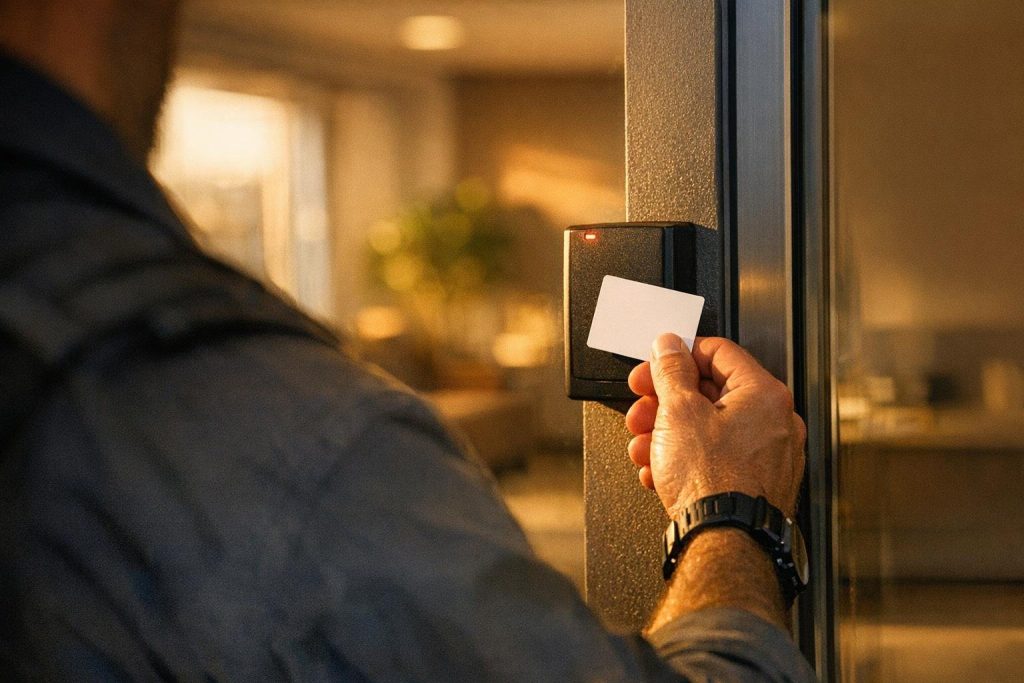
Plan an access control and camera system on paper before you ask for a single quote. Start by writing down, door by door, who needs in, when, with what credential, and how people get out when the power or the fire alarm changes the rules. Then confirm which Arizona licenses, life safety codes and federal contract rules apply. A plan built this way gives you bids you can compare line by line, and it keeps you from paying for hardware that has to be pulled out at inspection.
This guide covers those decisions in the order they usually come up. For how we deliver the project itself, see our access control and security system installation service.
Key takeaways
- A door schedule (one row per opening) is the most useful planning document you can own. It drives the hardware, the credentials, the cabling and the price.
- Every electrified door needs a stated fail-safe or fail-secure setting and a code-compliant way out. The local building official or fire marshal has the final word.
- Electric locking systems on egress doors generally must be listed to UL 294, and fire alarm interfaces must be coordinated with the licensed fire alarm contractor.
- Federal contractors must keep covered Huawei, ZTE, Hytera, Hikvision and Dahua equipment out of their systems under Section 889 and FAR 52.204-25, even in buildings with no federal work.
- In Arizona, check the installer’s ROC low-voltage license and the alarm business and agent certifications, and plan for a city alarm permit (Phoenix requires one within ten days of installation).
Start with a door schedule, not a product catalog
Access control is usually priced per door, so the door list is where the money is. A door schedule is a table with one row for every exterior door, gate, stair door and sensitive interior room (IT closets, cash rooms, records rooms). It forces decisions while they are still cheap to change.
| Column | What to decide | Example |
|---|---|---|
| Opening and use | Name, location and what the door is for | East employee entrance, main staff entry 6 a.m. to 7 p.m. |
| Who needs access | Groups, not individual names | All staff, cleaning crew after 6 p.m. |
| Credential | Card, fob, PIN, mobile or a combination | Card plus PIN after hours |
| Lock type and fail mode | Electric strike, maglock, electrified lever or exit device; fail-safe or fail-secure | Electrified exit device, fail-secure |
| Way out | How a person exits, including during a power loss or fire alarm | Mechanical panic bar, always free egress |
| Monitoring | Door position, forced-door and held-open alarms, who receives them | Held-open alert after 30 seconds to front desk |
| Camera coverage | Whether a camera records the approach and what it must show | Face-level view of everyone badging in |
The schedule also exposes doors you do not need to electrify. A storage room opened twice a month may only need a good mechanical lock and an alarm contact.
Choose credentials around how people actually work
Cards and fobs are familiar and fast. PIN codes get shared. Mobile credentials cut down on lost cards but depend on phone policy. Biometrics stop badge borrowing but raise privacy and enrollment questions for HR and legal. A common pattern is one credential by day and card plus PIN after hours or at high-value rooms. Plan these items before purchase:
- Card technology. Ask what the cards and readers use, whether the format supports encryption, and how the wiring between reader and controller is protected. Older card formats are harder to secure.
- Offboarding. Decide who disables a credential when someone leaves, and how fast. If HR and the access system are not connected, write the manual step into the exit checklist.
- Visitors and contractors. Temporary credentials should expire on their own. Docks and gates need a process for drivers who arrive without notice.
- Audits. Review who holds each access group every quarter.
- Ownership. You, not the installer, should hold the administrator accounts and the software license.
Fail-safe, fail-secure and free egress
Every electrified lock has a fail mode. A fail-safe lock unlocks when power is removed. A fail-secure lock stays locked from the outside when power is removed, but a person inside can still leave using the mechanical lever or panic bar. Maglocks are fail-safe by nature. Electric strikes and electrified exit devices can usually be ordered either way.
The choice is not only about security. Fire-rated door assemblies must latch, which is why a fail-safe electric strike is not used on a fire door, while stair doors that must allow re-entry during an alarm usually need fail-safe lever trim. State the fail mode for every opening so the fire marshal and the installer read the same plan.
The building and life safety codes then set the conditions for locking a door in the path of egress. The International Building Code covers this in Section 1010. Phoenix, for example, enforces an amended 2018 IBC, where the key provisions are:
- Sensor release (1010.1.9.9). Typically a maglock with a motion sensor. The lock must unlock on loss of power, a “PUSH TO EXIT” manual unlocking device must sit 40 to 48 inches above the floor within 5 feet of the door, the device must cut power to the lock directly and hold it unlocked for at least 30 seconds, and fire alarm activation must unlock the door until the alarm is reset.
- Door hardware release (1010.1.9.10). Operating the lever or panic bar must cut power to the lock and open the door immediately, and loss of power must unlock it.
- Delayed egress (1010.1.9.8). Allowed only in certain occupancies in sprinklered buildings or buildings with approved detection. Pushing the door starts an irreversible release in no more than 15 seconds (30 where approved), with an audible signal, signage and emergency lighting.
Newer IBC editions renumber these sections, so confirm which edition your city has adopted. NFPA 101, the Life Safety Code, covers the same ground in Section 7.2.1.6 (special locking arrangements), including delayed egress, sensor release and elevator lobby door locking. Depending on the occupancy and the regulator, some facilities are held to both documents. This is general information, not legal advice, and the local fire marshal or building official has the final say on every egress door.
UL 294 listings and the fire alarm interface
UL 294 is the Underwriters Laboratories standard for access control system units. The IBC provisions above require the locking system units on those egress doors to be listed to UL 294. Some electric locks are listed to UL 1034, the standard for burglary-resistant electric locking mechanisms, and the two are not interchangeable in every application. Ask for the listing on each lock and power supply in the submittal package, and keep it with your project records.
Where doors must unlock when the fire alarm activates, the access control system has to take a signal from the fire alarm panel. Fire alarm systems follow NFPA 72 and are designed and installed by licensed fire alarm contractors. Arizona law also excludes fire alarm installation and monitoring from the definition of an alarm business under A.R.S. 32-101, so the intrusion installer and the fire alarm contractor are often different companies.
Plan the handoff in writing: which fire panel relay drops power to which lock power supply, what happens on reset, and who tests it. Then witness the test with both contractors present.
Cameras: plan each view before you count cameras
Camera quotes are usually written as a count. A better plan lists each view by the job it must do: an overview of a parking lot, identification of a face at a door, or capture of a license plate at a gate. Each job needs a different lens, mounting height and amount of light. A camera asked to do all three usually does none of them well.
Three Arizona factors belong in the plan. Check each camera’s rated operating temperature against summer conditions on the roof or pole where it will mount. Plan lens cleaning after monsoon dust storms. Budget for lighting on large lots and yards, where night light is often too weak for identification.
Storage is simple math once you pick a retention period. One megabit per second of video, recorded around the clock, uses about 10.8 gigabytes per day. Twenty cameras averaging 4 Mbps for 30 days need roughly 26 terabytes before redundancy. Ask the designer to show this calculation using the real bitrates of the cameras specified.
Federal contractors: Section 889 and FAR 52.204-25
If your company holds or bids federal contracts, equipment choice is a compliance decision. Section 889 of the FY2019 National Defense Authorization Act, implemented in FAR 52.204-25, covers telecommunications and video surveillance equipment produced by Huawei, ZTE, Hytera, Hikvision and Dahua, and their subsidiaries and affiliates.
The rule has two parts. Since August 13, 2019, contractors may not provide covered equipment to the government as a substantial or essential component of a system. Since August 13, 2020, agencies may not contract with an entity that uses covered equipment as a substantial or essential component, and the clause states this applies whether or not the use is in performance of federal work. That second part reaches your own office cameras and recorders.
The clause requires a report to the contracting officer within one business day of finding covered equipment during performance, and it flows down to subcontracts. Ask the integrator to document the manufacturer of every camera, recorder, switch and intercom so you can complete a reasonable inquiry. Our government and SDVOSB contracting page covers how we support federal buyers.
Arizona licenses, alarm certification and city permits
Arizona separates three questions: who may contract the installation, who may sell and install alarms, and whether the building owner needs a permit to operate one.
| Requirement | Who it applies to | What to check |
|---|---|---|
| ROC contractor license | The company that contracts the installation | Low voltage communication systems classification: C-67 (commercial), R-67 (residential) or CR-67 (both), in good standing with the Arizona Registrar of Contractors |
| Alarm business certificate (A.R.S. 32-122.05) | A business that sells, installs, services or monitors alarm systems | The business and each controlling person are certified by the Board of Technical Registration; certificates last three years |
| Alarm agent certificate (A.R.S. 32-122.06) | Each person who installs, services or sells alarms for that business | Agent certification backed by a valid fingerprint clearance card; agents must carry the card on the job |
| City alarm permit | The alarm subscriber (usually the owner or tenant) | Phoenix City Code Sec. 10-86.01: permit within ten days of installation, from Police for intrusion alarms and Fire for fire alarms |
A.R.S. 32-1151 makes it unlawful to bid or act as a contractor without a license in good standing, so the license number belongs on the proposal and you should look it up yourself. In Phoenix, the alarm subscriber permit is valid for one year, each address and control panel needs its own permit, and the city lists the fee at $17. Other cities set their own rules. This is general information, not legal advice.
Planning checklist before you request bids
- Door schedule complete, with fail mode and egress method for every electrified opening
- Credential types and the after-hours rule decided
- Offboarding owner named, with a target time to disable access
- Fire alarm interface points listed and the fire alarm contractor identified
- Camera views listed by purpose, with lighting needs noted
- Retention period set, storage math shown and network plan approved by IT
- Section 889 review done if you hold or bid federal contracts
- Installer’s ROC classification and alarm certifications confirmed
- Someone named to answer alarms day and night, plus the city permit step
The last item is the one most often skipped. Our alarm response services guide explains the options for who responds when a sensor trips at 2 a.m.
How Honeybadger Solutions helps
Honeybadger Solutions is a veteran-led, service-disabled veteran-owned firm based in Casa Grande, Arizona. On system projects, we assess the site, build the door schedule and camera plan, write the specification, coordinate the schedule and other trades, test the finished system against the design on your behalf, and connect it to the people who respond: officers, patrol, remote guarding operators and alarm response. Installation work is performed and contracted by our licensed Arizona ROC contractor partner. Honeybadger Solutions LLC is not a licensed contractor.
Installation through this service is available in Arizona only. You receive written quotes before any work starts, and you keep the admin credentials, as-built records and training at handover. To start, read about our access control and camera system design and installation coordination and request a system design online.
Frequently asked questions
Should my doors be fail-safe or fail-secure?
It depends on the door. Fire-rated doors must latch, which usually points to fail-secure hardware with mechanical free egress, while stair re-entry and some sensor-release doors are fail-safe. List the choice per door in your schedule and have it reviewed against the code your city enforces.
Do I need a permit for an alarm system in Phoenix?
Yes. Phoenix City Code Sec. 10-86.01 requires every alarm subscriber to obtain an alarm subscriber permit within ten days of installation, from the Police Department for intrusion alarms and the Fire Department for fire alarms. Other Arizona cities have their own rules.
Does Section 889 apply if my building has no federal work?
If your company holds or seeks federal contracts, it can. FAR 52.204-25 bars agencies from contracting with an entity that uses covered equipment as a substantial or essential component of any system, and states that this applies regardless of whether the use is in performance of federal work.
Can we keep our existing cameras and readers?
Often, yes. Devices that still do their job, are supported and can be secured on your network are worth keeping. Anything unsupported or covered by Section 889 should be flagged in writing.
Sources: Phoenix Building Construction Code 2018 (IBC 2018) Chapter 10, I Dig Hardware, Electrified Hardware Refresher (IBC and NFPA 101 section references), I Dig Hardware, Code Requirements for UL 294, FAR 52.204-25, Arizona Registrar of Contractors, License Classification Requirements, A.R.S. 32-1151, A.R.S. 32-101, A.R.S. 32-121, A.R.S. 32-122.05, A.R.S. 32-122.06, Phoenix City Code Sec. 10-86.01
Browse by topic
Security guard services · Private investigations · Cybersecurity · Digital forensics · Financial fraud investigation · Executive protection · All articles