
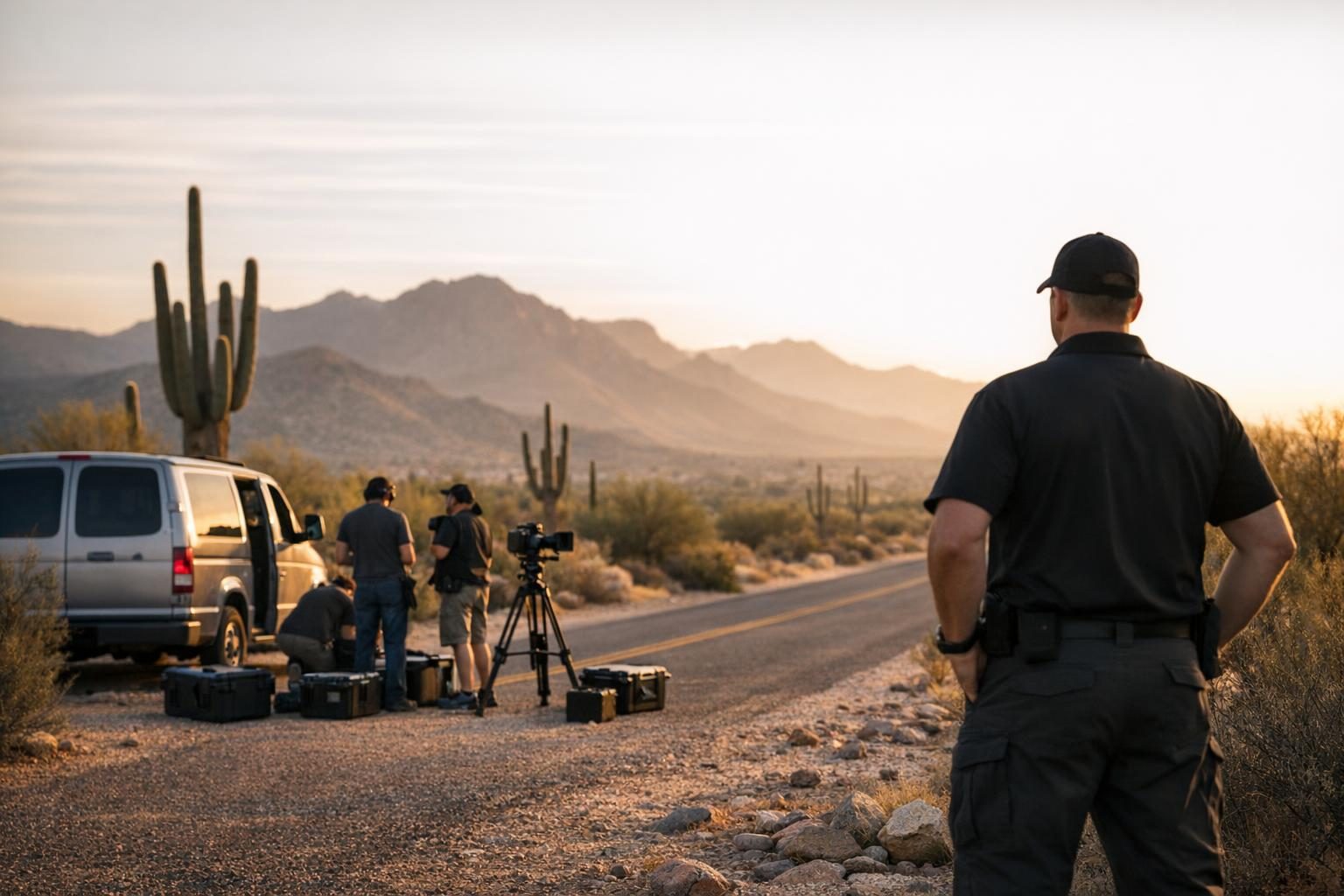
News crews, documentary teams and film productions work in public, carry expensive gear and often show up where tension is highest. That makes them easy targets for theft, harassment and assault. Media protection security is the planning and protective coverage that keeps reporters, crews and on-camera talent safe at a protest, during a live shot, on a remote desert location or on a busy city street.
This guide covers the risks crews face, how to build a crew safety plan, Arizona film permits and set security as of October 2026, digital safety for reporters, and how to choose the right level of coverage. Our media protection services for journalists, crews and productions cover location advances, on-set security, close protection, secure transport and equipment security. If anyone is in immediate danger, call 911.
Key takeaways
- The U.S. Press Freedom Tracker documented over 150 assaults of journalists during protests in 2025 and at least 28 arrests of journalists covering protests, per a December 2025 CPJ release.
- Every field assignment needs a written plan: risk assessment, advance, check-ins, a buddy, an extraction route, a rally point and medical support.
- Arizona has no statewide film permit. ADOT, federal and tribal land managers and city film offices each set their own police and traffic conditions.
- Phishing-resistant sign-in, carrier PINs and a smaller public footprint protect reporters from doxxing and account takeover.
- Coverage scales from a single safety advisor, to a crew security team, to a crew team plus executive protection for talent.
Where this guidance comes from. We used the U.S. Press Freedom Tracker, CPJ’s protest checklist and Digital Safety Kit, CISA and FCC guidance on account security, OSHA heat guidance, Arizona’s security guard statute, and filming policies from ADOT, the Arizona Commerce Authority, the Phoenix Film Office and Film Tucson. It also reflects our team’s field experience running advances, protective details and event security as a veteran-led Arizona firm.
Why news crews and productions need media protection security
A crew draws attention by design, works long hours in public, and often has to stay put when everyone else is leaving. Cameras, lenses and drives are portable and valuable, and unreleased footage can matter to people who want it leaked or destroyed.
In an August 28, 2025 post, the U.S. Press Freedom Tracker reported that nearly 100 journalists had been assaulted by the end of August 2025, the third highest annual total in its database, mostly at immigration-related protests in and around Los Angeles. It also noted nearly 800 assaults across 2020 and 2021. By December 22, 2025, CPJ reported the Tracker had documented over 150 assaults during protests that year and at least 28 journalists arrested while covering protests.
The Tracker also logs equipment damage and equipment search or seizure as their own categories. For a wider view of the threats productions and public figures face, see our threat picture for media, production and public figures.
Protests and civil unrest
A calm crowd at noon can turn at dusk. Police lines move, crowd-control munitions do not sort press from protesters, and crews get separated. CPJ warns that devices may be broken, stolen or confiscated and that connectivity can drop during protest coverage.
Live shots and stand-ups
Live shots fix a crew in one spot with a lit camera and an open van. Consider a hypothetical evening stand-up outside a courthouse: the correspondent faces the lens, the photographer watches the frame, and nobody watches the people walking up behind them. A safety advisor whose only job is the surroundings changes that.
Remote locations and equipment theft
In Arizona, remote work means heat, long drives to a hospital, patchy cell coverage and monsoon storms. OSHA’s heat guidance stresses water, rest, shade, gradual acclimatization and scheduling heavy work for the morning. Theft hits base camps, parked trucks and hotel lots, so decide who carries cards and drives off set before the first shot.
How to build a crew safety plan
A crew safety plan should be short, written down and specific to the day. CPJ’s editors’ checklist for U.S. protest assignments is a good baseline, and the same steps work for film and video productions.
- Risk assessment. Name the location, the people and what could realistically go wrong: crowd violence, theft, a hostile subject, heat, arrest. Consider who is going and whether their experience or profile changes the risk.
- Advance. Walk or research the location first. Map access points, exits, parking, the nearest emergency room and who controls the property.
- Communications. Set a check-in schedule with the desk or production office, a backup way to reach each person and a withdrawal code word. Carry power banks and plan for the network failing.
- Buddy system. Nobody works alone.
- Equipment and identification. Pack protective gear suited to the risk, first aid and water. Keep credentials and permits easy to show and legal counsel’s contact ready.
- Extraction plan. Agree on withdrawal triggers, a primary and alternate exit, vehicle staging and a rally point if the team is separated, and who makes the call to leave.
- Medical. Know the nearest hospital and travel time, and who on the team has first aid training.
- After-action review. Capture what worked and what to change next time.
Hostile-environment awareness sits under all of it: reading a crowd, noticing who is paying too much attention, keeping an exit at your back and leaving before you have to.
Planning a shoot or a field assignment? Send us the dates, locations and talent, and we will scope coverage that fits the risk. Request media protection online, or book a consultation online to talk through the plan.
Film production location security in Arizona
Set security in Arizona starts with the permit, because the permit decides which police, traffic control and neighbor obligations come with the location. The Arizona Commerce Authority says there is no single statewide permit: find the location, then the jurisdiction, then the permit. This is general information, not legal advice, so confirm specifics with the film office and production counsel.
Permits and who controls the location
- State highways. ADOT requires a permit to film on or along its highways and right of way, applied for at least 10 business days ahead. A traffic control plan is needed if traffic may be disrupted, and the district office decides whether DPS officers are required, at the applicant’s cost.
- Phoenix. The Phoenix Film Office policies (updated January 21, 2026) require a permit for commercial projects using city property or rights-of-way and Phoenix PD for any street filming. On private property, city personnel are required for triggers such as neighbor complaints or after-hours work between 11 p.m. and 5 a.m. from May 1 through October 15.
- Tucson. Film Tucson asks for one week for simple shoots and two weeks for complex ones. Tucson Police decide whether officers or barricades are a permit condition, and productions must talk with homeowners within at least two blocks.
- Federal and tribal land. Federal land managers issue their own permits, and tribal land requires the tribal government’s approval.
Police and private security do different jobs. Officers handle traffic and law enforcement. Private security handles the perimeter, access, equipment, crew movement and overnight watch. Under A.R.S. 32-2621, anyone acting as a security guard in Arizona must be registered and working for a licensed agency, unless a commissioned peace officer.
Set perimeter, overnight gear and crowds
Define the working area, base camp and parking, then decide who can enter each. Use one entry point where possible and sign in visitors and vendors. Keep call sheets tight, since they list names, hotels and addresses.
Unattended gear overnight is an easy target. If trucks and carts stay on location, plan a lit or watched area, an inventory at wrap and call, and an officer on site through the night. On street shoots, a good team holds a quiet line, keeps fans out of shots and spots the one onlooker whose interest is more than curiosity. Larger public-facing work overlaps with event planning, covered in our threat picture at hotels, venues and events.
Digital safety for reporters: doxxing and account takeover
Many incidents start with information. A geotagged post, a street sign in a story clip, or a home address on a data broker site can tell a hostile person where to go. An attacker who takes over a reporter’s email or social account can impersonate them, read source messages or post the crew’s location.
The CPJ Digital Safety Kit (updated February 20, 2026) recommends two-factor authentication on all accounts, security keys for high-risk journalists, passwords of more than 16 characters in a password manager, device encryption, and data broker removal. CISA’s October 2022 fact sheet calls FIDO/WebAuthn the only widely available phishing-resistant authentication and names SIM swap and push bombing as threats to weaker methods. Our phishing-resistant MFA guide explains how to roll out passkeys and security keys.
In November 2023 the FCC adopted rules requiring carriers to securely authenticate customers before moving a number and to notify them of SIM change and port-out requests. Reporters should still add a carrier PIN and move key accounts off SMS codes. When threats move from online to offline, open-source intelligence (OSINT) research helps identify who is behind an account and what a production should lock down.
Media protection security levels compared
Most media protection security falls into three levels. The right one depends on the assignment, the talent and the location.
| Level | Best fit | What it covers | Limits |
|---|---|---|---|
| Single safety advisor | Small news crews, live shots, protest coverage, short documentary days | Risk assessment, advance, watching the surroundings, check-ins, calling the withdrawal, first aid | Cannot hold a perimeter, guard gear overnight or protect several people at once |
| Crew security team | Film and TV sets, commercials, multi-day location work, base camps | Perimeter and access control, onlooker management, equipment and footage security, overnight watch, coordination with police and the film office | Protects the production, not a specific person who travels away from set |
| Crew team plus executive protection for talent | High-profile talent, correspondents with active threats, contested documentary subjects | All of the above, plus close protection agents for the principal, secure transport and threat monitoring | Highest staffing and planning effort; needs one plan so the teams do not overlap or leave gaps |
Movement is often the most exposed part of the day for talent, which is why trained security drivers matter for company moves and airport runs. Premieres and public appearances can also call for event security services with a written plan for access, crowds and egress.
How to choose a media protection security provider
- Licensing. Is the company a licensed agency where you are shooting, with registered officers? Armed coverage should follow an assessed risk and licensing rules.
- Advance work. Will they walk locations first and give you a written plan with exits, medical and communications?
- Low profile. Do they plan around the call sheet and stay out of frame?
- Coordination and confidentiality. Will they work with your production office, the film office and police through one point of contact, and sign your NDA?
What drives the cost of media protection security
Pricing follows the plan, not a flat rate. The main cost drivers are the talent profile and any active threats, total hours and overnight watch, the number of locations and company moves, armed versus unarmed coverage, and travel to remote or out-of-state locations. More notice usually helps, because advances and staffing can be planned rather than rushed.
How Honeybadger Solutions protects journalists, crews and productions
Honeybadger Solutions is a veteran-owned SDVOSB and licensed security guard agency based in Casa Grande, Arizona. Our media protection work covers news and broadcast crews, film and TV production, documentary shoots, commercial work, correspondents and on-camera talent. We are Arizona-based and deploy to the assignment where licensed.
- Risk and location advances mapping access, exits, medical support and local conditions before the crew arrives.
- On-set and location security with controlled access and quiet management of crowds and onlookers.
- Close protection for talent, correspondents and crew, kept out of frame and backed by our executive protection services.
- Secure transport between hotels, sets and locations through our security driver services.
- Asset and equipment security for cameras, kit and footage on location and in transit.
- Hostile-environment support from experienced operators, starting with a candid risk assessment.
- Information protection, including posting rules, location exposure checks, social media OSINT and TSCM sweeps of production offices or hotel suites where eavesdropping is a real risk.
We coordinate with your production team and local authorities on permits, road closures and law enforcement contact, sign production NDAs, and keep intake confidential and available 24/7. To start, submit a service request online with your dates, locations and talent profile, or book a consultation online to walk through the plan. Use the buttons below.
Why the online intake is faster than a phone call: it takes about two minutes, and your answers are routed straight to the specialist team that handles your kind of matter, whether that is cyber and forensics, investigations or field security. That team sees the full picture before it replies, so you skip phone tag and get a real answer and next steps sooner. If it cannot wait for business hours, use the urgent intake form, which is read seven days a week.
Frequently asked questions
What is media protection security?
It is protective coverage built around journalists, film and video crews and on-camera talent. It usually combines risk assessment and location advances, on-set or field security, equipment protection, secure transport and, for higher-profile talent, close protection, without getting in the way of the work.
Do news crews really need security at protests?
Every protest assignment needs a plan, even if it does not need a dedicated officer. The U.S. Press Freedom Tracker documented over 150 assaults of journalists during protests in 2025, as reported by CPJ. A safety advisor or crew team makes sense when the risk assessment shows a real chance of violence, theft or separation.
Who issues film permits in Arizona?
There is no single statewide permit. ADOT covers state highways, Arizona State Parks and Trails covers state parks, federal agencies cover federal land, tribal governments approve filming on tribal land, and cities and counties work through local film offices. This is general information, not legal advice.
Can private security replace police officers on an Arizona film set?
No. Phoenix, for example, requires Phoenix PD for any street filming or intermittent traffic control. Private security covers the perimeter, access, equipment and overnight watch, and Arizona requires those officers to be registered guards working for a licensed agency.
How do reporters protect themselves from doxxing and account takeover?
Use unique passwords in a password manager and phishing-resistant sign-in such as passkeys or security keys on email and social accounts. Add a carrier PIN or port-out lock, tighten privacy settings and use data broker removal to shrink what is public.
What is the difference between a crew security team and executive protection?
A crew security team protects the production as a whole: set, perimeter, gear and crew movement. Executive protection assigns agents to one person, such as on-camera talent, and stays with them through hotels, transport and appearances. High-profile shoots often run both under one plan.
Sources and further reading
- U.S. Press Freedom Tracker: Nearly 100 journalists assaulted (Aug. 2025) — 2025 and 2020-2021 assault figures.
- U.S. Press Freedom Tracker — Equipment damage and seizure categories.
- CPJ: US press freedom concerns spike demand for safety training (Dec. 2025) — 2025 protest assault and arrest figures.
- CPJ: Editors’ checklist for U.S. protest assignments — Crew safety plan steps.
- CPJ: Resources for journalists covering protests — Device loss and connectivity risks.
- CPJ Digital Safety Kit (Feb. 2026) — Account, device and personal data protection.
- CISA: Implementing Phishing-Resistant MFA (Oct. 2022) — Phishing-resistant authentication.
- FCC: SIM swap and port-out rules (Nov. 2023) — Carrier authentication and notice.
- Arizona Commerce Authority: Film permits — Permits by jurisdiction.
- ADOT: Film permits — Highway filming requirements.
- Phoenix Film Office Policies (Jan. 2026) — Phoenix permit and police triggers.
- Film Tucson: Permits — Tucson lead times and police conditions.
- A.R.S. 32-2621 — Arizona security guard registration.
- OSHA: Heat exposure — Heat illness prevention for outdoor crews.
Written and reviewed by the Honeybadger Solutions security and investigations team, a veteran-led Arizona firm (Arizona DPS private investigation agency license No. 1759795). Facts checked against the cited sources on October 2, 2026. This article is general information, not legal advice.
Browse by topic
Security guard services · Private investigations · Cybersecurity · Digital forensics · Financial fraud investigation · Executive protection · All articles