
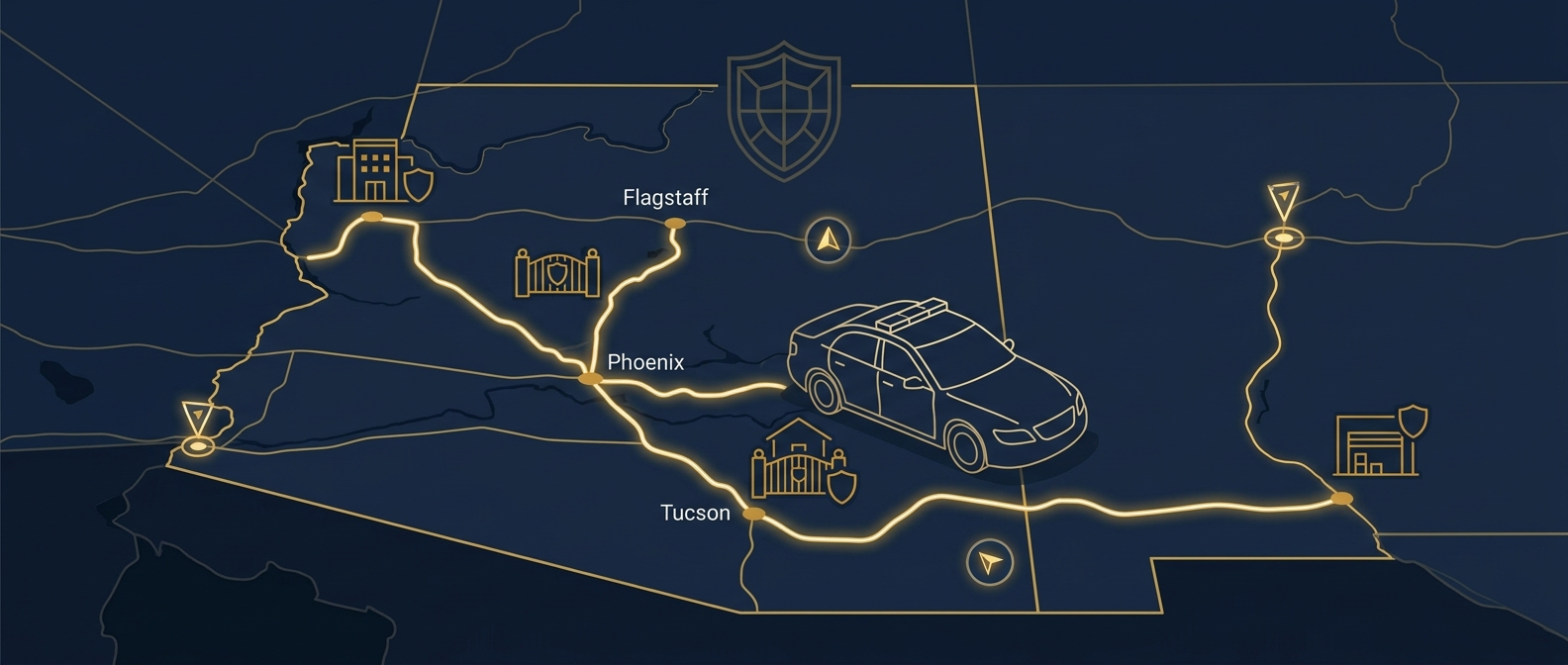
Mobile patrol security deploys licensed, marked-vehicle officers who move between properties on scheduled and deliberately randomized routes — inspecting access points, deterring intruders, and responding to alarms — rather than standing a single fixed post. Across Arizona it delivers visible, unpredictable coverage for large sites and multi-location portfolios at a fraction of the cost of round-the-clock static guards, with GPS- and photo-verified proof of every stop.
Honeybadger Solutions is an Arizona-licensed security and investigations firm headquartered in Casa Grande, with offices in Phoenix and Oro Valley. In Arizona, our patrol officers are our own in-house, AZDPS-licensed and registered personnel — not a subcontracted patchwork — supervised directly from those three offices and dispatched across the entire state, from the I-10 industrial and data-center corridor through the Phoenix metro and down into Pima County. This page explains how mobile patrol actually works, when it beats a static guard, how alarm response and multi-site coverage function in practice, and what separates a disciplined patrol program from a truck that drives past your gate once a night. When you’re ready, you can book directly with our on-site AI chat agent.
What is mobile patrol security, and how does it work?
Mobile patrol security is a service model in which a uniformed, licensed officer in a marked vehicle covers one large property or a group of separate properties by moving through them on a defined route, instead of remaining stationary at one post for an entire shift. A patrol officer’s shift is built around a sequence of visits: arriving at each site, conducting an exterior and interior sweep of the points that matter — perimeter fencing, gates, entry doors, loading docks, equipment yards, stairwells, mechanical rooms — documenting what they find, and then continuing to the next stop. The value is created by two things working together: visible presence and unpredictability. A marked truck arriving at irregular intervals tells anyone surveilling a property that they cannot count on a fixed gap in coverage, which is exactly the certainty a thief, trespasser, or vandal needs.
A modern patrol program is verifiable, not a promise. Officers scan checkpoint tags or geofenced waypoints at each location, capture timestamped and geotagged photos of anything noteworthy, and file exception reports the moment they encounter an open gate, a broken light, a water leak, an unauthorized vehicle, or evidence of attempted entry. That record does two jobs: it gives the property owner defensible documentation that patrols actually happened as contracted, and it turns the patrol officer into an early-warning system for maintenance and liability problems, not just crime. In Arizona, that same officer is frequently tasked with opening and closing duties, lock-and-unlock service, lighting and sprinkler checks, and welfare or vacancy checks — the routine operational work that keeps a site both secure and functioning.
Mobile patrol vs. static guard: which does your property actually need?
The most common and most expensive mistake in physical security is defaulting to a 24/7 static guard when a patrol program would deliver equal or better protection for a fraction of the cost — or, conversely, choosing patrol for a site that genuinely needs a continuous fixed presence. The right answer is driven by the threat you’re managing, not by habit. A static guard creates certainty at one location: a single controlled point that is watched every minute of the shift, which is what access control, crowd management, and high-value single-site protection require. A mobile patrol trades constant coverage of one point for periodic, unpredictable coverage of many points — ideal when the risk is spread across a large footprint or several addresses and the goal is deterrence plus rapid documentation rather than minute-by-minute control.
| Factor | Mobile patrol | Static (fixed-post) guard |
|---|---|---|
| Coverage model | Periodic, randomized visits across a route | Continuous presence at one location |
| Best for | Large sites, multi-location portfolios, after-hours deterrence, alarm response | Access control, lobbies, gates, events, single high-value points |
| Relative cost | Lower — one officer covers many properties per shift | Higher — each post requires roughly 3–4 guards to staff 24/7 |
| Deterrence mechanism | Unpredictable, visible marked-vehicle presence | Constant fixed, known presence |
| Response to incidents | Officer travels to the site; minutes, not seconds | Immediate — already on site |
| Documentation | GPS/geotagged checkpoint scans and exception reports per visit | Continuous shift log and incident reports |
| Coverage gap risk | Windows between visits (mitigated by randomization) | None while posted; gaps only at shift change |
In practice, the strongest programs blend the two. A distribution center might run a static officer at the truck gate during operating hours for access control and switch to overnight mobile patrol once the docks close, when a fixed post would be paying a guard to watch an empty lot. A construction developer with three active sites across Pinal County gets far more protection from a single patrol officer hitting all three on randomized loops than from one static guard chained to one of them. The decision is a risk-and-economics question, and a competent provider will tell you when patrol is enough and when it isn’t — rather than selling you the more expensive option by reflex.
How does mobile patrol alarm response work?
Alarm response is where mobile patrol earns its keep and where the difference between a professional program and a cheap one becomes obvious. When an intrusion, fire, or duress alarm trips at a covered property, a patrol program provides trained key-holder response: a licensed officer is dispatched to the site to physically verify the cause before anyone escalates. That officer confirms whether it’s an actual break-in, an open door, an environmental fault, a wandering animal, or a genuine emergency — then secures the premises, documents the scene, and coordinates with law enforcement only when a real threat warrants it. The property owner does not have to leave home at 2 a.m. to meet police at a rattling back door, and the alarm-monitoring chain gets an eyewitness verification instead of a guess.
This model solves two problems most owners underestimate. First, it removes the executive, manager, or homeowner from the personal-safety and time burden of being the after-hours key-holder — responding to an unknown alarm alone is exactly the situation a security firm exists to absorb. Second, verified response reduces the cost and friction of false alarms; many Arizona jurisdictions assess escalating false-alarm fines and can deprioritize repeatedly false-triggering addresses, so having a licensed officer confirm the cause before police are dispatched protects both your budget and your standing with local dispatch. A serious provider ties alarm-response service directly to the patrol route and supervision chain so the nearest officer responds, the response time is measured, and every call generates a written record.
How does mobile patrol cover multiple sites and large portfolios?
Multi-site coverage is the scenario mobile patrol was built for. Property-management firms, HOA portfolios, retail chains, industrial parks, storage operators, and developers with several active locations rarely need a dedicated guard standing at each address around the clock — they need reliable, documented, unpredictable coverage across all of them. A patrol program lets one officer service a cluster of properties on a single shift, weighting the frequency and timing of visits by each site’s risk profile: a high-theft equipment yard on the I-10 corridor might get several randomized passes a night while a low-risk office park gets one thorough sweep. Because the visits are logged per location, a portfolio manager gets a consolidated, defensible record showing exactly which sites were checked, when, and what was found — across the whole portfolio, not one building at a time.
That consolidated model is also how the economics work in the client’s favor. Instead of every property carrying its own full guard budget, the cost of a shift is effectively shared across the route, which is why a portfolio can afford professional, licensed coverage everywhere rather than a real guard at the flagship site and nothing at the rest. For clients whose properties span the state, a provider with owned personnel and supervision in more than one metro — central Arizona, the Valley, and Southern Arizona — can run coherent statewide coverage under one contract and one chain of command instead of stitching together separate local vendors with inconsistent standards.

Is mobile patrol more cost-efficient than a static guard?
For most after-hours and multi-site scenarios, yes — and the reason is staffing math, not corner-cutting. Covering a single post continuously for 24 hours a day, seven days a week is not one guard’s job; accounting for shift length, days off, call-outs, and relief, it takes roughly three to four full-time officers to keep one post staffed every hour of the year. A mobile patrol program spreads one officer’s shift across many properties, so each property pays for the coverage it actually needs rather than financing a full-time human presence it doesn’t. When the genuine risk is deterrence, verification, and documentation during unoccupied hours — not constant control of a single doorway — patrol delivers the protection that matters at a materially lower cost.
What drives the price within a patrol program is worth understanding, because the cheapest quote usually signals which protection has been removed. The real cost drivers are: armed versus unarmed officers (armed posts carry firearms training, additional insurance, and stricter AZDPS licensing); the number and length of visits per night; whether dedicated alarm-response and key-holding are included; the size and complexity of each site’s sweep; and planned backup coverage for call-offs, set out in your contract, so your property is not silently left uncovered. A dramatically low bid typically means fewer or shorter visits than advertised, no real supervision, misclassified labor, or thin insurance — and the property owner inherits whatever gap that creates. Ask any low bidder precisely how many visits per night, of what duration, and whether officers are direct W-2 employees or subcontractors.
Which Arizona properties benefit most from mobile patrol?
Mobile patrol fits any property where risk is spread out, concentrated in unoccupied hours, or duplicated across several locations. Across Arizona, the highest-value applications include:
- Construction and development sites — the I-10 corridor from Casa Grande through Eloy and Coolidge is dense with active builds where copper, tools, fuel, and heavy equipment are prime overnight targets.
- Data centers, solar farms, and critical infrastructure — large, remote perimeters in Pinal County and beyond that need perimeter integrity checks and unpredictable presence rather than a single fixed post.
- Industrial parks, warehouses, and distribution centers — sprawling footprints and yards best covered by randomized sweeps after the docks close.
- HOAs, gated, and residential communities — common areas, amenities, and streets that benefit from visible deterrence patrols and after-hours enforcement.
- Retail centers and shopping plazas — parking-lot patrols, closing coverage, and loss-prevention deterrence across multiple tenants.
- Vacant and transitional properties — buildings between tenants that need documented occupancy checks to deter squatting, vandalism, and metal theft.
- Auto dealerships, storage facilities, and equipment yards — high-value inventory in open lots that are magnets for after-hours theft.
These map directly to how our teams deploy from Casa Grande, Phoenix, and Oro Valley — central, metro, and Southern Arizona — which lets a single program cover properties statewide without handing your account to a different vendor in every city.
What does a professional mobile patrol program include?
Not all patrol is equal. Use the following as a checklist when evaluating any Arizona provider — a disciplined operation satisfies every item without hesitation, and a truck-and-a-flashlight operation cannot.
- Licensed, in-house officers. Every patrol officer holds a current AZDPS guard registration tied to the agency you contracted with — direct employees, not anonymous subcontractors who rotate week to week.
- Randomized, risk-weighted routing. Visit timing and frequency vary deliberately and are weighted to each site’s threat profile, so no observer can predict the gap between passes.
- GPS and checkpoint verification. Geofenced or tag-scanned waypoints prove each stop happened, with timestamped, geotagged photos of anything noteworthy.
- Exception and incident reporting. Written, per-visit documentation of open doors, damage, hazards, trespassers, or attempted entry — delivered to you, not filed and forgotten.
- Alarm response and key-holding. A defined protocol for dispatching the nearest officer to verify alarms and coordinate with law enforcement, with measured response times.
- Site-specific post orders. Written instructions built for your property — what to check, in what order, who to call, and what constitutes an escalation — not a generic template.
- Reachable local supervision. A real supervisor on a real phone number who answers after hours, backed by planned relief coverage, set out in your contract, so a call-off does not leave your site unpatrolled.
- Insurance, bonding, and clear reporting. Current certificate of insurance, required surety bond, and consolidated reporting you can hand to your insurer, board, or lender as defensible proof of coverage.
How Honeybadger Solutions structures statewide mobile patrol
In Arizona, Honeybadger Solutions runs mobile patrol with our own in-house, AZDPS-licensed and registered officers — armed or unarmed depending on your risk profile — dispatched and supervised from our Casa Grande headquarters and our Phoenix and Oro Valley offices. That footprint lets one program cover Pinal County’s construction, data-center, and solar corridor, the greater Phoenix metro, and the Tucson and Oro Valley area under a single contract, one chain of command, and one consistent standard, rather than a loose collection of local subcontractors. Every route is built on site-specific post orders, verified with checkpoint and GPS logging, and backed by supervision you can actually reach. Our patrol and armed security and patrol services integrate with our broader Arizona security guard services and personal protection capabilities, so a single provider can move from routine patrol to a dedicated post, an escort, or an executive detail as your needs change.
Because we are also a licensed investigations firm, a patrol program doesn’t dead-end when an officer’s report surfaces a pattern — repeated after-hours entry, internal theft, or fraud. Our security and investigations teams coordinate directly, so a recurring incident on patrol can move into a licensed investigation without you having to find and vet a separate firm mid-crisis. Whether you manage one site in Casa Grande, a portfolio across Phoenix, or properties spanning the state, you can book now with our on-site AI chat agent to scope a route and get a quote, or book a consultation online to speak with our team.
Frequently asked questions
What is the difference between mobile patrol and a static security guard?
A static guard remains at one fixed post for the whole shift, providing continuous coverage of a single location — ideal for access control and single high-value points. A mobile patrol officer covers one large property or several separate properties on randomized routes, delivering visible deterrence, alarm response, and documented checks across a wide footprint at a lower cost than staffing a fixed post around the clock.
How does mobile patrol respond to alarms in Arizona?
With key-holder alarm response, a licensed officer is dispatched to your property to physically verify the cause of an alarm, secure the premises, document the scene, and coordinate with law enforcement only when a real threat exists. This spares owners from responding personally at night and, because the officer confirms genuine events before police are called, helps reduce false-alarm fines that many Arizona jurisdictions assess.
Is mobile patrol cheaper than hiring a full-time guard?
Usually, for after-hours and multi-site needs. Staffing one post 24/7 takes roughly three to four full-time officers once relief, days off, and call-outs are covered. Mobile patrol spreads one officer’s shift across many properties, so each site pays only for the visits and response it needs. Cost depends on visit frequency and duration, armed versus unarmed officers, and whether alarm response is included.
Does Honeybadger provide mobile patrol across all of Arizona?
Yes. Honeybadger Solutions deploys its own in-house, AZDPS-licensed patrol officers statewide from offices in Casa Grande (HQ), Phoenix, and Oro Valley — covering Pinal County and the I-10 corridor, the Phoenix metro, and the Tucson and Oro Valley area under one contract and one chain of command. Book with our AI chat agent to scope a route.
About Honeybadger Solutions
Honeybadger Solutions is an Arizona-licensed security and investigations firm. In Arizona, our mobile patrol officers, armed and unarmed security guards, and private investigators are our own in-house, AZDPS-licensed personnel — owned and supervised, not subcontracted. Digital forensics, cybersecurity, financial investigations, and background intelligence are handled in-house and serve clients nationwide and internationally. This article is educational and does not constitute legal advice; for a specific situation, consult an Arizona attorney or AZDPS directly.
Offices: Casa Grande (HQ), Phoenix, and Oro Valley, Arizona — serving all of Arizona, nationwide, and international clients.
Phone: Book a consultation online
Book now: scope a patrol route or get a quote with our on-site AI chat agent, or call to speak with our team.
Sources and further reading
- FinCEN — Legal Authorities — The Bank Secrecy Act, USA PATRIOT Act and Anti-Money Laundering Act authorities that govern financial and virtual-asset reporting.
- FBI Internet Crime Complaint Center — Annual Reports — Annual and state-level internet crime statistics, including dedicated reports on cryptocurrency fraud and elder fraud.
Honeybadger Solutions delivers Blockchain Forensics, Blockchain Consulting and Cyber Investigations from its Arizona office for clients across the United States and internationally. This casework is performed remotely under Arizona licensure, so there is no geographic limit on where a client can be based.
Browse by topic
Security guard services · Private investigations · Cybersecurity · Digital forensics · Financial fraud investigation · Executive protection · All articles