

Digital forensics for Casa Grande, Arizona matters is handled in-house by Honeybadger Solutions’ own laboratory—headquartered in Casa Grande and remote-by-design—covering mobile devices, cloud accounts, computers, and industrial or logistics system data for the manufacturing, agriculture, and fast-growth economy along the Interstate 10/Interstate 8 corridor. Engagements produce court-ready evidence for trade-secret, workplace-misconduct, fraud, and family-law matters in Pinal County Superior Court and beyond, built on write-blocked imaging, hash verification, and a documented chain of custody.
Casa Grande’s evidence landscape has changed as fast as its skyline. A city once defined by cotton fields and a Union Pacific rail junction—still visible in the historic downtown along Florence Street and Main Street—is now home to Lucid Motors’ AMP-1 electric-vehicle assembly plant, a Frito-Lay/PepsiCo manufacturing facility, an Abbott Nutrition plant, and a growing footprint of warehousing and logistics operators strung along the I-10/I-8 interchange. Alongside that industrial base, Pinal County remains one of the state’s fastest-growing residential markets, with new subdivisions filling in around the historic core. Between advanced manufacturing, agriculture, logistics, and a booming population, digital evidence now sits at the center of most disputes that reach a Casa Grande courtroom or boardroom. This guide covers who does that forensic work, what Arizona courts require, the evidence sources specific to Casa Grande’s economy, the process from preservation to expert report, and where forensics earns its cost. It is general information, not legal advice.
Who performs digital forensics for Casa Grande matters?
Honeybadger Solutions’ digital forensics practice is in-house, not outsourced to a rotating bench of contract examiners. Our laboratory is headquartered in Casa Grande and built to be remote-by-design, so preservation, imaging, analysis, and reporting are handled by the same accountable team whether the evidence is a phone sitting on our own bench or a cloud account accessed from anywhere in the country. That structure matters for chain-of-custody integrity—every examiner who ever touches the evidence is one of ours, trained to the same standard, and available to testify to methodology if a Pinal County matter goes to trial.
Because our headquarters sits in Casa Grande itself, on-the-ground steps—device pickups from a plant HR office, on-site collection at a warehouse, coordinating with a local employer’s IT staff—happen without the delay a Phoenix- or Tucson-based lab would face reaching central Pinal County. Statewide, our field investigators are also our own AZ-licensed employees, which keeps physical evidence collection and digital evidence collection under one command rather than split across vendors.
What do Arizona courts require for digital evidence in a Casa Grande case?
Arizona state courts, including Pinal County Superior Court in Florence, apply the Daubert framework for expert testimony under Ariz. R. Evid. 702, which Arizona adopted in its modern form in 2012—asking whether the expert is qualified, whether the methodology is reliable and testable, and whether the testimony will assist the trier of fact. Federal matters arising from a Casa Grande dispute (for example, a trade-secret case implicating interstate commerce) fall under the same Rule 702 Daubert standard in federal court. In practice, both standards are satisfied the same way:
- Write-blocked, forensically sound imaging. A bit-for-bit copy is made before any analysis, so the original source is never altered.
- Cryptographic hash verification. A matching hash value on the image and the source proves the copy is identical, byte for byte.
- Documented, unbroken chain of custody. Every transfer, storage location, and access is logged from collection through to the final report.
- Validated tools and repeatable methodology. Industry-standard forensic software and documented procedures—consistent with the testing frameworks published by the NIST Computer Forensics Tool Testing program—so the process can be explained and defended, not just asserted.
Arizona’s computer-tampering statute, A.R.S. § 13-2316, also frames the criminal side of many disputes we see feed into civil matters—unauthorized access to an employer’s network or a former partner’s device is itself a chargeable offense in Arizona, separate from any downstream fraud or trade-secret claim.
What makes digital forensics in Casa Grande distinct from a Phoenix or Tucson case?
Casa Grande’s evidence profile is shaped by its specific economy, not a generic city caseload. Four patterns recur:
Advanced-manufacturing trade secrets and insider threats. A city hosting a major electric-vehicle assembly plant and other precision-manufacturing operations sees a distinct category of matter: a departing engineer who copied design files before resigning, an employee who photographed a production line for a competitor, or suspected unauthorized drone activity over a manufacturing campus. These cases hinge on device and cloud-account forensics—file-access timestamps, USB and cloud-transfer logs, and communications with a competing employer—handled with the same rigor as any intellectual-property litigation.
Large-employer HR and wage-and-hour disputes. Facilities the size of Casa Grande’s food-manufacturing and consumer-goods plants generate their own volume of workplace-misconduct, harassment, and wage-and-hour matters, many of which now turn on text messages, shared work-phone data, or timekeeping-system records that require forensically sound extraction rather than a screenshot.
Logistics and telematics data. With warehousing and distribution operations clustered around the I-10/I-8 interchange, cargo-theft and fleet-misuse investigations increasingly turn on GPS telematics, electronic logging device (ELD) records, and dash-cam footage—data sources that live on servers and in cloud dashboards, not on a single device, and that can roll off or be overwritten quickly if not preserved.
Family law and fraud matters in a fast-growing population. Pinal County’s rapid residential growth around Casa Grande brings a steady volume of family-law digital evidence—text threads, social media, and location history relevant to custody or asset disputes—alongside the financial-fraud matters that follow any fast-growing market, from contractor and real-estate fraud to elder-financial-exploitation cases.
Which evidence sources come up most in Casa Grande matters?
The right acquisition method depends entirely on where the data lives. The table below maps Casa Grande’s most common evidence sources to the forensic approach and the local wrinkle that affects each one.
| Evidence source | Forensic approach | Casa Grande-specific consideration |
|---|---|---|
| Company laptop / desktop (plant or office) | Write-blocked full-disk imaging, hash verification, targeted analysis | Coordinate collection with plant IT/security under a legal hold before a departing employee’s access is revoked or the device is reimaged |
| Personal or work mobile device | Validated mobile-forensic extraction (logical or physical, device-dependent) | Time is critical—phones can be remotely wiped in minutes once a dispute becomes known |
| Cloud accounts (email, storage, messaging) | Preservation letter/legal hold, then lawful, authorized acquisition | Cloud audit logs and retention windows roll off on their own schedule; a hold must issue immediately |
| Fleet telematics / ELD / dash-cam data | Server- and dashboard-level export with vendor cooperation, hash and log the export | Common to Casa Grande’s I-10/I-8 logistics operators; data often overwrites on a rolling cycle measured in days |
| Industrial network / badge-access logs | Coordinated export with plant IT under legal hold, chain-of-custody documentation | Relevant to insider-threat and trade-secret matters at manufacturing campuses; access windows are typically brief |
The common thread across every row is speed: the longer a source sits unpreserved, the more likely it is overwritten, wiped, or aged out of a retention window.
What is the forensic process, from legal hold to expert report?
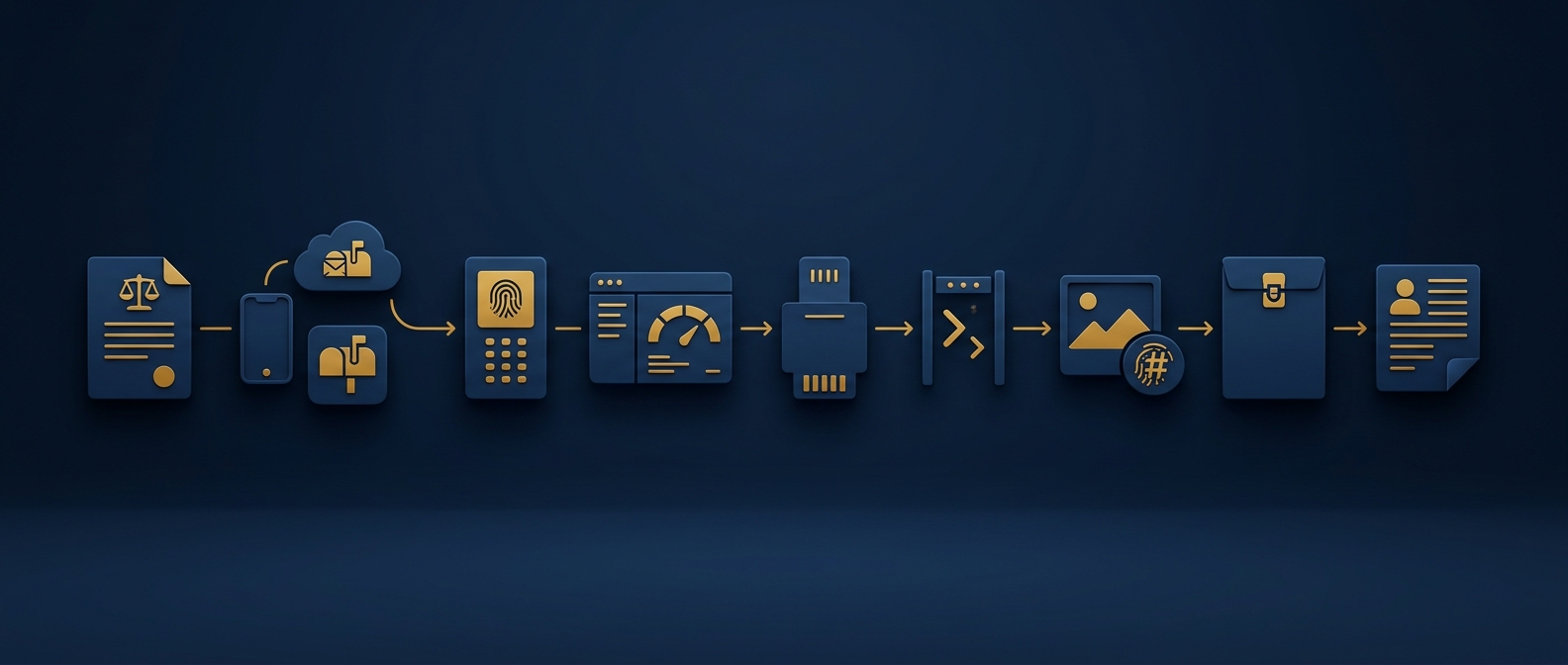
Every Casa Grande engagement follows the same disciplined sequence, regardless of whether the evidence is a phone, a laptop, or a fleet-telematics export:
- Legal hold and preservation notice. Issued the moment litigation, a regulatory inquiry, or an internal investigation is reasonably anticipated—before any device, account, or system is touched.
- Forensically sound acquisition. Write-blocked, bit-for-bit imaging of devices, or authorized, documented export of cloud and system data.
- Hash verification. A cryptographic hash confirms the image or export matches the source exactly, and that match is preserved for later verification.
- Analysis. Validated forensic tools recover, correlate, and time-line the relevant data—deleted files, communications, access logs, location history—without altering the underlying evidence.
- Expert report and testimony. Findings are documented in a clear, defensible report, with the examiner available to testify to methodology under Ariz. R. Evid. 702 or Fed. R. Evid. 702 as the venue requires.
When is digital forensics the right tool for a Casa Grande matter?
Digital forensics earns its cost when the data itself is the case, or when it corroborates work already underway. Recurring engagements around Casa Grande include:
- Trade-secret and insider-threat investigations tied to advanced-manufacturing and precision-engineering employers, covering device, cloud, and communications forensics for departing or suspected employees.
- Business email compromise and vendor-fraud schemes targeting local manufacturers, distributors, and agricultural operators—covered in depth in our business email compromise investigation guide.
- Workplace-misconduct and HR investigations involving company devices, shared accounts, or timekeeping-system data at larger Casa Grande-area employers.
- Corroborating surveillance and fraud findings with geolocation, social-media, or device data, working alongside our surveillance team on the same matter.
- Family law and asset disputes requiring authenticated text, social-media, or financial-account evidence for Pinal County Superior Court.
Honeybadger Solutions handles Casa Grande, Eloy, Coolidge, Florence, Maricopa, and the rest of Pinal County from our own in-house laboratory, coordinated statewide from our Casa Grande headquarters, Phoenix office, and Oro Valley office. For matters that also need on-the-ground device recovery or witness coordination, our investigations practice and security service line integrate directly with the forensic team.
Representative scenario: the departing engineer and the copied files
Consider a representative matter. A Casa Grande-area advanced-manufacturing employer suspected that a departing engineer had copied proprietary design files to a personal cloud account before resigning to join a competitor. Within hours of the resignation, counsel issued a legal hold and our laboratory forensically imaged the employee’s company laptop before it was reissued. Analysis of file-access timestamps and cloud-sync logs showed a cluster of large-file transfers to a personal account in the final week of employment, time-stamped and correlated against the badge-access log showing the employee on-site at the time. The image, hash values, and chain-of-custody log were preserved and summarized in an expert report, giving counsel a documented, testable basis to pursue injunctive relief. This is an illustrative scenario, not a named client or claimed outcome, but it reflects how quickly acting to preserve volatile data protects an employer’s position in exactly the kind of trade-secret dispute a manufacturing hub like Casa Grande generates.
Frequently asked questions
Does Arizona follow the Daubert or Frye standard for digital forensic evidence in Pinal County?
Arizona state courts, including Pinal County Superior Court, apply the Daubert framework under Ariz. R. Evid. 702, adopted in its modern form in 2012, asking whether the expert is qualified, whether the methodology is reliable and testable, and whether the testimony assists the trier of fact. Federal courts apply the equivalent Rule 702 Daubert standard. Established forensic practice—write-blocked imaging, hash verification, and a documented chain of custody—is designed to satisfy both because it is testable, repeatable, and generally accepted in the field.
Can deleted texts or plant-system logs be recovered as evidence in a Casa Grande case?
Often, yes—if action is taken before the data is overwritten. Deleted messages, files, and log entries frequently persist in device storage, cloud backups, or system logs until reclaimed, but industrial and telematics systems in particular often cycle or overwrite on a short, rolling schedule. Recovery is done through validated forensic tools on a bit-for-bit image, never by breaking encryption or improperly accessing an account. The critical variable is time: the sooner a source is forensically preserved, the more can be recovered and defended.
When does the duty to preserve evidence begin in a Casa Grande dispute?
The duty attaches once litigation, a regulatory inquiry, or an internal investigation is reasonably anticipated—not when a complaint is filed. At that point a written legal hold should issue to every relevant custodian, and auto-deletion, routine purges, and device reissuance should be suspended. Because cloud audit logs roll off, telematics and industrial systems overwrite data quickly, and phones can be wiped in minutes, the most defensible practice is to preserve perishable sources forensically at the earliest sign of a problem to avoid spoliation exposure.
Do you need to be physically in Casa Grande to handle a digital forensics matter?
For most digital forensic work, no. Our laboratory is in-house and remote-by-design, headquartered in Casa Grande, so preservation, acquisition, analysis, and reporting are handled by the same accountable team regardless of where the data or custodians sit. Because our headquarters is physically in Casa Grande, on-the-ground steps—device pickups from a local plant or office, on-site collections, or witness coordination—happen faster than they would through a firm based in Phoenix or Tucson.
About Honeybadger Solutions
Honeybadger Solutions is an Arizona-licensed security and investigations firm delivering full-spectrum investigations and security services, including security guard services statewide. Our digital forensics work is performed entirely in-house by our own examiners—not outsourced—supervised under documented methodology with write-blocked imaging, hash verification, and chain-of-custody controls at every step. We operate three Arizona offices—Casa Grande (headquarters), Phoenix, and Oro Valley—serving Casa Grande and all of Pinal County, every Arizona venue, and, through our in-house statewide and nationwide laboratory, matters across the country.
Need in-house digital forensics for a Casa Grande matter? Book a consultation online to brief an examiner and put a legal hold in place today, or request a free case assessment online. Confidential. Court-ready. Arizona-owned.
This article is general information, not legal advice; laws vary and change—confirm specifics with qualified counsel before acting. Authoritative references: A.R.S. § 13-2316, computer tampering (Arizona State Legislature), the NIST Computer Forensics Tool Testing program, the FBI Internet Crime Complaint Center (IC3), and the City of Casa Grande.
Related Casa Grande digital forensics resources
Honeybadger handles every Casa Grande digital forensics case with one court-ready, in-house Arizona lab—no evidence is shipped to a third-party subcontractor. Every examination is run in-house through Honeybadger digital forensics division. You can also reach Honeybadger in Casa Grande, Arizona for local, in-person coordination. Businesses and counsel in nearby cities engage our digital forensics services in Tucson. If you are still comparing providers or need background reading, see digital forensics expert-witness testimony. For phone-specific evidence, we frequently pair a full exam with Casa Grande cell phone forensics.
Browse by topic
Security guard services · Private investigations · Cybersecurity · Digital forensics · Financial fraud investigation · Executive protection · All articles